Espetacular horizonte do Porto à noite
2016-02-24
Imagenes del Mundo - Los sumideros del Mar Muerto,
Cientos de sumideros aparecen cada año a orillas del Mar Muerto. Las autoridades aún no logran medir los daños. "No es un problema que podamos resolver solos", ha dicho Dov Litvinoff, el alcalde de Tamar, la región que cubre la mitad sur del Mar Muerto en Israel.
AMIR COHEN (REUTERS)
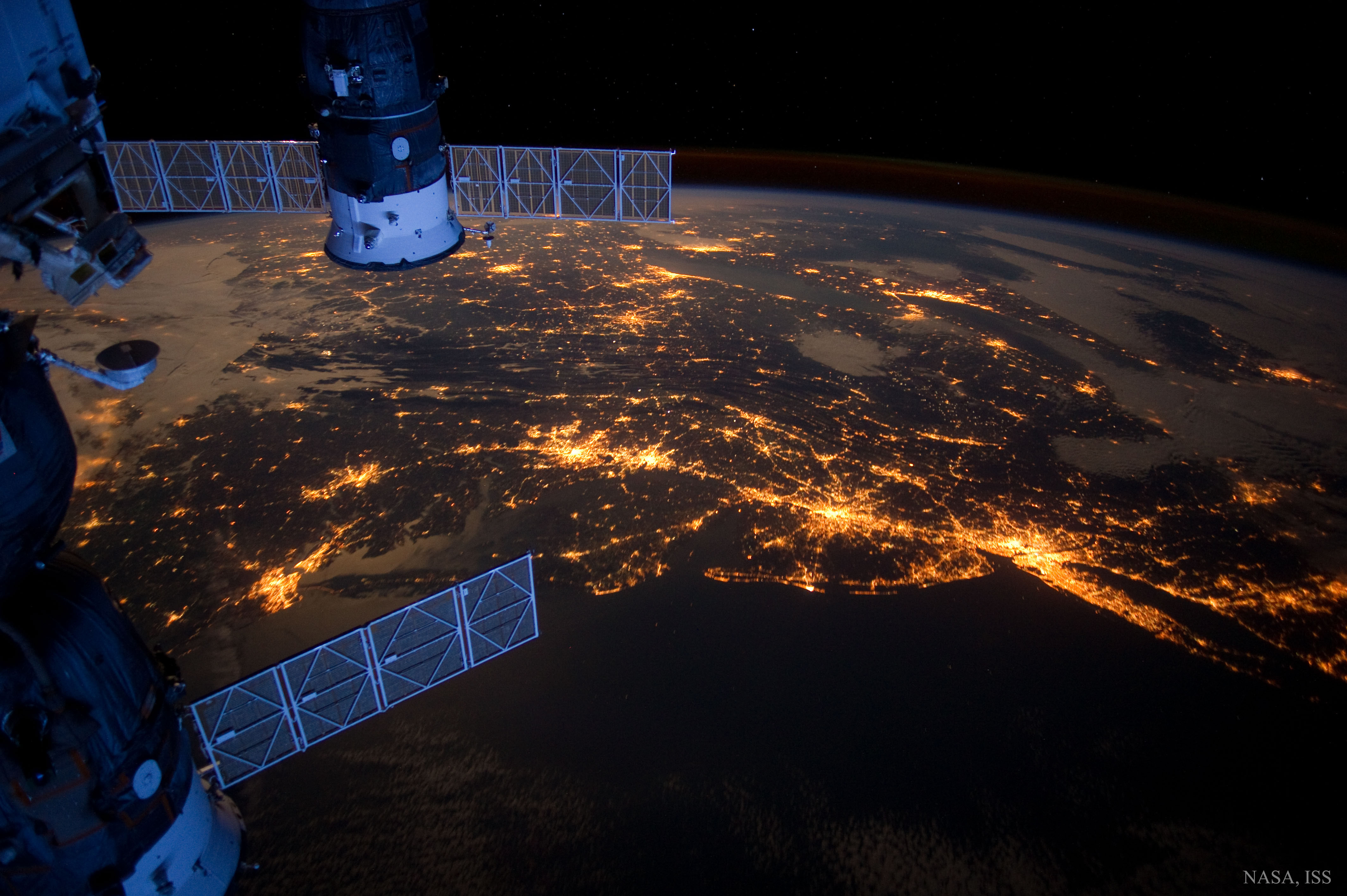
Astronomy picture of the day - 2016 February 24 - USA's Northeast Megalopolis from Space
Image Credit: NASA, International Space Station
Explanation: Can you identify a familiar area in the northeast USA just from nighttime lights? It might be possible because many major cities are visible, including (right to left) New York, Philadelphia, Baltimore, Washington,Richmond and Norfolk -- Boston of the USA's Northeast megalopolis is not pictured. The featured image was taken in 2012 from the International Space Station. In the foreground are two Russian cargo ships with prominent solar panels. This Northeast megalopolis of the USA contains almost 20 percent of the people of the USA but only about 2 percent of the land area. Also known also as the Northeast Corridor and part of the Eastern Seaboard, about 10 percent of the world's largest companies are headquartered here. The near continuity of the lights seem to add credence to the 1960s-era prediction that the entire stretch is evolving into one continuous city.
2016-02-23
Efemérides - Morte de Zeca Afonso - "Os vampiros" - Video - Musica - Ao vivo
1987 - Morre Zeca Afonso
Nasceu a 2 de Agosto de 1929
|
A 23 de Fevereiro de 1987, morre, em Setúbal, o compositor português de música de intervenção, José Manuel Cerqueira Afonso dos Santos, mais conhecido por Zeca Afonso.
"Os vampiros"
|
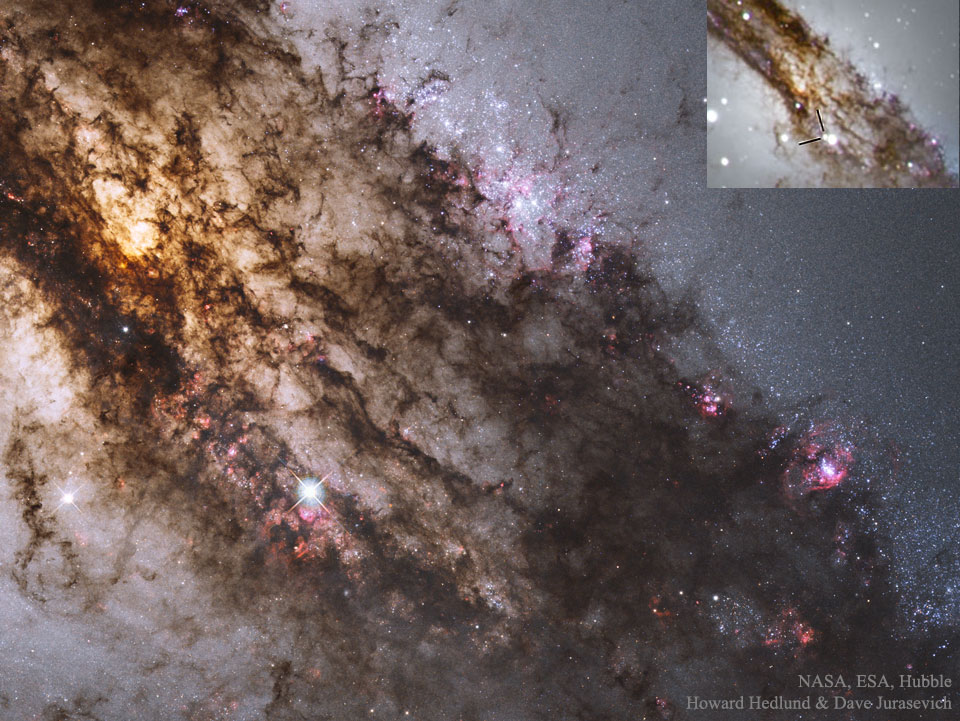
Astronomy picture of the day - 2016 February 23 - A Supernova through Galaxy Dust
Image Credit: NASA, ESA, and the Hubble Heritage (STScI/AURA);
Inset Image: Howard Hedlund & Dave Jurasevich, Las Campanas Obs.
Explanation: Telescopes around the world are tracking a bright supernova that occurred in a nearby dusty galaxy. The powerful stellar explosion was first noted earlier this month. The nearby galaxy is the photogenic Centaurus A, visible with binoculars and known for impressive filaments of light-absorbing dust that cross its center. Cen A is featured here in a high-resolution archival Hubble Space Telescope image, with an inset image featuring the supernovataken from the ground only two days after discovery. Designated SN2016adj, the supernova is highlighted with crosshairs in the inset, appearing just to the left of a bright foreground star in our Milky Way Galaxy. This supernova is currently thought to be of Type IIb, a stellar-core-collapse supernova, and is of high interest because it occurred so nearby and because it is being seen through a known dust filament. Current and future observations of this supernovamay give us new clues about the fates of massive stars and how some elements found on our Earth were formed.
2016-02-22
Astronomy picture of the day - 2016 February 22 - Flying Over Pluto's Moon Charon
Video Credit: NASA, Johns Hopkins U. APL, SwRI, Stuart Robbins
Explanation: Given some poetic license, there is now scientific evidence that hell has frozen over. To start, Greek mythology holds that Charon is the ferryman of the underworld. Next, recent analysis of data taken by the robotic New Horizons spacecraft that shot past Charon -- the namesake that is the largest moon of Pluto -- in July now indicates that the cause of the huge chasm that runs across the 1200-km moon was that a huge internal sea froze. And sincewater expands when it freezes, the already hardened outer crust could not contain it and cracked. To better picture the crack, a fanciful journey over some of Charon's has been digitally created from collected images. The featured video starts by showing the Dark Polar Deposit (dubbed Mordor) near Charon's north pole and then flies over the dwarf-planet-wide canyon. Last, the video shows a much-debated protuberance called Moated Mountain. Understanding the history of Pluto and Charon is helping humanity to better understand both the friendliest and more forbidding places in the early Solar System from which Earth formed and life somehow emerged.
2016-02-21
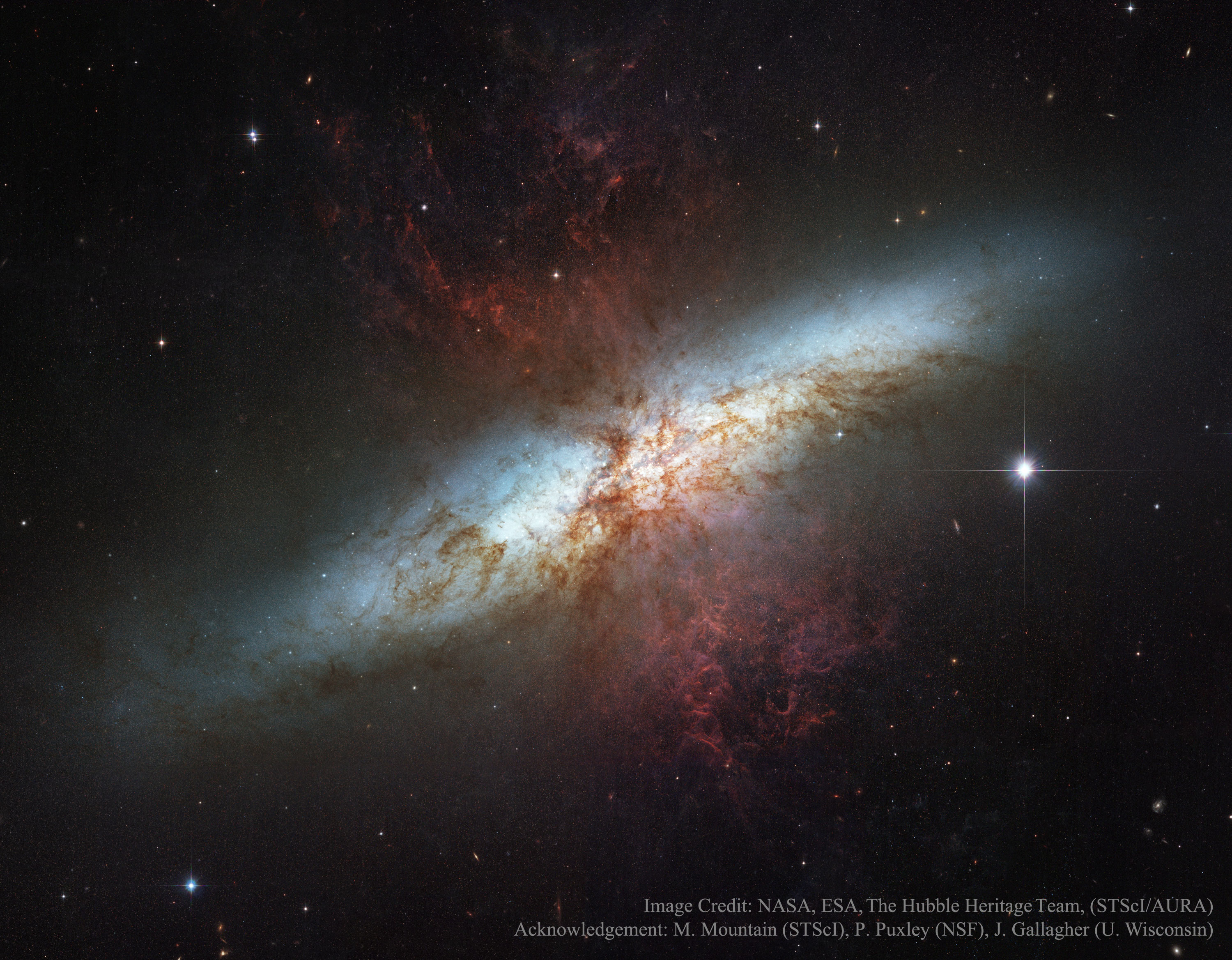
Astronomy picture of the day - 2016 February 21 - M82: Galaxy with a Supergalactic Wind
Image Credit: NASA, ESA, The Hubble Heritage Team, (STScI/AURA)
Acknowledgement: M. Mountain (STScI), P. Puxley (NSF), J. Gallagher (U. Wisconsin)
Explanation: What's lighting up the Cigar Galaxy? M82, as this irregular galaxy is also known, was stirred up by a recent pass near large spiral galaxy M81. This doesn't fully explain the source of the red-glowing outwardly expanding gas, however. Evidence indicates that this gas is being driven out by the combined emerging particle winds of many stars, together creating a galactic superwind. The featured photographic mosaic highlights a specific color of red light strongly emitted by ionized hydrogen gas, showing detailed filaments of this gas. The filaments extend for over 10,000 light years. The 12-million light-year distant Cigar Galaxy is the brightest galaxy in the sky in infrared light, and can be seen in visible light with a small telescope towards the constellation of the Great Bear (Ursa Major).
2016-02-20
Inscription à :
Commentaires (Atom)