5 DE FEVEREIRO |
2016-02-05
Expressões populares portuguesas: "De partir o coco a rir"
No período das Descobertas, os portugueses chamaram coco a um novo fruto que encontraram porque, visto de um certo ângulo, parecia a cara de um monstro io coco maginário com que se assustava as crianças, uma espécie de bicho-papão - ao qual também se dava o nome de coco. É o que conta o historiador João de Barros nas Décadas da Ásia: "[...] por razão da qual figura, sem ser figura, os nossos lhe chamaram coco, nome imposto pelas mulheres a qualquer coisa, com que querem fazer medo às crianças, o qual nome assim lhe ficou, que ninguém lhe sabe outro [...]." Se o fruto fosse usado para representar o monstro, percebe-se a alegria das crianças quando o coco era partido. Entre as várias interpretações, assim como o coco assustava, a lenda conta que a representação feminina, a coca, ficava atenta às crianças mais desobedientes, à espera que se portassem mal... ficava por isso "à coca".
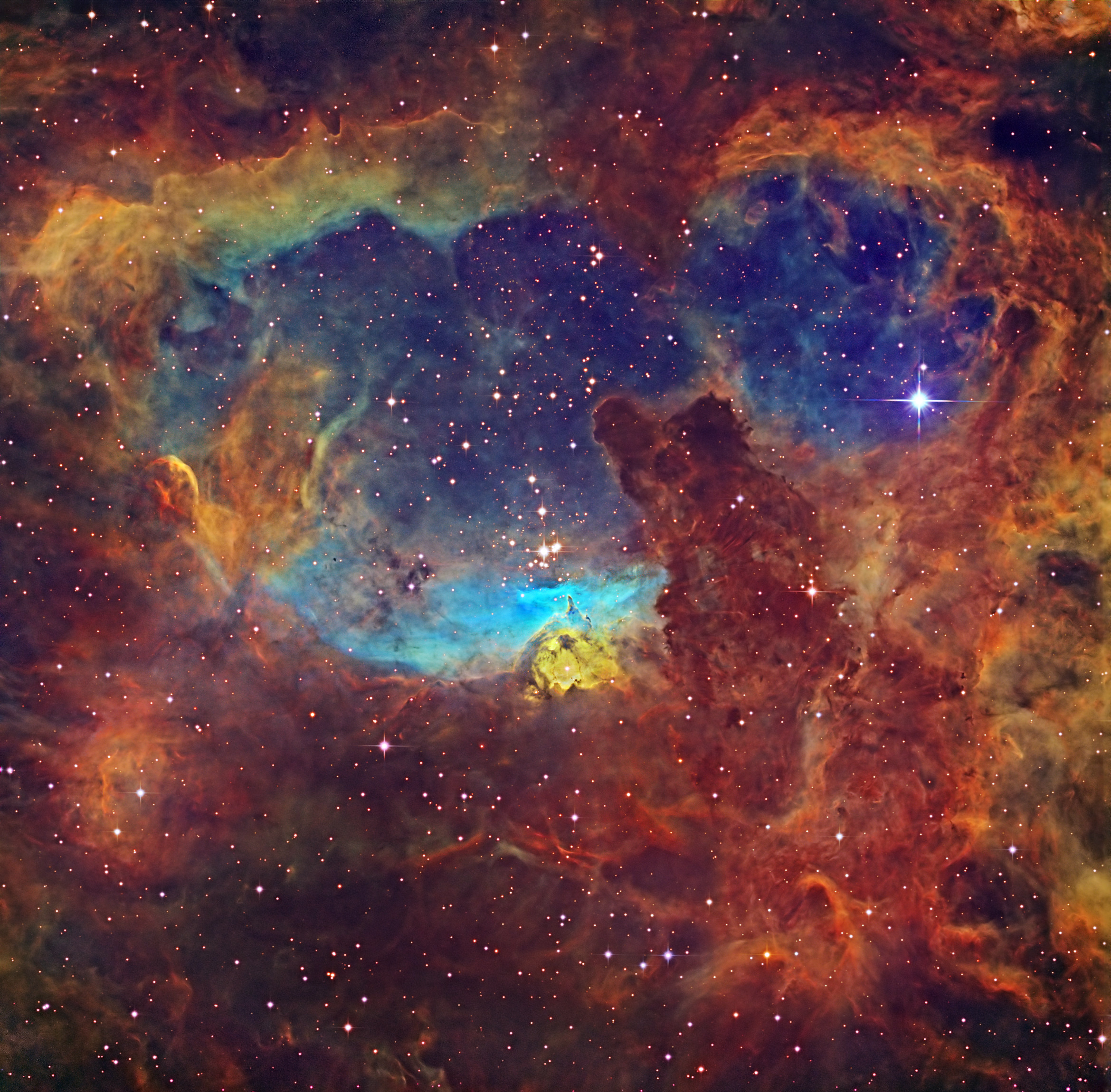
Astronomy picture of the day - 2016 February 5 - Massive Stars in NGC 6357
Image Credit & Copyright: CHART32 Team, Processing - Johannes Schedler
Explanation: Massive stars lie within NGC 6357, an expansive emission nebula complex some 6,500 light-years away toward the tail of the constellation Scorpius. In fact, positioned near center in this ground-based close-up of NGC 6357, star cluster Pismis 24 includes some of the most massive stars known in the galaxy, stars with nearly 100 times the mass of the Sun. The nebula's bright central region also contains dusty pillars of molecular gas, likely hiding massive protostars from the prying eyes of optical instruments. Intricate shapes in the nebula are carved as interstellar winds and energetic radiation from the young and newly forming massive stars clear out the natal gas and dust and power the nebular glow. Enhancing the nebula's cavernous appearance, narrowband image data was included in this composite color image in a Hubble palette scheme. Emission from sulfur, hydrogen, and oxygen atoms is shown in red green and blue hues. The alluring telescopic view spans about 50 light-years at the estimated distance of NGC 6357.
Inscription à :
Commentaires (Atom)