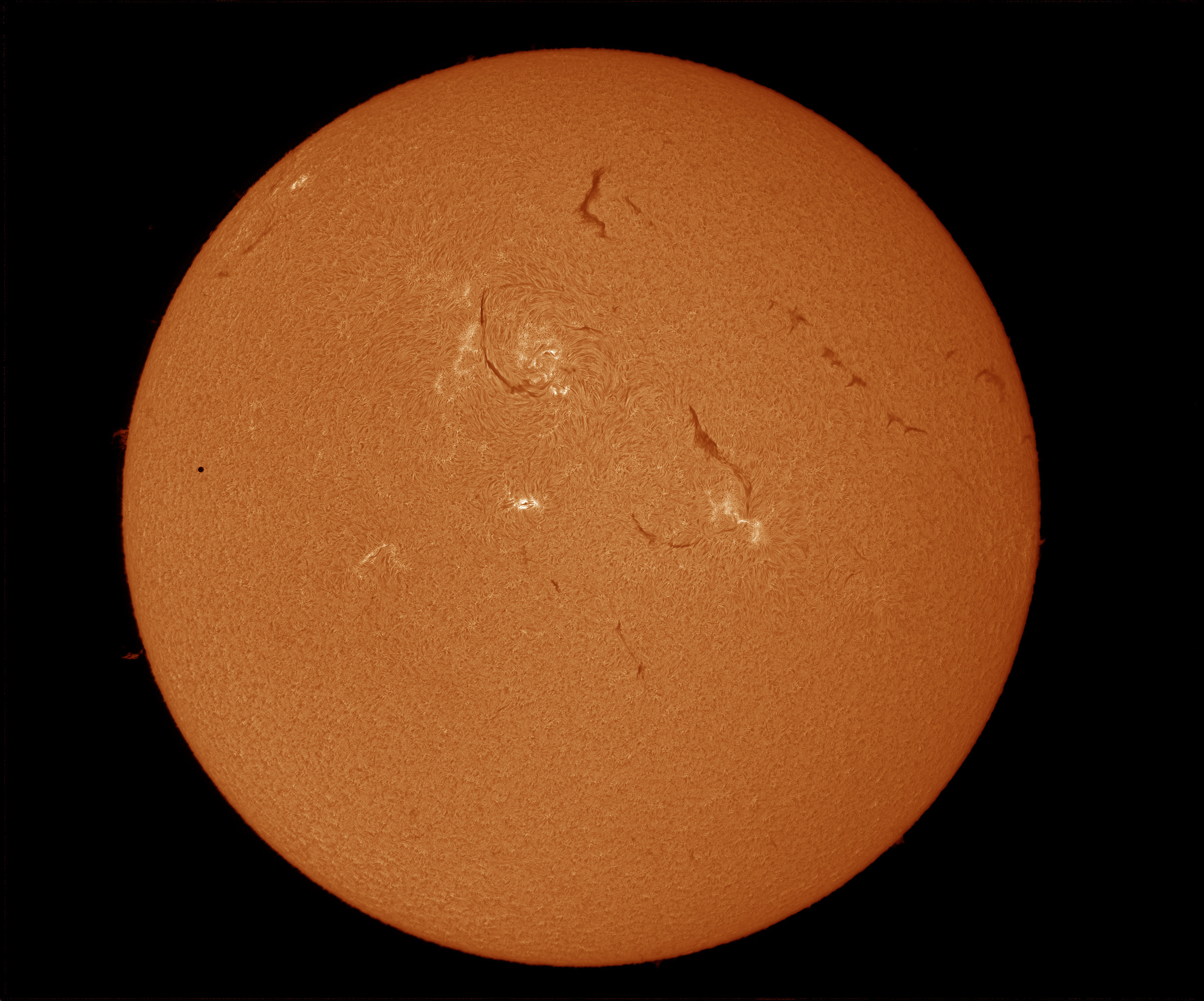
Explanation: On May 9, the diminutive disk of Mercury spent about seven and a half hours crossing in front of the Sun as viewed from the general vicinity of Earth. It was the second of 14 transits of the Solar System's innermost planet in the 21st century. Captured from Fulham, London, England, planet Earth the tiny silhouette shares the enormous solar disk with prominences, filaments, and active regions in this sharp image. But Mercury's round disk (left of center) appears to be the only dark spot, despite the planet-sized sunspots scattered across the Sun. Made with an H-alpha filter that narrowly transmits the red light from hydrogen atoms, the image emphasizes the chromosphere, stretching above the photosphere or normally visible solar surface. In H-alpha pictures of the chromosphere, normally dark sunspot regions are dominated by bright splotches called plages.
Esta noite, debruçando-me à janela do meu quarto, com um céu de uma pureza limpida, as estrelas cintilantes envolvendo um quarto de crescente lua, vi como nunca antes tinha visto, um astro magnifico de luminosidade intensa, tentando dissimular o teu sorriso malicioso... Não te escondas "Pierre" (Pedro Teixeira), sei que és tu!
Tem duas horas e quarenta minutos para preencher? Então pode assistir ao naufrágio do Titanic... em tempo real. Sim, é possível acompanhar ao minuto o que aconteceu após o trágico embate do famoso barco com um icebergue, através de uma simulação que tenta representar todos os momentos do acidente. E, ao contrário do que acontece na versão cinematográfica do evento, tudo se processou de forma bem mais lenta... No primeiro minuto, vemos o fatídico embate e, nos longos minutos que se seguem, a simulação dá-nos um olhar privilegiado do interior e exterior do barco enquanto este vai (lentamente) afundando. O resto é história.