2016-08-21

Astronomy picture of the day - 2016 August 21 - Map of Total Solar Eclipse Path in 2017 August

2016 August 21
See Explanation.  Clicking on the picture will download
 the highest resolution version available.
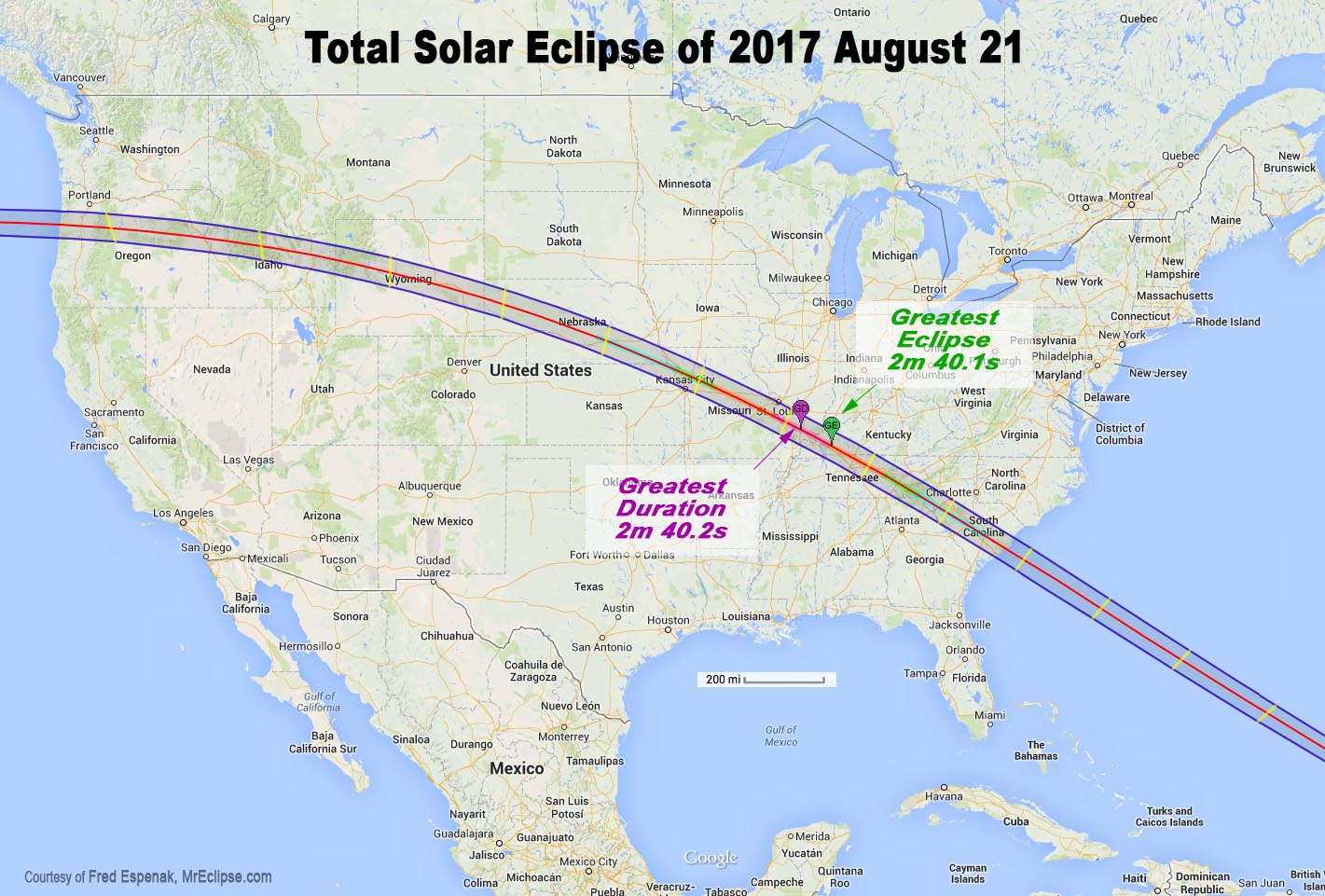
Map of Total Solar Eclipse Path in 2017 August 
Image Credit: Fred Espenak (NASA's GSFC), MrEclipse.comGoogle Maps
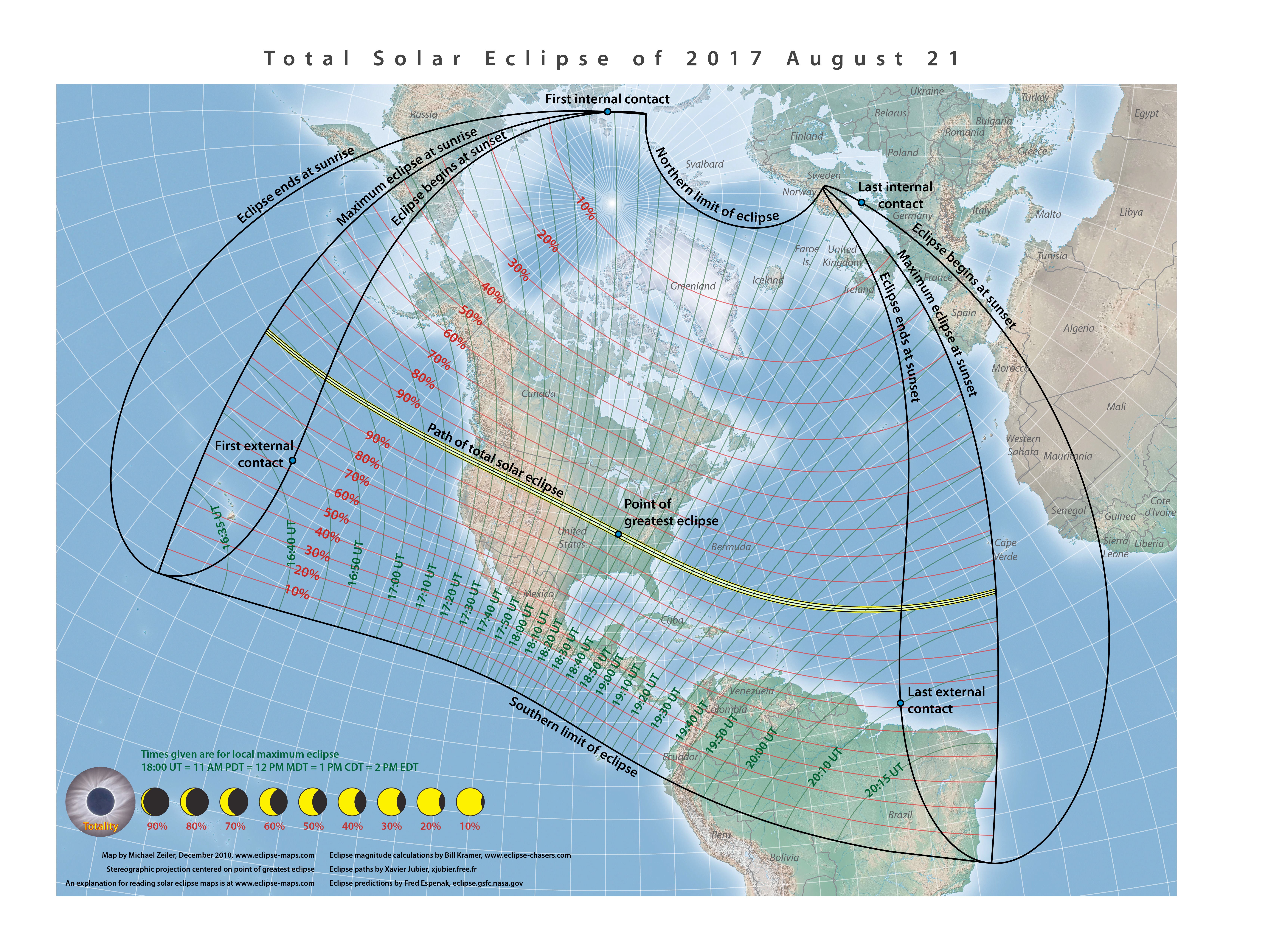
Explanation: Would you like to see a total eclipse of the Sun? If so, do any friends or relatives live near the path of next summer's eclipse? If yes again, then you might want to arrange a visit for one year from today. Next year on this exact date, the path of a total solar eclipse will cut right across the center of the contiguous USA. All of North America and part of South America will experience, at the least, a partial solar eclipse. Featured here is a map of the path of totality, computed by eclipse expert Fred Espenak of NASA's GSFC. Many people who have seen a total solar eclipse tell stories about it for the rest of their lives. The last path of solar totality that included any part of the contiguous USA was in 1979, and the next two will be in 2024 and 2045.

2016-08-20

Astronomy picture of the day - 2016 August 20 - Gamma-rays and Comet Dust

See Explanation.  Clicking on the picture will download
 the highest resolution version available.
Gamma-rays and Comet Dust 
Image Credit & CopyrightDaniel López (El Cielo de Canarias)
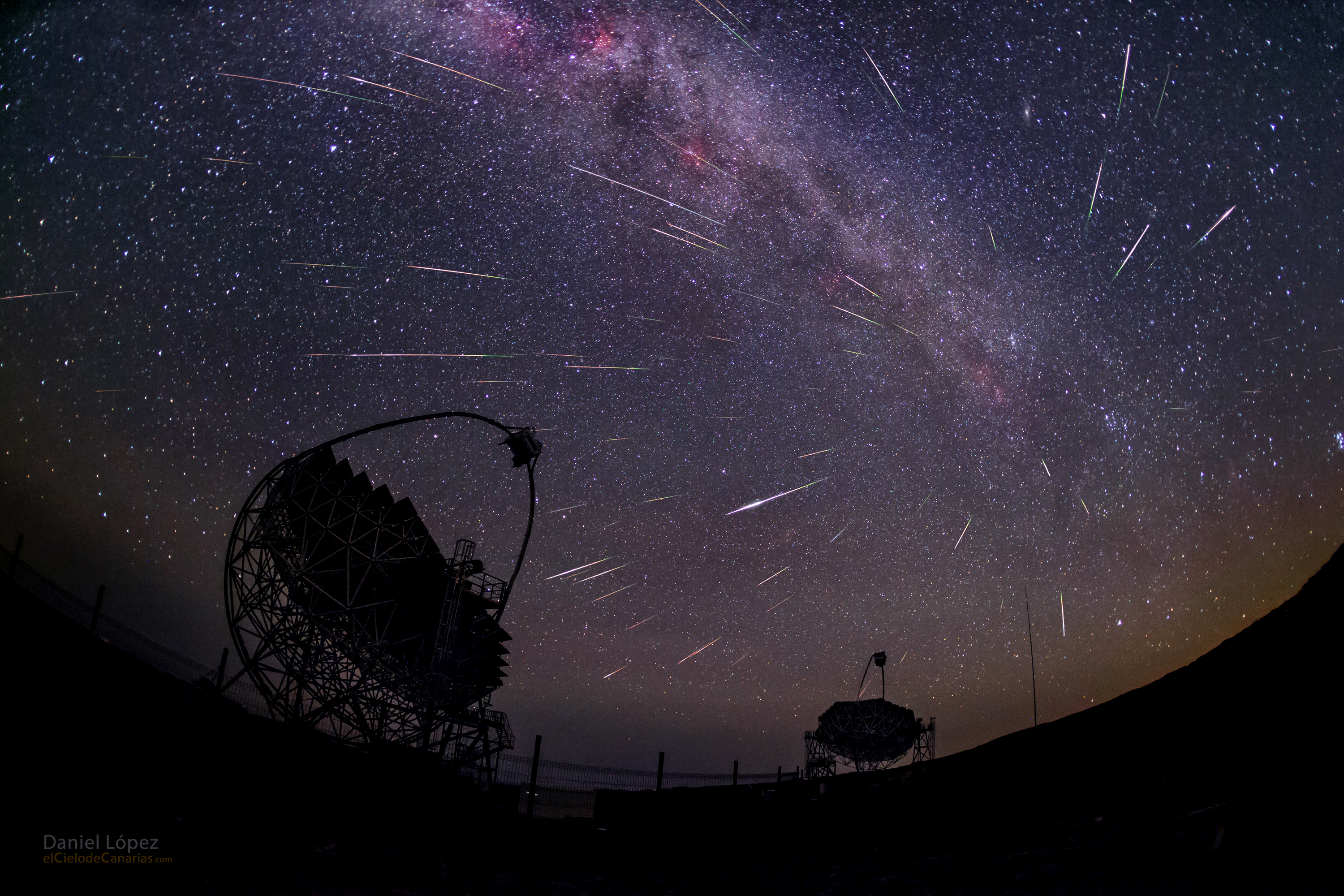
Explanation: Gamma-rays and dust from periodic Comet Swift-Tuttle plowed through planet Earth's atmosphere on the night of August 11/12. Impacting at about 60 kilometers per second the grains of comet dust produced this year's remarkably active Perseid meteor shower. This composite wide-angle image of aligned shower meteors covers a 4.5 hour period on that Perseid night. In it the flashing meteor streaks can be traced back to the shower's origin on the sky. Alongside the Milky Way in the constellation Perseus, the radiant marks the direction along the perodic comet's orbit. Traveling at the speed of light, cosmic gamma-rays impacting Earth's atmosphere generated showers too, showers of high energy particles. Just as the meteor streaks point back to their origin, the even briefer flashes of light from the particles can be used to reconstruct the direction of the particle shower, to point back to the origin on the sky of the incoming gamma-ray. Unlike the meteors, the incredibly fast particle shower flashes can't be followed by eye. But both can be followed by the high speed cameras on the multi-mirrored dishes in the foreground. Of course, the dishes are MAGIC (Major Atmospheric Gamma Imaging Cherenkov) telescopes, an Earth-based gamma-ray observatory on the Canary Island of La Palma.

2016-08-19

Jamás una rueda de prensa fue tan violenta - Video - Insulto


McGregor increpa al equipo del estadounidense Nate Diaz, justo antes de la batalla.
"Estoy preparado para luchar y va a ser un auténtico espectáculo", aseguró ayer McGregor en una rueda de prensa que no tardaría en irse de madre. La revancha entre Diaz y McGregor, que tendrá lugar este sábado 20 de agosto, fue la razón por la que se reunieron en Las Vegas decenas de medios que vivieron atónitos cómo volaban botellas, insultos y amenazas por una sala de prensa que se convirtió en un campo de batalla.

El Pais - España

Imagenes del mundo - Niños ensangrentados - Alepo, Siria

Omran Daqneesh, de cinco años, con la cara sucia y ensangrentada, espera sentado junto a su hermana dentro de una ambulancia, tras ser rescatados de un ataque aéreo en la zona rebelde de al-Qaterji , en Alepo (Siria).
STRINGER REUTERS

Imagenes del mundo - Incendio en California

El humo se levanta de un bosque quemado en el incendio de California.
JONATHAN ALCORN AFP

Astronomy picture of the day - 2016 August 19 - Perseid Fireball at Sunset Crater

See Explanation.  Clicking on the picture will download
 the highest resolution version available.
Perseid Fireball at Sunset Crater 
Image Credit & CopyrightJeremy Perez
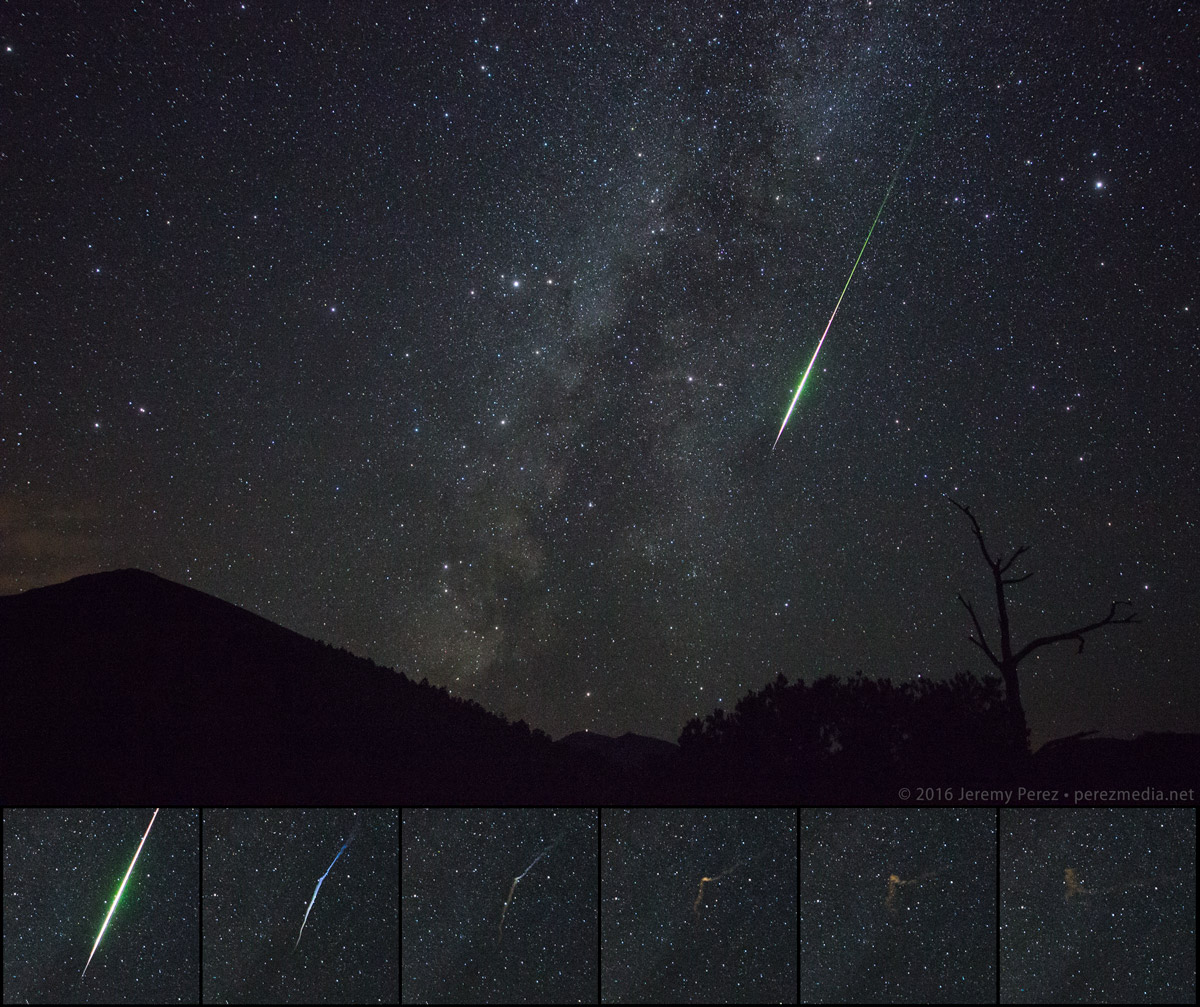
Explanation: On the night of August 12, this bright Perseid meteor flashed above volcanic Sunset Crater National Monument, Arizona, USA, planet Earth. Streaking along the summer Milky Way, its initial color is likely due to the shower meteor's characteristically high speed. Entering at 60 kilometers per second, Perseid meteors are capable of exciting green emission from oxygen atoms while passing through the tenuous atmosphere at high altitudes. Also characteristic of bright meteors, this Perseid left a visibly glowing persistent train. Its evolution is seen over a three minute sequence (left to right) spanning the bottom of the frame. The camera ultimately captured a dramatic timelapse video of the twisting, drifting train.

2016-08-18

Astronomy picture of the day - 2016 August 18 - Perseid Night at Yosemite

See Explanation.  Clicking on the picture will download
 the highest resolution version available.
Perseid Night at Yosemite 
Image Credit & CopyrightMike Shaw
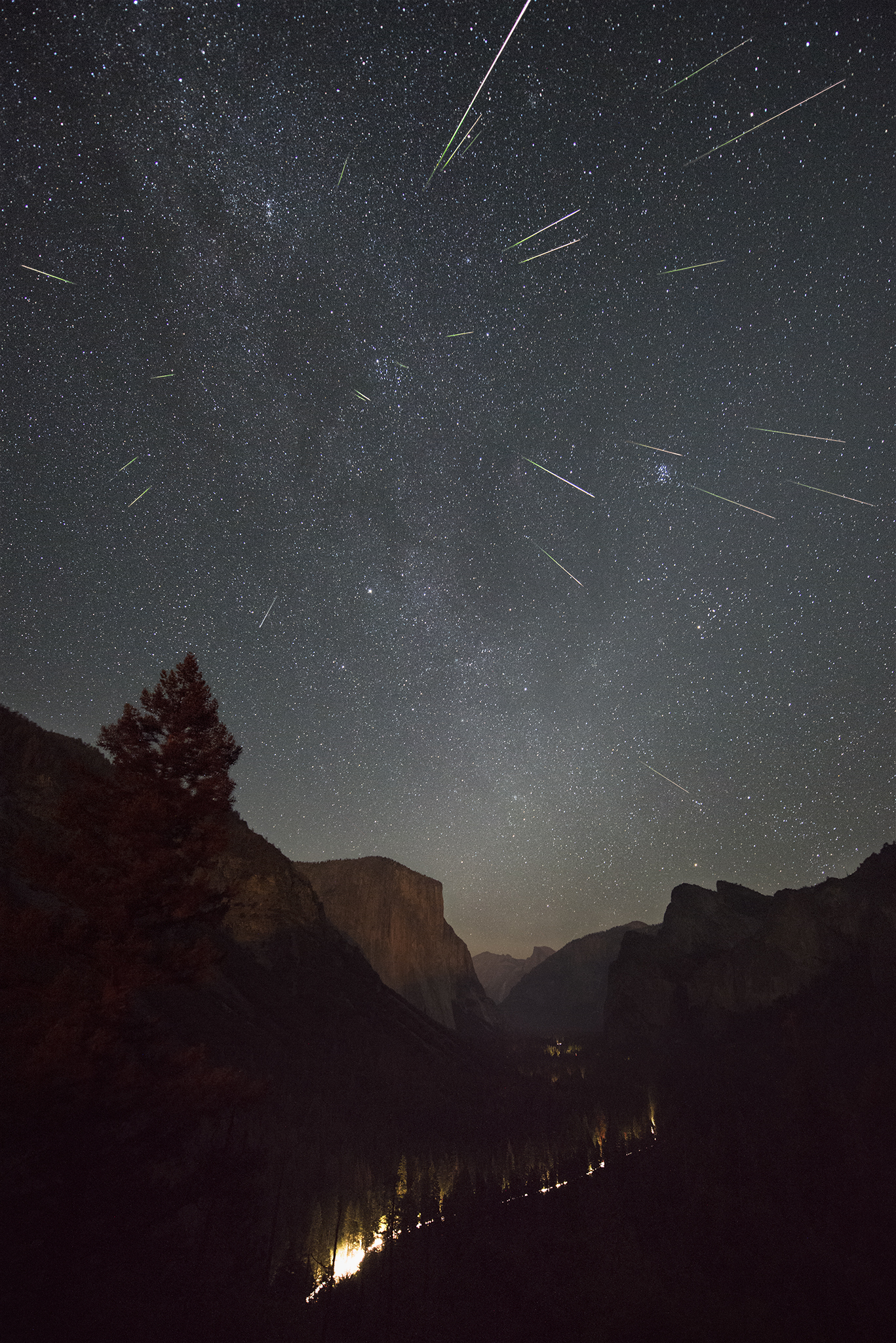
Explanation: The 2016 Perseid meteor shower performed well on the night of August 11/12. The sky on that memorable evening was recorded from a perch overlooking Yosemite Valleyplanet Earth, in this scene composed of 25 separate images selected from an all-night set of sequential exposures. Each image contains a single meteor and was placed in alignment using the background stars. The digital manipulation accounts for the Earth's rotation throughout the night and allows the explosion of colorful trails to be viewed in perspective toward the shower's radiant in the constellation Perseus. The fading alpenglow gently lights the west face of El Capitan just after sunset. Just before sunrise, a faint band zodiacal light, or the false dawn, shines upward from the east, left of Half Dome at the valley's far horizon. Car lights illuminate the valley road. Of course, the image is filled with other celestial sights from that Perseid night, including the Milky Way and the Pleiades star cluster.

2016-08-17

Imagens do Mundo - Sitios lindos de Portugal - Alfama, Lisboa

Afficher l'image d'origine
Alfama

Fotos do passado - Teste de coletes à prova de balas, 1923

Teste de coletes à prova de balas, 1923

Astronomy picture of the day - 2016 August 17 - Meteor before Galaxy

See Explanation.  Clicking on the picture will download
 the highest resolution version available.
Meteor before Galaxy 
Image Credit & Copyright: Fritz Helmut Hemmerich
Explanation: What's that green streak in front of the Andromeda galaxy? A meteor. While photographing the Andromeda galaxy last Friday, near the peak of the Perseid Meteor Shower, a sand-sized rock from deep space crossed right in front of our Milky Way Galaxy's far-distant companion. The small meteor took only a fraction of a second to pass through this 10-degree field. The meteor flared several times while braking violently upon entering Earth's atmosphere. The green color was created, at least in part, by the meteor's gas glowing as it vaporized. Although the exposure was timed to catch a Perseids meteor, the orientation of the imaged streak seems a better match to a meteor from the Southern Delta Aquariids, a meteor shower that peaked a few weeks earlier.