2017-01-14

Astronomy picture of the day - 2017 January 14 - Stardust in the Perseus Molecular Cloud

See Explanation.  Clicking on the picture will download
 the highest resolution version available.
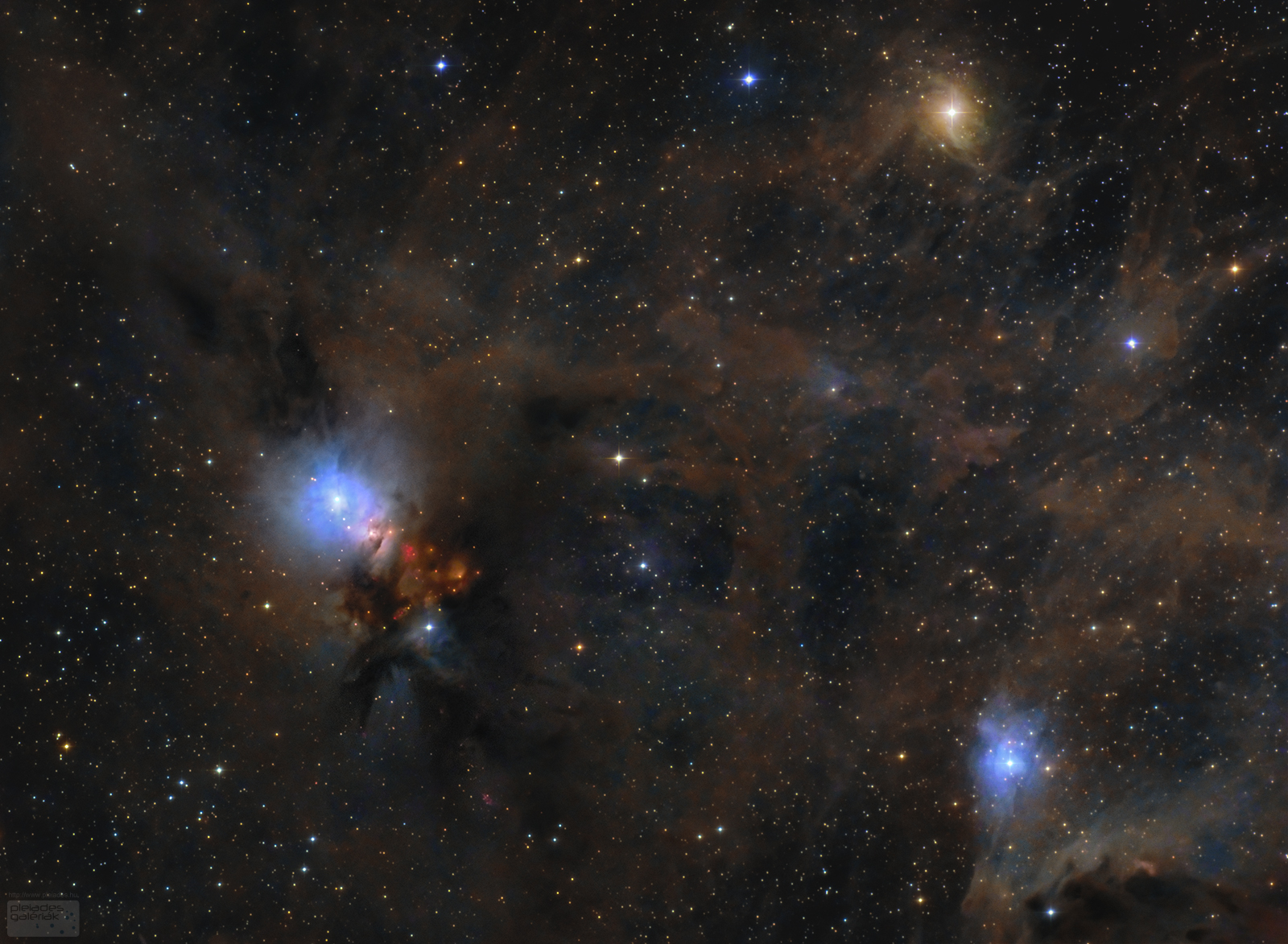
Stardust in the Perseus Molecular Cloud 
Image Credit & CopyrightLorand Fenyes
Explanation: Clouds of stardust drift through this deep skyscape. The cosmic scene spans nearly 2 degrees across the Perseus molecular cloud some 850 light-years away. A triangle of dusty nebulae reflecting light from embedded stars is captured in the telescopic field of view. With a characteristic bluish color reflection nebula NGC 1333 is at left, vdB13 at bottom right, and rare yellowish reflection nebula vdB12 lies at the top. Stars are forming in the Perseus molecular cloud, though most are obscured at visible wavelengths by the pervasive dust. Still, hints of contrasting red emission from Herbig-Haro objects, the jets and shocked glowing gas emanating from recently formed stars, are evident in NGC 1333. At the estimated distance of the molecular cloud, legs of the triangle formed by the reflection nebulae would be about 20 light-years long.

2017-01-13

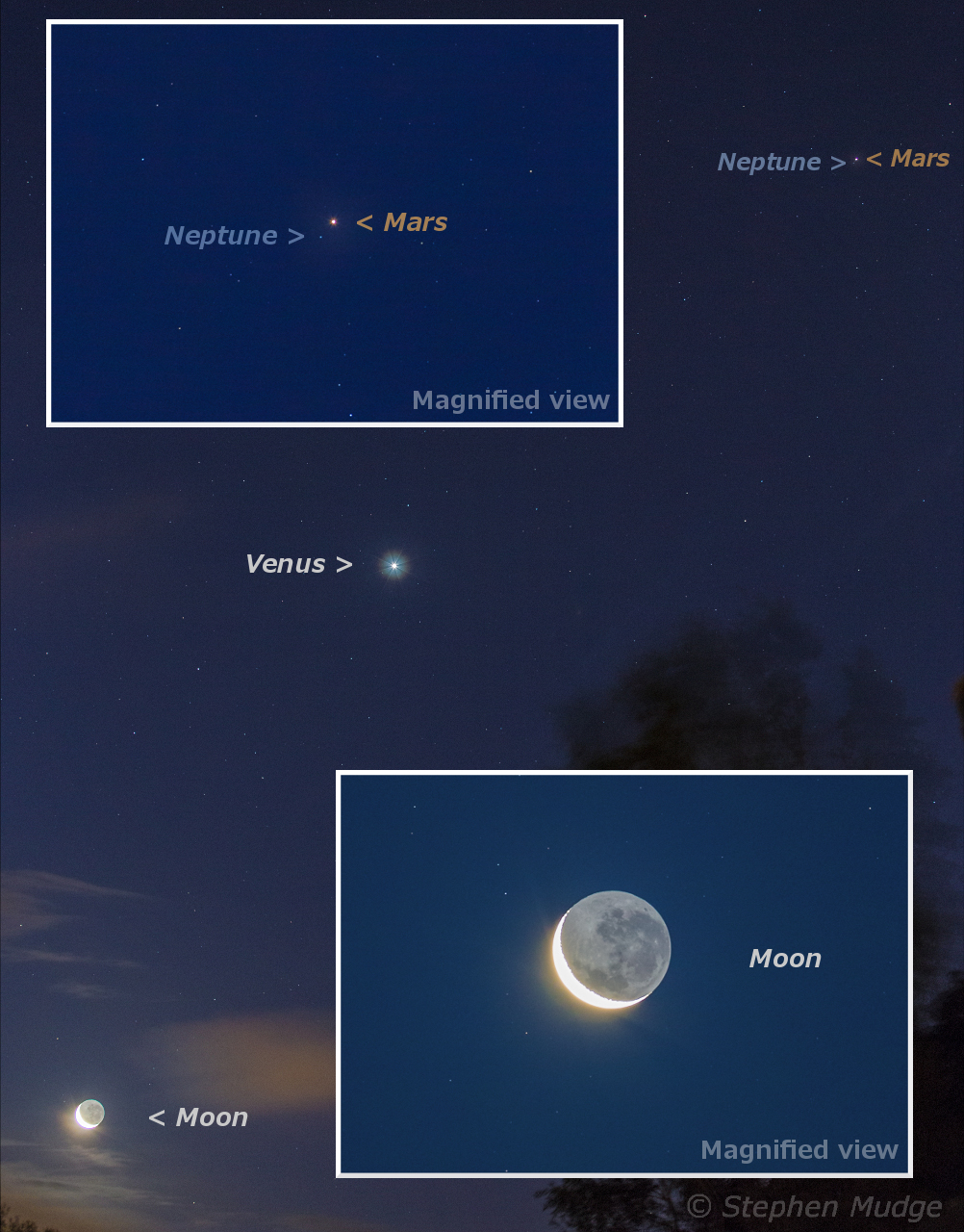
Astronomy picture of the day - 2017 January 13 - When Mars met Neptune

See Explanation.  Clicking on the picture will download
 the highest resolution version available.
When Mars met Neptune 
Image Credit & CopyrightStephen Mudge
Explanation: On January 1, a Mars-assisted viewing opportunity allowed binocular-equipped skygazers to cross an ice giant off their life list. Remarkably, the line-of-sight to the bright Red Planet could guide you to within 0.02 degrees of a faint, pale Neptune in Earth's night skies. Taken within 3 hours of their closest conjunction, these panels capture the odd couple's appearance in skies over Brisbane, Australia. A wide field view includes the new year'sslender crescent moon near the western horizon and Venus as the brilliant evening star. Mars and Neptune are indicated at the upper right. The two inset magnified views were taken with the same telephoto lens and so do show the Mars-Neptune conjunction and the apparent size of the crescent moon at the same scale. This week Neptune hangs out near Venus on the western sky.

2017-01-12

Astronomy picture of the day - 2017 January 12 - Edge-On NGC 891

See Explanation.  Clicking on the picture will download
 the highest resolution version available.
Edge-On NGC 891
Image Credit & Copyright: Alessandro Falesiedi
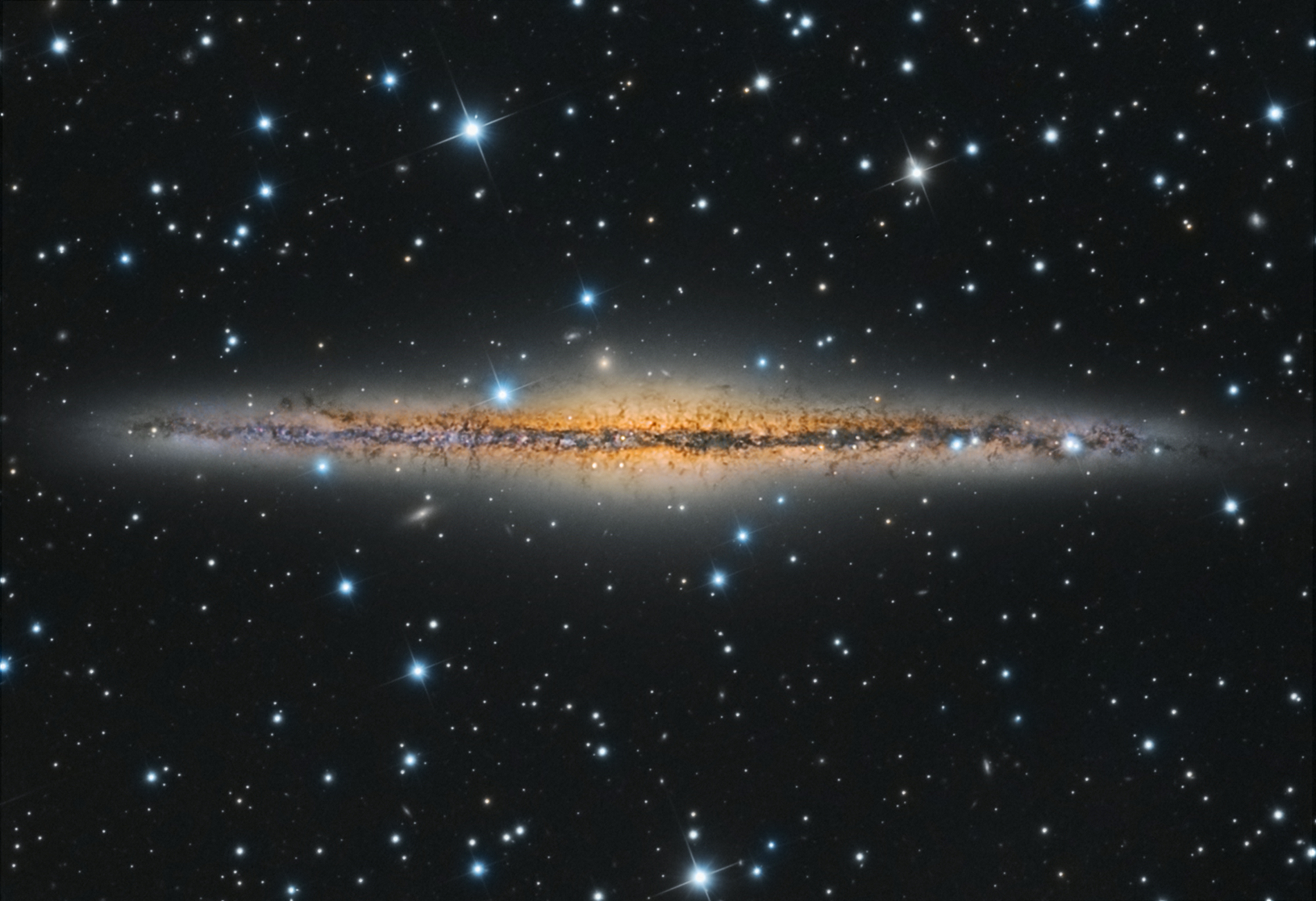
Explanation: Large spiral galaxy NGC 891 spans about 100 thousand light-years and is seen almost exactly edge-on from our perspective. In fact, about 30 million light-years distant in the constellation Andromeda, NGC 891 looks a lot like our Milky Way. At first glance, it has a flat, thin, galactic disk of stars and a central bulge cut along the middle by regions of dark obscuring dust. But remarkably apparent in NGC 891's edge-on presentation are filaments of dust that extend hundreds of light-years above and below the center line. The dust has likely been blown out of the disk by supernova explosions or intense star formation activity. Fainter galaxies can also be seen near the edge-on disk in this deep portrait of NGC 891.

2017-01-11

Astronomy picture of the day - 2017 January 11 - Mimas, Crater, and Mountain

2017 January 11
See Explanation.  Clicking on the picture will download
 the highest resolution version available.
Mimas, Crater, and Mountain
Image Credit: Cassini Imaging TeamSSIJPLESANASA
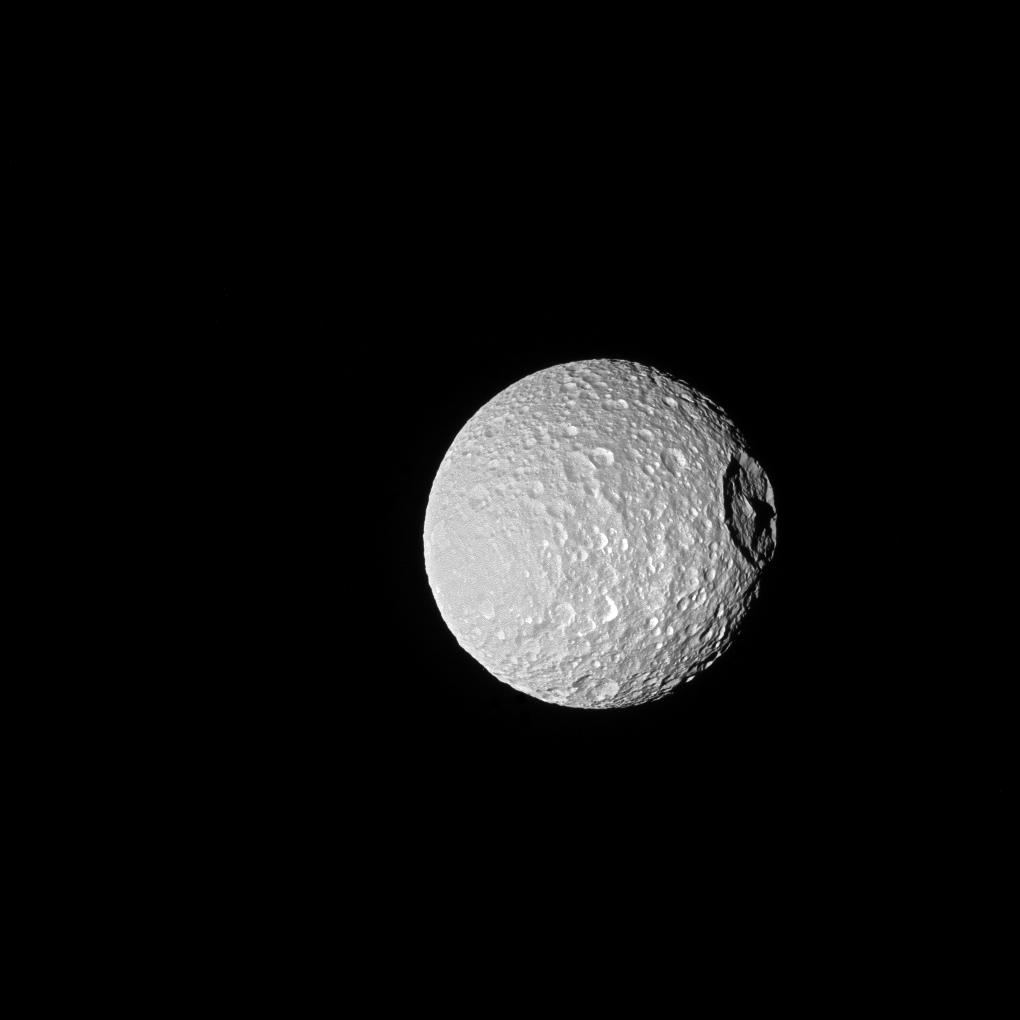
Explanation: Mimas is an icy, crater-pocked moon of Saturn a mere 400 kilometers (250 miles) in diameter. Its largest crater Herschel is nearly 140 kilometers wide. About a third the diameter of Mimas itself, Herschel crater gives the small moon an ominous appearance, especially for scifi fans of the Death Star battlestation of Star Wars fame. In fact, only a slightly bigger impact than the one that created such a large crater on a small moon could have destroyed Mimas entirely. In this Cassini image from October 2016, the anti-Saturn hemisphere of the synchronously rotating moon is bathed in sunlight, its large crater near the right limb. Casting a long shadow across the crater floor, Herschel's central mountain peak is nearly as tall as Mount Everest on planet Earth.

2017-01-10

Astronomy picture of the day - 2017 January 10 - Sentinels of a Northern Sky

See Explanation.  Clicking on the picture will download
 the highest resolution version available.
Sentinels of a Northern Sky 
Image Credit & Copyright: Pierre Destribats
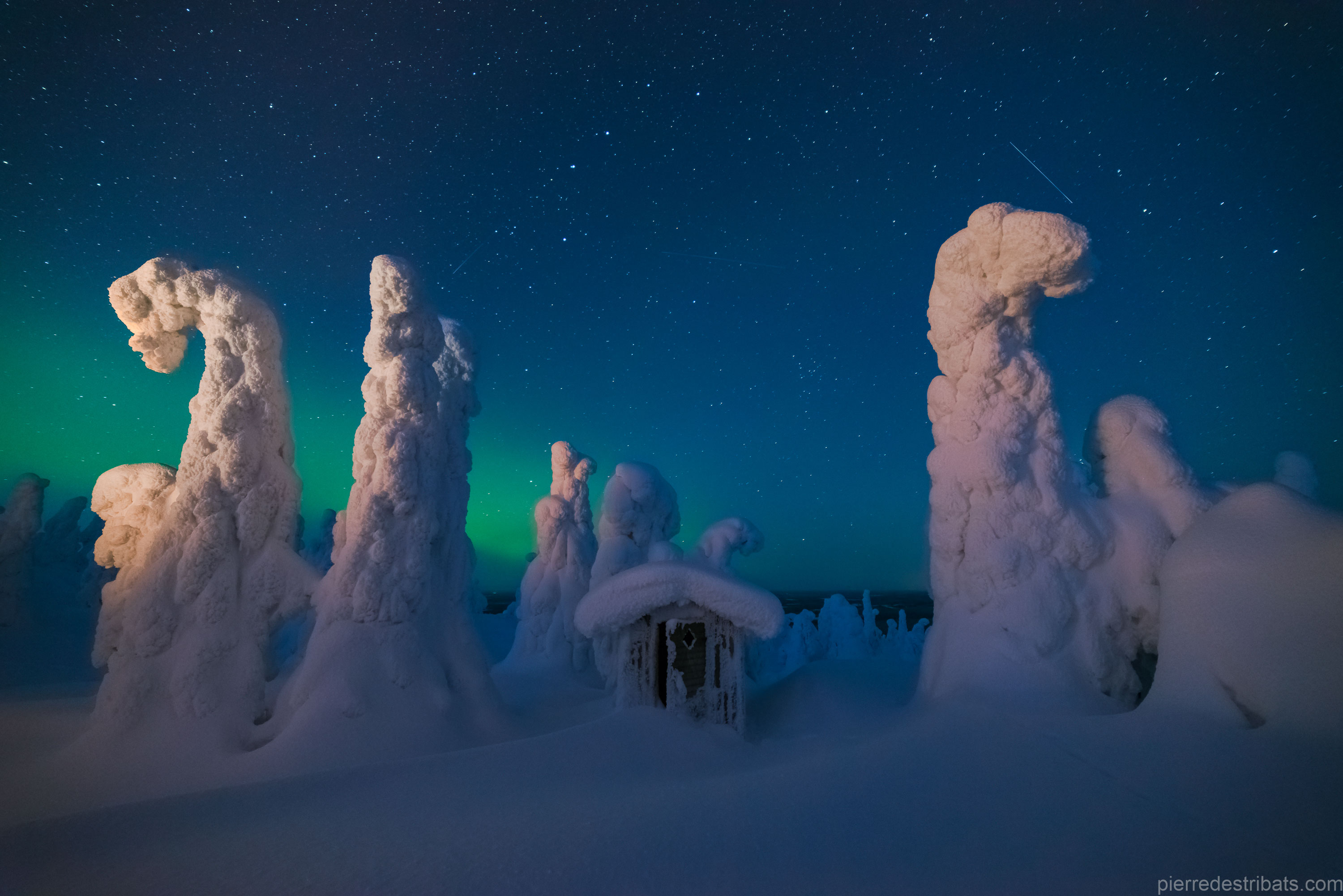
Explanation: Who guards the north? The featured picture was taken last March in Finnish Lapland where weather can include sub-freezing temperatures and driving snow. Surreal landscapes sometimes result, where white alien-looking sentinels seem to patrol the landscape. In actuality though, the aliens are snow-covered trees, and the red hut they seem to be guarding is an outhouse. Far in the distance, behind this uncommon Earthly vista, is a beautiful night sky which includes a green aurora, bright stars, and streaks of orbiting satellites. Of course, in the spring, the trees thaw and Lapland looks much different.

2017-01-09

Astronomy picture of the day - 2017 January 9 - In the Center of Spiral Galaxy NGC 5033

See Explanation.  Clicking on the picture will download
 the highest resolution version available.
In the Center of Spiral Galaxy NGC 5033 
Image Credit: NASAESAHubbleMAST - Processing: Judy Schmidt
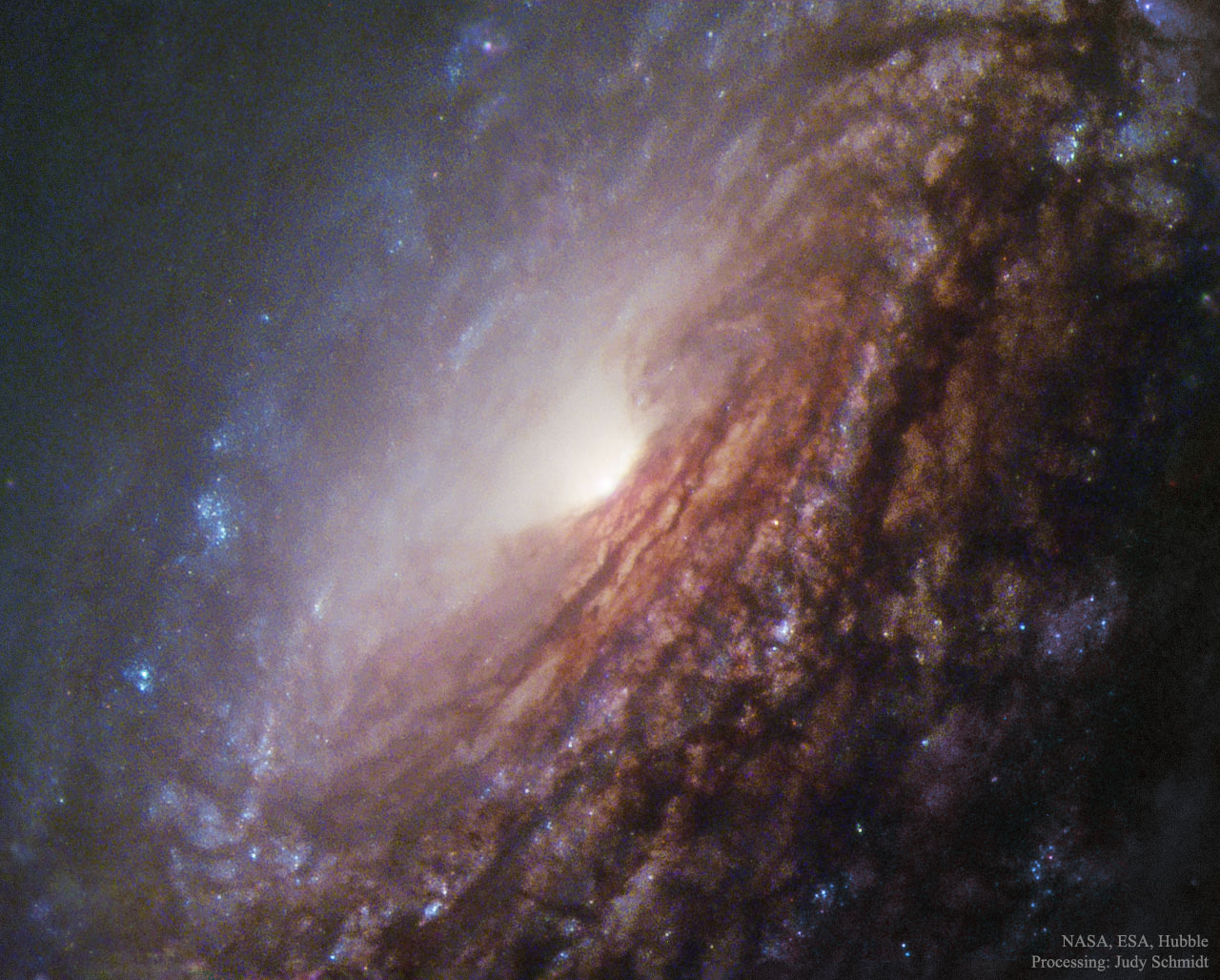
Explanation: What's happening in the center of spiral NGC 5033? Many things -- some circular, some energetic, and some not well understood. NGC 5033 is known as a Seyfert galaxy because of the great activity seen in its nucleus. Bright stars, dark dust, and interstellar gas all swirl quickly around a galactic center that appears slightly offset from a supermassive black hole. This offset is thought to be the result of NGC 5033 merging with another galaxy sometime in the past billion years. The featured image was taken by the Hubble Space Telescope in 2005. NGC 5033 spans about 100,000 light years and is so far away that we see it only as it existed about 40 million years ago.

2017-01-08

Artigo - Morreu o antigo presidente da República Mário Soares

Morreu o antigo presidente da República Mário Soares
O antigo Presidente da República Mário Soares morreu no sabado aos 92 anos, disse à agência Lusa fonte do Hospital da Cruz Vermelha.

Mário Soares, que foi ainda fundador e líder do PS, assim como ministro dos Negócios Estrangeiros e primeiro-ministro, morreu hoje, aos 92 anos, no Hospital da Cruz Vermelha, em Lisboa, onde estava internado desde 13 de dezembro de 2016.

Filho de João Lopes Soares, um ministro na I República, e de Elisa Nobre Baptista, Mário Alberto Nobre Lopes Soares nasceu a 07 de dezembro de 1924, em Lisboa, tendo estado omnipresente na vida pública do país, tanto nas décadas anteriores à revolução de 25 de Abril de 1974, como nos primeiros 40 anos da democracia portuguesa.

Preso político e posteriormente exilado em São Tomé e Príncipe e França durante a ditadura, Soares regressou "em ombros" à sua pátria em 1974 para desempenhar as pastas dos Negócios Estrangeiros dos primeiros governos provisórios, liderar os I, II e IX Governos Constitucionais (1976-78 e 1983-85), até chegar à Presidência da República, no Palácio de Belém, onde ficaria por dois mandatos (1986-1996).

Manuel Resendes c/Lusa

2017-01-07

Astronomy picture of the day - 2017 January 7 - Sharpless 249 and the Jellyfish Nebula

See Explanation.  Clicking on the picture will download
 the highest resolution version available.
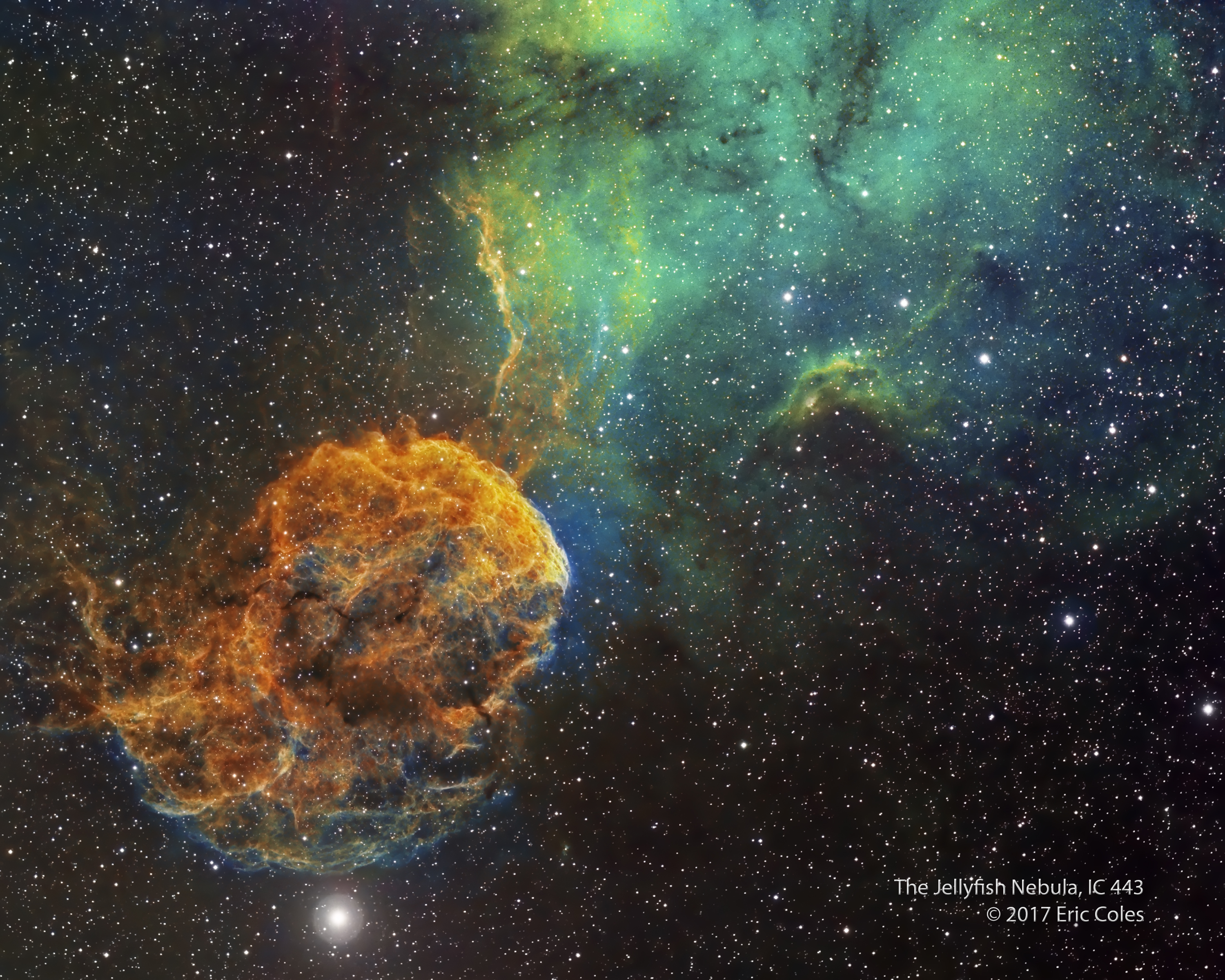
Sharpless 249 and the Jellyfish Nebula 
Image Credit & Copyright: Eric Coles
Explanation: Normally faint and elusive, the Jellyfish Nebula is caught in this alluring telescopic mosaic. The scene is anchored below by bright star Eta Geminorum, at the foot of the celestial twin, while the Jellyfish Nebula is the brighter arcing ridge of emission with tentacles dangling below and left of center. In fact, the cosmic jellyfish is part of bubble-shaped supernova remnant IC 443, the expanding debris cloud from a massive star that exploded. Light from the explosion first reached planet Earth over 30,000 years ago. Like its cousin in astrophysical waters the Crab Nebula supernova remnant, the Jellyfish Nebula is known to harbor a neutron star, the remnant of the collapsed stellar core. An emission nebula cataloged as Sharpless 249 fills the field at the upper right. The Jellyfish Nebula is about 5,000 light-years away. At that distance, this narrowband composite image presented in the Hubble Palette would be about 300 light-years across.

2017-01-06

Astronomy picture of the day - 2017 January 6 - New York Harbor Moonset

See Explanation.  Clicking on the picture will download
 the highest resolution version available.
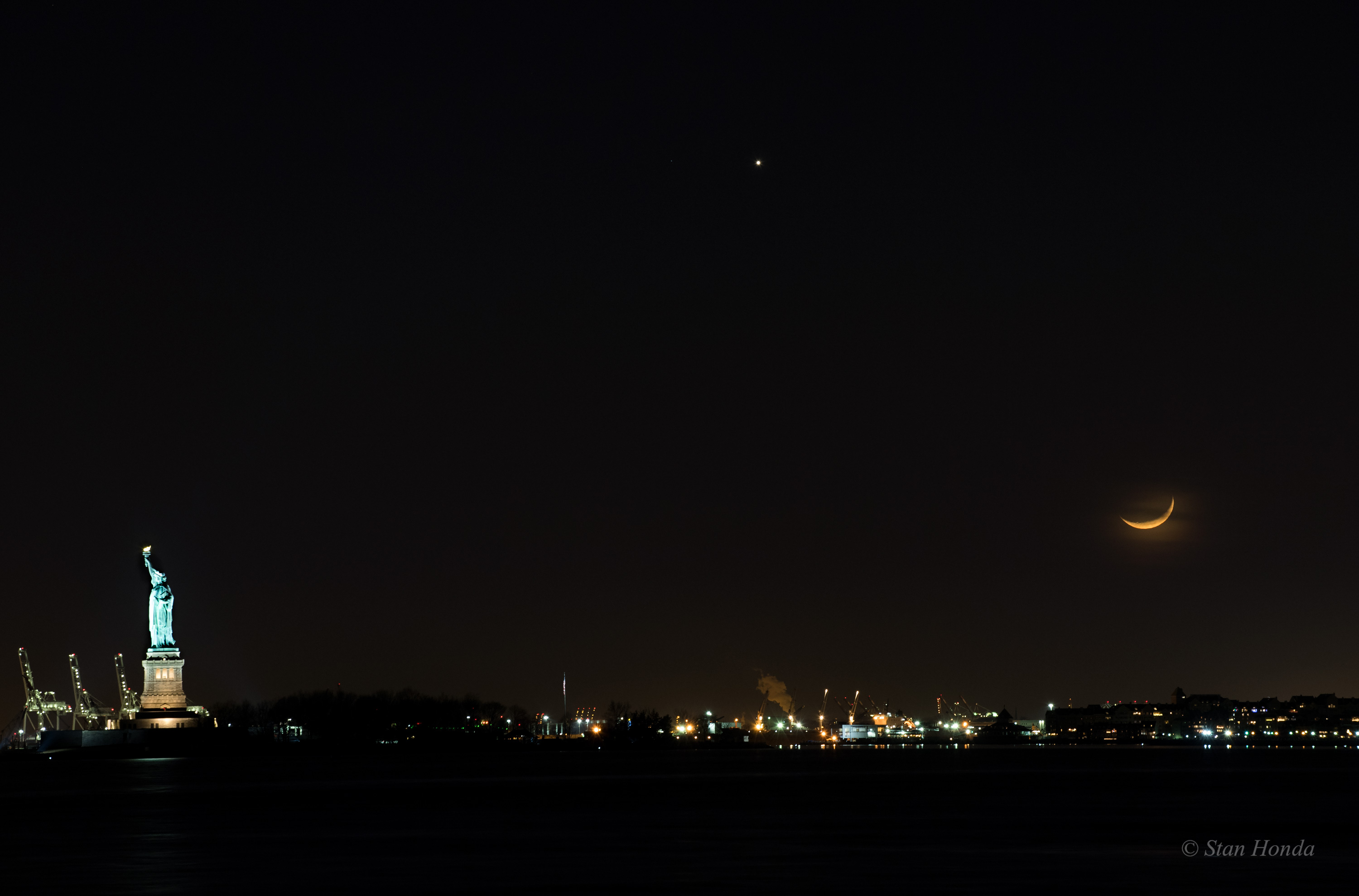
New York Harbor Moonset 
Image Credit & Copyright: Stan Honda
Explanation: Moonset on January 1 is captured in this sea and night sky snapshot from the port city of New York. Its warm moonlight shining through haze and thin clouds, this New Year's Moon was about 3 days old, in a waxingcrescent phase. The visible lunar disk is about 10 percent illuminated. Also easy to spot in hazy urban skies, Venus blazes forth over the western horizon, begining the year as Earth's evening star. Like the Moon, Venus goes through a range of phases as seen from planet Earth. As the year began, telescopic views of the brilliant inner planet's disk would show it about 50 percent illuminated, growing into a larger but thinner crescent by early March. New York Harbor's welcoming beacon, the Statue of Liberty, anchors a terrestrial corner of the night's triangle at the far left.

2017-01-05

Astronomy picture of the day - 2017 January 5 - Peculiar Galaxies of Arp 273

See Explanation.  Clicking on the picture will download
 the highest resolution version available.
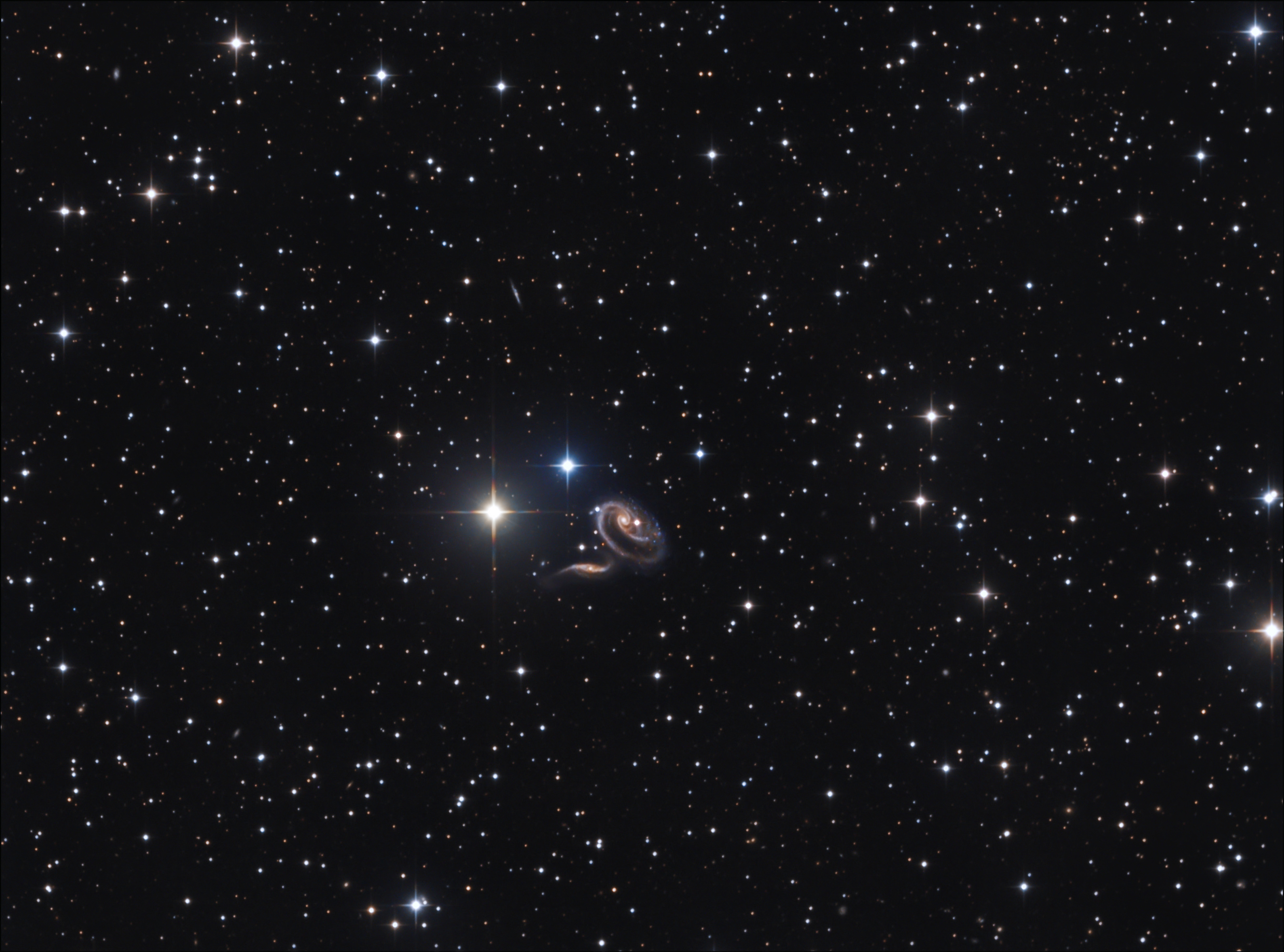
Peculiar Galaxies of Arp 273 
Image Credit & Copyright: Wolfgang Ries/Stefan Heutz (Astrokooperation)
Explanation: The spiky stars in the foreground of this sharp cosmic portrait are well within our own Milky Way Galaxy. The two eye-catching galaxies lie far beyond the Milky Way, at a distance of over 300 million light-years. Their distorted appearance is due to gravitational tides as the pair engage in close encounters. Cataloged as Arp 273 (also as UGC 1810), the galaxies do look peculiar, but interacting galaxies are now understood to be common in the universe. In fact, the nearby large spiral Andromeda Galaxy is known to be some 2 million light-years away and approaching the Milky Way. Arp 273 may offer an analog of their far future encounter. Repeated galaxy encounters on acosmic timescale can ultimately result in a merger into a single galaxy of stars. From our perspective, the bright cores of the Arp 273 galaxies are separated by only a little over 100,000 light-years.