2017-05-11

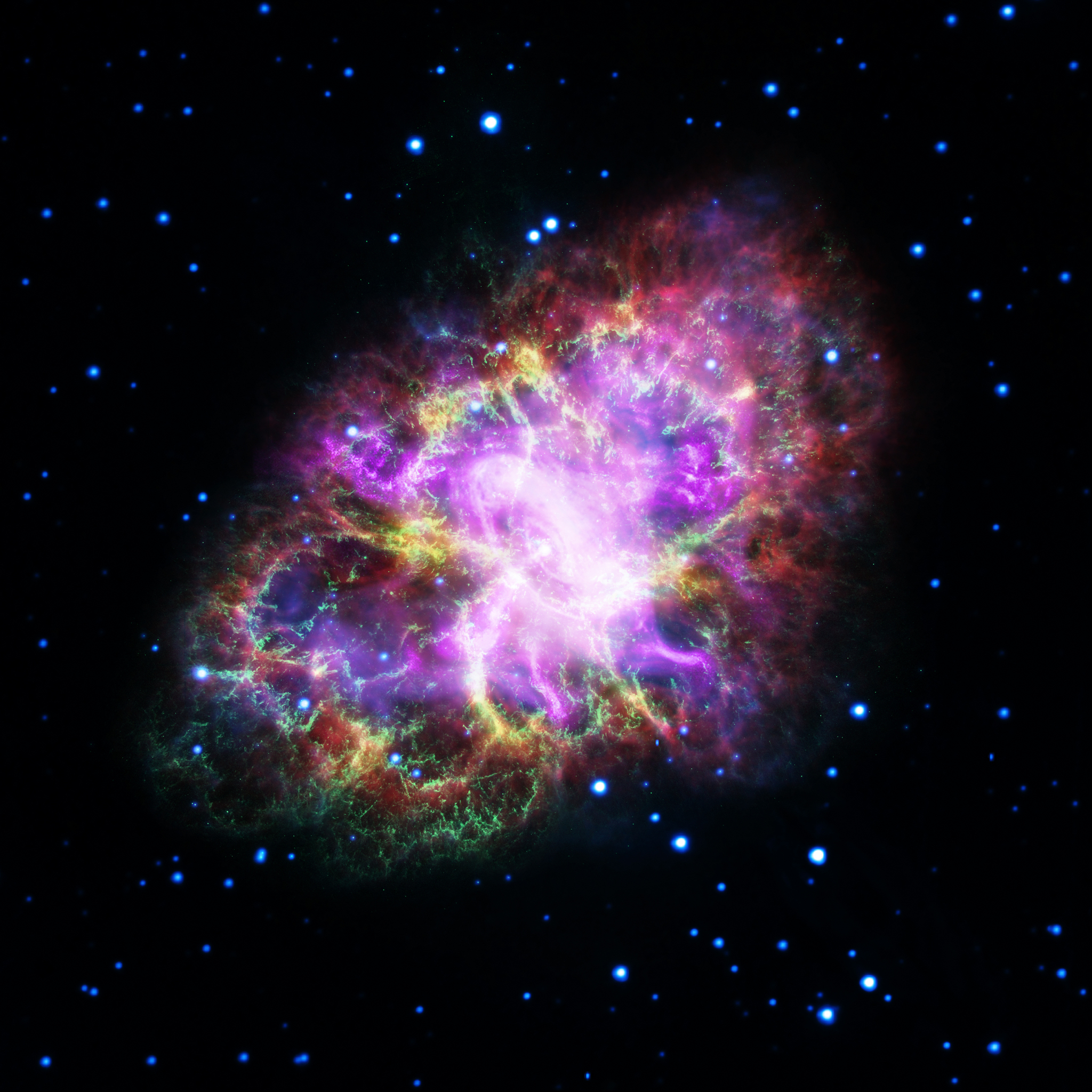
Astronomy picture of the day - 2017 May 11 - The Multiwavelength Crab

See Explanation.  Clicking on the picture will download
 the highest resolution version available.
The Multiwavelength Crab 
Image Credit: NASAESAG. Dubner (IAFE, CONICET-University of Buenos Aires) et al.;
A. Loll et al.; T. Temim et al.; F. Seward et al.; VLA/NRAO/AUI/NSF; Chandra/CXC;
Spitzer/JPL-Caltech; XMM-Newton/ESA; Hubble/STScI
Explanation: The Crab Nebula is cataloged as M1, the first object on Charles Messier's famous list of things which are not comets. In fact, the Crab is now known to be a supernova remnant, expanding debris from massive star's death explosion, witnessed on planet Earth in 1054 AD. This brave new image offers a 21st century view of the Crab Nebula by presenting image data from across the electromagnetic spectrum as wavelengths of visible light. From space, Chandra (X-ray) XMM-Newton (ultraviolet), Hubble (visible), and Spitzer (infrared), data are in purple, blue, green, and yellow hues. From the ground, Very Large Array radio wavelength data is in shown in red. One of the most exotic objects known to modern astronomers, the Crab Pulsar, a neutron star spinning 30 times a second, is the bright spot near picture center. Like a cosmic dynamo, this collapsed remnant of the stellar core powers the Crab's emission across the electromagnetic spectrum. Spanning about 12 light-years, the Crab Nebula is 6,500 light-years away in the constellation Taurus.

2017-05-10

U2 - "Desire" - Video - Music

Résultat de recherche d'images pour "images U2"
"Desire"

Images - La Terre vue de l'Espace - Le Moyen Orient

PHOTOS. 6 mois dans l'espace avec l'astronaute Thomas Pesquet
Le Moyen-Orient de nuit photographié par Thomas Pesquet le 26 novembre. "J'ai encore un peu de mal avec les photos à 400 kilomètres d'altitude et 28.000 km/h, mais je m'entraîne !", fait-il savoir.

Astronomy picture of the day - 2017 May 10 - UGC 1810: Wildly Interacting Galaxy from Hubble

See Explanation. Clicking on the picture will download
 the highest resolution version available.
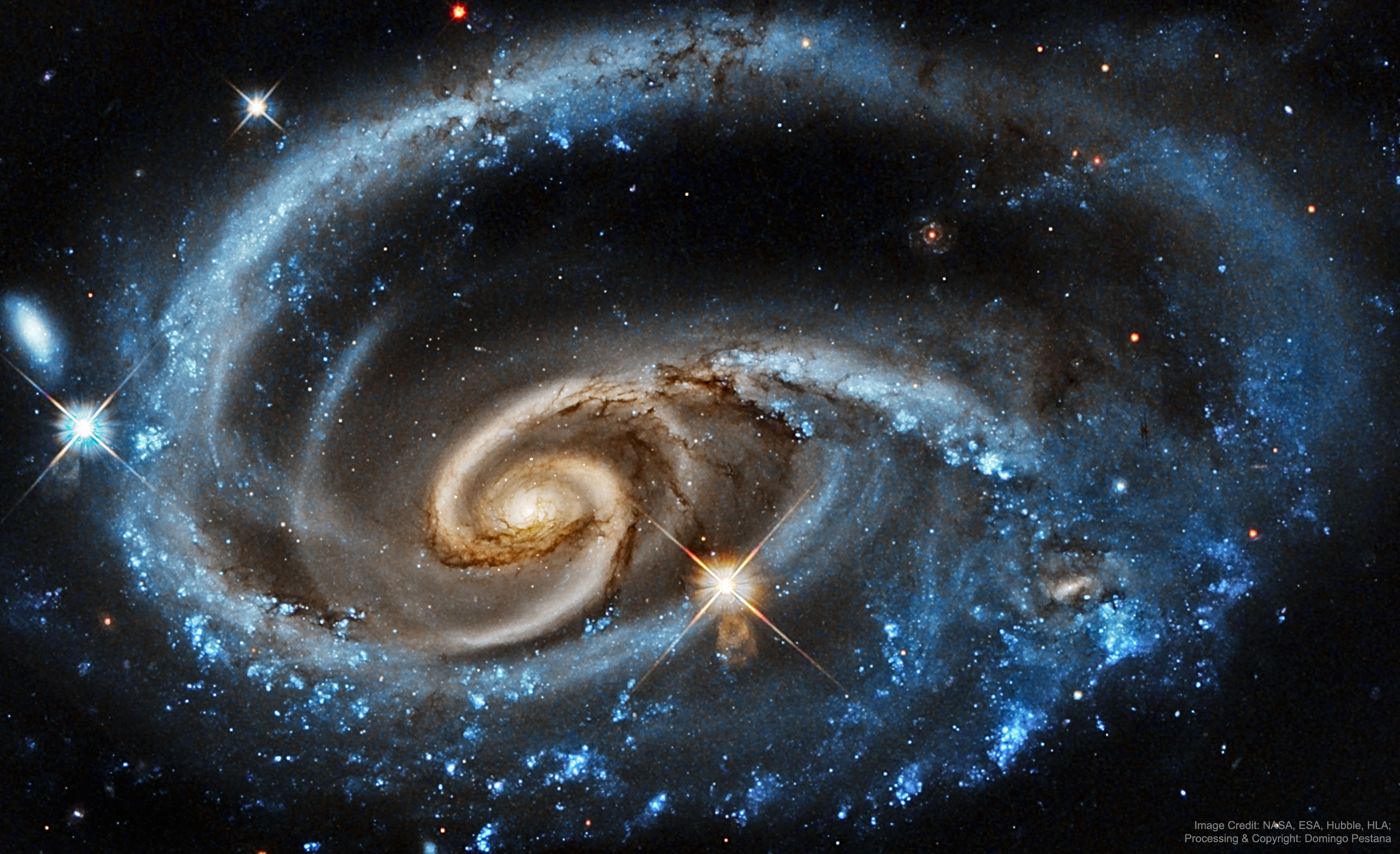
UGC 1810: Wildly Interacting Galaxy from Hubble 
Image Credit: NASAESAHubbleHLAProcessing & Copyright: Domingo Pestana
Explanation: What's happening to this spiral galaxy? Although details remain uncertain, it surely has to do with an ongoing battle with its smaller galactic neighbor. The featured galaxy is labelled UGC 1810 by itself, but together with itscollisional partner is known as Arp 273. The overall shape of the UGC 1810 -- in particular its blue outer ring -- is likely a result of wild and violent gravitational interactions. This ring's blue color is caused by massive stars that are blue hot and have formed only in the past few million years. The inner galaxy appears older, redder, and threaded with cool filamentary dust. A few bright stars appear well in the foreground, unrelated to UGC 1810, while several galaxies are visible well in the background. Arp 273 lies about 300 million light years away toward the constellation of Andromeda. Quite likely, UGC 1810 will devour its galactic sidekick over the next billion years and settle into a classic spiral form.

2017-05-09

Images - La Terre vue de l'Espace - Delta du Nil

PHOTOS. 6 mois dans l'espace avec l'astronaute Thomas Pesquet
Le delta du Nil immortalisé de nuit par Thomas Pesquet

Astronomy picture of the day - 2017 May 9 - Big Dipper Above and Below Chilean Volcanoes

See Explanation. Clicking on the picture will download
 the highest resolution version available.
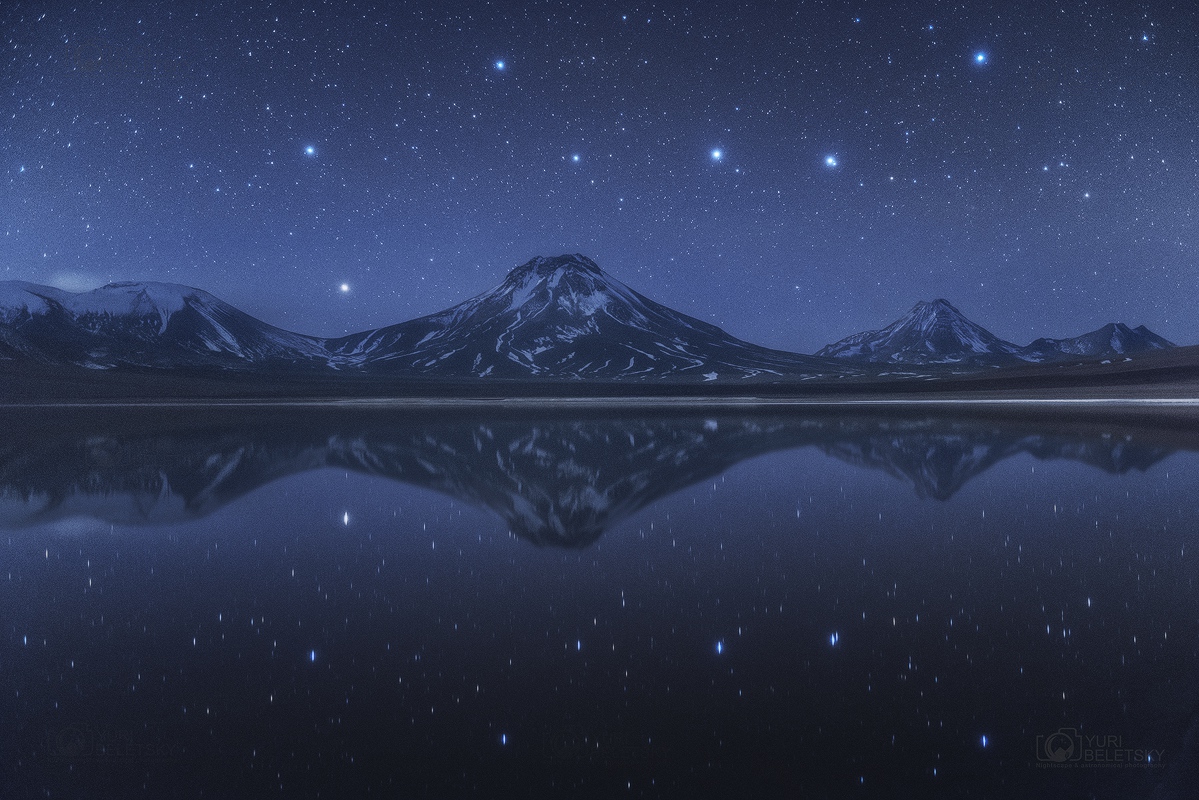
Big Dipper Above and Below Chilean Volcanoes 
Image Credit & Copyright: Yuri Beletsky (Carnegie Las Campanas ObservatoryTWAN)
Explanation: Do you see it? This common question frequently precedes the rediscovery of one of the most commonly recognized configurations of stars on the northern sky: the Big Dipper. This grouping of stars is one of the few things that has likely been seen, and will be seen, by every generation. The Big Dipper is not by itself a constellation. Although part of the constellation of the Great Bear (Ursa Major), the Big Dipper is an asterism that has been known by different names to different societies. Five of the Big Dipper stars are actually near each other in space and were likely formed at nearly the same time. Connecting two stars in the far part of the Big Dipper will lead one to Polaris, the North Star, which is part of the Little Dipper. Relative stellar motions will cause the Big Dipper to slowly change its configuration over the next 100,000 years. Pictured in late April, the Big Dipper was actually imaged twice -- aboveand below distant Chilean volcanoes, the later reflected from an unusually calm lagoon.

2017-05-08

Astronomy picture of the day - 2017 May 8 - Ancient Ogunquit Beach on Mars

See Explanation. Clicking on the picture will download
 the highest resolution version available.
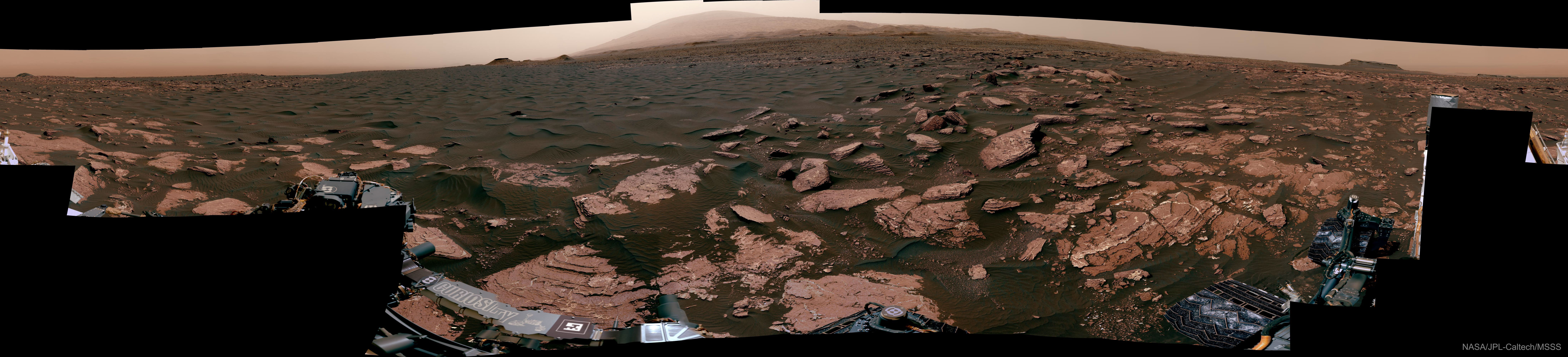
Ancient Ogunquit Beach on Mars 
Image Credit: NASAJPL-CaltechMSSS;
Explanation: This was once a beach -- on ancient Mars. The featured 360-degree panoramahorizontally compressed, was taken by the robotic Curiosity rover currently exploring the red planet. Named Ogunquit Beach after itsterrestrial counterpart, evidence shows that at times long ago the area was underwater, while at other times it was at the edge of an ancient lake. The light peak in the central background is the top of Mount Sharp, the central feature inGale Crater where Curiosity has been deployed. Curiosity is slowly ascending Mount Sharp. Portions of the dark sands in the foreground have been scooped up for analysis. The light colored bedrock is composed of sediment that likely settled at the bottom of the now-dried lakebed. The featured panorama (interactive version here) was created from over 100 images acquired in late March and seemingly signed by the rover on the lower left. Currently, Curiosity is carefully crossing deep megaripples of dark sands on its way to explore Vera Rubin Ridge.

Astronomy picture of the day - 2017 May 7 - Star Formation in the Tadpole Nebula

See Explanation. Clicking on the picture will download
 the highest resolution version available.
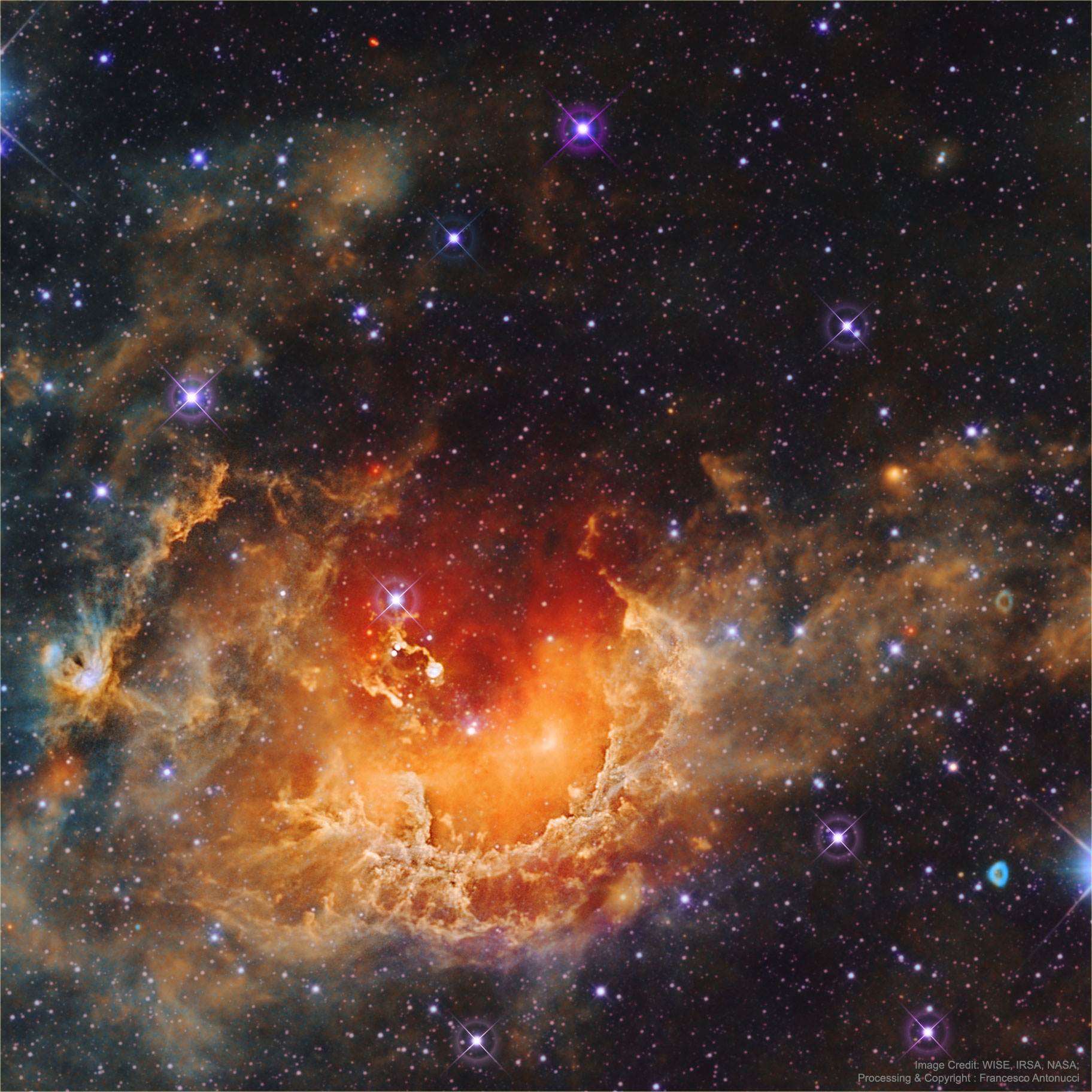
Star Formation in the Tadpole Nebula 
Image Credit: WISEIRSANASAProcessing & CopyrightFrancesco Antonucci
Explanation: What's all of the commotion in the Tadpole nebula? Star formation. Dusty emission in the Tadpole nebula, IC 410, lies about 12,000 light-years away in the northern constellation of the Charioteer (Auriga). The cloud of glowing gas is over 100 light-years across, sculpted by stellar winds and radiation from embedded open star cluster NGC 1893Formed in the interstellar cloud a mere 4 million years ago, bright newly formed cluster stars are seen all around the star-forming nebula. Notable near the image center are two relatively dense streamers of material trailing away from the nebula's central regions. Potentially sites of ongoing star formation in IC 410, these cosmic tadpoleshapes are about 10 light-years long. The featured image was taken in infrared light by NASA's Wide Field Infrared Survey Explorer (WISE) satellite.

2017-05-06

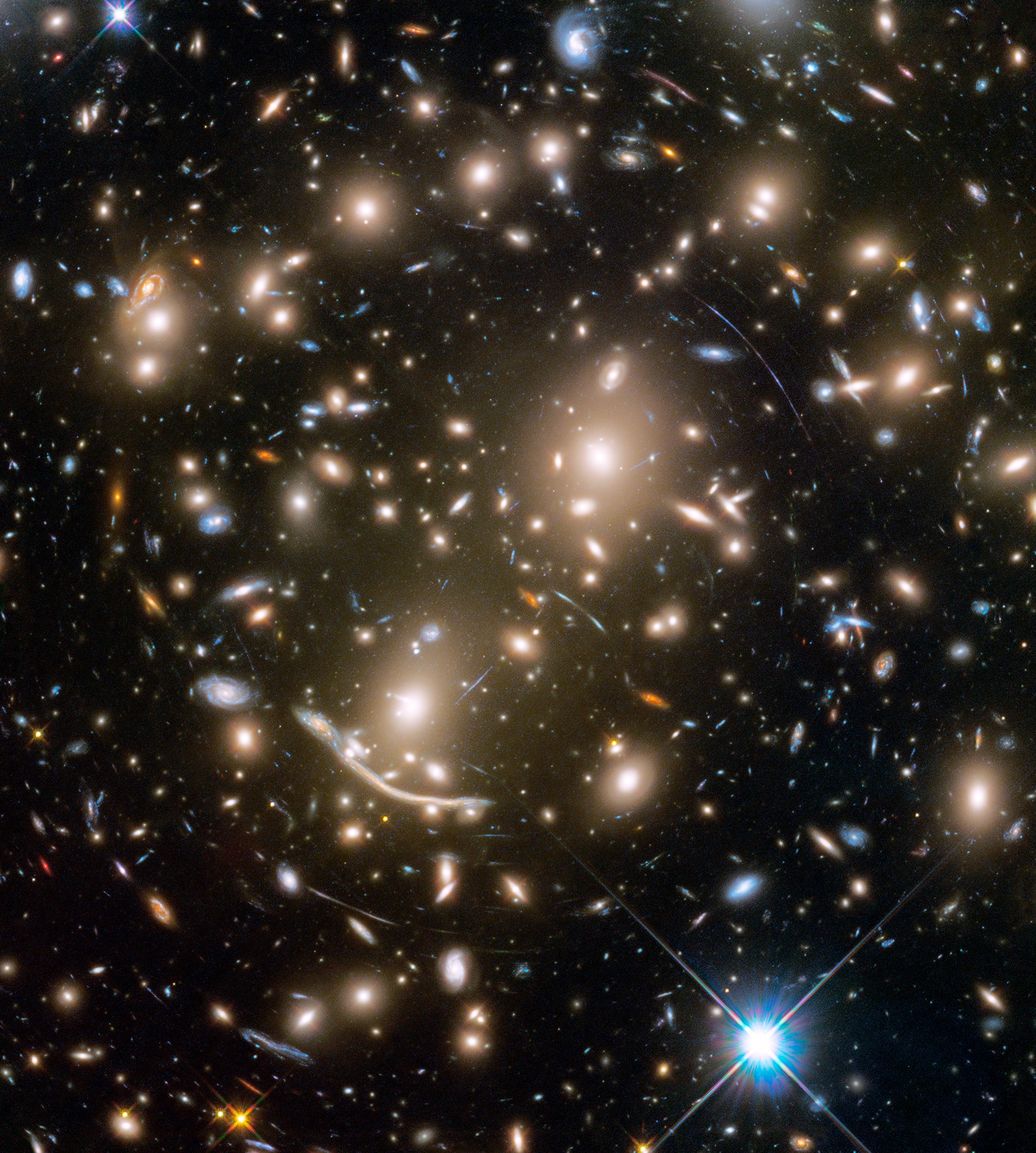
Astronomy picture of the day - 2017 May 6 - Galaxy Cluster Abell 370 and Beyond

See Explanation.  Clicking on the picture will download
 the highest resolution version available.
Galaxy Cluster Abell 370 and Beyond 
Image Credit: NASAESA, Jennifer Lotz and the HFF Team (STScI)

Explanation: Some 4 billion light-years away, massive galaxy cluster Abell 370 only appears to be dominated by two giant elliptical galaxies and infested with faint arcs in this sharp Hubble Space Telescope snapshot. The fainter, scattered bluish arcs along with the dramatic dragon arc below and left of center are images of galaxies that lie far beyond Abell 370. About twice as distant, their otherwise undetected light is magnified and distorted by the cluster's enormous gravitational mass, dominated by unseen dark matter. Providing a tantalizing glimpse of galaxies in the early universe, the effect is known as gravitational lensing. A consequence of warped spacetime it was first predicted by Einstein a century ago. Far beyond the spiky foreground Milky Way star at lower right, Abell 370 is seen toward the constellation Cetus, the Sea Monster. It is the last of six galaxy clusters imaged in the recently concluded Frontier Fields project.