LISBOA
2017-10-04

Astronomy picture of the day - 2017 October 4 - The Soul Nebula in Infrared from Herschel
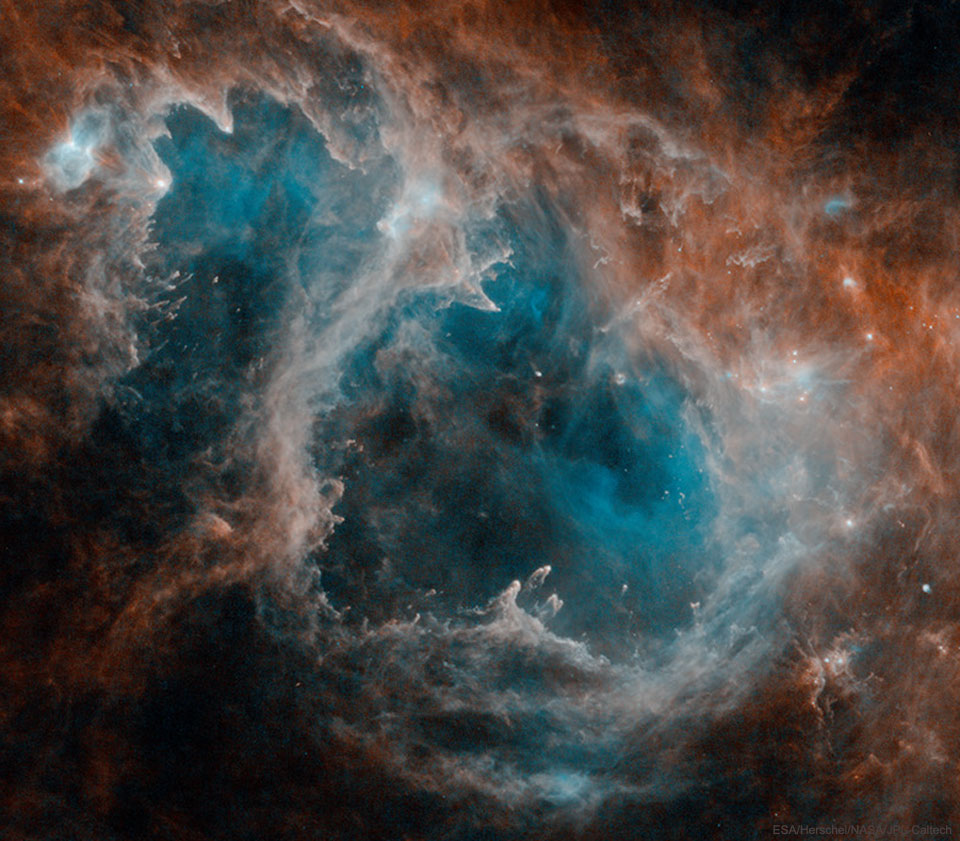
Image Credit & License: ESA, Herschel Space Obs., NASA, JPL-Caltech
Explanation: Stars are forming in the Soul of the Queen of Aethopia. More specifically, a large star forming region called the Soul Nebula can be found in the direction of the constellation Cassiopeia, who Greek mythology credits as the vain wife of a King who long ago ruled lands surrounding the upper Nile river. The Soul Nebula houses several open clusters of stars, a large radio source known as W5, and huge evacuated bubbles formed by the winds of young massive stars. Located about 6,500 light years away, the Soul Nebula spans about 100 light years and is usually imaged next to its celestial neighbor the Heart Nebula (IC 1805). The featured image, impressively detailed, was taken last month in several bands of infrared light by the orbiting Herschel Space Observatory.
2017-10-03
Astronomy picture of the day - 2017 October 3 - Ice Ring around Nearby Star Fomalhaut
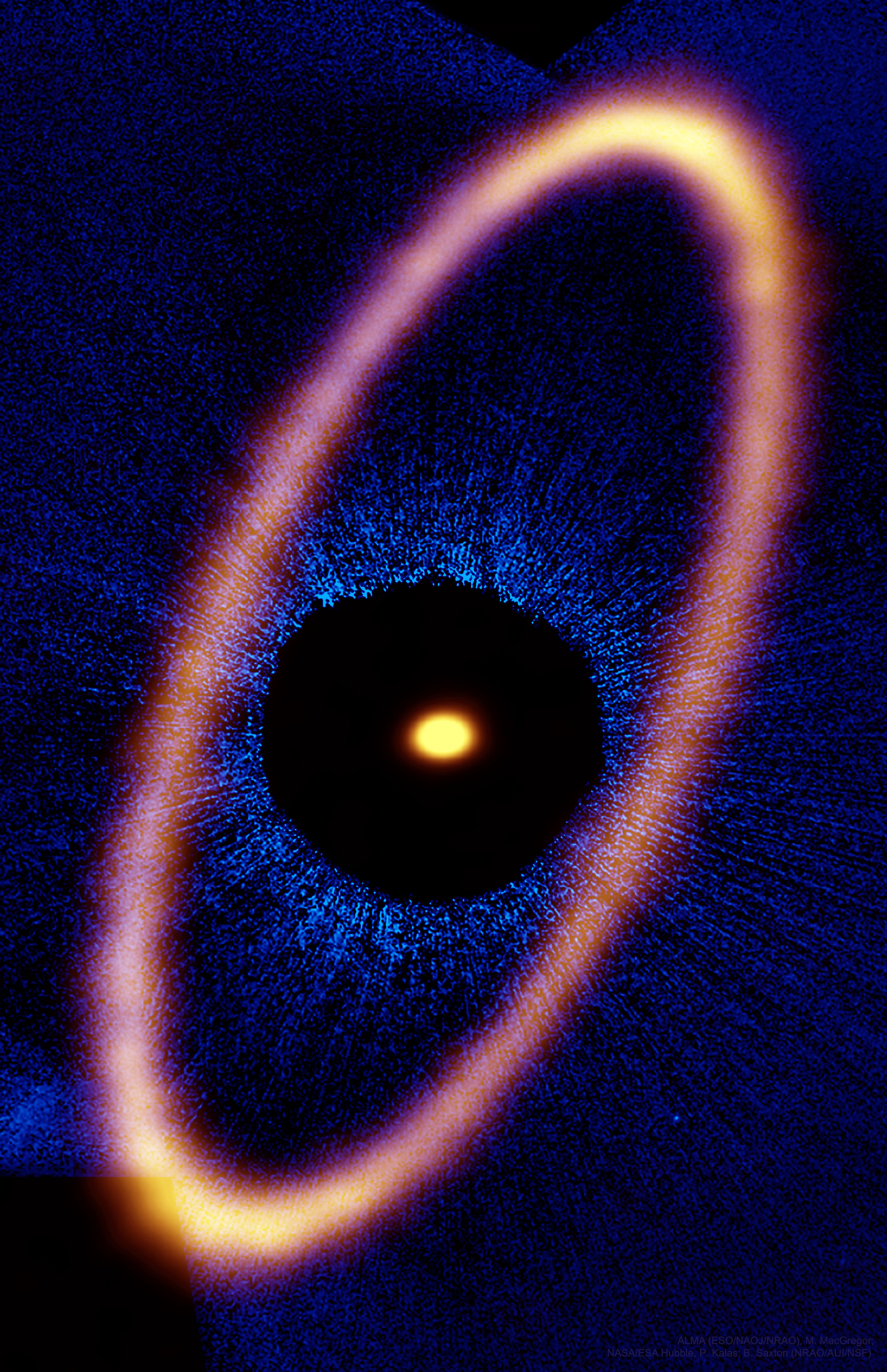
Image Credit: ALMA (ESO/NAOJ/NRAO), M. MacGregor; NASA/ESA Hubble, P. Kalas; B. Saxton (NRAO/AUI/NSF)
Explanation: Why is there a large ice ring around Fomalhaut? This interesting star -- easily visible in the night sky -- lies only about 25 light-years away and is known to be orbited by at least one planet, Dagon, as well as several inner dust disks. More intriguing, perhaps, is an outer ring, first discovered about 20 years ago, that has an unusually sharp inner boundary. The featured recent image by the Atacama Large Millimeter Array (ALMA) shows this outer ring with complete and unprecedented detail -- in pink -- superposed on a Hubble image of the Fomalhaut system in blue. A leading theory holds that this ring resulted from numerous violent collisions involving icy comets and planetesimals, the component objects of planets, while the ring boundaries are caused by the gravity of yet unseen planets. If correct, any interior planets in the Fomalhaut system are likely being continually pelted by large meteors and comets -- an onslaught last seen in our own planetary system four billion years ago in an episode called the Late Heavy Bombardment.
2017-10-02

Astronomy picture of the day - 2017 October 2 - Two Comets and a Star Cluster
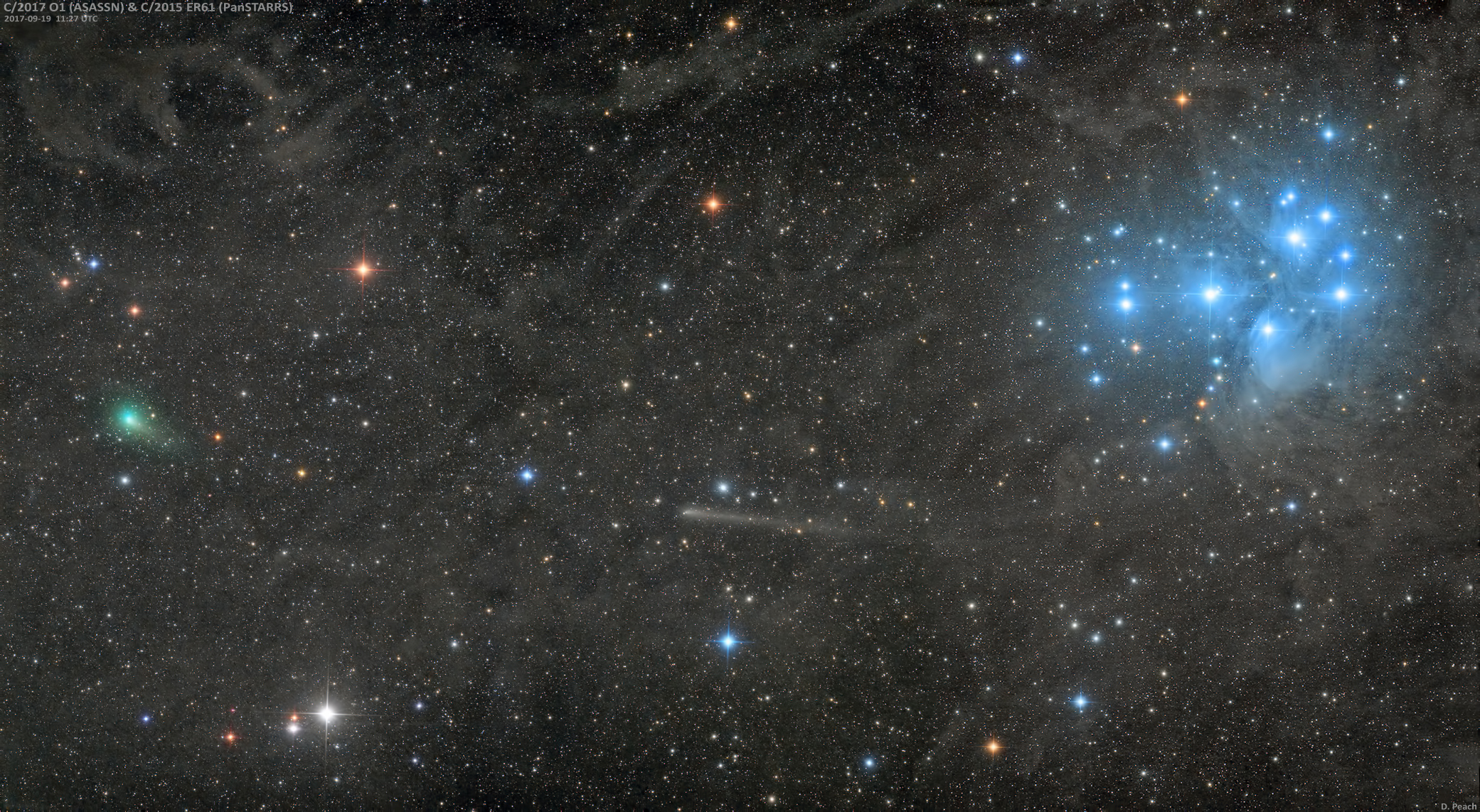
Image Credit & Copyright: Damian Peach
Explanation: Two unusual spots are on the move near the famous Pleiades star cluster. Shifting only a small amount per night, these spots are actually comets in our nearby Solar System that by chance wandered into the field of thelight-years distant stars. On the far left is comet C/2017 O1 ASAS-SN, a multi-kilometer block of evaporating ice sporting a bright coma of surrounding gas dominated by green-glowing carbon. Comet ASAS-SN1 shows a slight tail to its lower right. Near the frame center is comet C/2015 ER61 PanSTARRS, also a giant block of evaporating ice, but sporting a rather long tail to its right. On the upper right is the Pleiades, an open cluster dominated by bright blue stars illuminating nearby reflecting dust. This exposure, taken about two weeks ago, is so deep that the filamentary interstellar dust can be traced across the entire field. The Pleiades is visible to the unaided eye, but it should require binoculars to see the comets.

2017-10-01
Astronomy picture of the day - 2017 October 1 - Concept Plane: Supersonic Green Machine
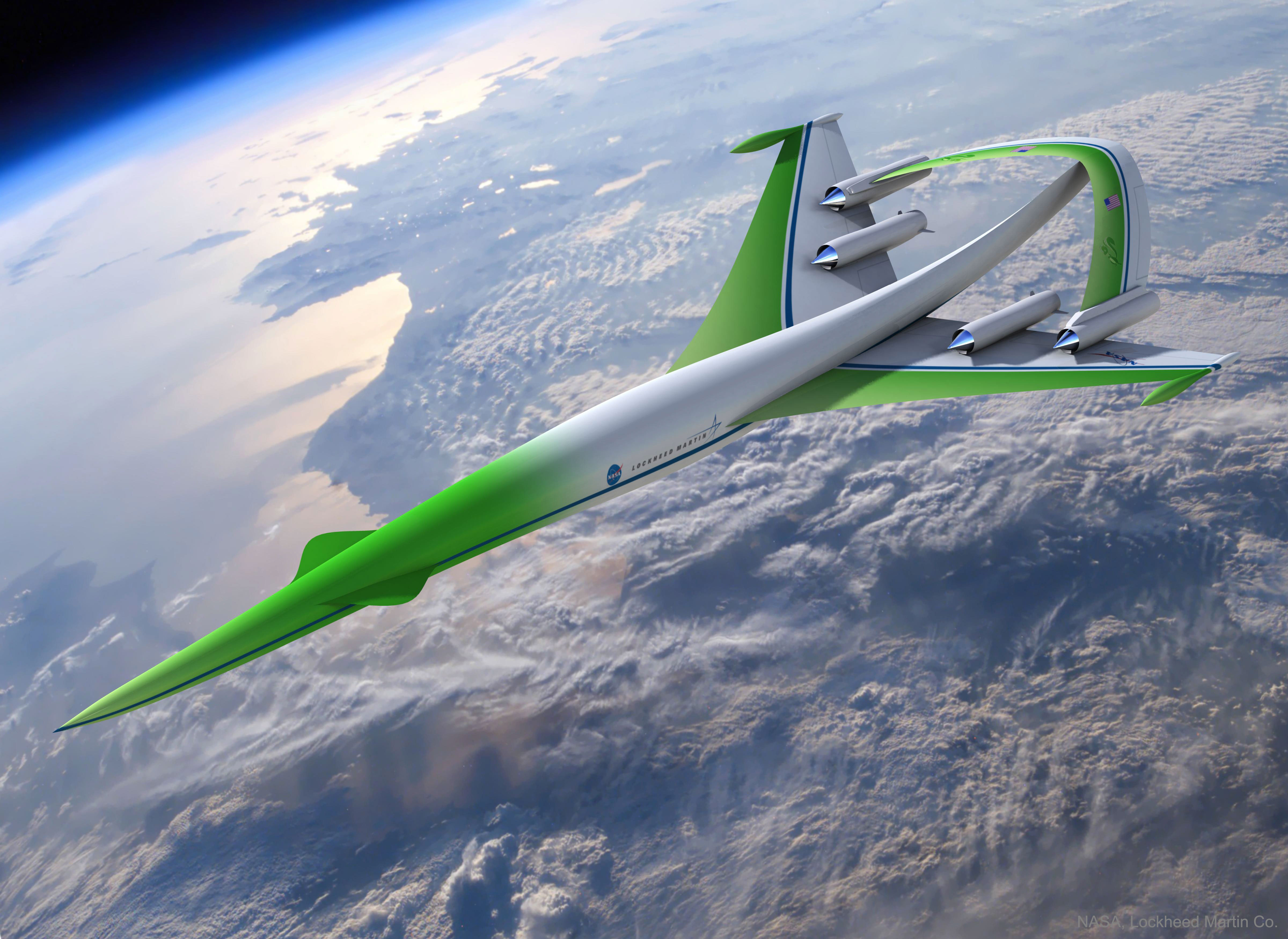
Illustration Credit: NASA, Lockheed Martin Co.
Explanation: What will passenger airplanes be like in the future? To help brainstorm desirable and workable attributes, NASA sponsors design competitions. Shown here is an artist's depiction of a concept plane that was suggested in 2010. This futuristic plane would be expected to achieve supersonic speeds, possibly surpassing the speeds of the supersonic transport planes that ran commercially in the late twentieth century. In terms of noise reduction, the future aircraft has been drawn featuring an inverted V wing stretched over its engines. The structure is intended to reduce the sound from annoying sonic booms. Additionally, future airplanes would aim to have relatively little impact on our environment, including green limits on pollution and fuel consumption. Aircraft utilizing similar design concepts might well become operational by the 2030s.

Estatisticas - Os Paises que mais seguiram este blogue desde o seu inicio
 USA - 157.125 Vizualizações
  FRANCE - 74.000 Vizualizações
 PORTUGAL - 40.740 Vizualizações
 BRASIL - 34.475 Vizualizações
 ALEMANHA - 19.346 Vizualizações
 RUSSIA - 13.489 Vizualizações
 ANDORRA - 8.006 Vizualizações
  CANADA - 3.941 Vizualizações
 REINO UNIDO - 3.529 Vizualizações
 CHINA - 2.371 Vizualizações
Inscription à :
Articles (Atom)