2017-11-14

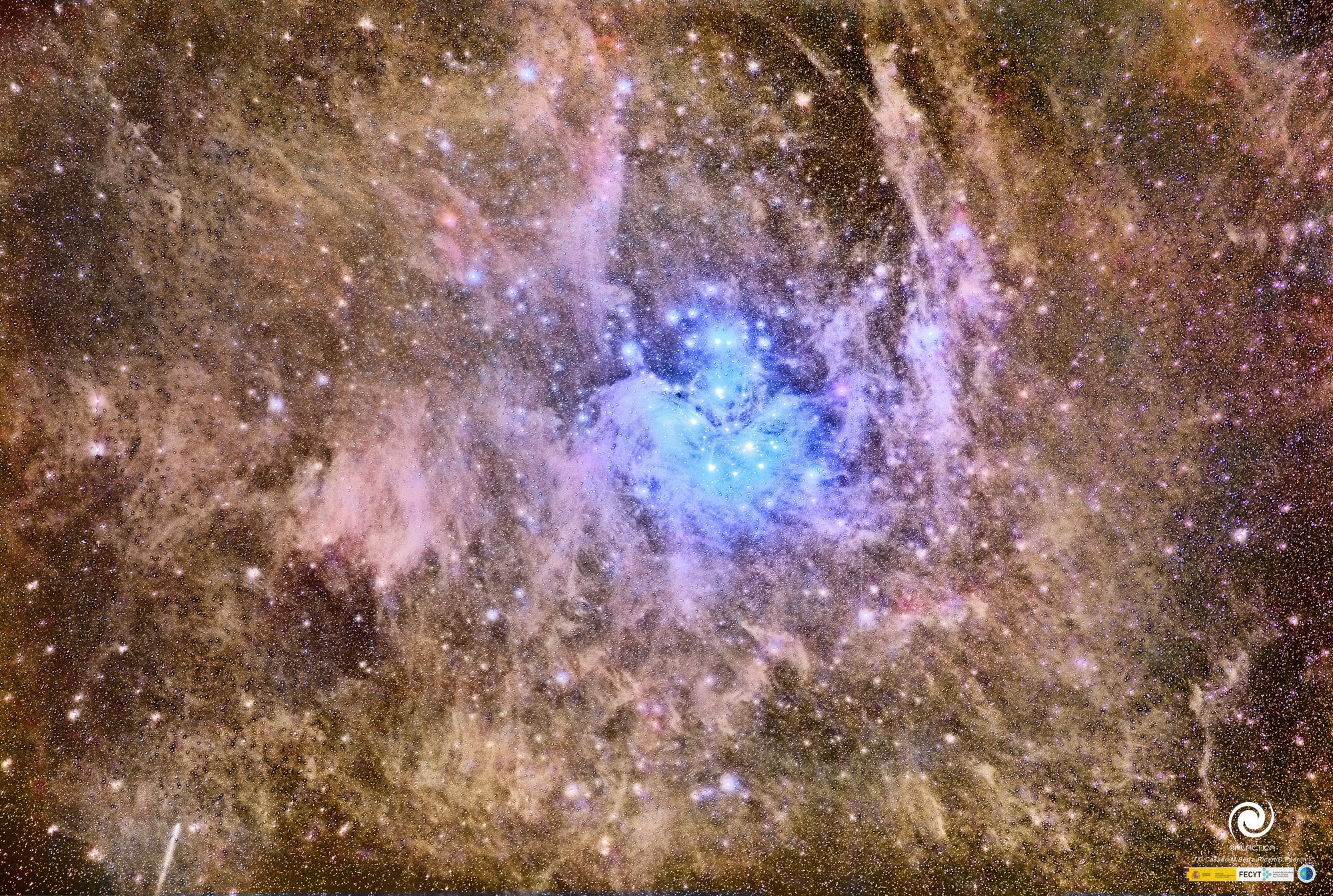
Astronomy pictures of the day - 2017 November 14 - The Pleiades Deep and Dusty

See Explanation.  Clicking on the picture will download
 the highest resolution version available.
The Pleiades Deep and Dusty 
Image Credit & Copyright: Juan Carlos Casado (TWANEarth & Stars), Miquel Serra-Ricart & Daniel Padron, FECYT
Explanation: The well-known Pleiades star cluster is slowly destroying part of a passing cloud of gas and dust. The Pleiades is the brightest open cluster of stars on Earth's sky and can be seen from almost any northerly location with the unaided eye. The passing young dust cloud is thought to be part of Gould's Belt, an unusual ring of young star formation surrounding the Sun in the local Milky Way Galaxy. Over the past 100,000 years, part of Gould's Belt is by chance moving right through the older Pleiades and is causing a strong reaction between stars and dust. Pressure from the stars' light significantly repels the dust in the surrounding blue reflection nebula, with smaller dust particles being repelled more strongly. A short-term result is that parts of the dust cloud have become filamentary and stratified. The featured deep image also captured Comet C/2015 ER61 (PanSTARRS) on the lower left.

2017-11-13

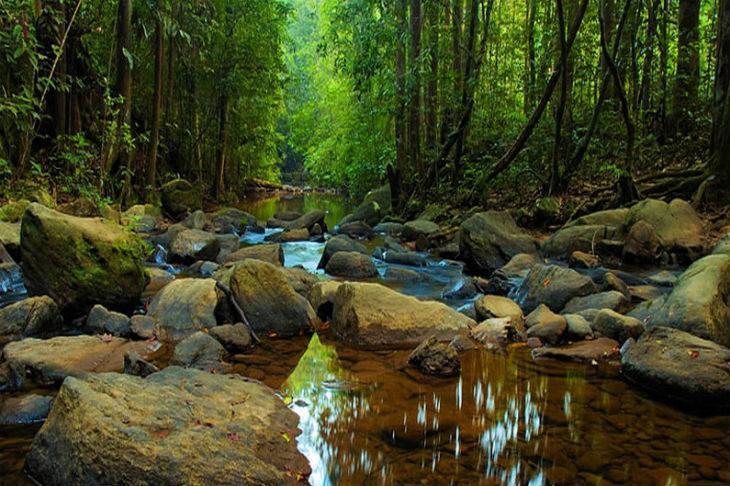
Florestas do Mundo - Reserva Florestal Sinharaja, Sri Lanka

A Sinharaja é uma das mais importantes florestas tropicais do Sri Lanka, que tem 88,64 km² e foi declarada pela UNESCO como uma reserva de biosfera em 1978. Ela conta com uma enorme quantidade de árvores endêmicas, é considerada o lar de animais como mamíferos, insetos raros, pássaros e borboletas e ainda abriga por lá outras espécies ameaçadas de extinção.

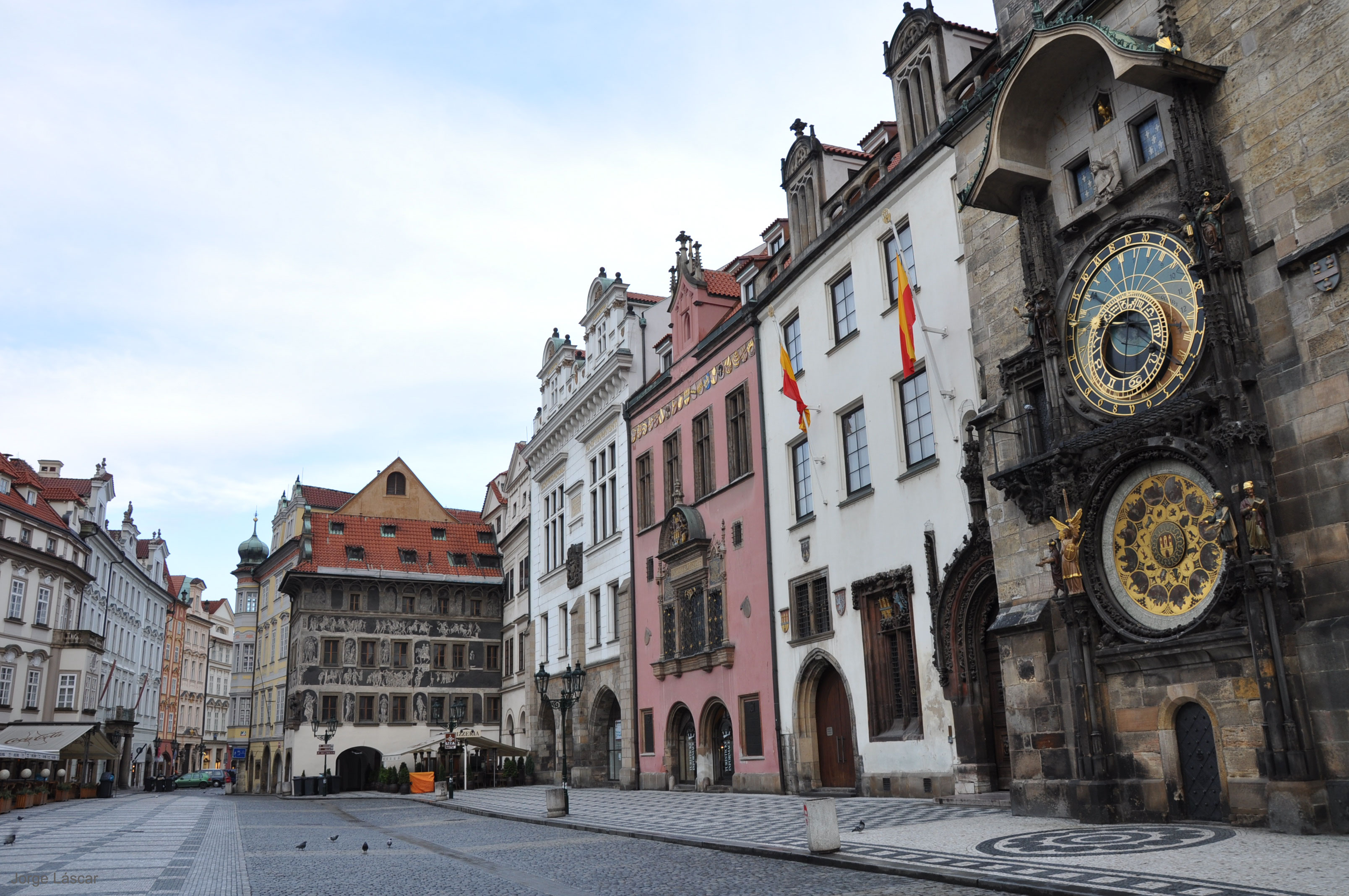
Astronomy picture of the day - 2017 November 13 - The Prague Astronomical Clock

See Explanation.  Clicking on the picture will download
 the highest resolution version available.
The Prague Astronomical Clock 
Image Credit & LicenseJorge Láscar
Explanation: In the center of Prague there's a clock the size of a building. During the day, crowds gather to watch the show when it chimes in a new hour. The Prague Astronomical Clock's face is impressively complex, giving not only the expected time with respect to the Sun (solar time), but the time relative to the stars (sidereal time), the times of sunrise and sunset at several latitudes including the equator, the phase of the Moon, and much more. The clock began operation in 1410, and even though much of its inner workings have been modernized several times, original parts remain. Below the clock is a nearly-equal sized solar calendar that rotates only once a year. Pictured, the Prague Astronomical Clock was photographed alone during an early morning in 2009 March. The Prague Astronomical Clock and the Old Town Tower behind it are currently being renovated once again, with the clock expected to be restarted in 2018 June.

2017-11-12

Imagenes del mundo - Surf en Nazaré, Portugal

El surfista francés Justine Dupont surfea una gran ola en Praia do Norte Nazare (Portugal).

OCTAVIO PASSOS GETTY IMAGES

Imagenes del mundo - Carrera de Océanos

El francés Charles Caudrelier, patrón de carrera del barco Dongfeng, mientras observa el océano Atlántico durante su participación en la segunda etapa de la Carrera de Océanos de Volvo de Lisboa (Portugal) a Ciudad del Cabo (Sudáfrica).

JEREMIE LECAUDEY EFE

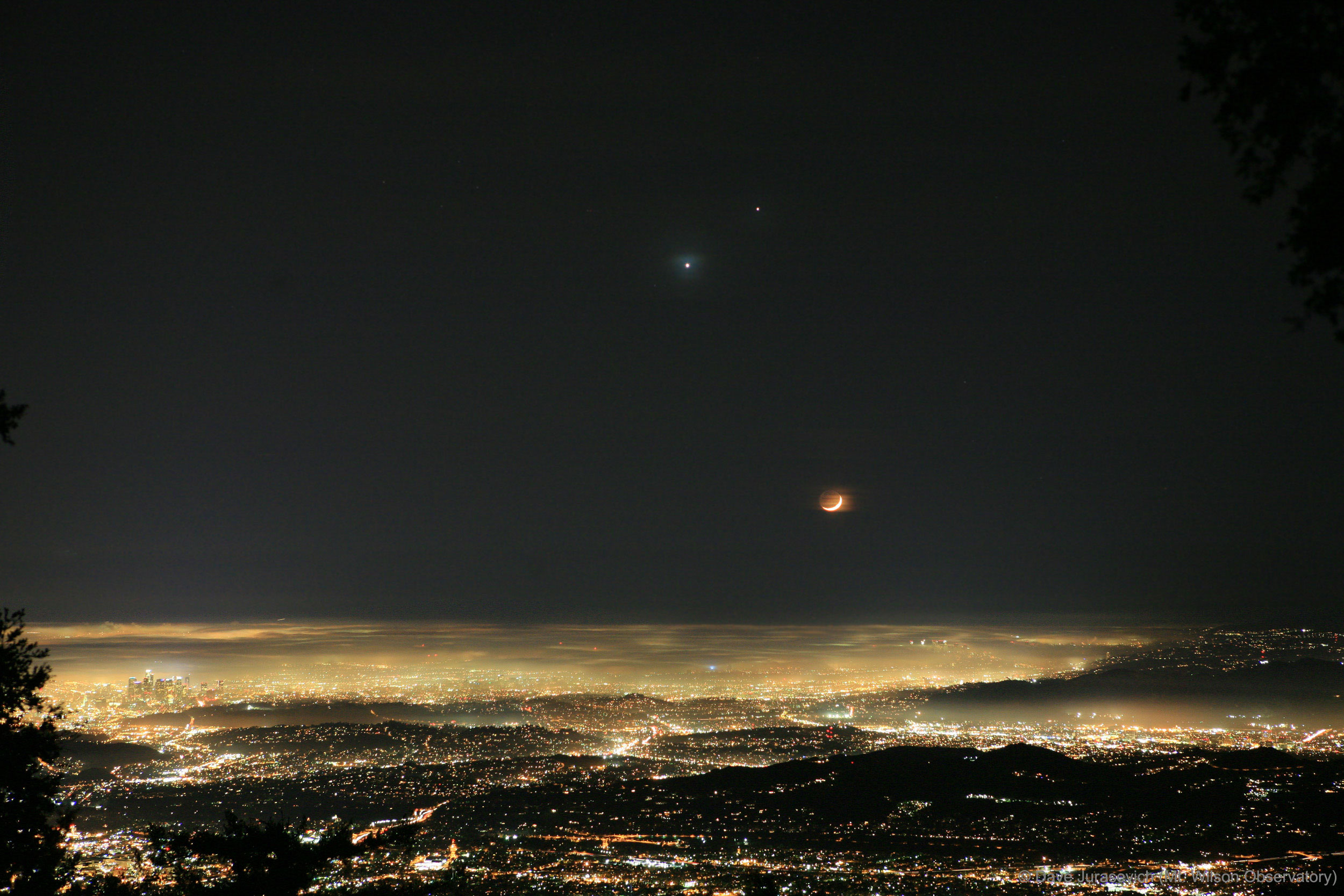
Astronomy picture of the day - 2017 November 12 - A Happy Sky over Los Angeles

See Explanation.  Clicking on the picture will download
 the highest resolution version available.
A Happy Sky over Los Angeles 
Image Credit & Copyright: Dave Jurasevich (Mt. Wilson Observatory)
Explanation: Sometimes, the sky may seem to smile over much of planet Earth. On this day in 2008, visible the world over, was an unusual superposition of our Moon and the planets Venus and Jupiter. Pictures taken at the right timeshow a crescent Moon that appears to be a smile when paired with the planetary conjunction of seemingly nearby Jupiter and Venus. Pictured here is the scene as it appeared from Mt. Wilson Observatory overlooking Los Angeles,CaliforniaUSA after sunset on 2008 November 30. Highest in the sky and farthest in the distance is the planet Jupiter. Significantly closer and visible to Jupiter's lower left is Venus, appearing through Earth's atmospheric clouds as unusually blue. On the far right, above the horizon, is our Moon, in a waxing crescent phase. Thin clouds illuminated by the Moon appear unusually orange. Sprawling across the bottom of the image are the hills of Los Angeles, many covered by a thin haze, while LA skyscrapers are visible on the far left. Hours after the taking of this image, the Moon approached the distant duo, briefly eclipsed Venus, and then moved on. This week, another conjunction of Venus and Jupiter is occurring and is visible to much of planet Earth to the east just before sunrise.

2017-11-11

Astronomy picture of the day - 2017 November 11 - A Colourful Moon

See Explanation.  Clicking on the picture will download
 the highest resolution version available.
A Colourful Moon 
Image Credit & CopyrightAlain Paillou
Explanation: The Moon is normally seen in subtle shades of grey. But small, measurable color differences have been greatly exaggerated in this mosaic of high-resolution images captured near the Moon's full phase, to construct a multicolored, central moonscape. The different colors are recognized to correspond to real differences in the mineral makeup of the lunar surface. Blue hues reveal titanium rich areas while more orange and purple colors show regions relatively poor in titanium and iron. The intriguing Sea of Vapors, or Mare Vaporum, is below center in the frame with the sweeping arc of the lunar Montes Apenninus (Apennine Mountains) above it. The dark floor of 83 kilometer diameter Archimedes crater within the Sea of Rains, or Mare Imbrium, is toward the top left. Near the gap at the top of the Apennine's arc is the Apollo 15 landing site. Calibrated by rock samples returned by the Apollo missions, similar multicolor images from spacecraft have been used to explore the Moon's global surface composition.

2017-11-10

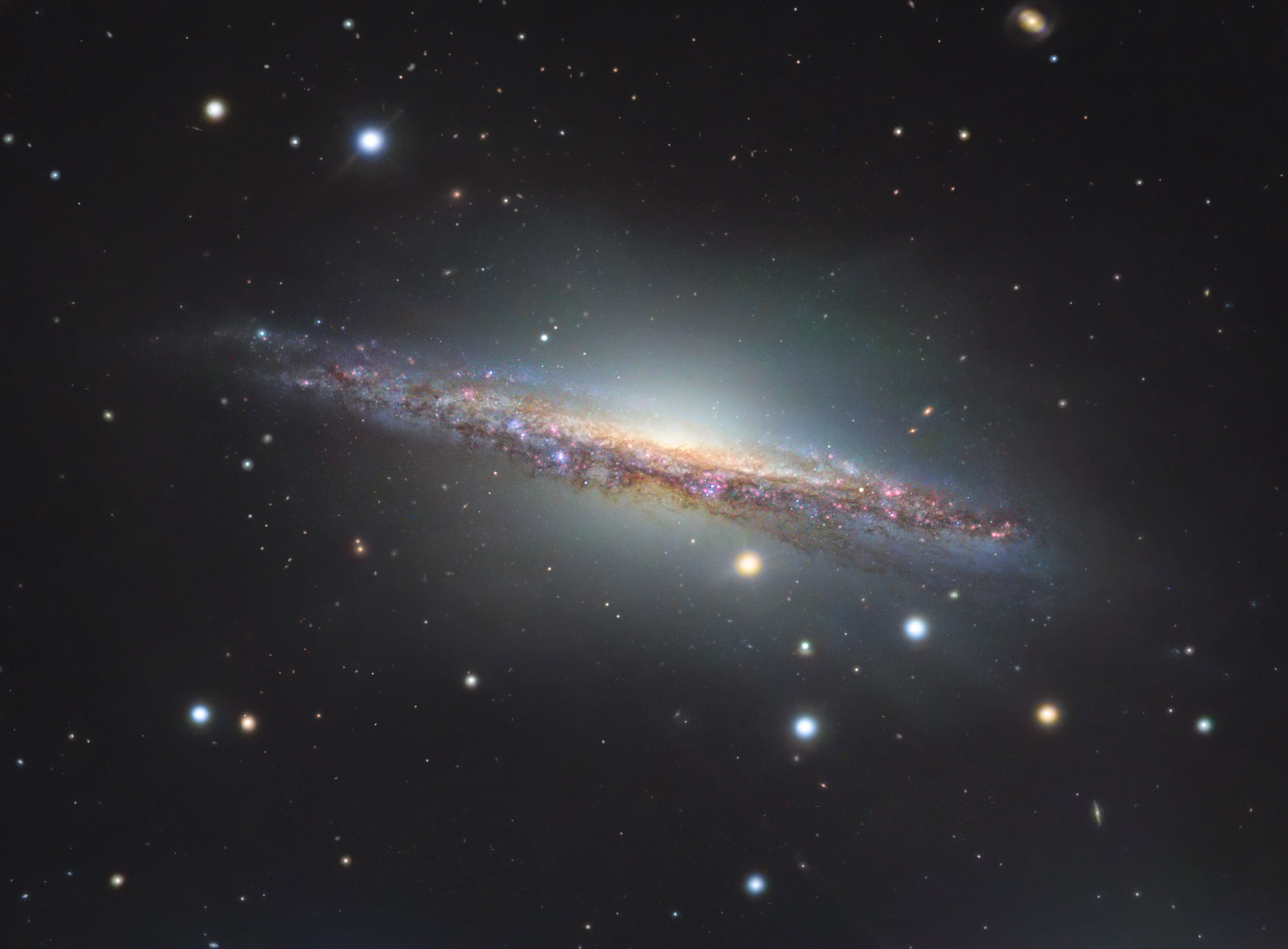
Astronomy picture of the day - 2017 November 10 - NGC 1055 Close-up

See Explanation.  Clicking on the picture will download
 the highest resolution version available.
NGC 1055 Close-up 
Image Credit & CopyrightProcessing - Robert GendlerRoberto Colombari
Data - European Southern ObservatorySubaru Telescope (NAOJ), et al.
Explanation: Big, beautiful spiral galaxy NGC 1055 is a dominant member of a small galaxy group a mere 60 million light-years away toward the aquatically intimidating constellation Cetus. Seen edge-on, the island universe spans over 100,000 light-years, a little larger than our own Milky Way. The colorful stars in this cosmic close-up of NGC 1055 are in the foreground, well within the Milky Way. But the telltale pinkish star forming regions are scattered through winding dust lanes along the distant galaxy's thin disk. With a smattering of even more distant background galaxies, the deep image also reveals a boxy halo that extends far above and below the central bluge and disk of NGC 1055. The halo itself is laced with faint, narrow structures, and could represent the mixed and spread out debris from a satellite galaxy disrupted by the larger spiral some 10 billion years ago.

2017-11-09

Bruce Spingsteen - "Streets of Philadelphia" - Video - Music

"Streets of Philadelphia"

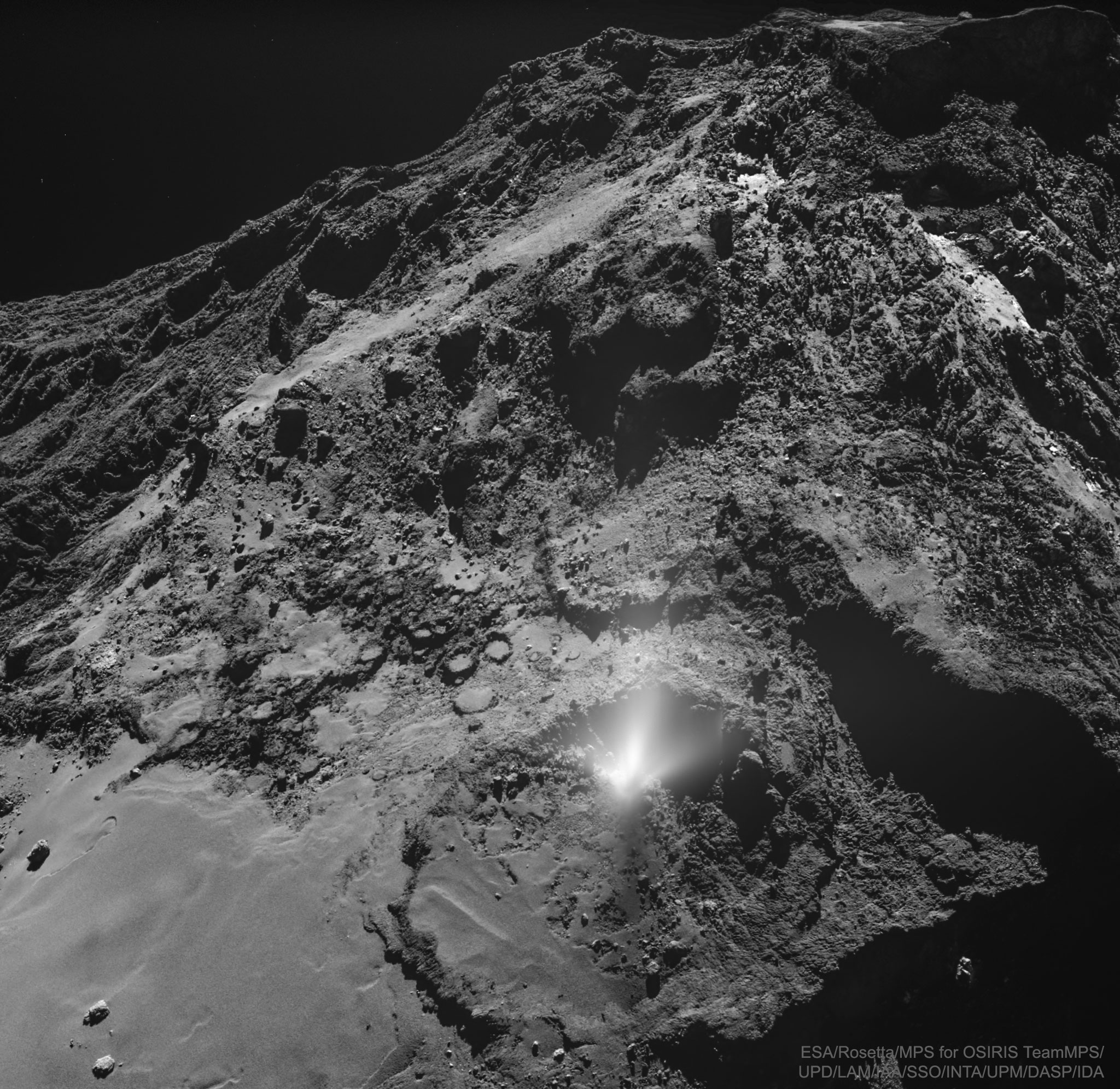
Astronomy picture of the day - 2017 November 9 - A Dust Jet from the Surface of Comet 67P

See Explanation.  Clicking on the picture will download
 the highest resolution version available.
A Dust Jet from the Surface of Comet 67P 
Image Credit & Copyright: ESARosettaMPS, OSIRIS; UPD/LAM/IAA/SSO/INTA/UPM/DASP/IDA
Explanation: Where do comet tails come from? There are no obvious places on the nuclei of comets from which the jets that create comet tails emanate. Last year, though, ESA's Rosetta spacecraft not only imaged a jet emergingfrom Comet 67P/Churyumov-Gerasimenko, but flew right through it. Featured is a telling picture showing a bright plume emerging from a small circular dip bounded on one side by a 10-meter high wall. Analyses of Rosetta data shows that the jet was composed of both dust and water-ice. The mundane terrain indicates that something likely happened far under the porous surface to create the plume. This image was taken last July, about two months before Rosetta's mission ended with a controlled impact onto Comet 67P's surface.