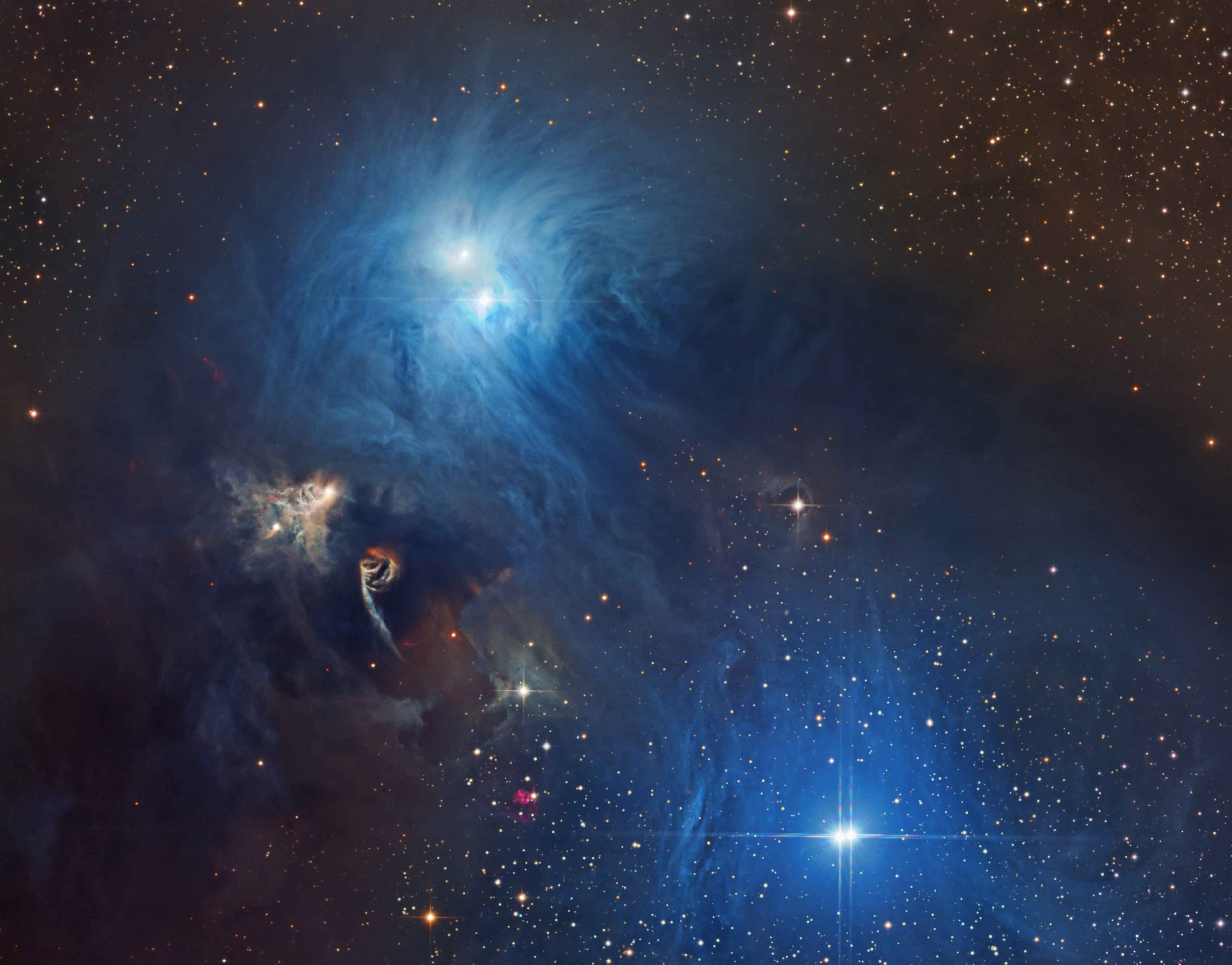
Explanation: Cosmic dust clouds and young, energetic stars inhabit this telescopic vista, less than 500 light-years away toward the northern boundary of Corona Australis, the Southern Crown. The dust clouds effectively block lightfrom more distant background stars in the Milky Way. But the striking complex of reflection nebulae cataloged as NGC 6726, 6727, and IC 4812 produce a characteristic blue color as light from the region's young hot stars is reflected by the cosmic dust. The dust also obscures from view stars still in the process of formation. At the left, smaller yellowish nebula NGC 6729 bends around young variable star R Coronae Australis. Just below it, glowing arcs and loops shocked by outflows from embedded newborn stars are identified as Herbig-Haro objects. On the sky this field of view spans about 1 degree. That corresponds to almost 9 light-years at the estimated distance of the nearby star forming region.
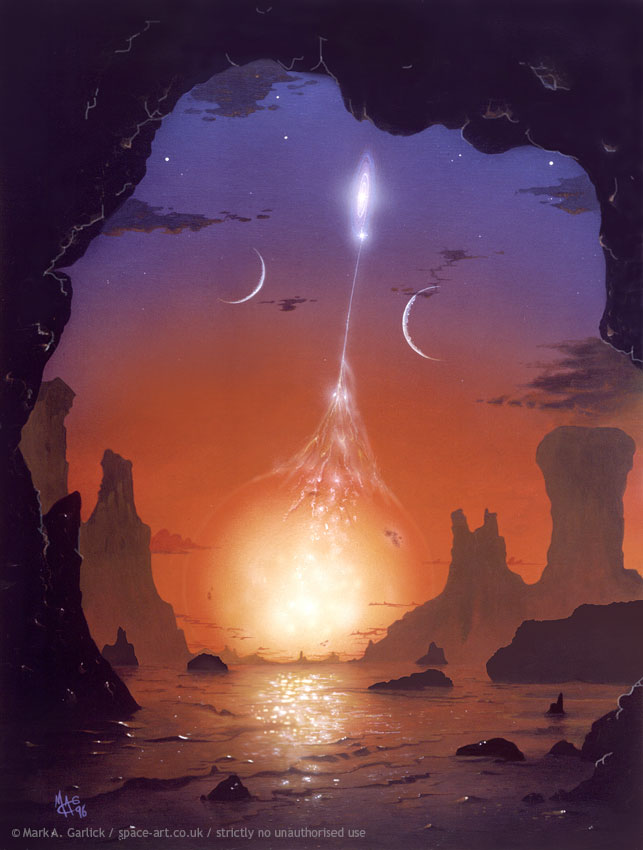
Explanation: Will this dawn bring another nova? Such dilemmas might be pondered one day by future humans living on a planet orbiting a cataclysmic variablebinary star system. Cataclysmic variables involve gas falling from a large star onto an accretion disk surrounding a massive but compact white dwarf star. Explosive cataclysmic events such as a dwarf nova can occur when a clump of gas in the interior of the accretion disk heats up past a certain temperature. At that point, the clump will fall more quickly onto the white dwarf and land with a bright flash. Such dwarf novas will not destroy either star, and may occur irregularly on time scales from a few days to tens of years. Although a nova is much less energetic than a supernova, if recurrent novas are not violent enough to expel more gas than is falling in, mass will accumulate onto the white dwarf star until it passes its Chandrasekhar limit. At that point, a foreground cavemay provide little protection, as the entire white dwarf star will explode in a tremendous supernova.
Dos continentes, 18 países y unos 47.000 kilómetros. La red de carreteras conocida como Panamericana se extiende desde el lejano norte de Alaska hasta Ushuaia, la ciudad más austral, en Argentina. En la imagen, el tramo que recorre el desierto de Nazca, en Perú.
Explanation: Seen from the Canary Island of Fuerteventura, this bright Full Moon rose at sunset. Reaching its full phase on the night of January 4/5, it was the first Full Moon of the new year and the first to follow December's solstice. Of course, in North America the first Full Moon of January has been known as the Wolf's Moon. But this Full Moon, posed in the twilight above an island of strong winds and traditional windmills, suggests another name. The telephoto image, taken at a distance from the foreground windmill, creates the dramatic comparison in apparent size for windmill and Full Moon.
Stéphane Charbonnier dit Charb est né le 21 août 1967 en France à Conflans-Sainte-Honorine. Il apprend à dessiner pendant les cours de maths et bon an, mal an finit par être un peu moins nul en dessin qu'en maths. Il publie ses premiers dessins dans le journal du collège à Pontoise où il signe encore de son vrai nom, Charbonnier. Sa signature prend souvent plus de place que le dessin qui l'accompagne, au lieu d'agrandir le dessin, il finit par rétrécir son nom. Il dessine ensuite pour les Nouvelles du Val-d'Oise, l'hebdomadaire local, tout en préparant un bac qu'il aura du mal à avoir du deuxième coup. Il entame un BTS de pub qui, pense-t-il, lui permettra d'apprendre à dessiner tout en lui garantissant un boulot à la sortie. Il arrête tout au bout de trois mois réalisant que le monde de la pub ne correspond pas à la caricature qu'on en fait : la réalité est bien pire. Il dessine alors pour les programmes des salles de cinéma Utopia. La charge de travail n'étant pas suffisante pour justifier un salaire de TUC (travail d'utilité collective), il nettoie aussi les chiottes puis devient surveillant dans un collège d'Argenteuil. Dans le même temps, il place quelques dessins à droite et à gauche (surtout à gauche en fait) et se défoule dans le fanzine Canicule. En 1991, il collabore régulièrement à La Grosse Bertha qu'il quittera en juillet 1992 avec le gros de l'équipe pour participer au relancement de Charlie Hebdo dans lequel il publie encore aujourd'hui l'essentiel de ses dessins et de ses textes. On a pu voir ou apercevoir aussi, au cours des vingt dernières années, ses dessins avec une fréquence variable dans le Monde Libertaire, Télérama, Mon Quotidien, l'Humanité, l'Hebdo, le monde des ados, Fluide Glacial, l'Écho des Savanes, Libération, les Cahiers pédagogiques, la Nouvelle Vie Ouvrière, Rouge, Zoo, Canal+...
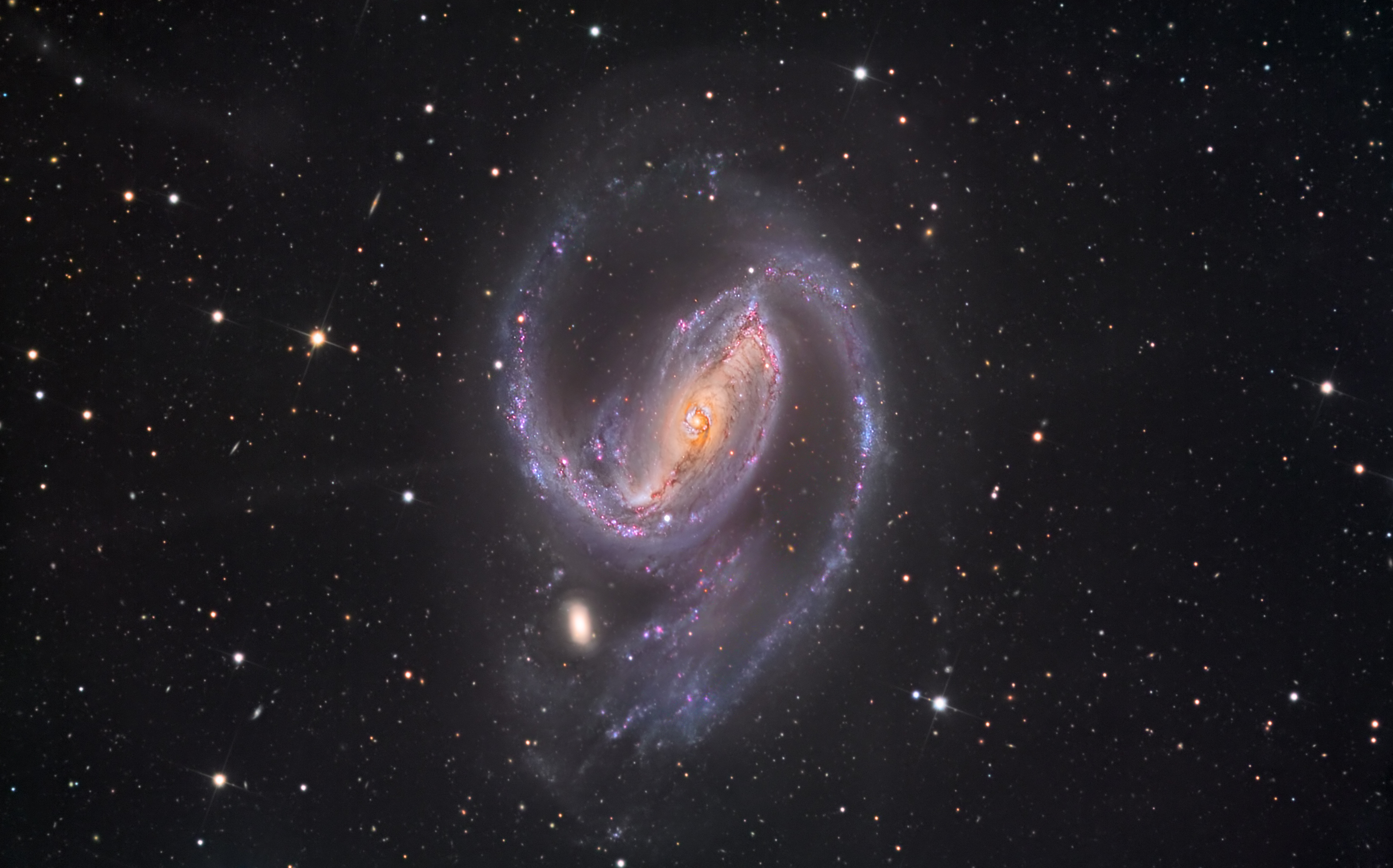
In the Arms of NGC 1097 Image Credit & Copyright: Steve Mazlin, Jack Harvey, Jose Joaquin Perez; SSRO-South, at PROMPT/CTIO
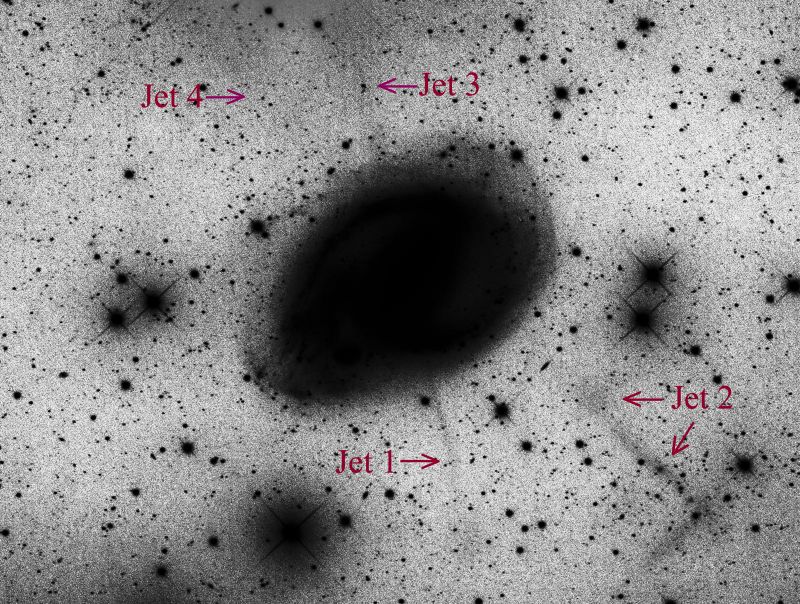
Explanation: Spiral galaxy NGC 1097 shines in southern skies, about 45 million light-years away in the chemical constellation Fornax. Its blue spiral arms are mottled with pinkish star forming regions in this colorful galaxy portrait. They seem to have wrapped around a small companion galaxy below and left of center, about 40,000 light-years from the spiral's luminous core. That's not NGC 1097's only peculiar feature, though. The very deep exposure hints of faint, mysterious jets, most easily seen to extend well beyond the bluish arms toward the left. In fact, four faint jets are ultimately recognized in optical images of NGC 1097. The jets trace an X centered on the galaxy's nucleus, but probably don't originate there. Instead, they could be fossil star streams, trails left over from the capture and disruption of a much smaller galaxy in the large spiral's ancient past. A Seyfert galaxy, NGC 1097's nucleus also harbors asupermassive black hole.
Le 2 janvier, le festival touristique de la neige de Changchun a été inauguré. Le « monde des sculptures de neige », situé au sein du parc national forestier de Jingyuetan, occupe une superficie de 40 000m² et a demandé 100 000 m³ de neige pour sa construction.
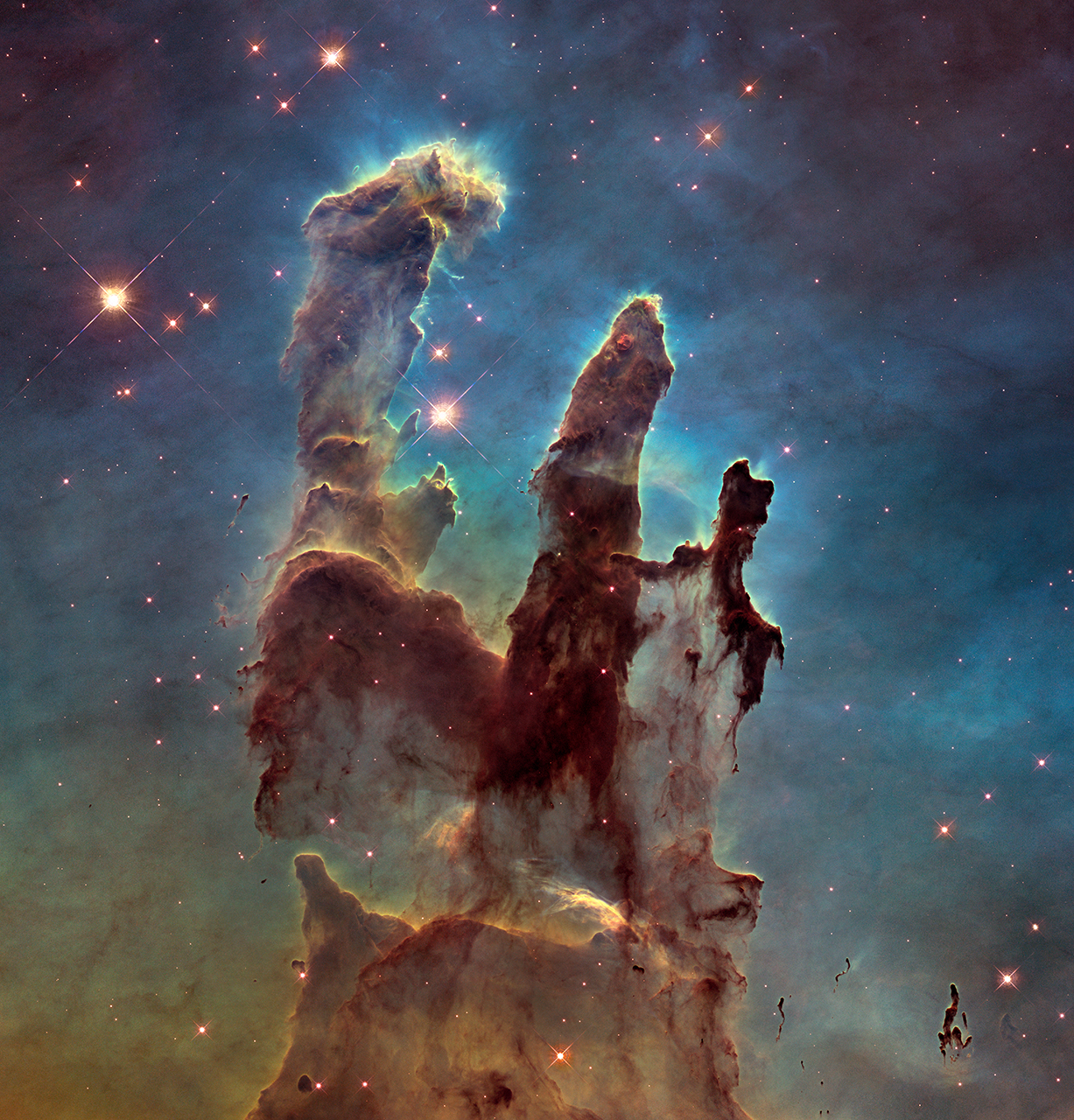
Explanation: To celebrate 25 years (1990-2015) of exploring the Universe from low Earth orbit, the Hubble Space Telescope's cameras were used to revisit its most iconic image. The result is this sharper, wider view of the region dubbed the Pillars of Creation, first imaged by Hubble in 1995. Stars are forming deep inside the towering structures. The light-years long columns of cold gas and dust are some 6,500 light-years distant in M16, the Eagle Nebula, toward the constellation Serpens. Sculpted and eroded by the energetic ultraviolet light and powerful winds from M16's cluster of young, massive stars, the cosmic pillars themselves are destined for destruction. But the turbulent environment of star formation within M16, whose spectacular details are captured in this Hubble visible-light snapshot, is likely similar to the environment that formed our own Sun.