2015-08-20
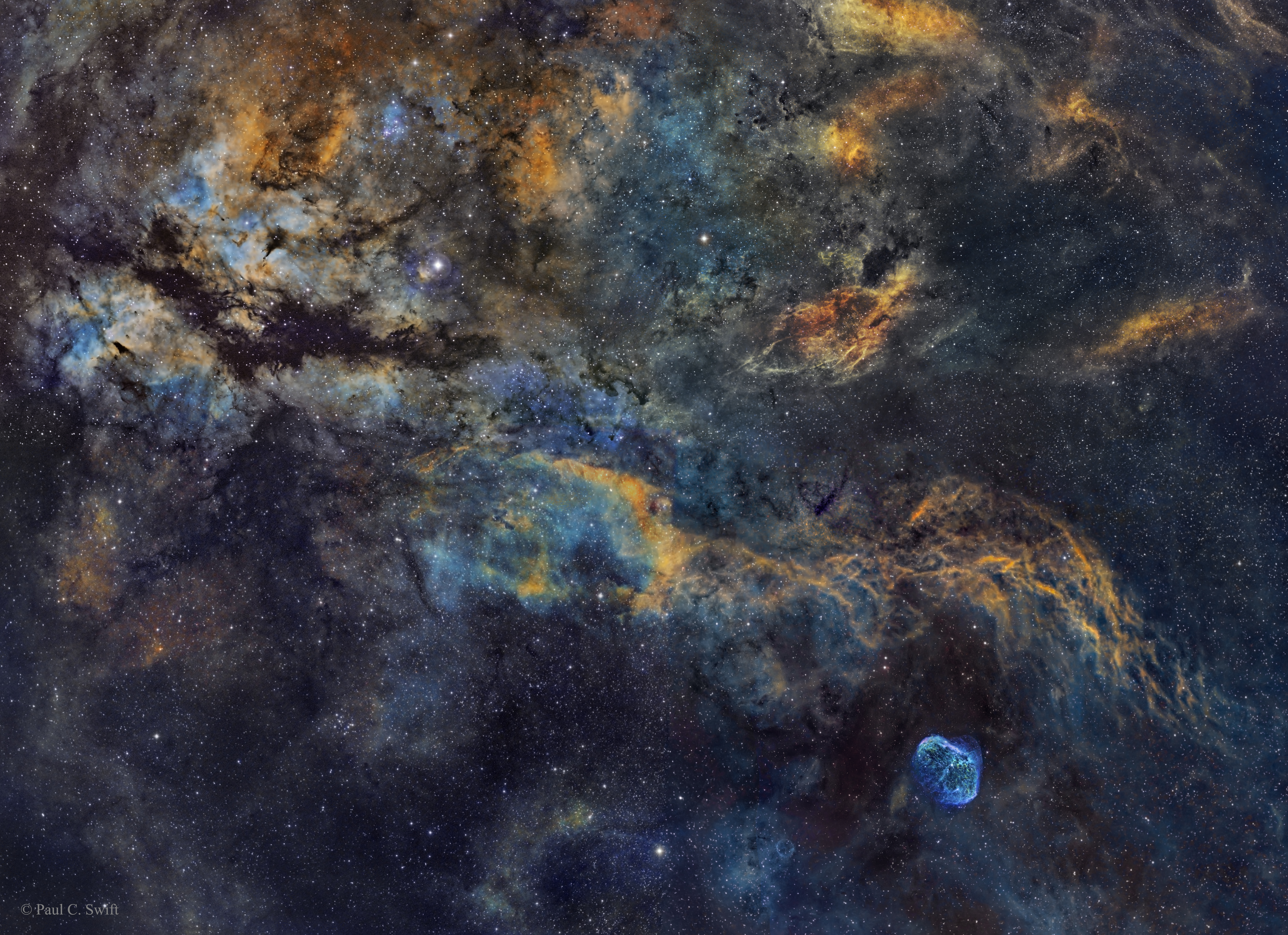
Astronomy picture of the day - 2015 August 19 - Central Cygnus Skyscape
Image Credit & Copyright: Paul C. Swift
Explanation: In cosmic brush strokes of glowing hydrogen gas, this beautiful skyscape unfolds across the plane of our Milky Way Galaxy and the center of the northern constellation Cygnus the Swan. The featured image spans about six degrees. Bright supergiant star Gamma Cygni (Sadr) to the upper left of the image center lies in the foreground of the complex gas and dust clouds and crowded star fields. Left of Gamma Cygni, shaped like two luminous wings divided by a long dark dust lane is IC 1318, whose popular name is understandably the Butterfly Nebula. The more compact, bright nebula at the lower right is NGC 6888, the Crescent Nebula. Some distance estimates for Gamma Cygni place it at around 1,800 light-years while estimates for IC 1318 and NGC 6888 range from 2,000 to 5,000 light-years.
2015-08-18
Imagenes del Mundo - Un hombre en la Plaza Roja - Moscu
Un hombre se refleja en un charco mientras camina por la Plaza Roja de Moscú (Rusia).
KIRILL KUDRYAVTSEV (AFP)
25 miradouros em Lisboa - Santo Estêvão
Still undiscovered by many locals and guidebooks, this viewpoint is found next to St. Stephen’s Church. It’s a quiet spot for a break after a stroll through the narrow streets of Alfama.
Ainda desconhecido de muitos lisboetas e dos guias turísticos, este miradouro fica junto à Igreja de Santo Estêvão. É um local tranquilo, para uma pausa depois de um passeio pelas ruelas de Alfama.
Astronomy picture of the day - 2015 August 18 - M1: The Crab Nebula from Hubble
Image Credit: NASA, ESA, J. Hester, A. Loll (ASU)
Explanation: This is the mess that is left when a star explodes. The Crab Nebula, the result of a supernova seen in 1054 AD, is filled with mysterious filaments. The filaments are not only tremendously complex, but appear to have less mass than expelled in the original supernova and a higher speed than expected from a free explosion. The featured image, taken by the Hubble Space Telescope, is presented in three colors chosen for scientific interest. The Crab Nebula spans about 10 light-years. In the nebula's very center lies a pulsar: a neutron star as massive as the Sun but with only the size of a small town. The Crab Pulsar rotates about 30 times each second.
Astronomy picture of the day - 2015 August 17 - Andromeda Rising over the Alps
Image Credit & Copyright: Matteo Dunchi
Explanation: Have you ever seen the Andromeda galaxy? Although M31 appears as a faint and fuzzy blob to the unaided eye, the light you see will be over two million years old, making it likely the oldest light you ever will see directly. Now rising near a few hours after sunset from mid-latitude northern locations, Andromeda is rising earlier each night and will be visible to northerners all night long starting in September. The featured image capturedAndromeda rising above the Italian Alps last month. As cool as it may be to see this neighboring galaxy to our Milky Way with your own eyes, long duration camera exposures can pick up many faint and breathtaking details. Recent data indicates that our Milky Way Galaxy will collide and coalesce with the slightly larger Andromeda galaxy in a few billion years.
2015-08-15
Lugares mas radioativos del mundo - Chernobyl
Chernobyl
El sitio radiactivo más conocido del mundo. El 26 de marzo de 1986, uno de los reactores de la planta nuclear de la ciudad, explotó, creando el peor desastre industrial y medioambiental de la historia de la humanidad, que, actualmente prevalece.
25 miradouros em Lisboa - Miradouro do Torel
This hilltop terrace overlooking downtown towards the triumphal arch of Rua Augusta is also a garden created in the 1960s, and remains one of the city’s top secrets.
Este miradouro no topo de uma colina com vista para a Baixa e para o Arco da Rua Augusta, é também um jardim criado nos anos 60 e ainda um dos grandes segredos da cidade.
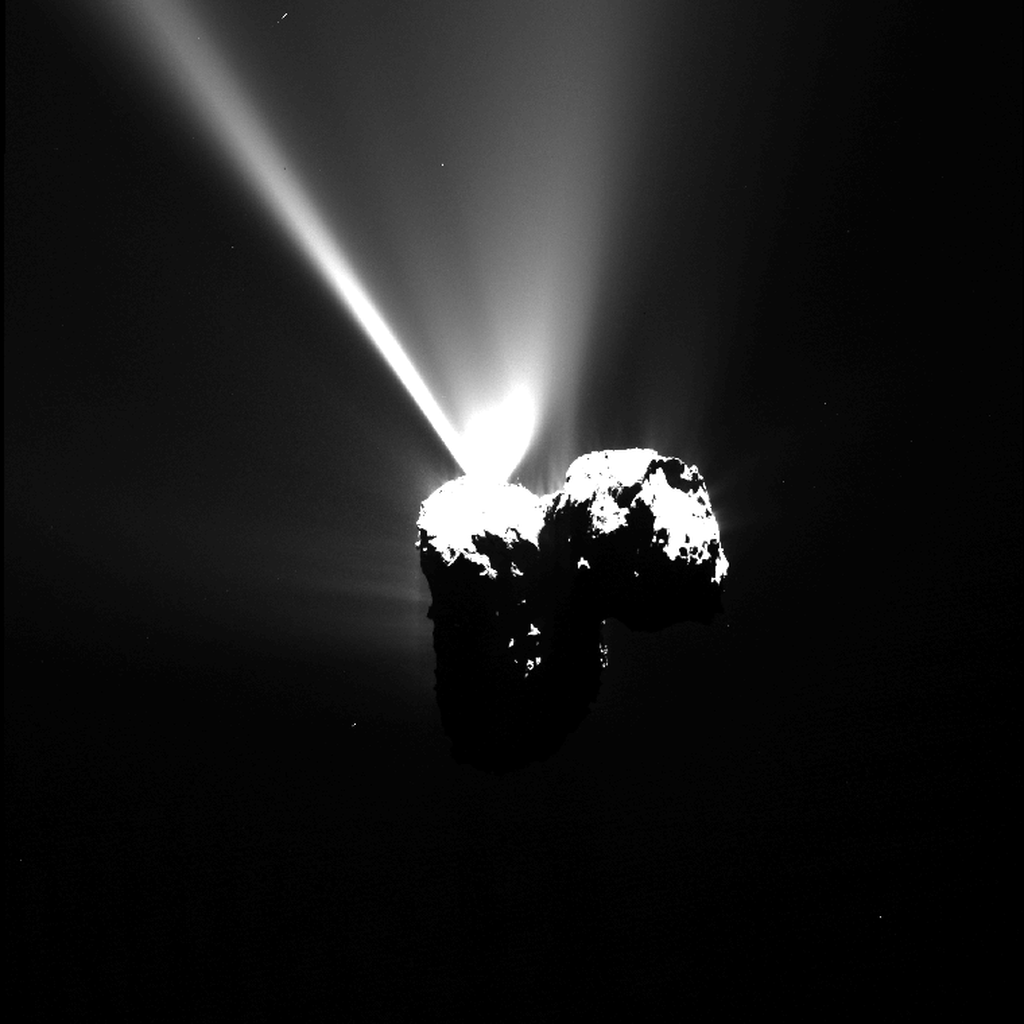
Astronomy picture of the day - 2015 August 15 - Perihelion Approaches
Image Credit: ESA / Rosetta / MPS for OSIRIS Team; MPS/UPD/LAM/IAA/SSO/INTA/UPM/DASP/IDA
Explanation: This dramatic outburst from the nucleus of Comet 67P/Churyumov-Gerasimenko occured on August 12, just hours before perihelion, its closest approach to the Sun. Completing an orbit of the Sun once every 6.45 years, perihelion distance for this periodic comet is about 1.3 astronomical units (AU), still outside the orbit of planet Earth (at 1 AU). The stark image of the 4 kilometer wide, double-lobed nucleus in bright sunlight and dark shadows was taken by the Rosetta spacecraft's science camera about 325 kilometers away. Too close to see the comet's growing tail, Rosetta maintains its ringside seat to watch the nucleus warm and become more active in coming weeks, as primordial ices sublimating from the surface produce jets of gas and dust. Of course, dust from the nucleus of periodic comet Swift-Tuttle, whose last perihelion passage was in 1992 at a distance of 0.96 AU, fell to Earth just this week.
Assim escreveu o "Portugal Glorioso": Salgado transferiu 1.800 milhões para familiares
A notícia é "falsa" e visa "atentar contra a imagem e bom-nome", diz Salgado.

Jornal Sol noticia que Salgado transferiu fortuna para familiares.
Antigo banqueiro desmente.
Os bens, no valor de 1.800 milhões de euros, foram passados para a mulher e três filhos antes da derrocada do grupo, escreve o semanário Sol esta sexta-feira, 14 de Agosto. Ricardo Salgado já reagiu à notícia, garantindo que é "falsa" e que visa "atentar contra a imagem e bom-nome" do antigo líder do BES.
Blogue Portugal Glorioso
Inscription à :
Commentaires (Atom)