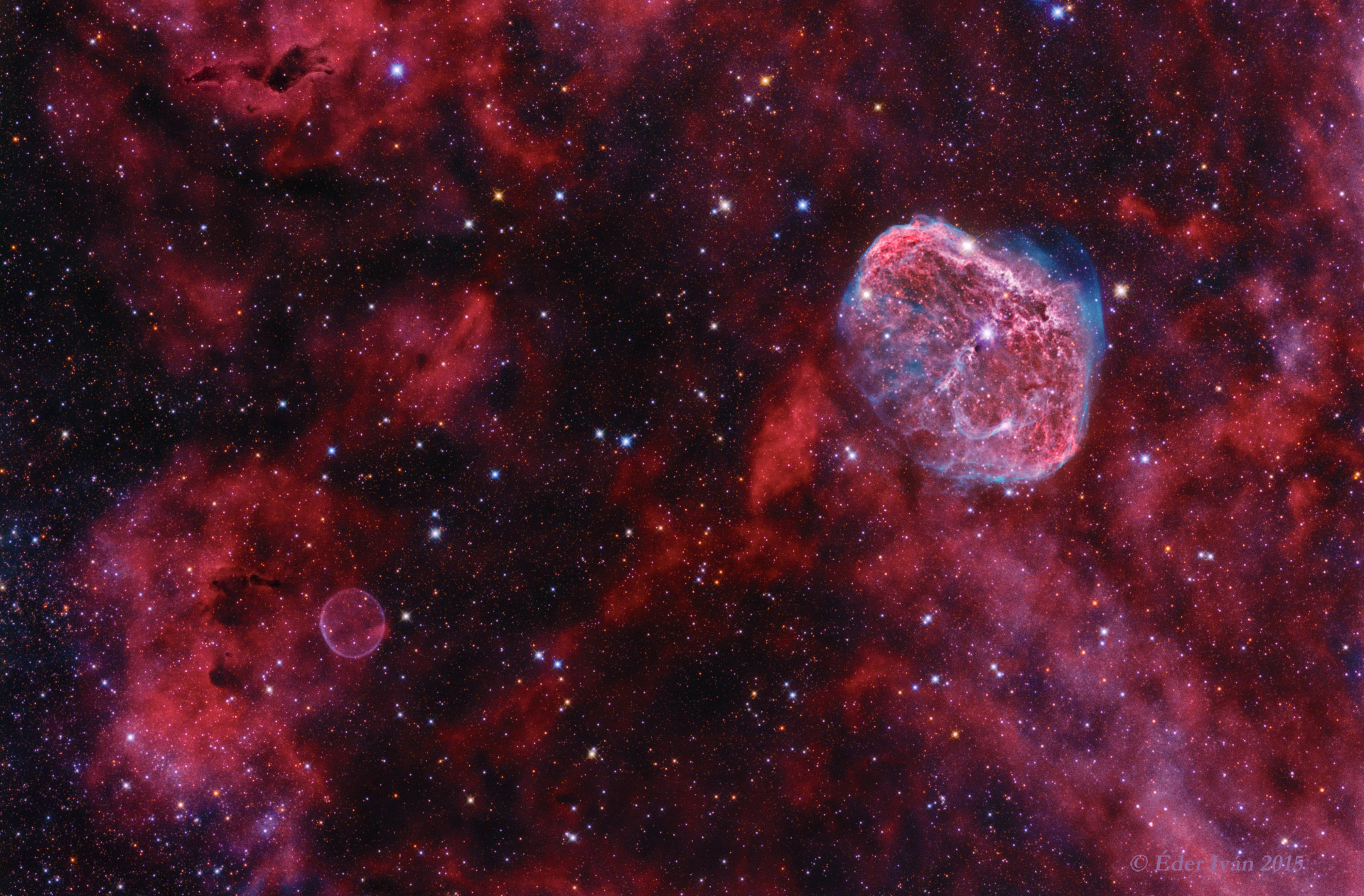
Explanation: These clouds of gas and dust drift through rich star fields along the plane of our Milky Way Galaxy toward the high flying constellation Cygnus. Caught within the telescopic field of view are the Soap Bubble (lower left) and the Crescent Nebula (upper right). Both were formed at a final phase in the life of a star. Also known as NGC 6888, the Crescent was shaped as its bright, central massive Wolf-Rayet star, WR 136, shed its outer envelope in a strong stellar wind. Burning through fuel at a prodigious rate, WR 136 is near the end of a short life that should finish in a spectacular supernova explosion. recently discovered Soap Bubble Nebula is likely a planetary nebula, the final shroud of a lower mass, long-lived, sun-like star destined to become a slowly cooling white dwarf. While both are some 5,000 light-years or so distant, the larger Crescent Nebula is around 25 light-years across.
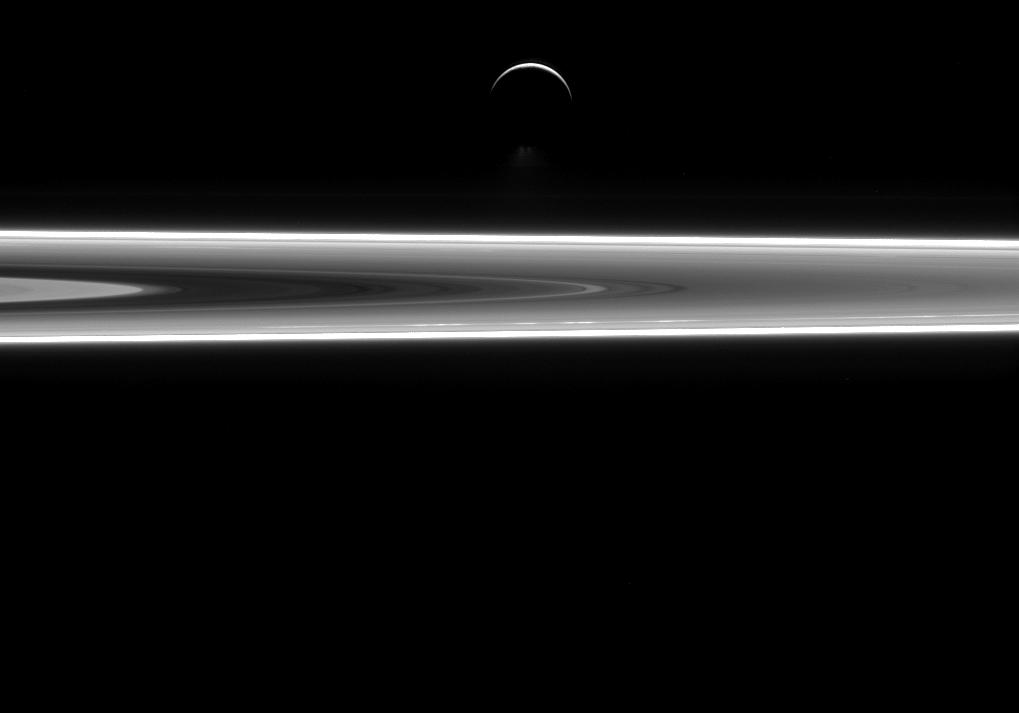
Explanation: Saturn's icy moon Enceladus poses above the gas giant's icy rings in this Cassini spacecraft image. The dramatic scene was captured on July 29, while Cassini cruised just below the ring plane, its cameras looking back in a nearly sunward direction about 1 million kilometers from the moon's bright crescent. At 500 kilometers in diameter, Enceladus is a surprisingly active moon though, its remarkable south polar geysers are visible venting beyond a dark southern limb. In fact, data collected during Cassini's flybys and years of images have recently revealed the presence of a global ocean of liquid water beneath this moon's icy crust. Demonstrating the tantalizing liquid layer's global extent, the careful analysis indicates surface and core are not rigidly connected, with Enceladus rocking slightly back and forth in its orbit.