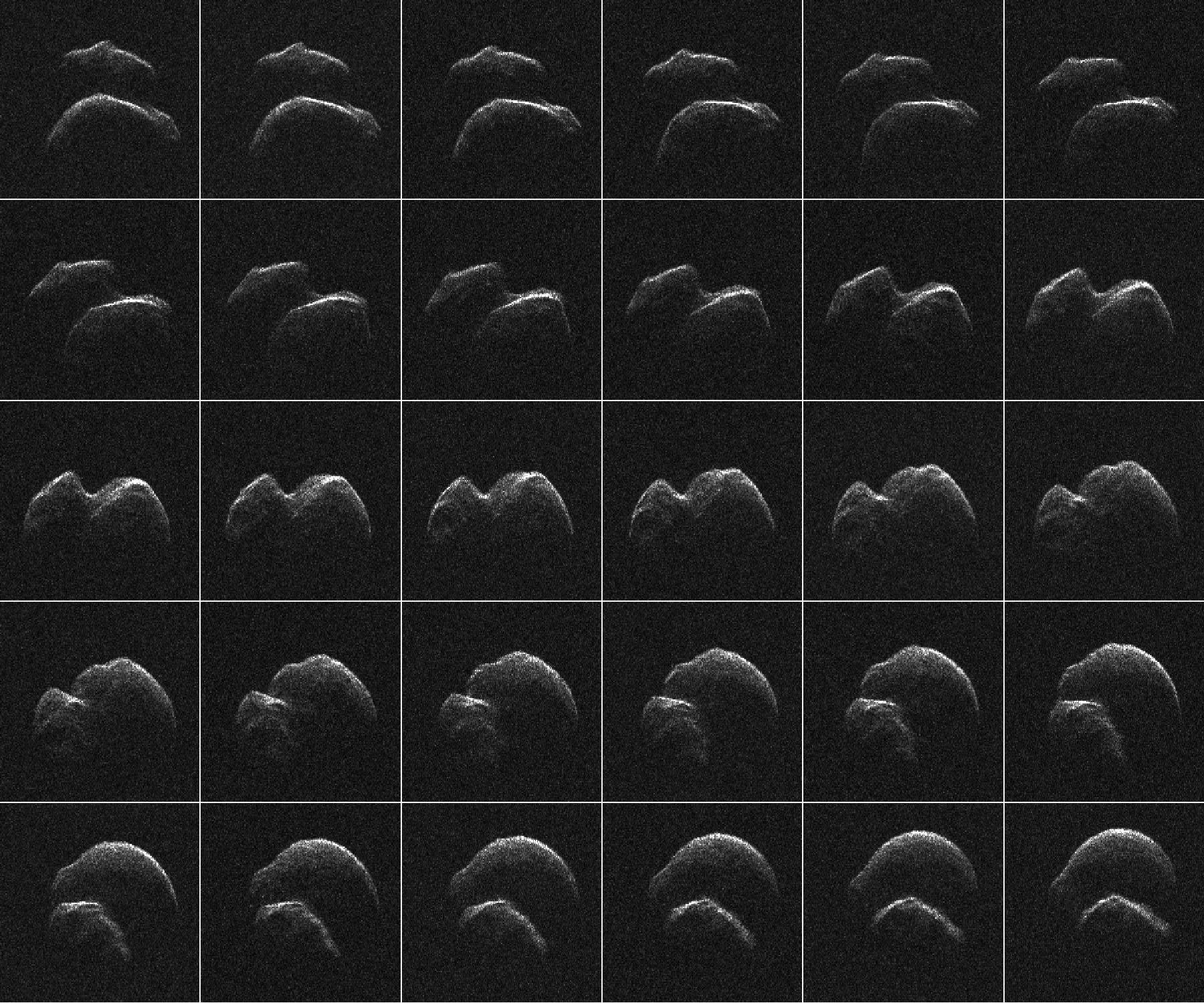
Explanation: A day before its closest approach, asteroid 2014 JO25 was imaged by radar with the 70-meter antenna of NASA's Goldstone Deep Space Communications Complex in California. This grid of 30 radar images, top left to lower right, reveals the two-lobed shape of the asteroid that rotates about once every five hours. Its largest lobe is about 610 meters across. On the list of Potentially Hazardous Asteroids, this space rock made its close approach to our fair planet on April 19, flying safely past at a distance of 1.8 million kilometers. That's over four times the distance from the Earth to the Moon. The asteroid was a faint and fast moving speck visible in backyard telescopes. Asteroid 2014 JO25 was discovered in May 2014 by the Catalina Sky Survey, a project of NASA's Near-Earth Objects Observations Program in collaboration with the University of Arizona.
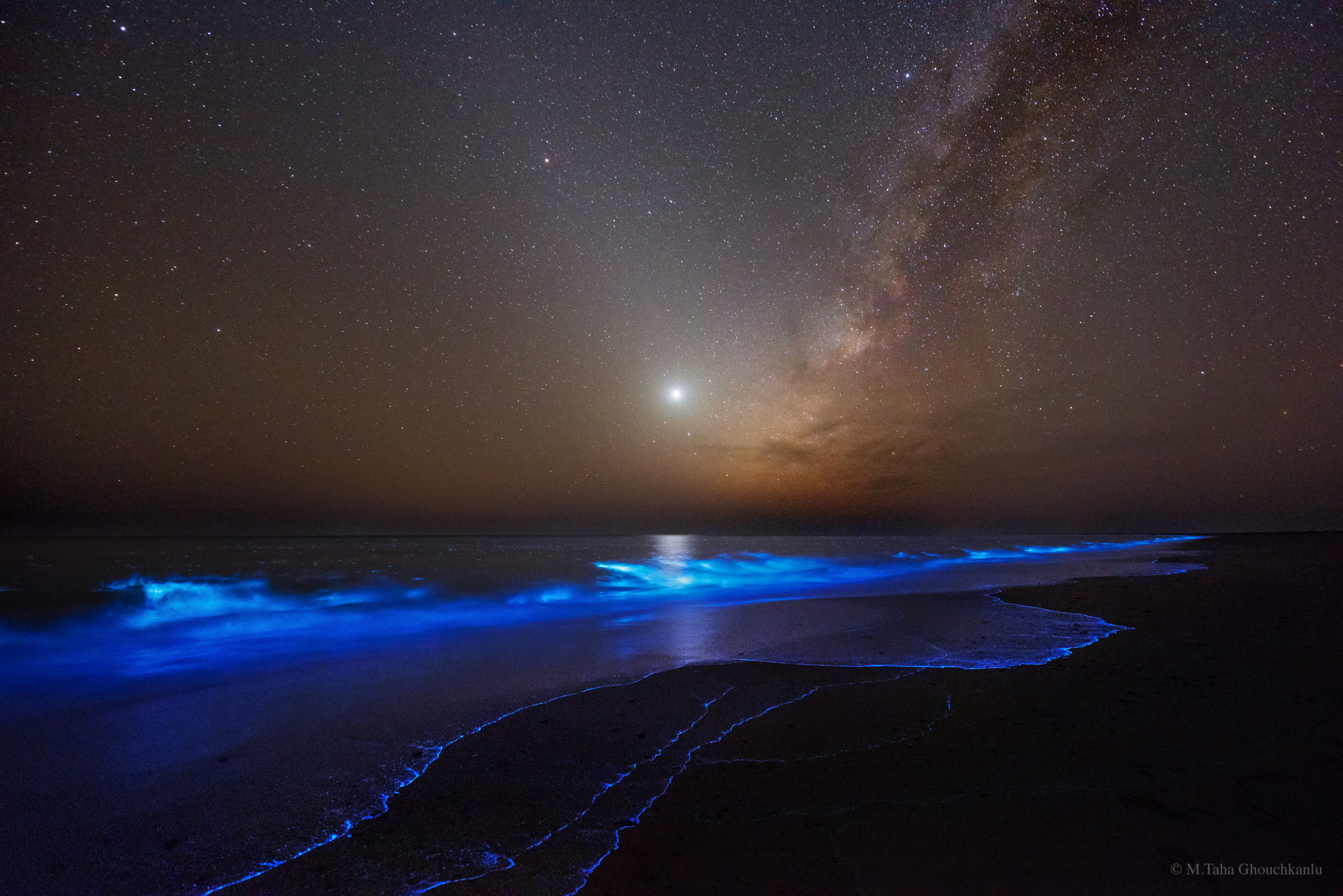
Explanation: What glows in the night? This night, several unusual glows were evident -- some near, but some far. The foreground surf glimmers blue with the light of bioluminescent plankton. Next out, Earth's atmosphere dims the horizon and provides a few opaque clouds. Further out, the planet Venus glows bright near the image center. If you slightly avert your eyes, a diagonal beam of light will stand out crossing behind Venus. This band is zodiacal light, sunlight scattered by dust in our Solar System. Much further away are numerous single bright stars, most closer than 100 light years away. Furthest away, also rising diagonally and making a "V" with the zodiacal light, is the central band of our Milky Way Galaxy. Most of the billions of Milky Way stars and dark clouds are thousands of light years away. The featured image was taken last November on the Iranian coast of Gulf of Oman.
Two Million Stars on the Move Video Credit: ESA, Gaia, DPAC
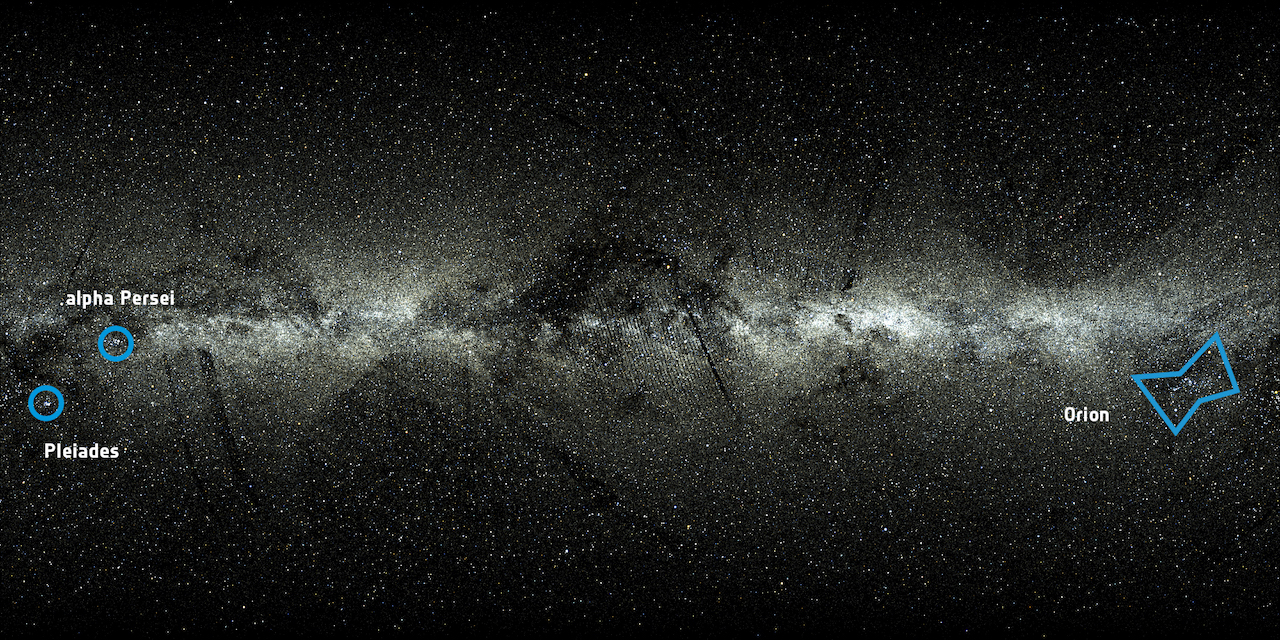
Explanation: If you could watch the night sky for one million years -- how would it change? Besides local effects caused by the Earth's spin and the reorientation of the Earth's spin axis, the stars themselves will move. Combining positional data of unprecedented accuracy for two-million stars taken over years by ESA's Earth-orbiting Hipparcos (now defunct) and Gaia satellites, a future extrapolation of star movements was made over millions years. As shown in the featured video, many stars make only small angular adjustments, but some stars -- typically those nearby -- will zip across the sky. Once familiar constellations and asterisms will become unrecognizable as the bright stars that formed them move around. Not shown are many local nebulas that will surely dissipate while new ones will likely form in different places. Perhaps reassuringly, future Earth inhabitants will still be able to recognize thecentral band of our Milky Way Galaxy.
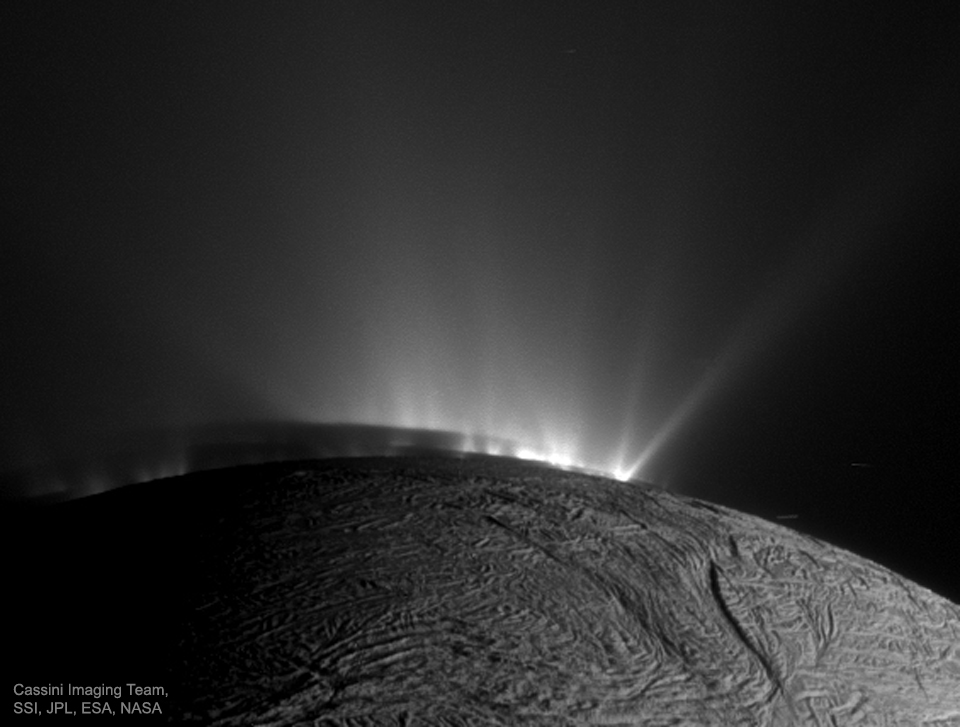
Explanation: Does Enceladus have underground oceans that could support life? The discovery of jets spewing water vapor and ice was detected by the Saturn-orbiting Cassini spacecraft in 2005. The origin of the water feeding the jets, however, was originally unknown. Since discovery, evidence has been accumulating that Enceladus has a deep underground sea, warmed by tidal flexing. Pictured here, the textured surface of Enceladus is visible in the foreground, while rows of plumes rise from ice fractures in the distance. These jets are made more visible by the Sun angle and the encroaching shadow of night. A recent fly-through has found evidence that a plume -- and so surely the underlying sea -- is rich in molecular hydrogen, a viable food source for microbes that could potentially be living there.