2014-11-30

Astronomy picture of the day - 30-11-2014 - The Seahorse of the Large Magellanic Cloud

See Explanation.  Clicking on the picture will download
 the highest resolution version available.
The Seahorse of the Large Magellanic Cloud 
Image Credit: NASAESA, and M. Livio (STScI)
Explanation: It may look like a grazing seahorse, but the dark object toward the image right is actually a pillar of smoky dust about 20 light years long. The curiously-shaped dust structure occurs in our neighboring Large Magellanic Cloud, in a star forming region very near the expansive Tarantula Nebula. The energetic nebula is creating a star cluster, NGC 2074, whose center is visible just off the top of the image in the direction of the neck of the seahorse. Therepresentative color image was taken last year by the Hubble Space Telescope's Wide Field Planetary Camera 2 in honor of Hubble's 100,000th trip around the Earth. As young stars in the cluster form, their light and winds will slowly erode the dust pillars away over the next million years.

2014-11-29

Astronomy picture of the day 29-11-2014 - 3D 67P

See Explanation.  Clicking on the picture will download
 the highest resolution version available.
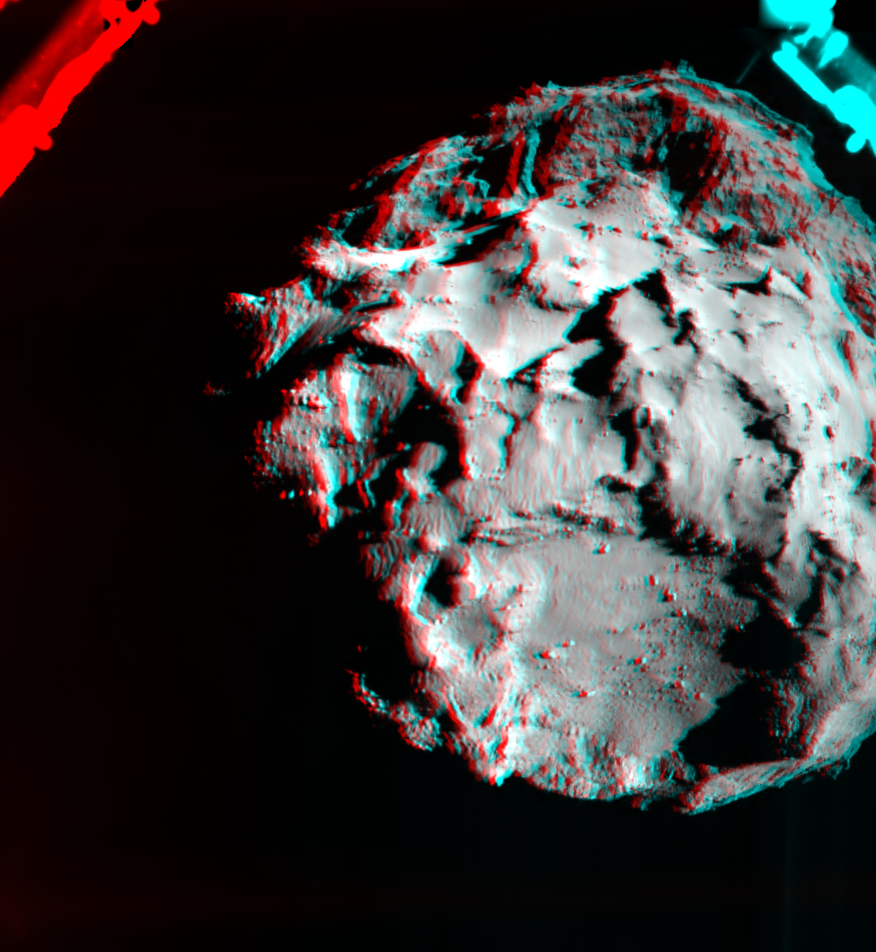
3D 67P
Image Credit: ESA/Rosetta/Philae/ROLIS
Explanation: Get out your red/blue glasses and float next to a comet! The Rosetta mission lander Philae's ROLIS camera snapped the two frames used to create this stereo anaglyph for 3D viewing during its November 12 descent to the nucleus of Comet 67P/Churyumov-Gerasimenko. The comet's curious double lobed nucleus is seen nearly end on from a distance of about 3 kilometers, about 1 hour before Philae arrived at the surface. Philae's initial landing site is near the center of the front facing lobe. Part of a landing gear foot cuts across the upper right corner, in the close foreground of the 3D-view. Philae bounced twice in the comet's weak gravity after its first contact with the surface. Using high resolution camera images from the Rosetta orbiter along with data from the lander's instruments, controllers have followed Philae's impromptu journey over the comet's surface and have identified a likely area for its final resting place.

2014-11-28

Astronomy picture of the day 28-11-2014 - Portrait of NGC 281

See Explanation.  Clicking on the picture will download
 the highest resolution version available.
Portrait of NGC 281 
Image Credit & CopyrightMartin Pugh
Explanation: Look through the cosmic cloud cataloged as NGC 281 and you might miss the stars of open cluster IC 1590. But, formed within the nebula, that cluster's young, massive stars ultimately power the pervasive nebular glow. The eye-catching shapes looming in this portrait of NGC 281 are sculpted columns and dense dust globules seen in silhouette, eroded by intense, energetic winds and radiation from the hot cluster stars. If they survive long enough, the dusty structures could also be sites of future star formation. Playfully called the Pacman Nebula because of its overall shape, NGC 281 is about 10,000 light-years away in the constellation Cassiopeia. This sharp composite image was made through narrow-band filters, combining emission from the nebula's hydrogen, sulfur, and oxygen atoms in green, red, and blue hues. It spans over 80 light-years at the estimated distance of NGC 281.

2014-11-27

Imagens do Mundo - Hôi An - Vietnam

Una pareja de novios se fotografía delante del puente cubierto, construido por los japoneses. Es el único puente que se conoce que está unido por un lado a una pagoda budista. Une el barrio comercial japonés,oeste, con el barrio chino,este.

Foto - Castelo de Palmela - Portugal - 11-09-2014

"Castelo de Palmela"

11-09-2014
JoanMira

Astronomy picture of the day 27-11-2014 - Galileo's Europa Remastered

2014 November 27
See Explanation.  Clicking on the picture will download
 the highest resolution version available.
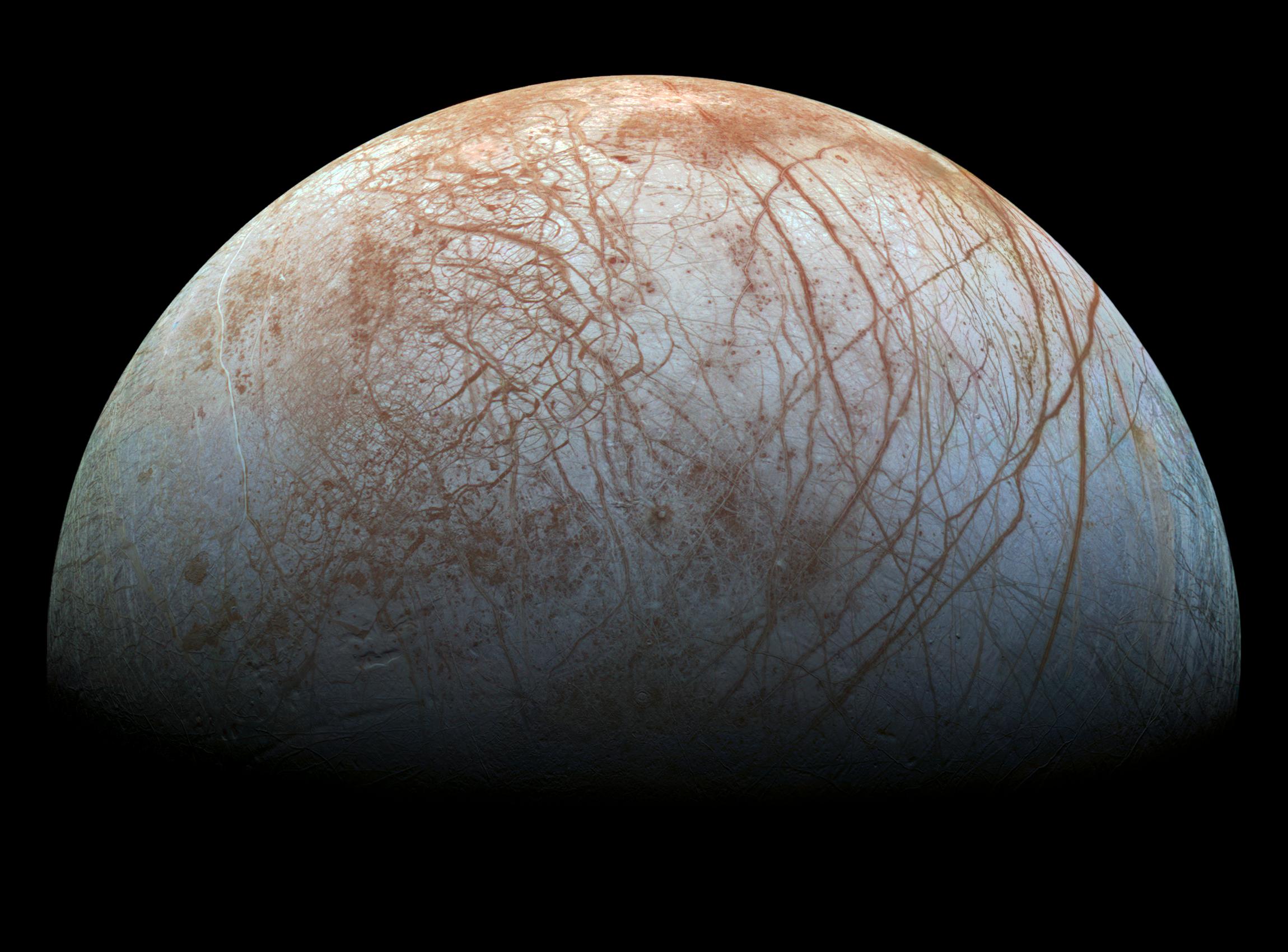
Galileo's Europa Remastered 
Image Credit: NASAJPL-CaltechSETI InstituteCynthia Phillips, Marty Valenti
Explanation: Looping through the Jovian system in the late 1990s, the Galileo spacecraft recorded stunning views of Europa and uncovered evidence that the moon's icy surface likely hides a deep, global ocean. Galileo's Europa image data has been newly remastered here, using improved new calibrations to produce a color imageapproximating what the human eye might see. Europa's long curving fractures hint at the subsurface liquid water. The tidal flexing the large moon experiences in its elliptical orbit around Jupiter supplies the energy to keep the ocean liquid. But more tantalizing is the possibility that even in the absence of sunlight that process could also supply the energy to support life, making Europa one of the best places to look for life beyond Earth. What kind of life could thrive in a deep, dark, subsurface ocean? Consider planet Earth's own extreme shrimp.

2014-11-26

Máquina transforma água em combustível


O Power Liquid é o aparelho que tem a capacidade de transformar água (H2O) e dióxido de carbono (CO2) em hidrocarbonetos líquidos, como a gasolina sintética e o gasóleo. A base está no processo Fischer-Tropsch, que data de 1952. Esta nova tecnologia foi agora desenvolvida pela empresa alemã Sunfire GmbH. Esta pode ser uma solução para o futuro do mercado dos combustíveis, diminuindo a dependência dos países em relação às petrolíferas. Além disso, o Power Liquid funciona de uma forma ecológica. A empresa afirmou que a taxa de eficácia do Power Liquid é de 70%. No estado atual, o aparelho recicla 3.2 toneladas de dióxido de carbono por dia, produzindo um barril de combustível. 

Imagens do Mundo - Parque de Hanau (Frankfurt) - Alemanha

Paraje de un parque de Hanau, cerca de Frankfurt, en el que el reflejo del agua dibuja una circunferencia casi perfecta a su paso por un puente.

2014-11-24

Astronomy picture of the day 24-11-2014 - Soaring over Titan (video)

Soaring over Titan 
Video Credit: Cassini Radar MapperJPLUSGSESANASA
Explanation: What would it look like to fly over Titan? Radar images from NASA's robotic Cassini satellite in orbit around Saturn have been digitally compiled to simulate such a flight. Cassini has swooped past Saturn's cloudiest moon several times since it arrived at the ringed planet in 2004. The virtual flight featured here shows numerous lakes colored black and mountainous terrain colored tan. Surface regions without detailed vertical information appear more flat, while sufficiently mapped regions have their heights digitally stretched. Among the basins visualized is Kraken Mare, Titan's largest lake which spans over 1,000 kilometers long. Titan's lakes are different from Earth's lakes in that they are composed of hydrocarbons with similarities to liquid natural gas. How Titan's lakes were created and why they survive continues to be a topic of research.