2015-01-09

Astronomy picture of the day - 09-01-2015 - In the Arms of NGC 1097

See Explanation.  Clicking on the picture will download
 the highest resolution version available.
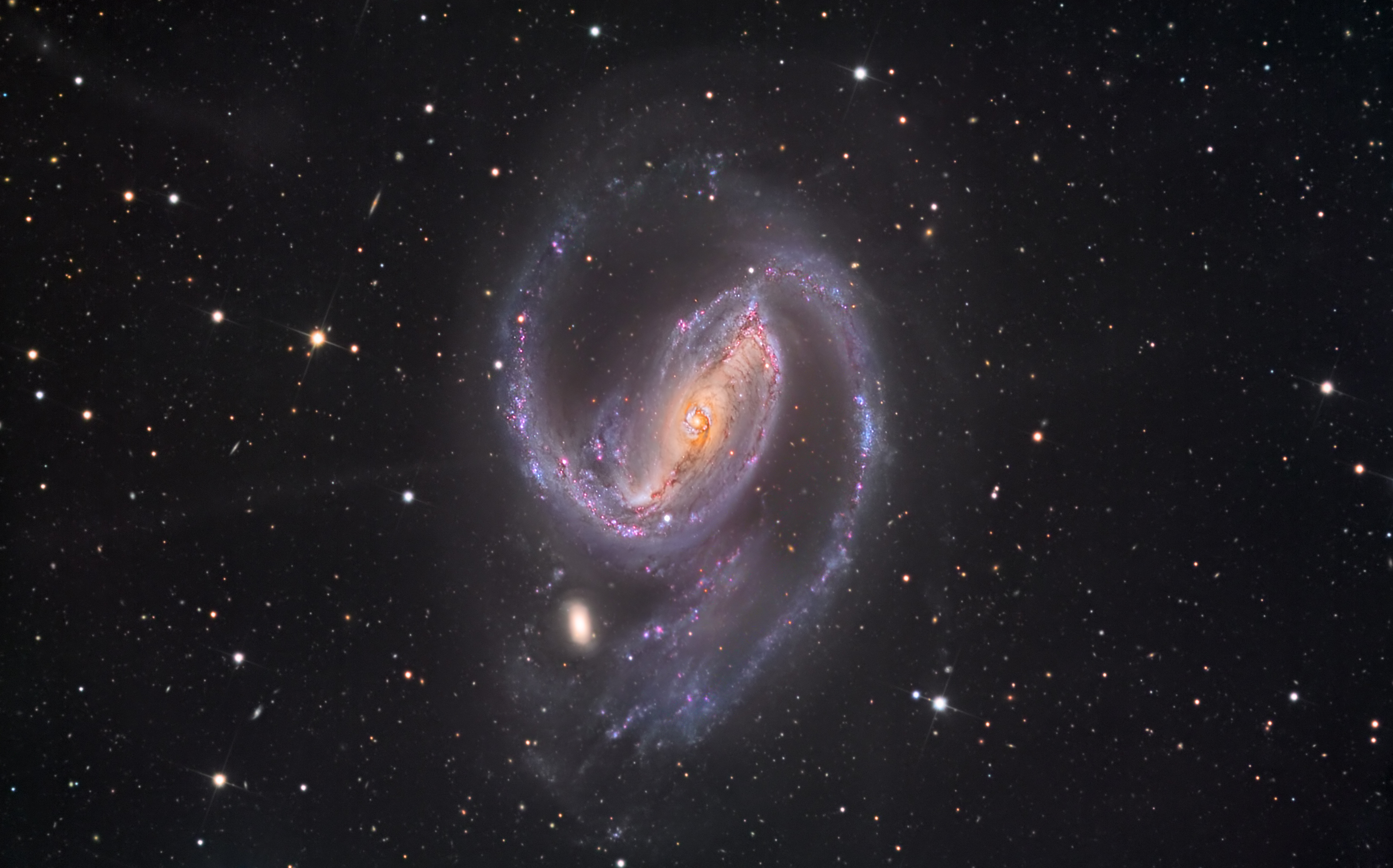
In the Arms of NGC 1097 
Image Credit & CopyrightSteve Mazlin, Jack Harvey, Jose Joaquin Perez; SSRO-South, at PROMPT/CTIO
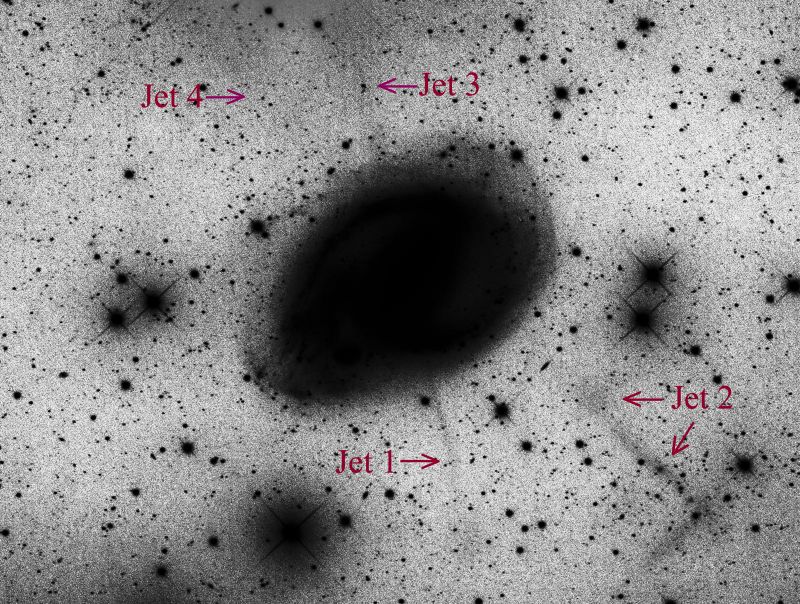
Explanation: Spiral galaxy NGC 1097 shines in southern skies, about 45 million light-years away in the chemical constellation Fornax. Its blue spiral arms are mottled with pinkish star forming regions in this colorful galaxy portrait. They seem to have wrapped around a small companion galaxy below and left of center, about 40,000 light-years from the spiral's luminous core. That's not NGC 1097's only peculiar feature, though. The very deep exposure hints of faint, mysterious jets, most easily seen to extend well beyond the bluish arms toward the left. In fact, four faint jets are ultimately recognized in optical images of NGC 1097. The jets trace an X centered on the galaxy's nucleus, but probably don't originate there. Instead, they could be fossil star streams, trails left over from the capture and disruption of a much smaller galaxy in the large spiral's ancient past. A Seyfert galaxy, NGC 1097's nucleus also harbors asupermassive black hole.

2015-01-07

Imagens do Mundo - China - Esculturas de neve - Changchun

Le 2 janvier, le festival touristique de la neige de Changchun a été inauguré. Le « monde des sculptures de neige », situé au sein du parc national forestier de Jingyuetan, occupe une superficie de 40 000m² et a demandé 100 000 m³ de neige pour sa construction.
Source: french.china.org.cn

Astronomy picture of the day - 07-01-2015 - Hubble 25th Anniversary: Pillars of Creation

See Explanation.  Clicking on the picture will download
the highest resolution version available.

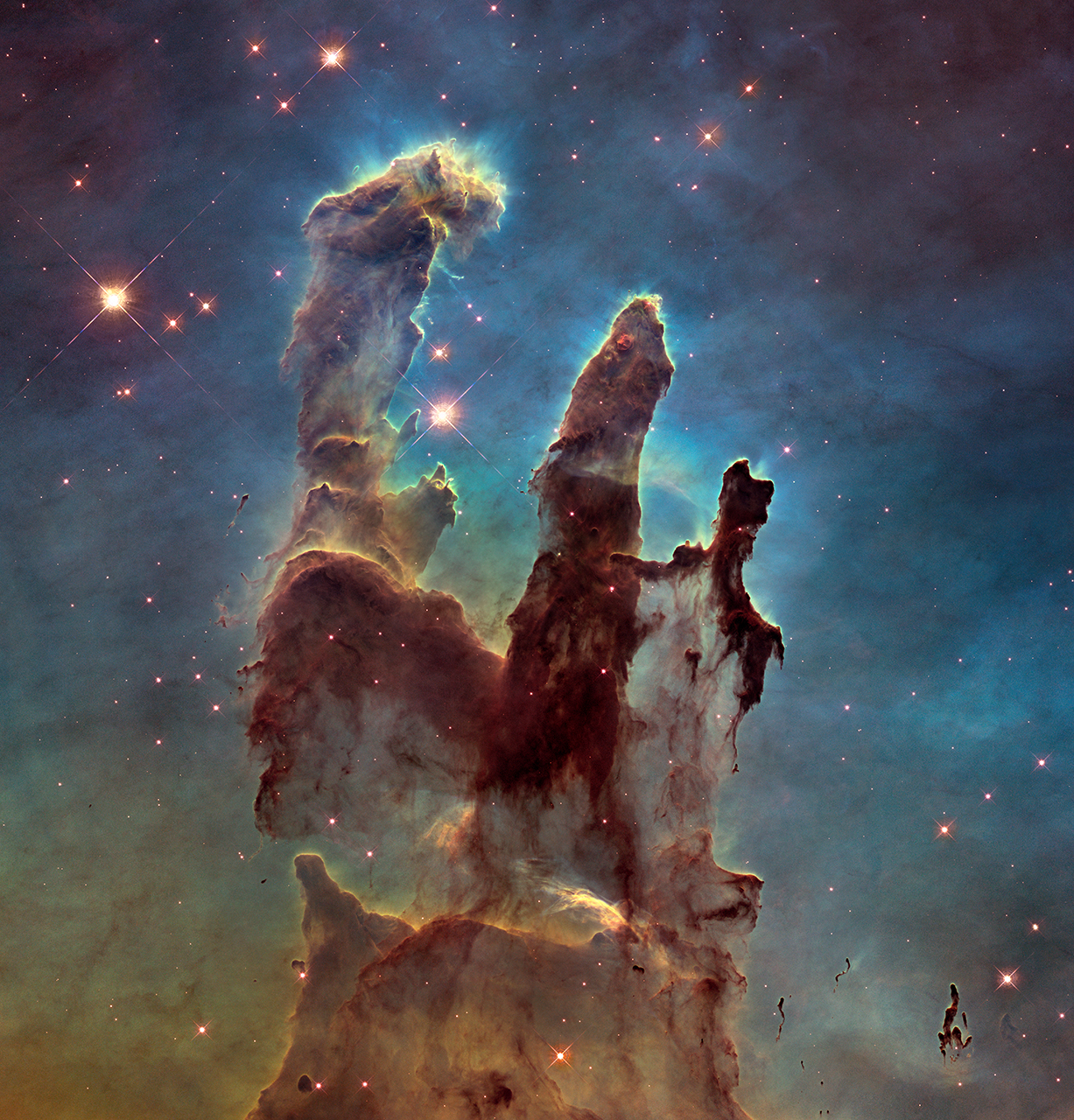
Hubble 25th Anniversary: Pillars of Creation 
Image Credit: NASAESA, and The Hubble Heritage Team (STScI / AURA)
Explanation: To celebrate 25 years (1990-2015) of exploring the Universe from low Earth orbit, the Hubble Space Telescope's cameras were used to revisit its most iconic image. The result is this sharper, wider view of the region dubbed the Pillars of Creation, first imaged by Hubble in 1995. Stars are forming deep inside the towering structures. The light-years long columns of cold gas and dust are some 6,500 light-years distant in M16, the Eagle Nebula, toward the constellation Serpens. Sculpted and eroded by the energetic ultraviolet light and powerful winds from M16's cluster of young, massive stars, the cosmic pillars themselves are destined for destruction. But the turbulent environment of star formation within M16, whose spectacular details are captured in this Hubble visible-light snapshot, is likely similar to the environment that formed our own Sun.

2015-01-06

Foto - "Le Capitole" - Toulouse - France

Toulouse - "Le Capitole"

06-01-2015
JoanMira

Foto - Toulouse - France - 06-01-2015

Restaurante "Le Patio de la Table Ronde"

Toulouse, 06-01-2015
JoanMira

Astronomy picture of the day - 06-01-2014 - 100 Million Stars in the Andromeda Galaxy

See Explanation.  Clicking on the picture will download
 the highest resolution version available.
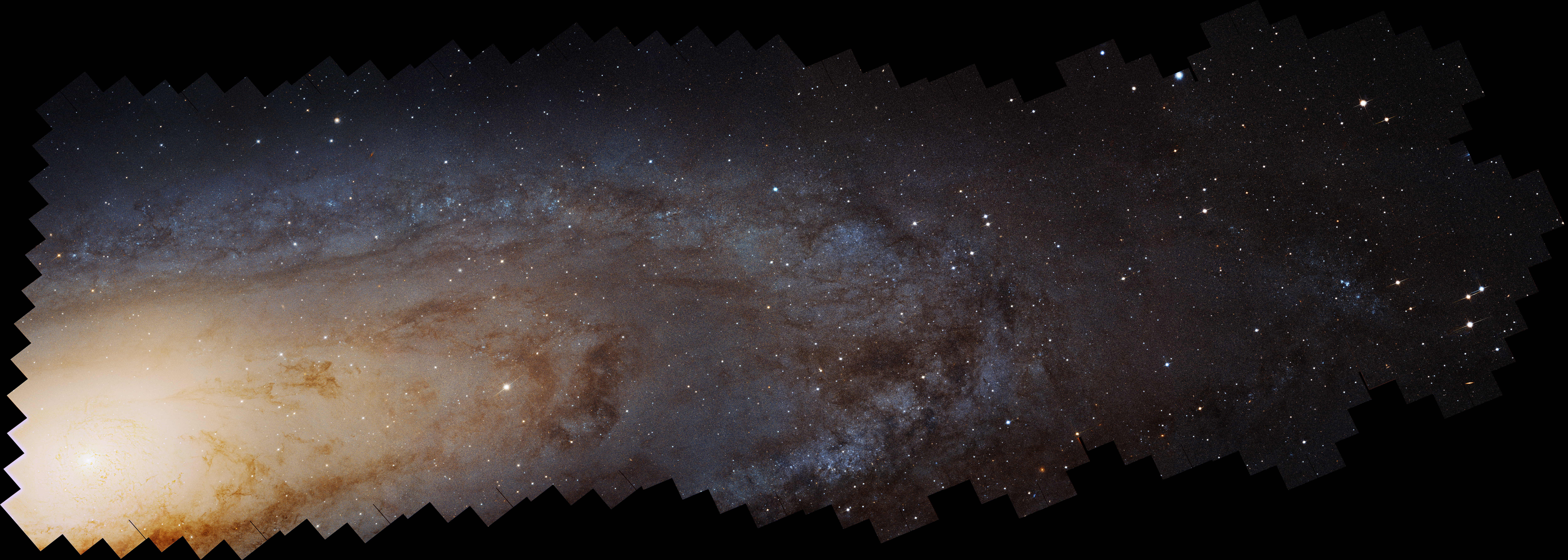
100 Million Stars in the Andromeda Galaxy 
Image Credit: NASAESAJ. Dalcanton, B. F. Williams, L. C. Johnson (U. Washington), PHAT teamR. Gendler
Explanation: What stars compose the Andromeda galaxy? To better understand, a group of researchers studied the nearby spiral by composing the largest image ever taken with the Hubble Space Telescope. The result, called thePanchromatic Hubble Andromeda Treasury (PHAT), involved thousands of observations, hundreds of fields, spanned about a third of the galaxy, and resolved over 100 million stars. In the featured composite image, the central part of the galaxy is seen on the far left, while a blue spiral arm is prominent on the right. The brightest stars, scattered over the frame, are actually Milky Way foreground stars. The PHAT data is being analyzed to better understand where and how stars have formed in M31 in contrast to our Milky Way Galaxy, and to identify and characterize Andromeda's stellar clusters and obscuring dust.

2015-01-05

Irlande. Peut-on débrancher une femme enceinte en état de mort cérébrale ?

Dessin de Bertrams.
Peut-on débrancher une femme enceinte qui se trouve en état de mort cérébrale ? C’est la question sur laquelle la Haute Cour d'Irlande devra se prononcer le 23 décembre, note The Irish Times. La femme, qui a souffert de lésions internes sévères à la suite d'un caillot sanguin, est maintenue en vie artificiellement à l’hôpital depuis deux semaines pour permettre à son fœtus de 17 semaines de survivre. 

Ses médecins craignaient d'enfreindre la loi en débranchant les appareils qui la maintiennent en vie : depuis 1983, la Constitution irlandaise donne en effet au fœtus les mêmes droits qu'à la mère. Autrement dit : le fœtus a autant le droit de vivre que sa mère. 

"Bourbier éthique des trente dernières années"

Si la cour décide de donner la vie au fœtus, il faudra maintenir la femme en vie jusqu'à ce que le fœtus ait au moins 24 semaines, le moment où il sera viable à l’extérieur de l'utérus. L’identité et l'endroit où se trouve la femme ne sont pas dévoilés. Ses proches, y compris son compagnon, "vivent une terrible catastrophe", selon le père de la victime cité par l'Irish Independent, car ils souhaitent qu’elle soit débranchée. "Je veux juste pouvoir reposer en paix ma pauvre fille", aurait dit son père. 

Il y a seulement dix-huit mois, la loi avait été assouplie pour permettre l'avortement dans le cas où la vie de la femme était en danger. Dans un article intitulé : "L’avortement, le débat qui ne semble jamais disparaître", une chroniqueuse souligne que cette loi ne constitue donc en aucun cas une réponse "au plus grand bourbier moral, éthique et politique des trente dernières années". Elle rappelle que "c’est la deuxième fois en seulement cinq mois que la nouvelle législation a été sapée". En effet, en août, une femme suicidaire tombée enceinte après avoir été violée s’était fait refuser un avortement.

Une loi "à effet paralysant sur les médecins"

Le ministre de la Santé, Leo Varadkar, a appelé à revoir la Constitution qui lui semble "trop restrictive" et qui "a un effet paralysant sur les médecins". Des propos salués par l'Irish Independent mais qui ne sont pas partagés par le Premier ministre, Enda Kenny, pourtant du même parti que le ministre de la Santé (Fine Gael, centre droit). Ce dernier n’est pas favorable à un changement de la Constitution, qui devrait être validée par référendum, rappelle The Irish Times. "Je n’ai pas l’intention de réagir de manière impulsive à une question aussi personnelle, sensible et complexe que celle-ci", a dit Enda Kenny, cité par le journal.

Astronomy picture of the day - 05-01-2014 - A Fox Fur, a Unicorn, and a Christmas Tree

See Explanation.  Clicking on the picture will download
 the highest resolution version available.
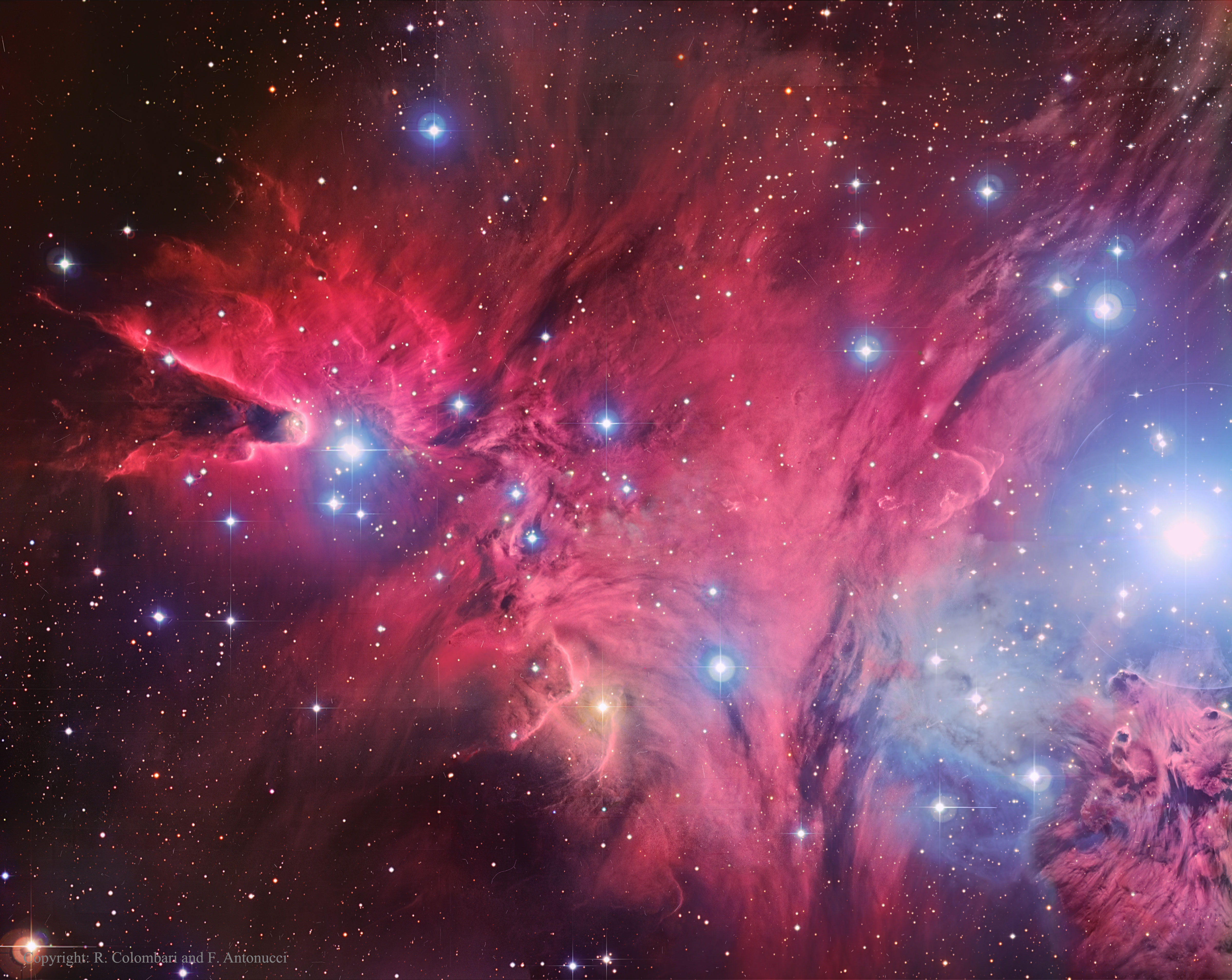
A Fox Fur, a Unicorn, and a Christmas Tree 
Image Credit & Copyright: R. Colombari & Francesco AntonucciData: SubaruESO, & F. Antonucci
Explanation: What do the following things have in common: a cone, the fur of a fox, and a Christmas tree? Answer: they all occur in the constellation of the unicorn (Monoceros). Pictured as a star forming region and cataloged as NGC 2264, the complex jumble of cosmic gas and dust is about 2,700 light-years distant and mixes reddish emission nebulae excited by energetic light from newborn stars with dark interstellar dust clouds. Where the otherwise obscuring dust clouds lie close to the hot, young stars they also reflect starlight, forming blue reflection nebulae. The image spans about the diameter of a full moon, covering about 30 light-years at the distance of NGC 2264. Its cast of cosmic characters includes the Fox Fur Nebula, whose convoluted pelt lies on the lower right, bright variable star S Mon visible just above the Fox Fur, and the Cone Nebula on the image left. Given their distribution, the stars of NGC 2264 are also known as the Christmas Tree star cluster. The triangular tree shape traced by the stars appears here with its apex at the Cone Nebula on the left with its broader base near S Mon on the right.

2015-01-04

Foto - "Leme - Copacabana - Rio de Janeiro"

"Leme - Copacabana - Rio de Janeiro"

17-03-2012
JoanMira

Astronomy picture of the day - 04-01-2015 - Crescent Rhea Occults Crescent Saturn

See Explanation.  Clicking on the picture will download
 the highest resolution version available.
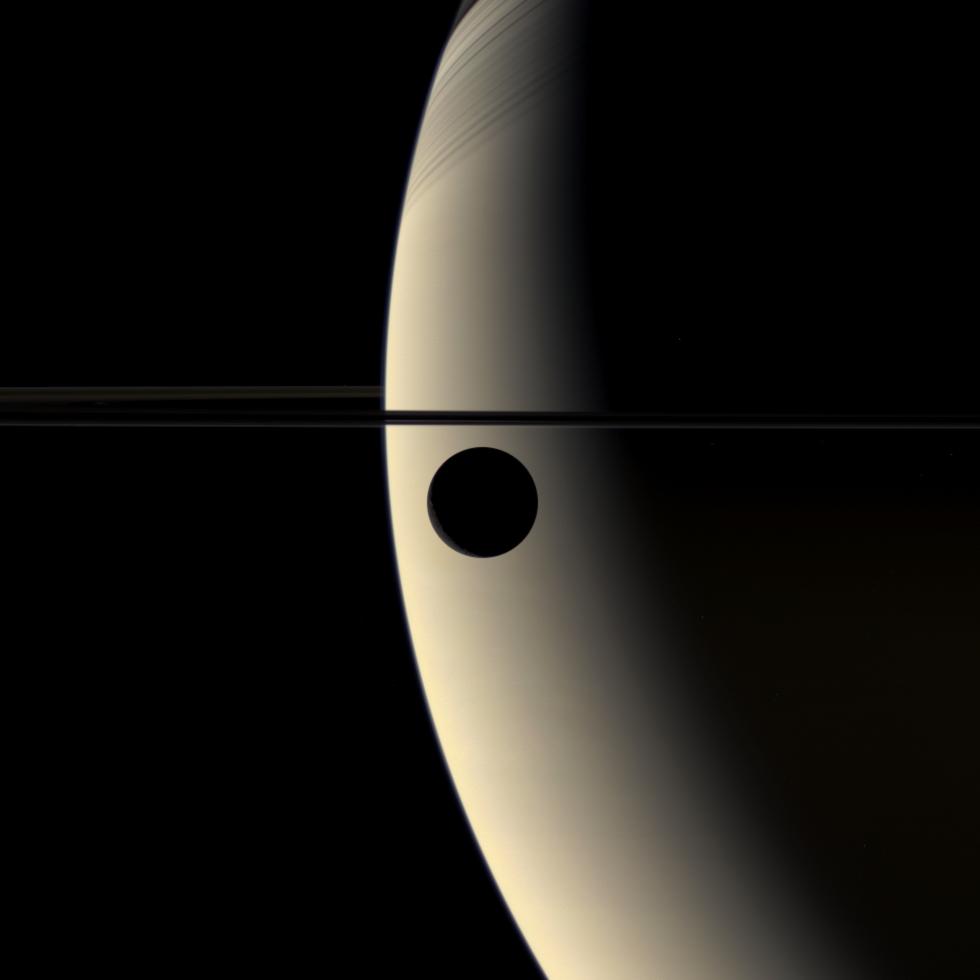
Crescent Rhea Occults Crescent Saturn 
Image Credit: Cassini Imaging TeamSSIJPLESANASA
Explanation: Soft hues, partially lit orbs, a thin trace of the ring, and slight shadows highlight this understated view of the majestic surroundings of the giant planet Saturn. Looking nearly back toward the Sun, the robot Cassini spacecraft now orbiting Saturn captured crescent phases of Saturn and its moon Rhea in color a few years ago. As striking as the above image is, it is but a single frame from a 60-frame silent movie where Rhea can be seen gliding in front of its parent world. Since Cassini was nearly in the plane of Saturn's rings, the normally impressive rings are visible here only as a thin line across the image center.