2015-04-12
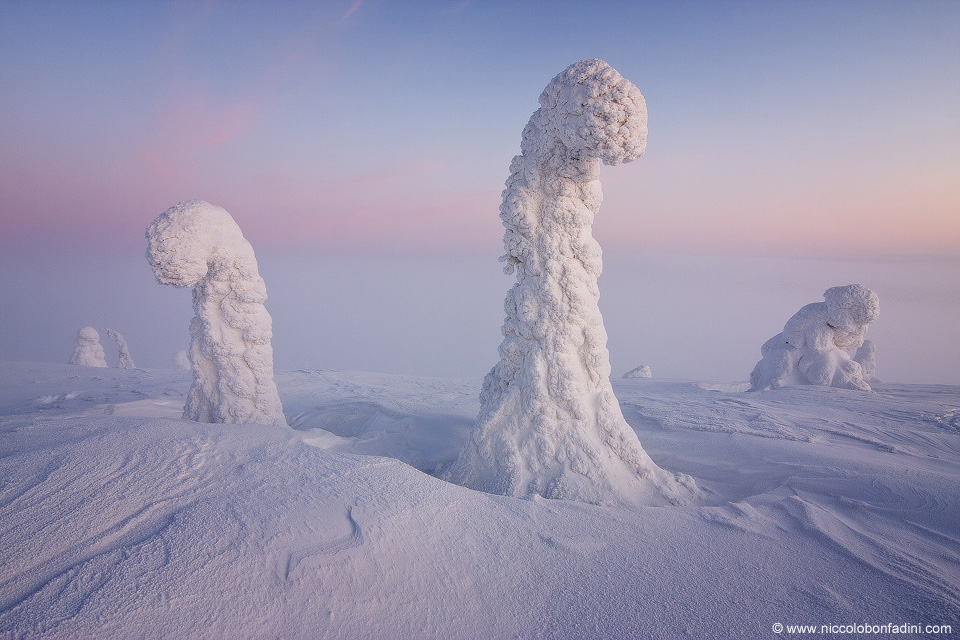
Astronomy picture of the day - 2015 April 12 - Sentinels of the Arctic
Image Credit & Copyright: Niccolò Bonfadini
Explanation: Who guards the north? Judging from the above photograph, possibly giant trees covered in snow and ice. The featured picture was taken a few winters ago in Finnish Lapland where weather can include sub-freezing temperatures and driving snow. Surreal landscapes sometimes result, where common trees become cloaked in white and so appear, to some, as watchful aliens. Far in the distance, behind this uncommon Earthly vista, is a more common sight -- a Belt of Venus that divided a darkened from sunlit sky as the Sun rose behind the photographer. Of course, in the spring, the trees thaw and Lapland looks much different.
2015-04-11
Arte - Christoph Niemann - 20 maneiras de fazer arte com o dia-a-dia - 11-04-2015,
Christoph Niemann is an artist who’s bursting at the seams with creativity. When he’s not drawing clever and insightful cartoons for the New York Times and other prestigious publications, he creates clever illustrations for fun, using everyday objects to enrich and complete his daily creations.
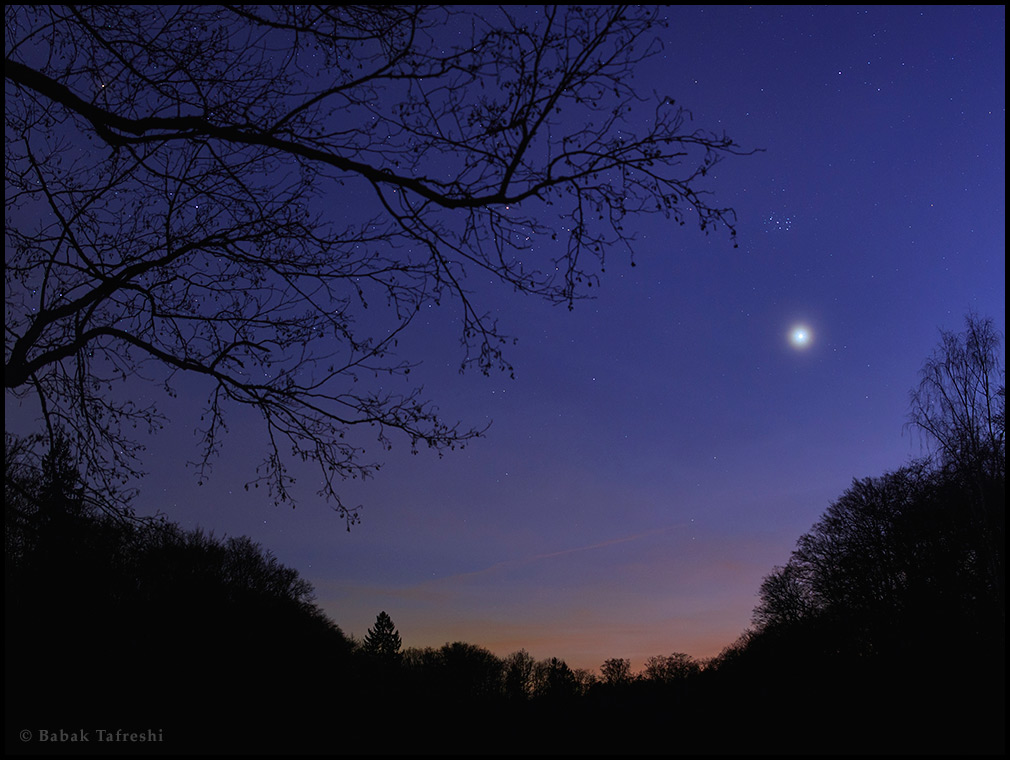
Astronomy picture of the day - 2015 April 11 - Venus in the West
Image Credit & Copyright: Babak Tafreshi (TWAN)
Explanation: In the coming days, Venus shines near the western horizon at sunset. To find Earth's sister planet in twilight skies just look for the brilliant evening star. Tonight very close to the Pleiades star cluster, Venus dominates this springtime night skyscape taken only a few days ago near the town of Lich in central Germany. Also known as the Seven Sisters, the stars of the compact Pleiades cluster appear above Venus in this picture. The budding tree branches to its left frame bright star Aldebaran, the eye of Taurus the Bull, and the V-shaped Hyades star cluster.
2015-04-10
Médecine. Un pas de plus vers une première mondiale : la greffe de tête sur un corps étranger
Ce sera une première mondiale : un patient originaire de Russie, atteint d'une grave maladie dégénérative qui le cloue à un fauteuil roulant, a accepté d’expérimenter une opération chirurgicale consistant à transplanter sa tête sur le corps d'un autre individu. Reste à trouver le corps.
Valeri Spiridonov a trente ans. Il est russe, programmeur et est atteint d’une grave maladie dégénérative. Il vient d’'accepter de devenir le premier être humain dont on transplantera la tête sur un nouveau corps, rapporte le quotidien en ligne mosocovite Gazeta.ru. C’est le chirurgien italien Sergio Canavero lui-même qui a annoncé, le 8 avril, avoir choisi le jeune homme originaire de Vladimir (à l’est de Moscou) pour réaliser la fameuse opération, autour de laquelle il a organisé toute une campagne médiatique en début d'année. Et qui a soulevé un tollé dans la communauté scientifique.
Valeri Spiridonov, qui, pour l'instant, ne s’est entretenu avec Sergio Canavero que par l’intermédiaire de Skype, s’est décidé à franchir ce“pas désespéré”, car il “veut saisir cette chance d’avoir un nouveau corps avant de mourir”, explique Gazeta.ru. “Si j’ai peur ? Bien sûr, mais je n’ai pas beaucoup d’autres solutions. Si je laisse passer cette chance, mon sort ne sera pas enviable. Chaque année mon état se dégrade”, a-t-il déclaré dans un entretien au quotidien britanniqueDaily Mail. La maladie de Werdnig-Hoffman dont il est atteint se caractérise par une grave atrophie musculaire qui le condamne au fauteuil roulant. Elle est mortelle à très court terme. Les personnes qui en souffrent ne survivent en général pas au-delà de 20 ans.
L’opération, qui pourrait être réalisée dès 2016, doit durer trente-six heures. Elle nécessitera le corps d’un donneur en mort cérébrale. Après avoir “reçu” le corps sain, Spiridonov devra ensuite être maintenu un mois dans un coma artificiel pour immobiliser les muscles du cou. Pendant ce temps, des électrodes seront utilisées pour régénérer les liaisons nerveuses et stimuler la fusion des moelles épinières. S’il survit, et si la greffe est un succès, il pourra bouger, parler avec sa propre voix et sentir son propre visage. Une physiothérapie lui permettra de se lever au bout d'un an.
Jusqu’ici, les essais sur les primates se sont soldés par la mort de l’animal, au bout de neuf jours.
Courrier International - France
Imagens do Mundo - Por do sol em Lisboa, Portugal
Puesta de sol en Lisboa desde el mirador de Nuestra Señora del Monte.
MICHAL BARAN
Arte - Christoph Niemann - 20 maneiras de fazer arte com o dia-a-dia - 10-04-2015
Christoph Niemann is an artist who’s bursting at the seams with creativity. When he’s not drawing clever and insightful cartoons for the New York Times and other prestigious publications, he creates clever illustrations for fun, using everyday objects to enrich and complete his daily creations.
Astronomy picture of the day - 2015 April 10 - NGC 2903: A Missing Jewel in Leo
Image Credit & Copyright: Tony Hallas
Explanation: Barred spiral galaxy NGC 2903 is only some 20 million light-years distant. Popular among amateur astronomers, it shines in the northern spring constellation Leo, near the top of the lion's head. That part of the constellation is sometimes seen as a reversed question mark or sickle. One of the brighter galaxies visible from the northern hemisphere, NGC 2903 is surprisingly missing from Charles Messier's catalog of lustrous celestial sights. Thiscolorful image from a small ground-based telescope shows off the galaxy's gorgeous spiral arms traced by young, blue star clusters and pinkish star forming regions. Included are intriguing details of NGC 2903's bright core, a remarkable mix of old and young clusters with immense dust and gas clouds. In fact, NGC 2903 exhibits an exceptional rate of star formation activity near its center, also bright in radio, infrared, ultraviolet, and x-ray bands. Just a little smaller than our own Milky Way, NGC 2903 is about 80,000 light-years across.
Inscription à :
Commentaires (Atom)