2015-08-29
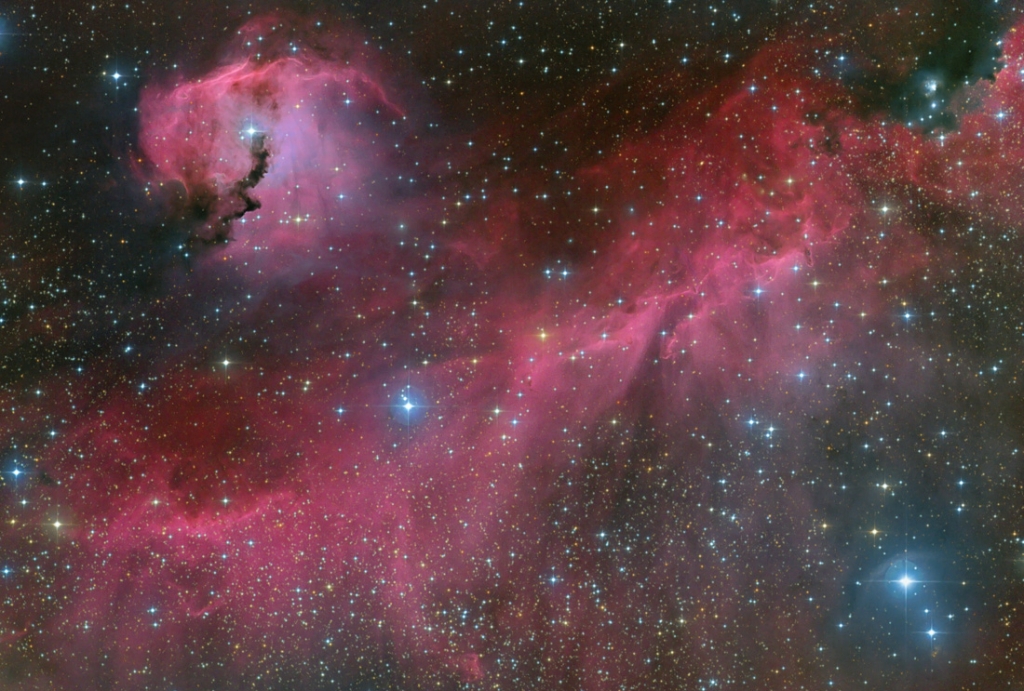
Astronomy picture of the day - 2015 August 29 - The Seagull Nebula
Image Credit & Copyright: Dieter Willasch (Astro-Cabinet)
Explanation: A broad expanse of glowing gas and dust presents a bird-like visage to astronomers from planet Earth, suggesting its popular moniker - The Seagull Nebula. This portrait of the cosmic bird covers a 1.6 degree wide swath across the plane of the Milky Way, near the direction of Sirius, alpha star of the constellation Canis Major. Of course, the region includes objects with other catalog designations: notably NGC 2327, a compact, dusty emission region with an embedded massive star that forms the bird's head (aka the Parrot Nebula, above center). Dominated by the reddish glow of atomic hydrogen, the complex of gas and dust clouds with bright young stars spans over 100 light-years at an estimated 3,800 light-year distance.
2015-08-28
Imagenes de Mundo - Ecuador - Volcan Cotopaxi
Vista desde el Pedregal (Ecuador) del volcán Cotopaxi, que sigue expulsando ceniza que ha caído en algunos poblados cercanos. El presidente de Ecuador, Rafael Correa, afirmó que la situación en el volcán Cotopaxi, es la mayor preocupación actual de su Gobierno.
JOSÉ JÁCOME (EFE)
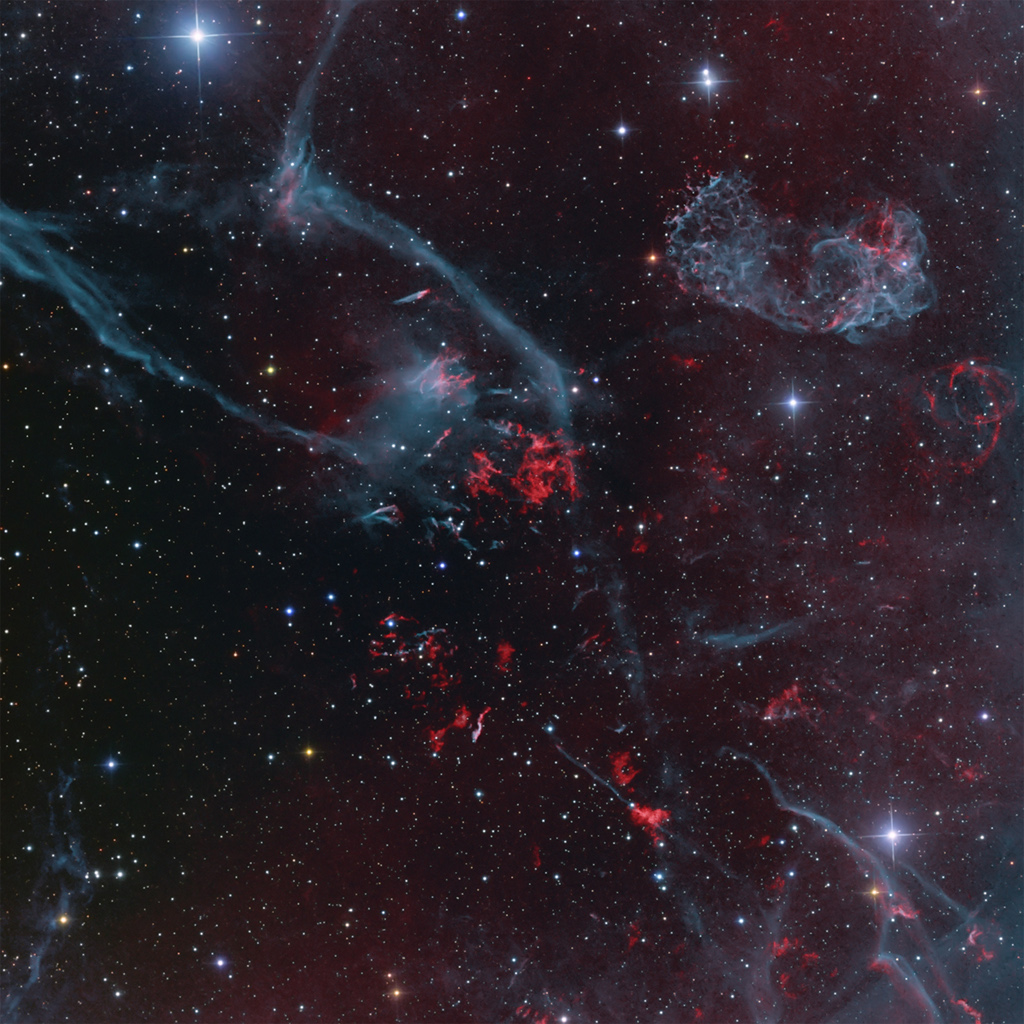
Astronomy picture of the day - 2015 August 28 - Puppis A Supernova Remnant
Image Credit & Copyright: Don Goldman
Explanation: Driven by the explosion of a massive star, supernova remnant Puppis A is blasting into the surrounding interstellar medium about 7,000 light-years away. At that distance, this colorful telescopic field based on broadband and narrowband optical image data is about 60 light-years across. As the supernova remnant expands into its clumpy, non-uniform surroundings, shocked filaments of oxygen atoms glow in green-blue hues. Hydrogen and nitrogen are in red. Light from the initial supernova itself, triggered by the collapse of the massive star's core, would have reached Earth about 3,700 years ago. The Puppis A remnant is actually seen through outlying emission from the closer but more ancient Vela supernova remnant, near the crowded plane of our Milky Way galaxy. Still glowing across the electromagnetic spectrum Puppis A remains one of the brightest sources in the X-ray sky.
2015-08-27
Inscription à :
Commentaires (Atom)