A aguia a voar sempre mais alto!
2016-03-09
Marcelo Rebelo de Sousa, novo Presidente da Republica Portuguesa

No seu discurso inaugural, o Chefe de Estado, Marcelo Rebelo de Sousa, defendeu que urge “recriar das convergências”, “redescobrir dos diálogos” e considerou ser necessário “cicatrizar feridas” deixadas pelos “longos sacrifícios”. No primeiro discurso na Assembleia da República, logo após o juramento da Constituição, Marcelo Rebelo de Sousa quis deixar uma mensagem de valorização do amor-próprio dos portugueses. A intervenção mereceu uma ovação de pé das bancadas do PS, PSD e CDS, bem como dos convidados. Ficaram sentados os deputados do PCP, BE e PEV, que não aplaudiram.
Apelando à necessidade de “sair do clima de crise” em que Portugal viveu “desde o início do século”, o Presidente referiu-se depois a um período mais recente da História. “Temos de cicatrizar feridas destes tão longos sacrifícios, no fragilizar do tecido social, na perda de consensos de regime, na divisão de hemisférios políticos”, disse, repetindo a mensagem de pacificação que deixou na campanha eleitoral. E considerou essa ruptura “indesejável precisamente em anos em que urge recriar convergências, redescobrir diálogos, refazer entendimentos”.
Publico - Portugal
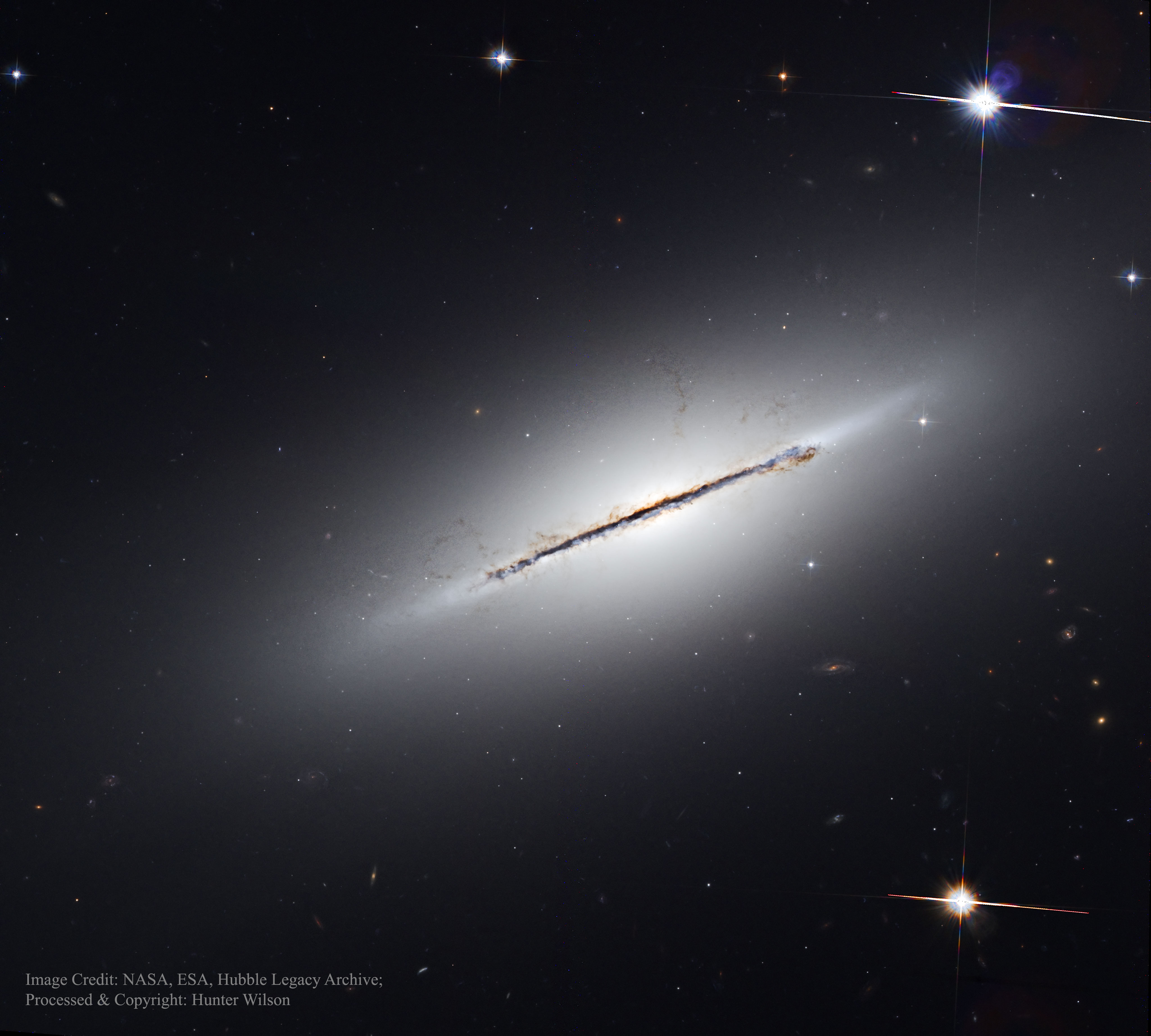
Astronomy picture of the day - 2016 March 9 -
Image Credit: NASA, ESA, Hubble Legacy Archive; Processed & Copyright: Hunter Wilson
Explanation: Why is this galaxy so thin? Many disk galaxies are actually just as thin as NGC 5866, pictured above, but are not seen edge-on from our vantage point. One galaxy that is situated edge-on is our own Milky Way Galaxy. Classified as a lenticular galaxy, NGC 5866 has numerous and complex dust lanes appearing dark and red, while many of the bright stars in the disk give it a more blue underlying hue. The blue disk of young stars can be seen extending past the dust in the extremely thin galactic plane, while the bulge in the disk center appears tinged more orange from the older and redder stars that likely exist there. Although similar in mass to our Milky Way Galaxy, light takes about 60,000 years to cross NGC 5866, about 30 percent less than light takes to cross our own Galaxy. In general, many disk galaxies are very thin because the gas that formed them collided with itself as it rotated about the gravitational center. Galaxy NGC 5866 lies about 50 million light years distant toward the constellation of the Dragon (Draco).
2016-03-08
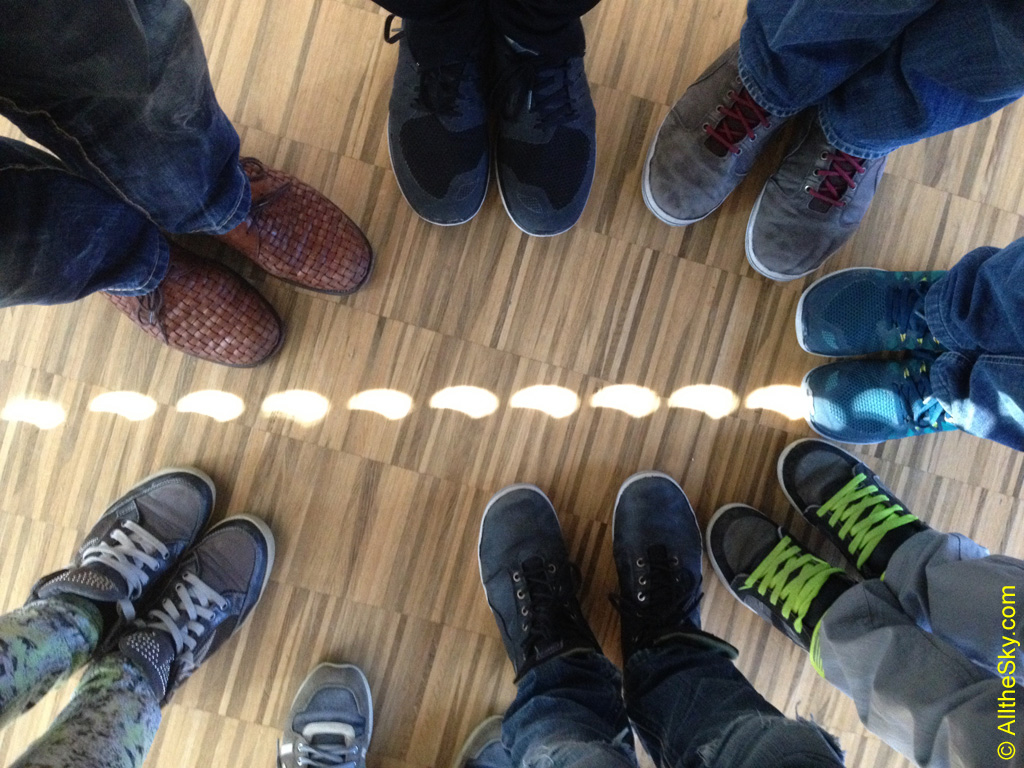
Astronomy pictures of the day - 2016 March 8 - Solar Eclipse Shoes in the Classroom
Image Credit & Copyright: Astronomie-AG, Progymnasium Rosenfeld, Till Credner, AlltheSky.com
Explanation: The total solar eclipse of March 8/9 will be the only total eclipse in 2016. The New Moon's dark shadow traces a limited, narrow path across planet Earth for viewing the total phase, making landfall in Indonesia and mostly tracking across the Pacific Ocean. A much larger region will be witness to a partially eclipsed Sun though, and safely viewing the eclipse can actually be very easy. One technique is demonstrated in this shoe group portrait from a classroom in Rosenfeld, Germany, taken during March 2015's solar eclipse. With blinds closed to darken the room, each threaded hole in the window blind creates a pinhole camera, projecting multiple images of the eclipsed sun that march across the floor. Other viewing alternatives include eclipse glasses and a comfortable chair, but be sure to wear a fashionable eclipse shirt.
2016-03-07
Astronomy picture of the day - 2016 March 7 - Mystery Feature Now Disappears in Titan Lake
Image Credit: Cassini Radar Mapper, Cornell, JPL, ESA, NASA
Explanation: What is that changing object in a cold hydrocarbon sea of Titan? Radar images from the robotic Cassini spacecraft orbiting Saturn have been recording the surface of the cloud-engulfed moon Titan for years. When imaging the flat -- and hence radar dark -- surface of the methane and ethane lake called Ligeia Mare, an object appeared in 2013 July just was not there in 2007. Subsequent observations in 2014 August found the object remained -- but had changed. In an image released last week, the mystery object seems to have disappeared in 2015 January. The featured false-color image shows how the 20-km long object has come, changed, and gone. Current origin speculative explanations include waves, bubbling foam and floating solids, but still no one is sure. Future observations, in particular Cassini's final close flyby of Titan in 2017 April, may either resolve the enigma or open up more speculation.
2016-03-06
Astronomy picture of the day - 2016 March 6 - A Solar Prominence Eruption from SDO
Video Credit: NASA/Goddard/SDO AIA Team
Explanation: One of the most spectacular solar sights is an erupting prominence. In 2011, NASA's Sun-orbiting Solar Dynamic Observatory spacecraft imaged an impressively large prominence erupting from the surface. The dramatic explosion was captured in ultraviolet light in the above time lapse video covering 90 minutes, where a new frame was taken every 24 seconds. The scale of the prominence is huge -- the entire Earth would easily fit under the flowingcurtain of hot gas. A solar prominence is channeled and sometimes held above the Sun's surface by the Sun's magnetic field. A quiescent prominence typically lasts about a month, and may erupt in a Coronal Mass Ejection (CME)expelling hot gas into the Solar System. The energy mechanism that creates a solar prominence is still a topic of research. As the Sun passes Solar Maximum, solar activity like eruptive prominences are expected to become less common over the next few years.
2016-03-05
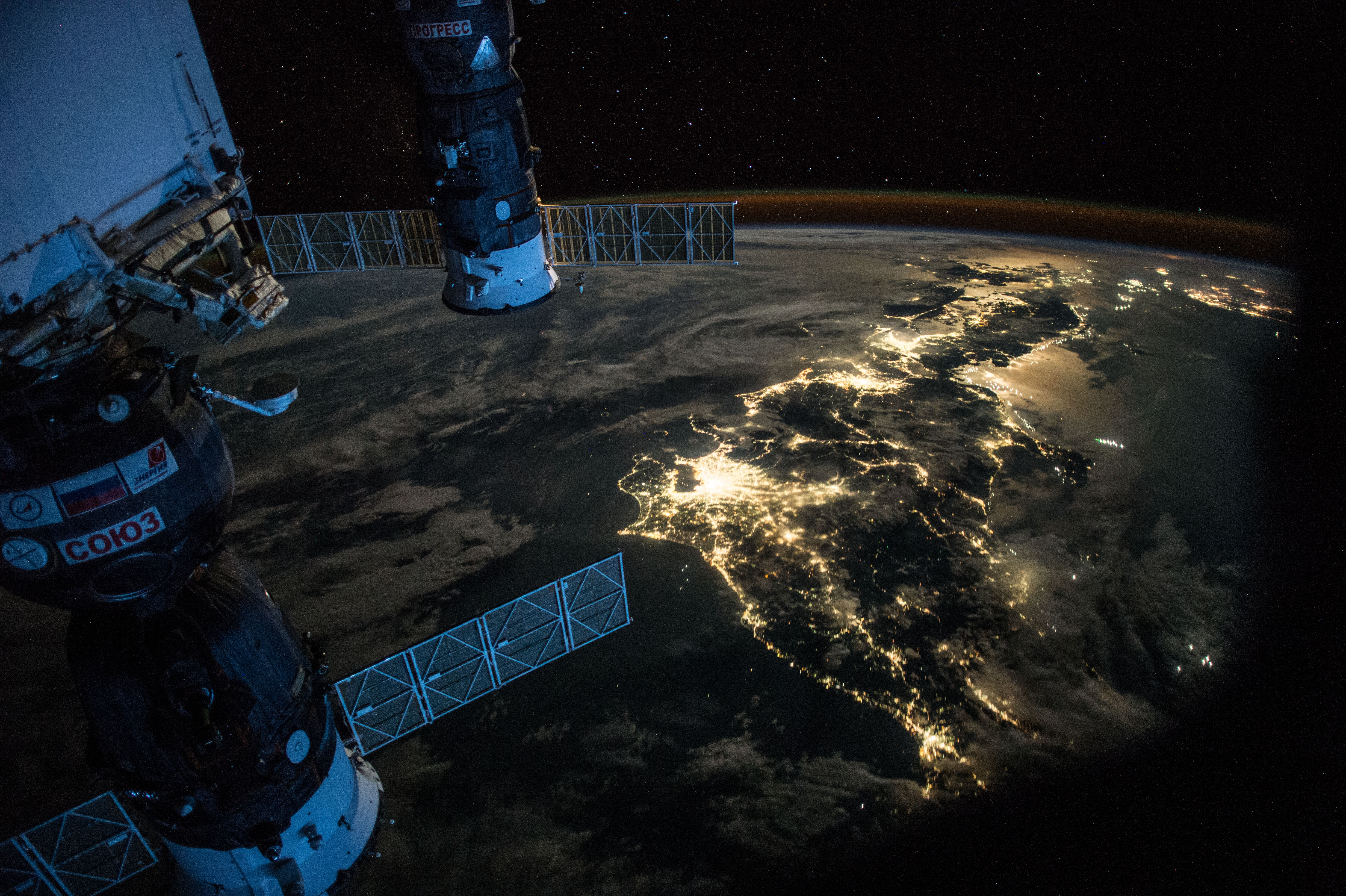
Astronomy picture of the day - 2016 March 5 - Cities at Night
Image Credit: NASA, Scott Kelly
Explanation: Looking toward the south from an altitude of 400 kilometers, this stunning snapshot from orbit finds bright lights of Tokyo and cities across central and southern Japan, planet Earth shining upward through broken clouds.The spacefaring perspective was captured last July by astronaut Scott Kelly during his stay on board the International Space Station. Thin stripes of airglow follow the curve of the planet's dark limb, while beyond lie stars of the constellation Centaurus and the southern sky. Their solar panels extended, a docked Soyuz (bottom) and Progress spacecraft are posed in the foreground. Kelly returned to planet Earth this week after his one-year mission in space.
Inscription à :
Commentaires (Atom)