"Fazer o que ainda não foi feito"
2016-04-14
2016-04-13
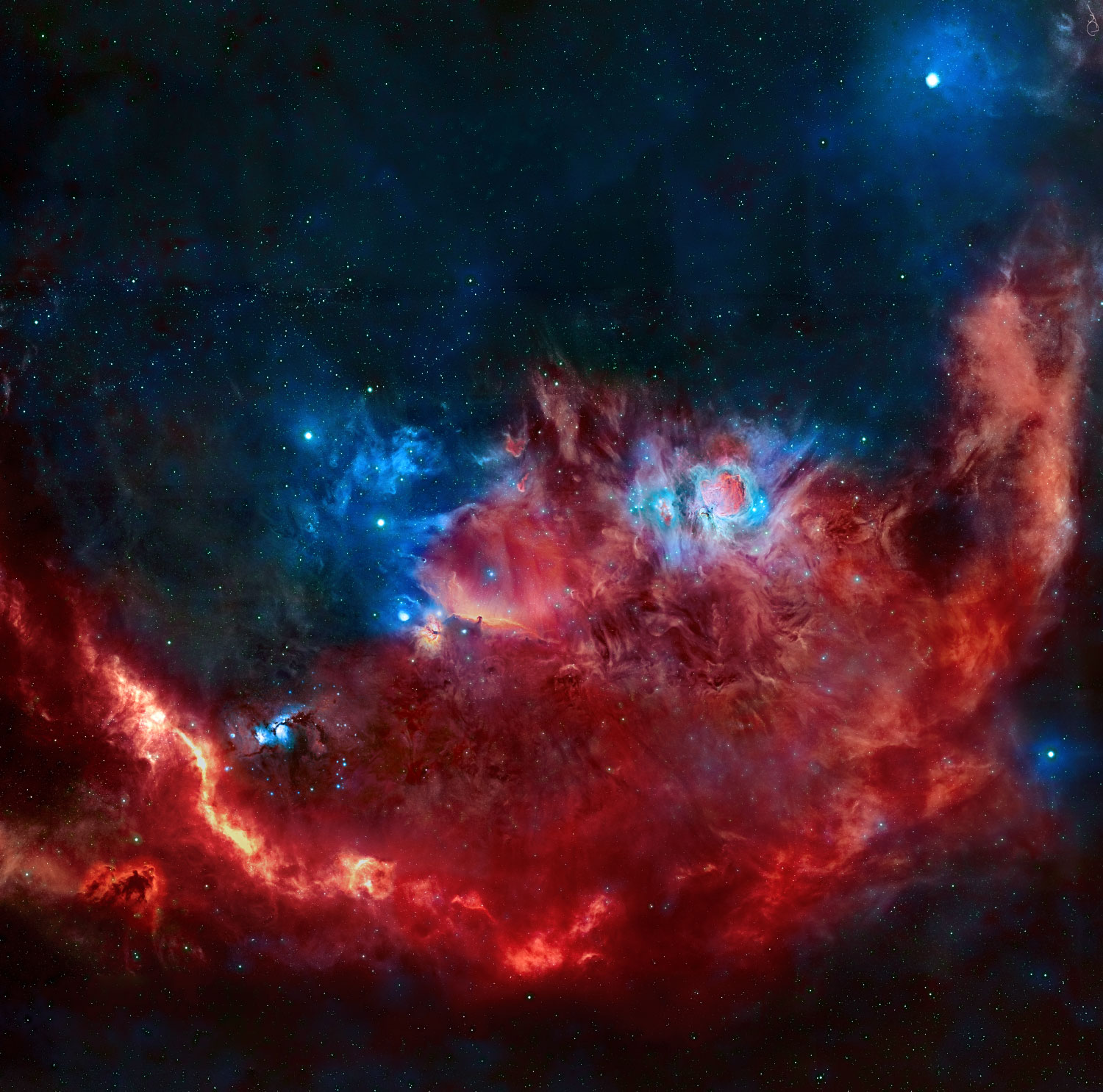
Astronomy picture of the day - 2016 April 13 - Orion in Red and Blue
Image Credit & Copyright: David Lindemann
Explanation: When did Orion become so flashy? This colorful rendition of part of the constellation of Orion comes from red light emitted by hydrogen and sulfur (SII), and blue-green light emitted by oxygen (OIII). Hues on thefeatured image were then digitally reassigned to be indicative of their elemental origins -- but also striking to the human eye. The breathtaking composite was painstakingly composed from hundreds of images which took nearly 200 hours to collect. Pictured, Barnard's Loop, across the image bottom, appears to cradle interstellar constructs including the intricate Orion Nebula seen just right of center. The Flame Nebula can also be quickly located, but it takes a careful eye to identify the slight indentation of the dark Horsehead Nebula. As to Orion's flashiness -- a leading explanation for the origin of Barnard's Loop is a supernova blast that occurred about two million years ago.
2016-04-12
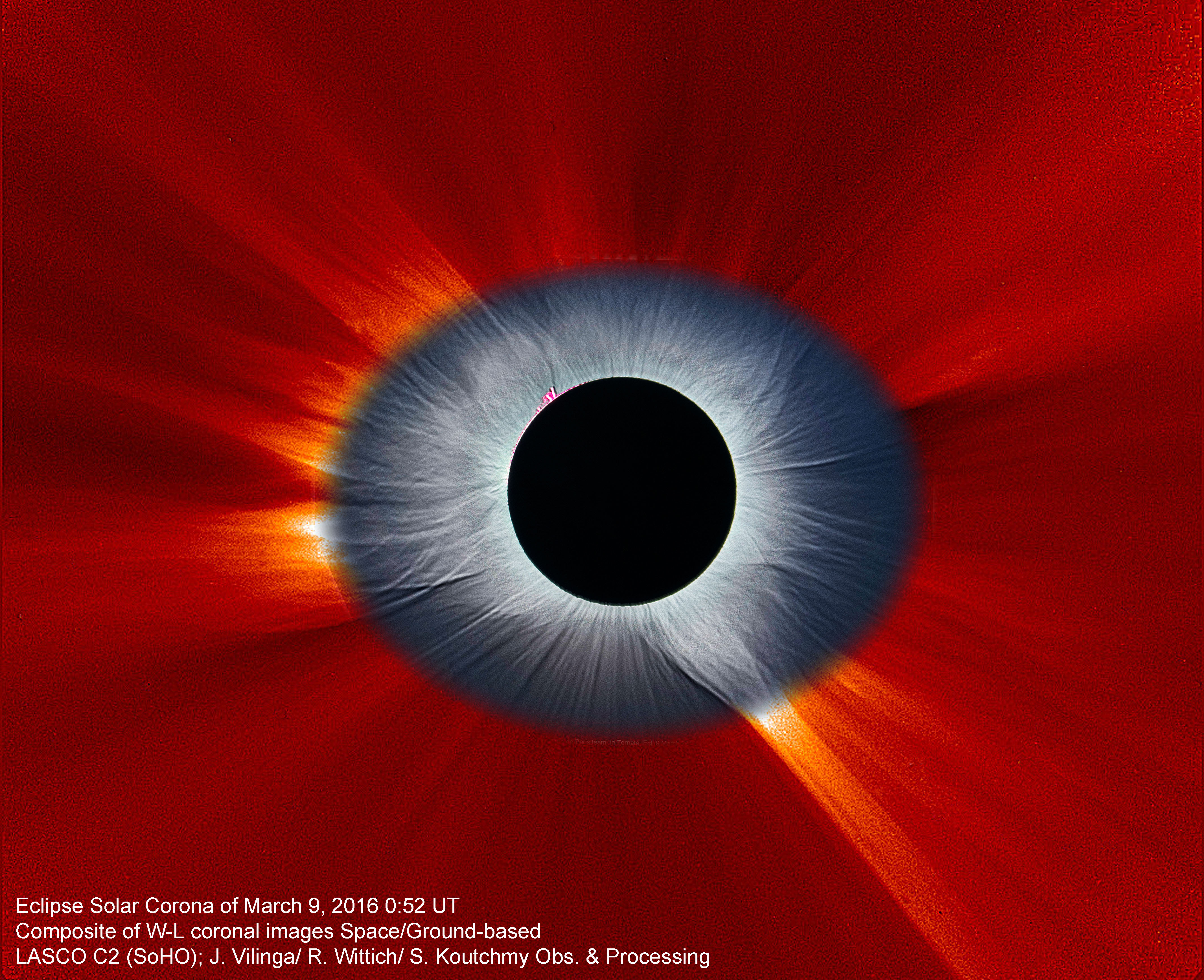
Astronomy picture of the day - 2016 April 12 - Combined Solar Eclipse Corona from Earth and Space
Image Credits: J. Vilinga (Angola, IAP), LASCO, NRL, SOHO, ESA, NASA;
Processing: R. Wittich; Composition & Copyright: S. Koutchmy (IAP, CNRS)
Explanation: Sometimes, a total eclipse is a good time to eye the Sun. Taking advantage of an unusual juxtaposition of Earth, Moon and Sun, the featured image depicts the total solar eclipse that occurred last month as it appeared -- nearly simultaneously -- from both Earth and space. The innermost image shows the total eclipse from the ground, with the central pupil created by the bright Sun covered by a comparatively dark Moon. Surrounding the blocked solar disk is the tenuous corona of Sun imaged in white light, easily visible from the ground only during an eclipse. Normally, this corona is hard to track far from the Sun, but the featured montage matches it to false-colored observations of the Sun from NASA and ESA's space-based, Sun-orbiting, Solar and Heliospheric Observatory (SOHO). Observations like this allow the study of the constantly changing magnetic activity both near and far from the Sun, the same activity that ultimately drives Earth's auroras.
2016-04-11
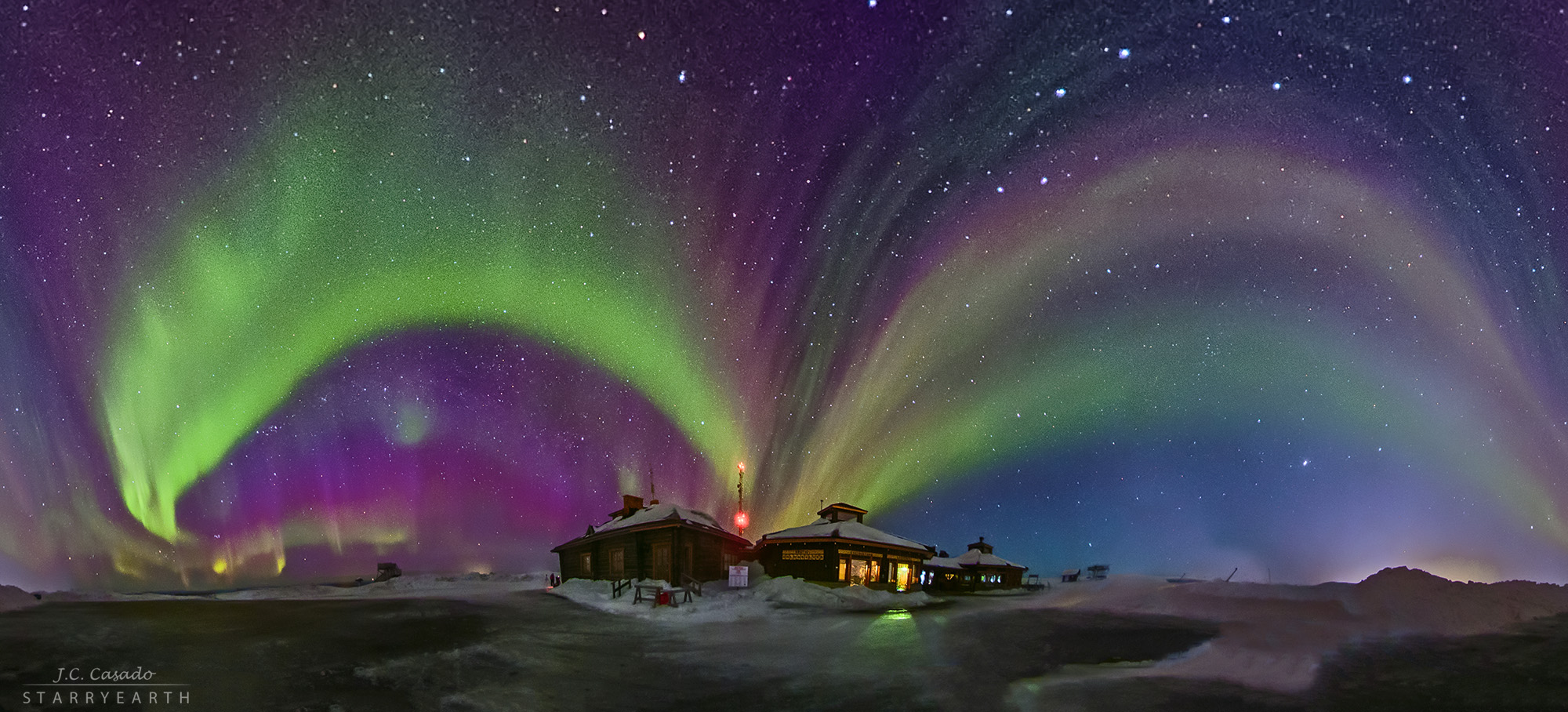
Astronomy picture of the day - 2016 April 11 - Lapland Northern Lights
Image Credit & Copyright: Juan Carlos Casado (TWAN, Earth and Stars)
Explanation: Early spring in the northern hemisphere is good season for aurora hunters. Near an equinox Earth's magnetic field is oriented to favor interactions with the solar wind that trigger the alluring glow of the northern lights. On March 28/29 the skies over Kaunispää Hill, Lapland, Finland did not disappoint. That night's expansive auroral curtains are captured in this striking panoramic view that covers a full 360 degrees. Local skywatchers were mesmerized by bright displays lasted throughout the dark hours, shimmering with colors easily visible to the naked eye.
2016-04-10
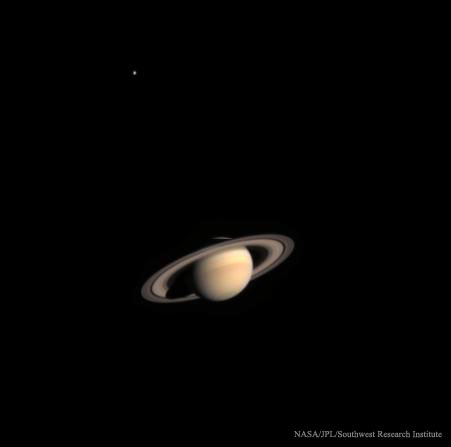
Astronomy picture of the day - 2016 April 10 - Cassini Approaches Saturn
Image Credit: Cassini Imaging Team, SWRI, JPL, ESA, NASA
Explanation: Cassini, a robot spacecraft launched in 1997 by NASA, became close enough in 2002 to resolve many rings and moons of its destination planet: Saturn. At that time, Cassini snapped several images during an engineering test. Several of those images were combined into the contrast-enhanced color composite featured here. Saturn's rings and cloud-tops are visible toward the image bottom, while Titan, its largest moon, is visible as the speck toward the top. When arriving at Saturn in July 2004, the Cassini orbiter began to circle and study the Saturnian system. A highlight was when Cassini launched the Huygens probe that made an unprecedented landing on Titan in 2005, sending back detailed pictures. Now nearing the end of its mission, Cassini is scheduled to embark on a Grand Finale phase in late 2016 where it will repeatedly dive between the giant planet and its innermost rings.
2016-04-09
Astronomy picture of the day - 2016 April 9 - A Green Flash of Spring
Image Credit & Copyright: Murray Schukar
Explanation: Taken on March 20 from the top of Haleakala on the isle of Maui, planet Earth, the first sunrise of northern spring is pictured in this vacation snapshot. The telephoto view from the volcanic caldera above a sea of clouds also captures an elusive green flash near the Sun's upper limb. Atmospheric layers with sharp temperature changes cause the colorful flash as the Sun rises behind a distant cloud bank. Refraction along sight lines through the layers creates multiple distorted images of the Sun, and for a moment, can visibly deflect shorter wavelength green light.
2016-04-07
Palerma João Soares, "ministro" da Cultura promete “bofetadas” a dois colunistas do PÚBLICO
O ministro da Cultura, João Soares, ameaçou na manhã desta quinta-feira dar “bofetadas” aos colunistas Augusto M. Seabra e Vasco Pulido Valente na sequência de um artigo de opinião de Seabra que critica os seus primeiros quatro meses de governação. Para Augusto M. Seabra, a ameaça de João Soares "é inqualificável" por parte de um membro de um "governo democrático". Já Pulido Valente diz: "Fico à espera, para me dar as bofetadas". Entretanto, o ministro disse ao Expresso: "Peço desculpa se os assustei".
Na manhã desta quinta-feira, e através da sua conta na rede social Facebook, o ministro recordava: “Em 1999 prometi-lhe publicamente um par de bofetadas. Foi uma promessa que ainda não pude cumprir, não me cruzei com a personagem, Augusto M. Seabra, ao longo de todos estes anos. Mas continuo a esperar ter essa sorte. Lá chegará o dia”. Mais à frente no seu post, João Soares diz: “Estou a ver que tenho de o procurar, a ele e já agora ao Vasco Pulido Valente, para as salutares bofetadas. Só lhes podem fazer bem. A mim também”.
O caso já mereceu críticas e reacções políticas de vários quadrantes e o PÚBLICO está a tentar contactar o ministro João Soares, mas até ao momento não obteve resposta. Na tarde desta quinta-feira, Soares enviou por SMS ao semanário Expresso o seu comentário: "Sou um homem pacífico, nunca bati em ninguém. Não reagi a opiniões, reagi a insultos. Peço desculpa se os assustei."...
Leia o artigo na integra em:
Publico - Portugal
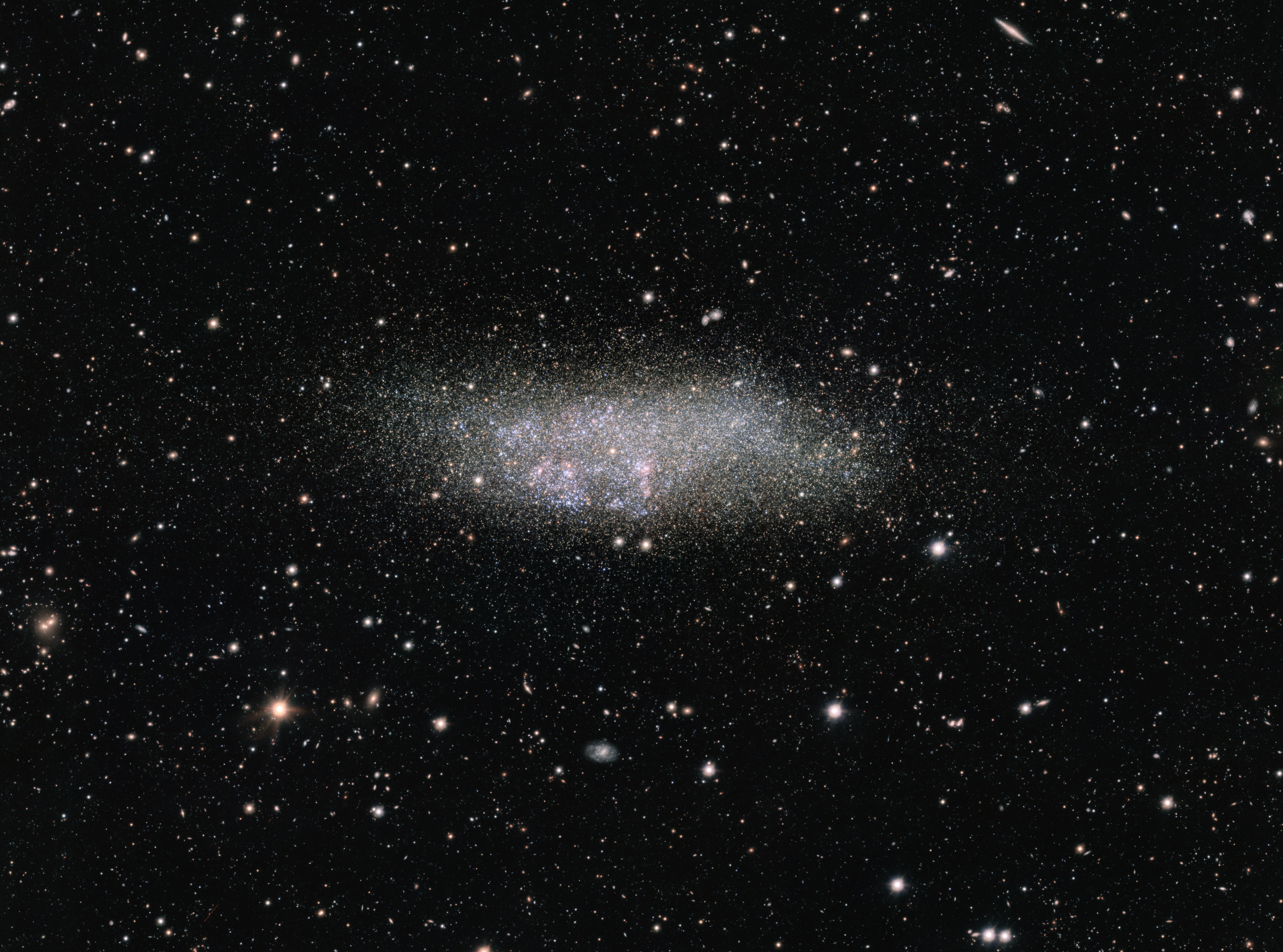
Astronomy picture of the day - 2016 April 7 - Wolf-Lundmark-Melotte
Image Credit: ESO, VST/Omegacam Local Group Survey
Explanation: Named for the three astronomers instrumental in its discovery and identification, Wolf - Lundmark - Melotte (WLM) is a lonely dwarf galaxy. Seen toward the mostly southern constellation Cetus, about 3 million light-years from the Milky Way, it is one of the most remote members of our local galaxy group. In fact, it may never have interacted with any other local group galaxy. Still, telltale pinkish star forming regions and hot, young, bluish stars speckle the isolated island universe. Older, cool yellowish stars fade into the small galaxy's halo, extending about 8,000 light-years across. This sharp portrait of WLM was captured by the 268-megapixel OmegaCAM widefield imager and survey telescope at ESO's Paranal Observatory.
2016-04-06
Ivete Sangalo - "Se eu não te amasse tanto assim/Eu sei que vou te amar" - Video - Musica - Ao vivo
"Se eu não te amasse tanto assim/Eu sei que vou te amar"
Inscription à :
Commentaires (Atom)