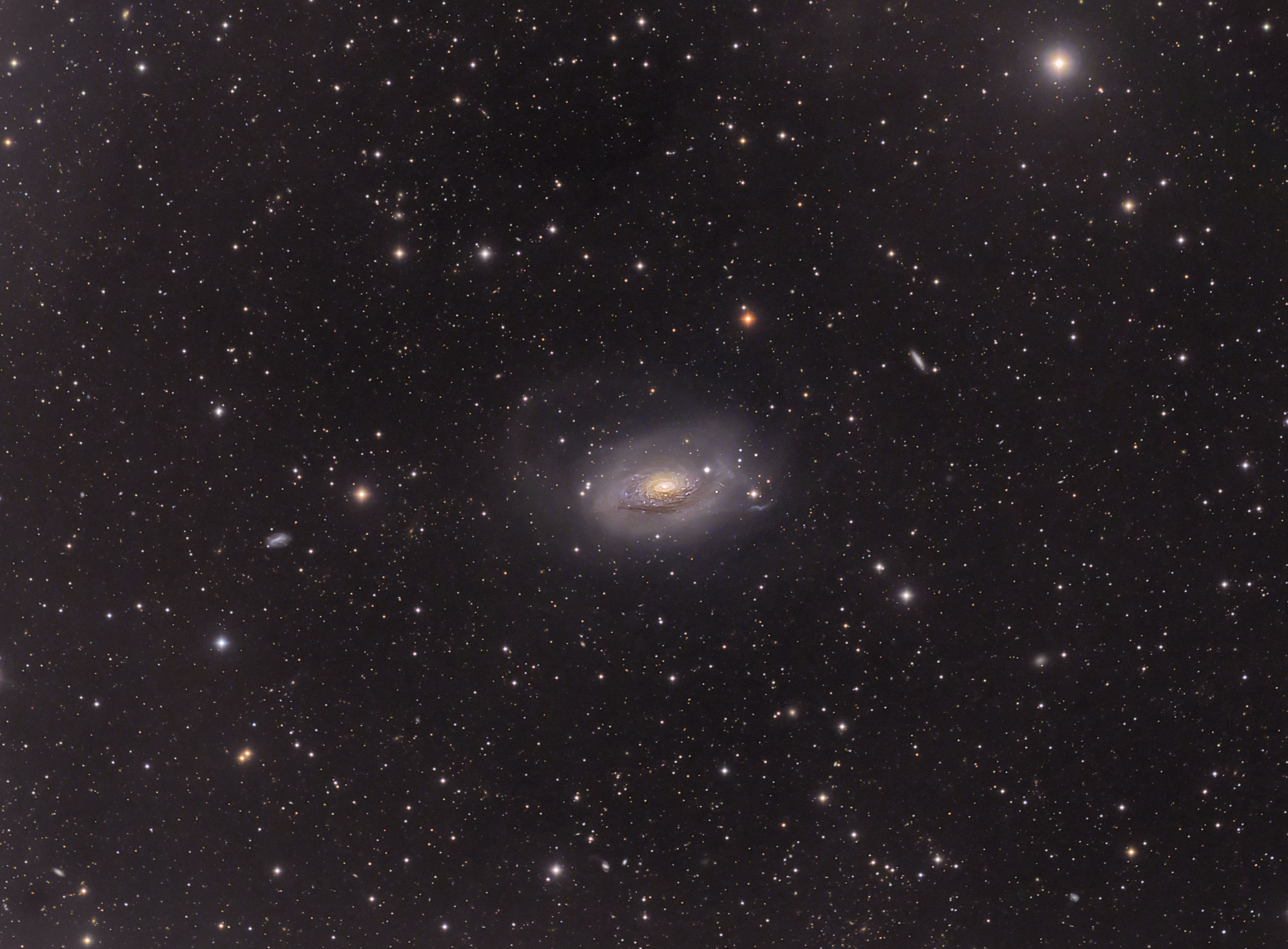
Explanation: The Sunflower Galaxy blooms near the center of this wide field telescopic view. The scene spans about 2 degrees or 4 full moons on the sky toward the loyal constellation Canes Venatici. More formally known as Messier 63, the majestic island universe is nearly 100,000 light-years across, about the size of our own Milky Way Galaxy. Surrounding its bright yellowish core, sweeping spiral arms are streaked with cosmic dust lanes and dotted with star forming regions. A dominant member of a known galaxy group, M63 has faint, extended features that could be the the remains of dwarf satellite galaxies, evidence that large galaxies grow by accreting small ones. M63 shines across the electromagnetic spectrum and is thought to have undergone bursts of intense star formation.
Esta noite sobrevoando Nova Iorque, quase ia acordando desfazendo meu sonho...
Mas no assento do lado o vizinho ressonava. Voltei ao meu sonho de paz e serenidade. Havia nuvens escondidas no céu e meu pensamento deslizava puro, sem intromissões mesmo de lights que iam desaparecendo...
Nem via aquela lua tão linda iluminando os rostos de pessoas alheias ao voo ...
Confesso que voar de noite sem ruidos parasitas, alheio a tudo que interfira com sonhos, é um previlégio, uma felicidade!
Do fundo das estrelas do Paraíso, que as primeiras luzes da Manhã iriam apagar, já nascia o sol; a vida, apagava o sonho. Os motores da nave iriam confundir-se, dentro de instantes, com os rumores sobrevoados…
Difícil deixar um sonho; mas, maravilha! Agora "O Corcovado", Guanabara, o Pão de… Acucar! Que doçura deliciosa… Estava chegando ao Brasil. Terra amada; tal Pedro Alvares Cabral senti um perfume de paraíso que jamais esquecerei. Meu Rio, meu Janeiro, meu Brasil brasileiro. "Minha saudade"!
Explanation: What if you climbed up on a rock and discovered the Universe? You can. Although others have noted much of it before, you can locate for yourself stars, planets, and even the plane of our Milky Way Galaxy. All you need is a dark clear sky -- the rock is optional. If you have a camera, you can further image faint nebulas, galaxies, and long filaments of interstellar dust. If you can process digital images, you can bring out faint features, highlight specific colors, and merge foreground and background images. In fact, an industrious astrophotographer has done all of these to create the presented picture. All of the component images were taken early last month on the same night within a few meters of each other. The picturesque setting was Sand Beach in Stonington, Maine, USA with the camera pointed south over Penobscot Bay.
Dos pequeñas crías de tigre de Bengala, con apenas un mes de vida, juegan dentro de una jaula en un zoo de Medan, en la región de Sumatra del Norte (Indonesia).
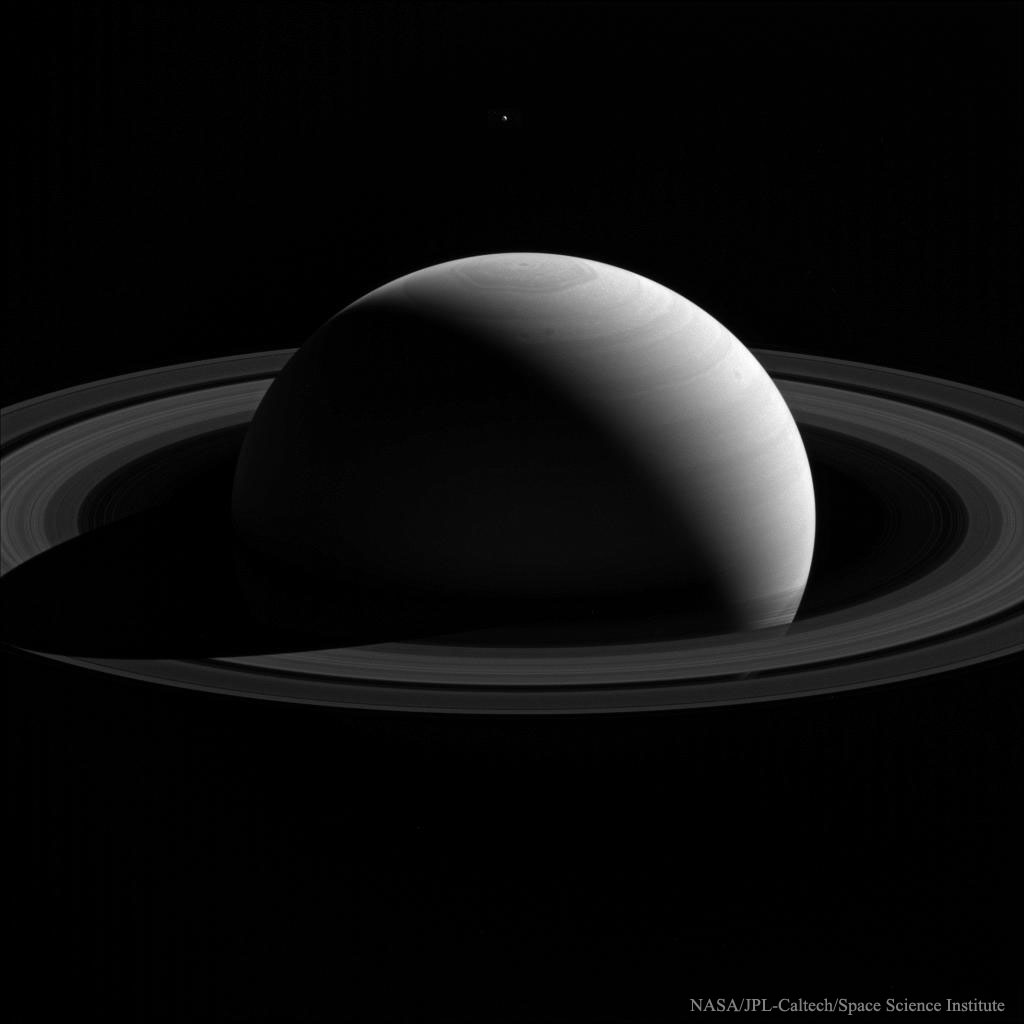
Explanation: What's behind Saturn? The first answer is the camera itself, perched on the Cassini spacecraft currently orbiting behind the planet with the most grand ring system in our Solar System. The unusual perspective places Cassini on the far side of Saturn from the Sun so that more than half of Saturn appears dark -- a perspective that no Earth-based observer could achieve. Behind Saturn, in the context of the featured infrared image, is Saturn's moon Tethys, visible as the small speck above the unusual hexagonal cloud pattern that encompasses Saturn's North Pole. Tethys actually orbits Saturn right in the ring plane, which places the 1000-km moon much farther from Cassini than the planet itself. Cassini has been studying Saturn and its moons for 12 years, but, unfortunately, its amazing mission will soon come to an end. In order to protect life that may exist on or inside Saturn's moons, the robotic spacecraft will be directed to crash into Saturn's thick atmosphere next September.