"Summer in the city"
2016-08-31
Brasil: azeite falsificado com alegada origem portuguesa
A Proteste Brasil – Associação de Consumidores testou 19 marcas de azeite extra virgem e descobriu que quatro são uma mistura de óleos refinados, entre as quais se encontram, alegadamente, três de origem portuguesa.
A notícia, avançada hoje pela TSF, refere que o Brasil compra azeite falsificado como sendo português, indicando que a Proteste brasileira detetou pelo menos três marcas portuguesas adulteradas ou contendo informação errada no rótulo, nomeadamente a Beirão, Figueira da Foz e Tradição.
De acordo com a TSF, duas marcas são falsificações, enquanto a outra é azeite virgem vendido como extra virgem. As marcas falsificadas dizem no rótulo que se trata de "azeite português", mas são engarrafadas no Brasil e podem ter outra origem.
Segundo apurou a TSF, as duas marcas vendidas como azeite português - Tradição e Figueira da Foz - "são na verdade contrafações, tratando-se de misturas de óleos vegetais que não são extraídos da azeitona", segundo avançou a advogada da Proteste Brasil Lívia Coelho.
No caso do azeite Beirão, o único embalado em Portugal, é azeite virgem vendido com a classificação de extra virgem.
A Proteste Brasil recomenda aos brasileiros que não comprem este azeite, ao mesmo tempo que enviou as análises realizadas para o Ministério Público brasileiro.
TVI 24 - Portugal
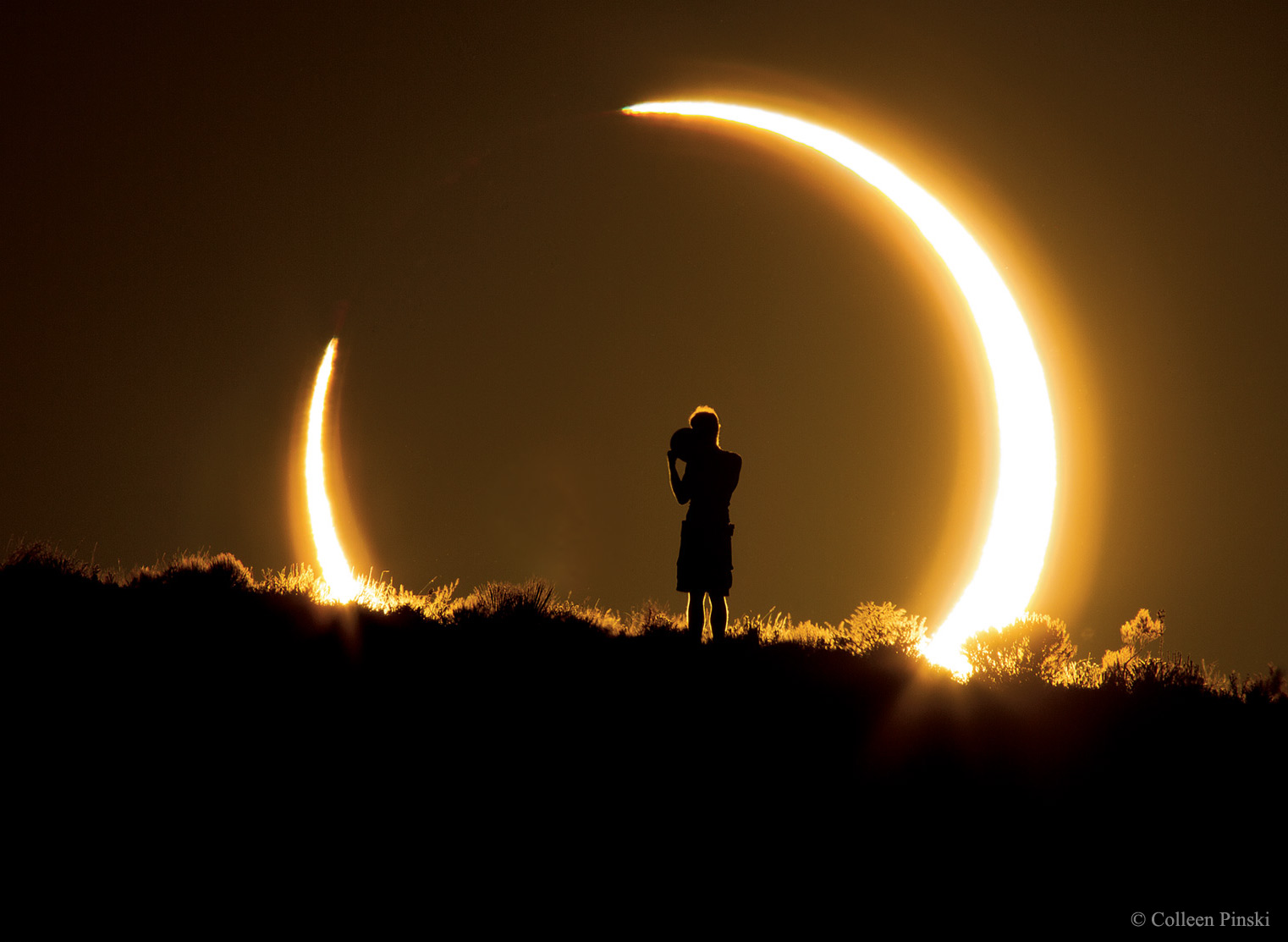
Astronomy picture of the day - 2016 August 31 - Annular Solar Eclipse over New Mexico
Image Credit & Copyright: Colleen Pinski
Explanation: What is this person doing? In 2012 an annular eclipse of the Sun was visible over a narrow path that crossed the northern Pacific Ocean and several western US states. In an annular solar eclipse, the Moon is too far from the Earth to block out the entire Sun, leaving the Sun peeking out over the Moon's disk in a ring of fire. To capture this unusual solar event, an industrious photographer drove from Arizona to New Mexico to find just the right vista. After setting up and just as the eclipsed Sun was setting over a ridge about 2.5 kilometers away, a person unknowingly walked right into the shot. Although grateful for the unexpected human element, the photographer never learned the identity of the silhouetted interloper. It appears likely, though, that the person is holding a circular device that would enable them to get their own view of the eclipse. The shot was taken at sunset on 2012 May 20 at 7:36 pm local time from a park near Albuquerque, New Mexico, USA. Tomorrow another annular solar eclipse will become visible, this time along a path crossing Africa and Madagascar.
2016-08-30
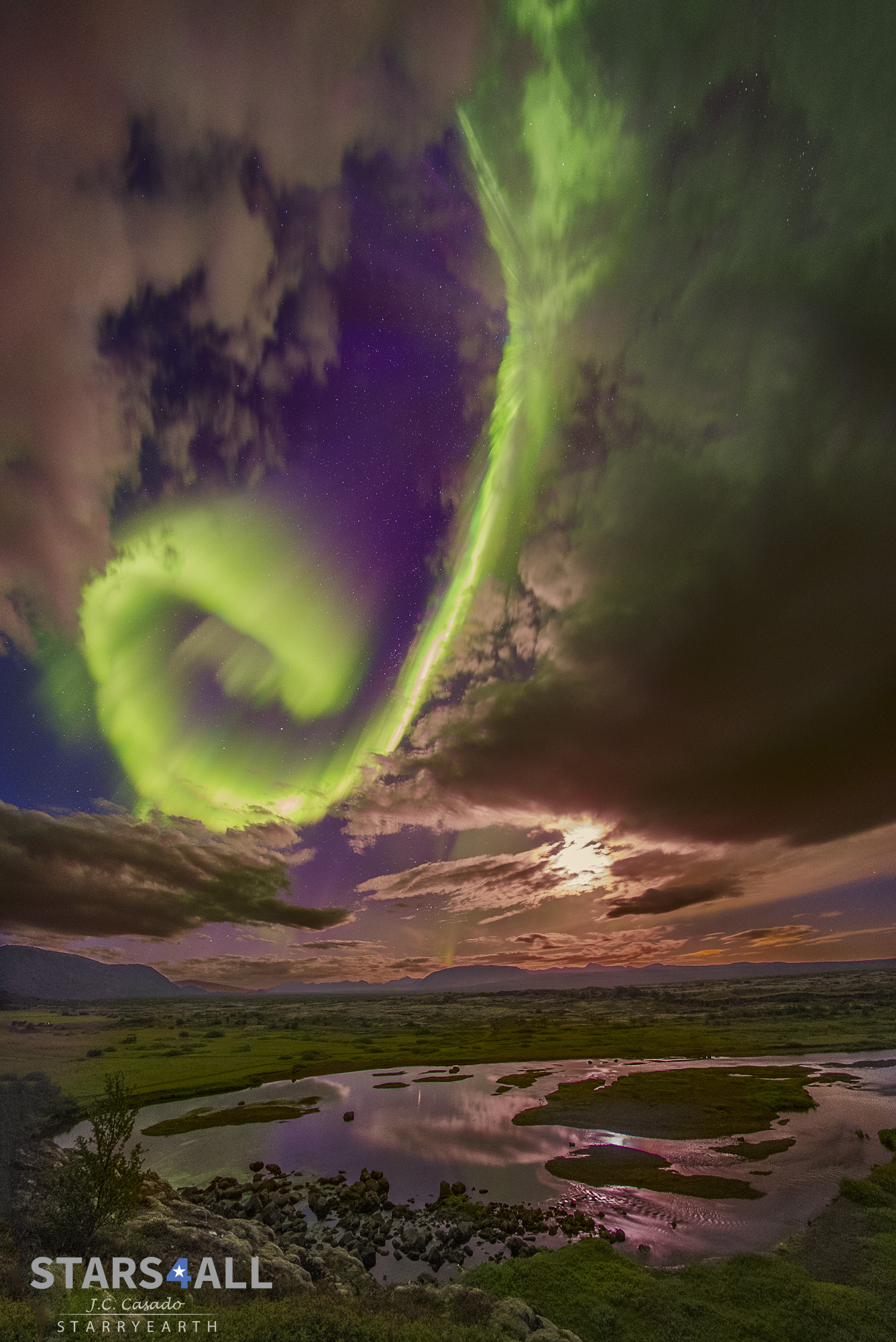
Astronomy picture of the day - 2016 August 30 - Aurora over Icelandic Fault
Image Credit & Copyright: Juan Carlos Casado (TWAN, Earth and Stars)
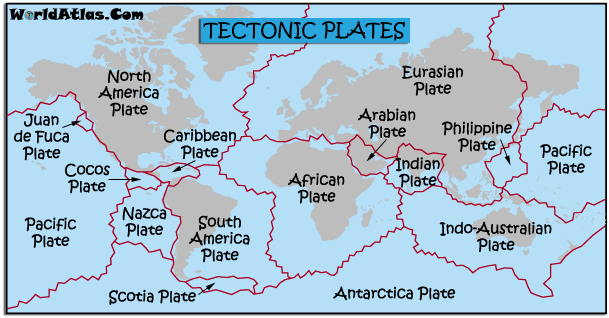
Explanation: Admire the beauty but fear the beast. The beauty is the aurora overhead, here taking the form of great green spiral, seen between picturesque clouds with the bright Moon to the side and stars in the background. The beast is the wave of charged particles that creates the aurora but might, one day, impair civilization. Exactly this week in 1859, following notable auroras seen all across the globe, a pulse of charged particles from a coronal mass ejection (CME) associated with a solar flare impacted Earth's magnetosphere so forcefully that they created the Carrington Event. A relatively direct path between the Sun and the Earth might have been cleared by a preceding CME. What is sure is that the Carrington Event compressed the Earth's magnetic field so violently that currents were created in telegraph wires so great that many wires sparked and gave telegraph operators shocks. Were a Carrington-classevent to impact the Earth today, speculation holds that damage might occur to global power grids and electronics on a scale never yet experienced. The featured aurora was imaged last week over Thingvallavatn Lake in Iceland, a lake that partly fills a fault that divides Earth's large Eurasian and North American tectonic plates.
2016-08-29
Fotos incriveis do passado - Bébé suspenso nas alturas
Era comum colocar bebês em gaiolas do lado de fora do apartamento para eles tomarem ar fresco e receber luz solar. EUA, 1937
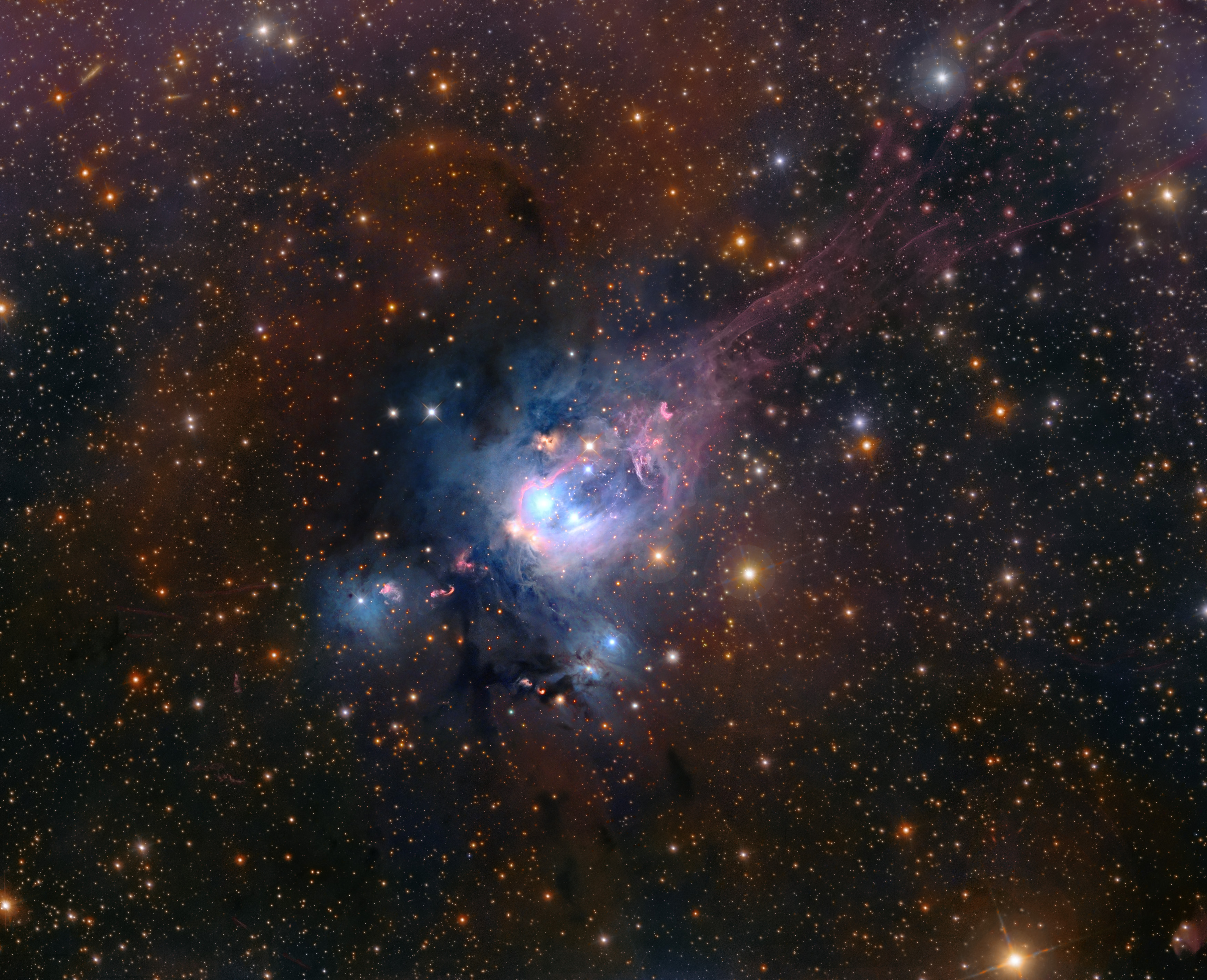
Astronomy picture of the day - 2016 August 29 - Young Suns of NGC 7129
Image Credit & Copyright: Robert Gendler,
Roberto Colombari, Eric Recurt, Adam Block - Additional Data: Subaru (NAOJ)
Explanation: Young suns still lie within dusty NGC 7129, some 3,000 light-years away toward the royal constellation Cepheus. While these stars are at a relatively tender age, only a few million years old, it is likely that our own Sun formed in a similar stellar nursery some five billion years ago. Most noticeable in the sharp image are the lovely bluish dust clouds that reflect the youthful starlight. But the compact, deep red crescent shapes are also markers of energetic, young stellar objects. Known as Herbig-Haro objects, their shape and color is characteristic of glowing hydrogen gas shocked by jets streaming away from newborn stars. Paler, extended filaments of reddish emissionmingling with the bluish clouds are caused by dust grains effectively converting the invisible ultraviolet starlight to visible red light through photoluminesence. Ultimately the natal gas and dust in the region will be dispersed, the stars drifting apart as the loose cluster orbits the center of the Galaxy. The processing of this remarkable composite image has revealed the faint red strands of emission at the upper right. They are recently recognized as a likely supernova remnantand are currently being analyzed by Bo Reipurth (Univ. Hawaii) who obtained the image data at the Subaru telescope. At the estimated distance of NGC 7129, this telescopic view spans over 40 light-years.
2016-08-28
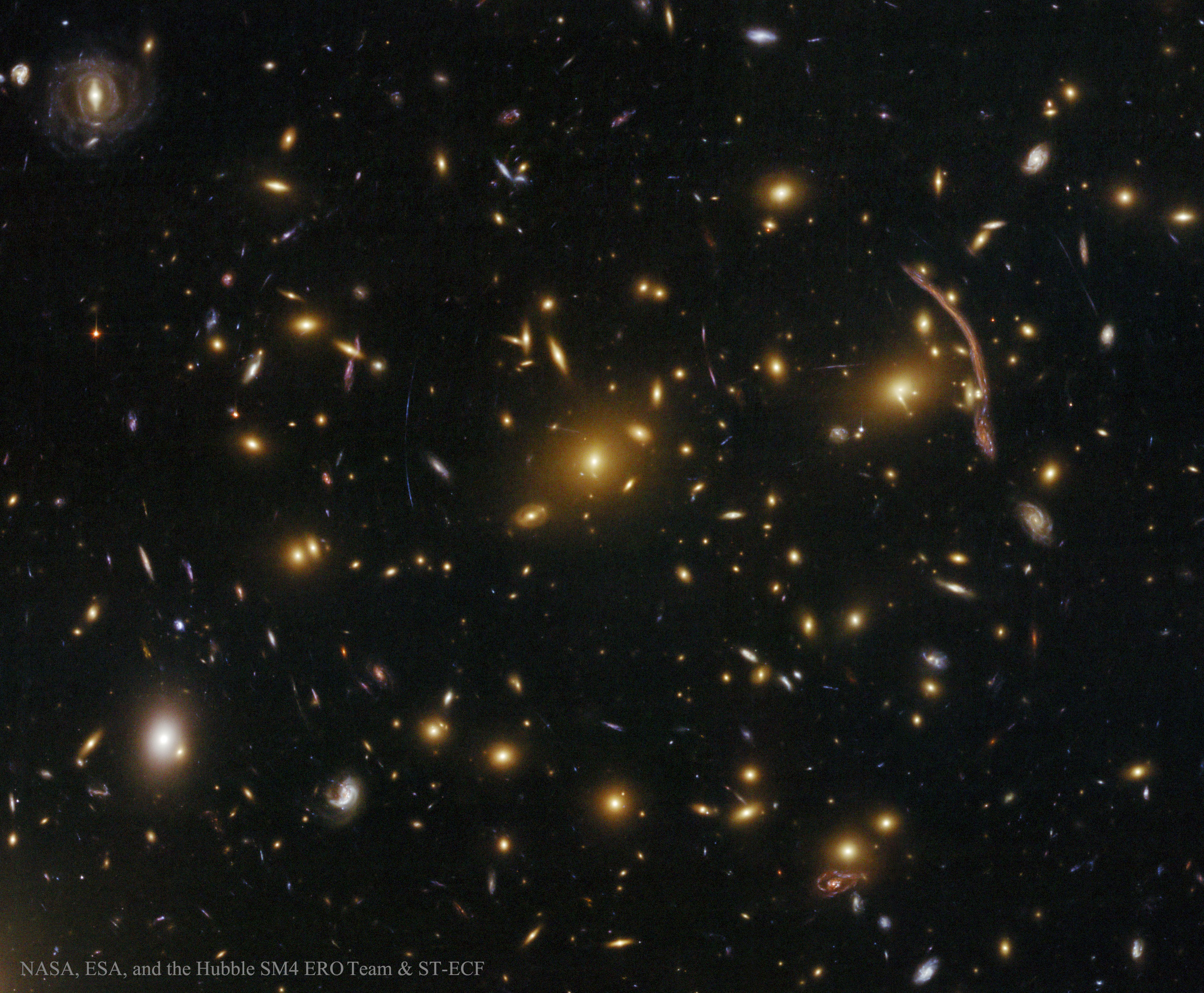
Astronomy picture of the day - 2016 August 28 - Abell 370: Galaxy Cluster Gravitational Lens
Image Credit: NASA, ESA, and the Hubble SM4 ERO Team & ST-ECF
Explanation: What is that strange arc? While imaging the cluster of galaxies Abell 370, astronomers had noted an unusual arc to the right of many cluster galaxies. Although curious, one initial response was to avoid commenting on the arc because nothing like it had ever been noted before. In the mid-1980s, however, better images allowed astronomers to identify the arc as a prototype of a new kind of astrophysical phenomenon -- the gravitational lens effect of entire cluster of galaxies on background galaxies. Today, we know that this arc actually consists of two distorted images of a fairly normal galaxy that happened to lie far behind the huge cluster. Abell 370's gravity caused the background galaxies' light -- and others -- to spread out and come to the observer along multiple paths, not unlike a distant light appears through the stem of a wine glass. In mid-July of 2009, astronomers used the then just-upgraded Hubble Space Telescope to image Abell 370 and its gravitational lens images in unprecedented detail. Almost all of the yellow images featured here are galaxies in the Abell 370 cluster. An astute eye can pick up many strange arcs anddistorted arclets, however, that are actually images of more distant galaxies. Studying Abell 370 and its images gives astronomers a unique window into the distribution of normal and dark matter in galaxy clusters and the universe.
2016-08-27
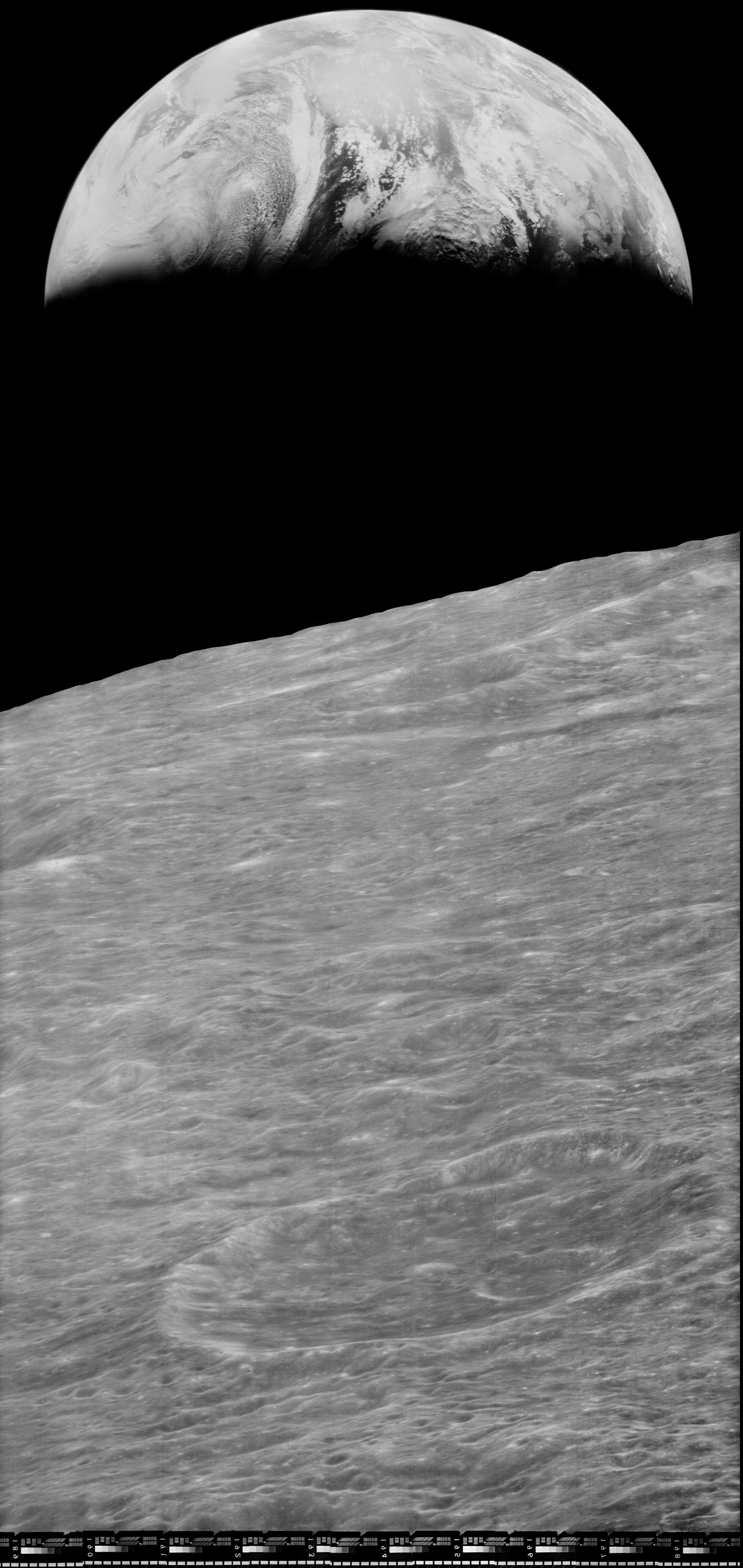
Astronomy picture of the day - 2016 August 27 - Lunar Orbiter Earthset
Image Credit: NASA / Lunar Orbiter Image Recovery Project
Explanation: August 10th was the 50th anniversary of the launch of Lunar Orbiter 1. It was the first of five Lunar Orbiters intended to photograph the Moon's surface to aid in the selection of future landing sites. That spacecraft's camera captured the data used in this restored, high-resolution version of its historic first image of Earth from the Moon on August 23, 1966 while on its 16th lunar orbit. Hanging almost stationary in the sky when viewed from the lunar surface, Earth appears to be setting beyond the rugged lunar horizon from the perspective of the orbiting spacecraft. Two years later, the Apollo 8 crew would record a more famous scene in color: Earthrise from lunar orbit.
Inscription à :
Commentaires (Atom)