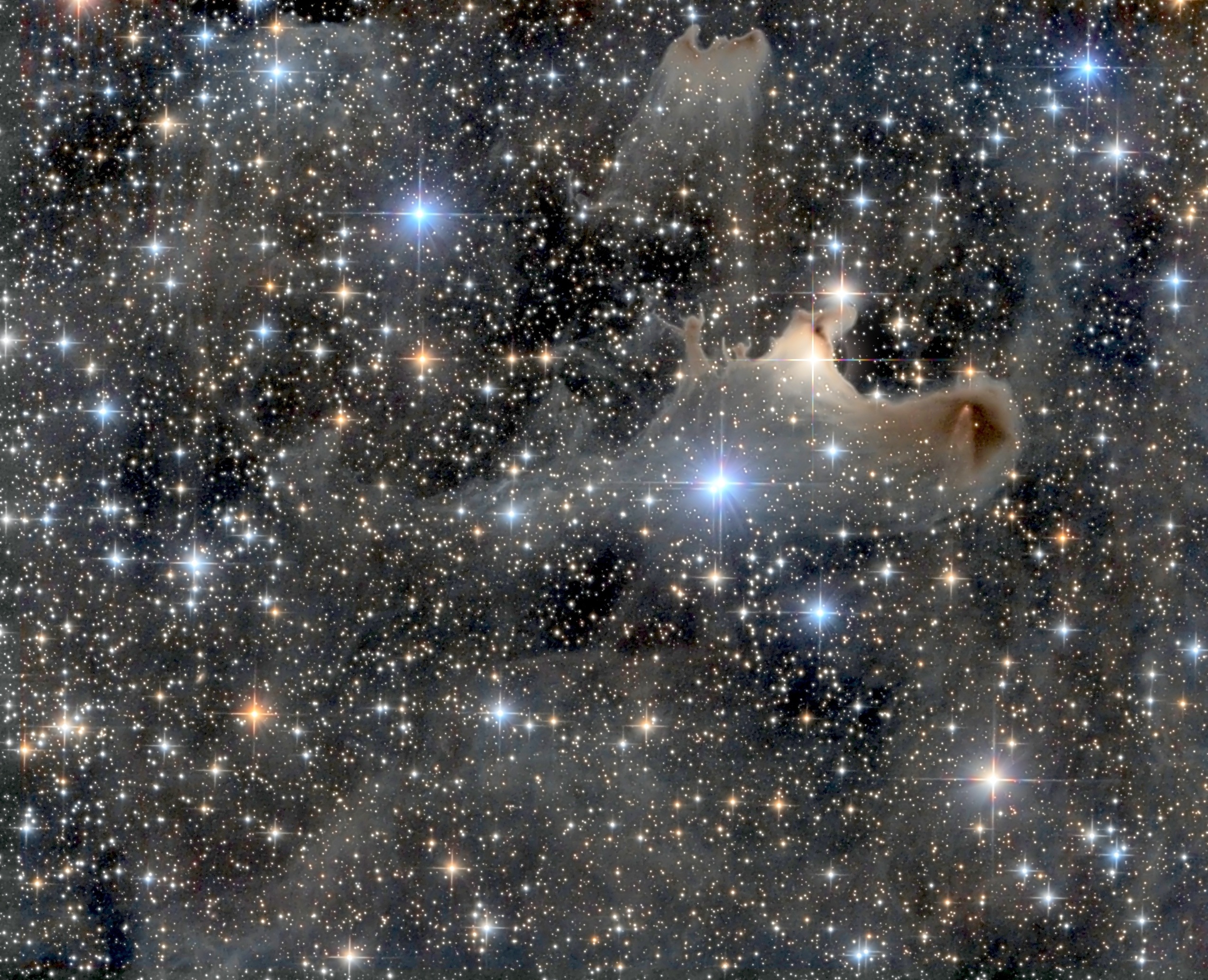
Explanation: Spooky shapes seem to haunt this jeweled expanse, drifting through the night in the royal constellation Cepheus. Of course, the shapes are cosmic dust clouds faintly visible in dimly reflected starlight. Far from your own neighborhood on planet Earth, they lurk along the plane of the Milky Way at the edge of the Cepheus Flare molecular cloud complex some 1,200 light-years away. Over 2 light-years across and brighter than the other ghostly apparitions, vdB 141 or Sh2-136 is also known as the Ghost Nebula, seen at the right of the starry field of view. Within the nebula are the telltale signs of dense cores collapsing in the early stages of star formation.
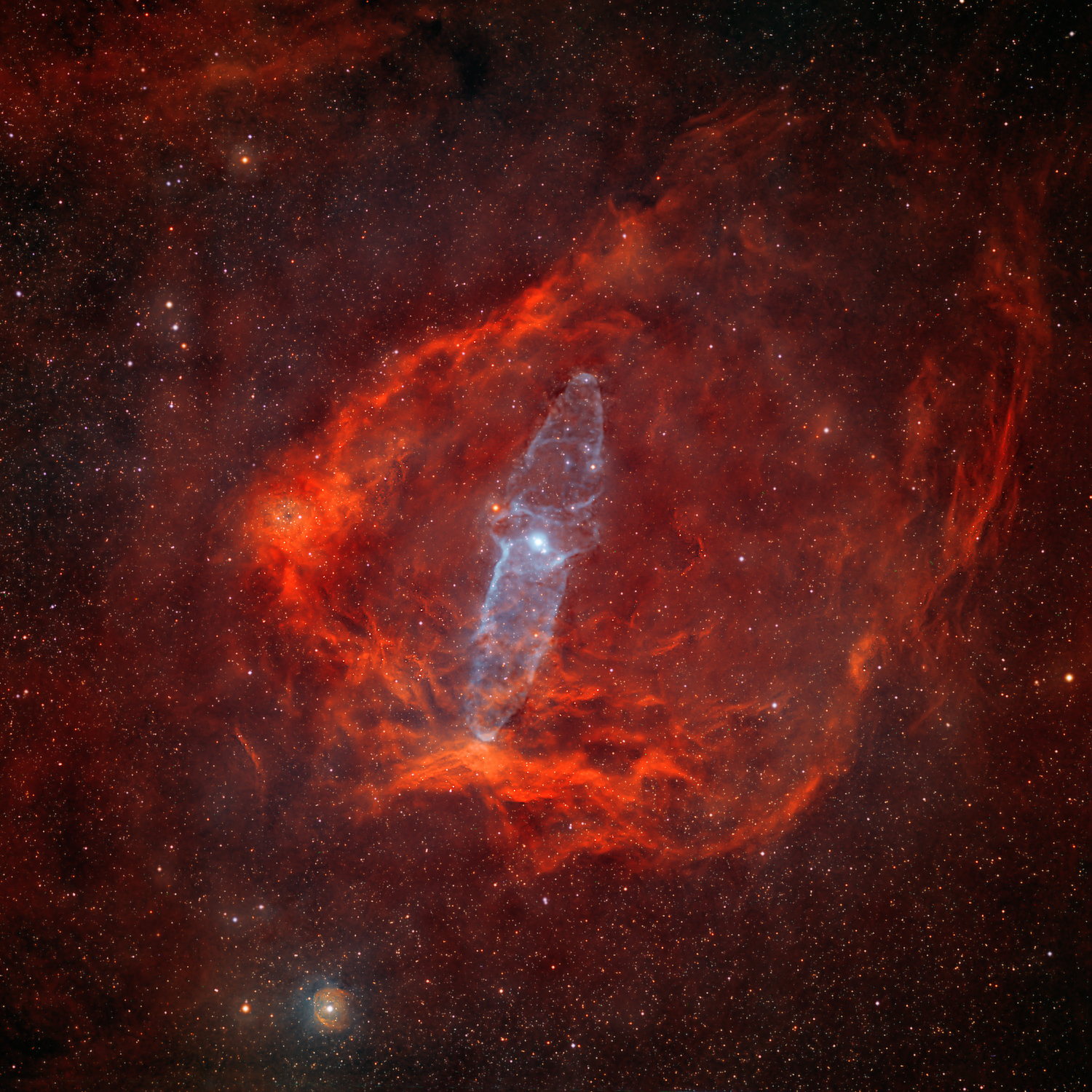
Explanation: Very faint but also very large on planet Earth's sky, a giant Squid Nebula cataloged as Ou4, and Sh2-129 also known as the Flying Bat Nebula, are both caught in this cosmic scene toward the royal constellation Cepheus. Composed with almost 17 hours of narrowband image data, the telescopic field of view is 4 degrees or 8 Full Moons across. Discovered in 2011 by French astro-imager Nicolas Outters, the Squid Nebula's alluring bipolar shape is distinguished here by the telltale blue-green emission from doubly ionized oxygen atoms. Though apparently completely surrounded by the reddish hydrogen emission region Sh2-129, the true distance and nature of the Squid Nebula have been difficult to determine. Still, a recent investigation suggests Ou4 really does lie within Sh2-129 some 2,300 light-years away. Consistent with that scenario, Ou4 would represent a spectacular outflow driven by HR8119, a triple system of hot, massive stars seen near the center of the nebula. The truly giant Squid Nebula would physically be nearly 50 light-years across.
Explanation: What created these unusually long shadows on Saturn's rings? The dark shadows -- visible near the middle of the image -- extend opposite the Sun and, given their length, stem from objects having heights up to a few kilometers. The long shadows were unexpected given that the usual thickness of Saturn's A and B rings is only about 10 meters. After considering the choppy but elongated shapes apparent near the B-ring edge, however, a leading theory has emerged that some kilometer-sized moonlets exist there that have enough gravity to create even larger vertical deflections of nearby small ring particles. The resulting ring waves are called propellers, named for how they appear individually. It is these coherent groups of smaller ring particles that are hypothesized to be casting the long shadows. The featured image was taken by the robotic Cassini spacecraft currently orbiting Saturn. The image was captured in 2009, near Saturn's equinox, when sunlight streamed directly over the ring plane and caused the longest shadows to be cast.
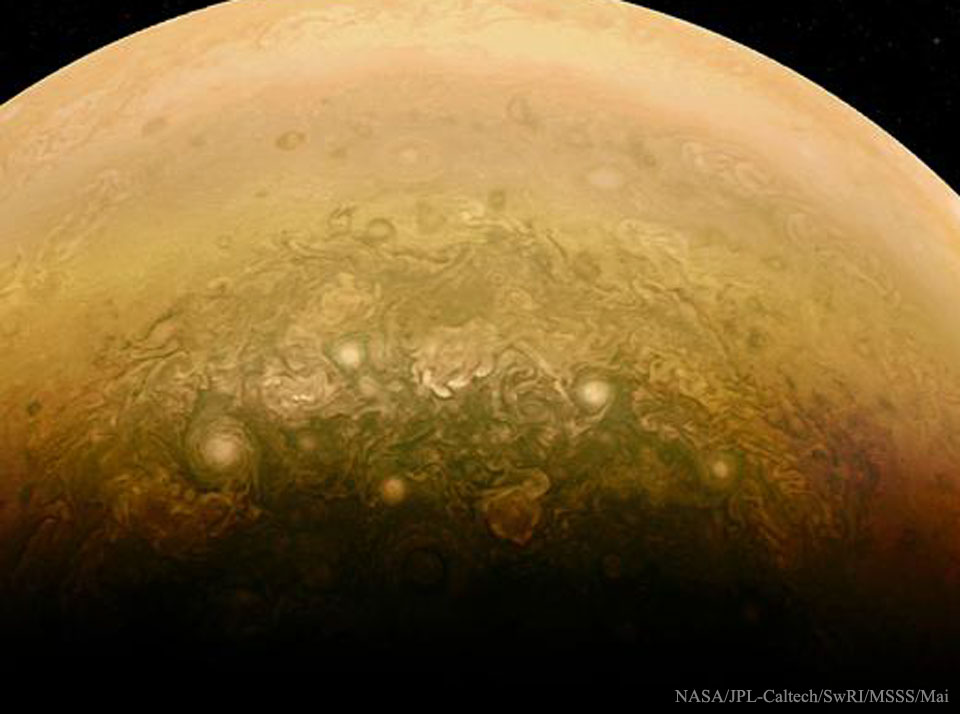
Clouds Near Jupiter's South Pole from Juno Image Credit: NASA, JPL-Caltech, SwRI, MSSS; Processing & CC-BY: Alex Mai
Explanation: What's happening near the south pole of Jupiter? Recent images sent back by NASA's robotic Juno spacecraft are showing an interesting conglomeration of swirling clouds and what appear to be white ovals. Juno arrived at Jupiter in July and is being placed into a wide, looping orbit that will bring it near the gas giant -- and over its poles -- about twice a month. The featured image is a composite taken by JunoCam and post-processed by a digitally savvy citizen scientist. White ovals have been observed elsewhere on Jupiter and are thought to be giant storm systems. They have been observed to last for years, while typically showing Category 5 wind speeds of around 350 kilometers per hour. Unlike Earthly cyclones and hurricanes where high winds circle regions of low pressure, white ovals on Jupiter show rotational directions indicating that they are anticylones -- vortices centered on high pressure regions. Juno will continue to orbit Jupiter over thirty more times while recording optical, spectral, and gravitational data meant to help determine Jupiter's structure and evolution.