"Honky tonk women"
2017-01-16
Astronomy picture of the day - 2017 January 16 - Geostationary Highway through Orion
Image Credit & Copyright: James A. DeYoung
Explanation: Put a satellite in a circular orbit about 42,000 kilometers from the center of the Earth and it will orbit once in 24 hours. Because that matches Earth's rotation period, it is known as a geosynchronous orbit. If that orbit is also in the plane of the equator, the satellite will hang in the sky over a fixed location in a geostationary orbit. As predicted in the 1940s by futurist Arthur C. Clarke, geostationary orbits are in common use for communication and weather satellites, a scenario now well-known to astroimagers. Deep images of the night sky made with telescopes that follow the stars can also pick up geostationary satellites glinting in sunlight still shining far above the Earth's surface. Because they all move with the Earth's rotation against the background of stars, the satellites leave trails that seem to follow a highway across the celestial landscape. The phenomenon was captured last month in this video showingseveral satellites in geostationary orbit crossing the famous Orion Nebula.
2017-01-15
Expressões populares portuguesas - Embandeirar em arco
Significado: Manifestação efusiva de alegria.
Origem: Na Marinha, em dias de gala ou simplesmente festivos, os navios embandeiram em arco, isto é, içam pelas adriças ou cabos (vergueiros) de embandeiramento galhardetes, bandeiras e cometas quase até ao topo dos mastros, indo um dos seus extremos para a proa e outro para a popa. Assim são assinalados esses dias de regozijo ou se saúdam outros barcos que se manifestam da mesma forma.
Imagenes del Mundo - Desiertos más curiosos de la Tierra - Bryce Canyon - Utah - Estados Unidos
Una formación natural impresionante. Bryce Canyon, en el estado de Utah
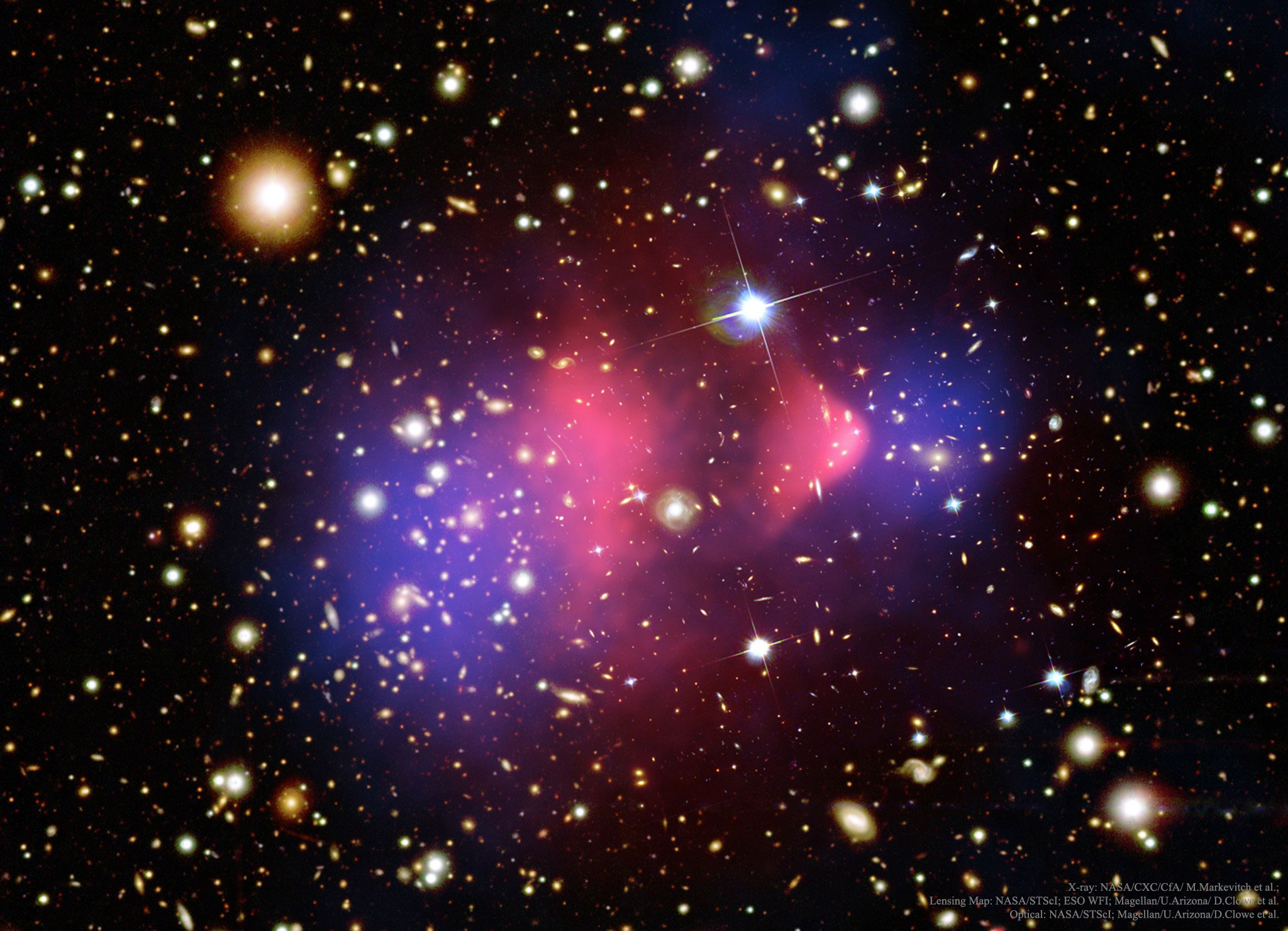
Astronomy picture of the day - 2017 January 15 - The Matter of the Bullet Cluster

Image Credit: X-ray: NASA/CXC/CfA/ M. Markevitch et al.;
Lensing Map: NASA/STScI; ESO WFI; Magellan/U.Arizona/ D.Clowe et al.
Optical: NASA/STScI; Magellan/U.Arizona/D.Clowe et al.
Explanation: What's the matter with the Bullet Cluster? This massive cluster of galaxies (1E 0657-558) creates gravitational lens distortions of background galaxies in a way that has been interpreted as strong evidence for the leading theory: that dark matter exists within. Different recent analyses, though, indicate that a less popular alternative -- modifying gravity-- could explain cluster dynamics without dark matter, and provide a more likely progenitor scenario as well. Currently, the two scientific hypotheses are competing to explain the observations: it's invisible matter versus amended gravity. The duel is dramatic as a clear Bullet-proof example of dark matter would shatter the simplicity ofmodified gravity theories. For the near future, the battle over the Bullet cluster is likely to continue as new observations, computer simulations, and analyses are completed. The featured image is a Hubble/Chandra/Magellan composite with red depicting the X-rays emitted by hot gas, and blue depicting the suggested separated dark matter distribution.
2017-01-14
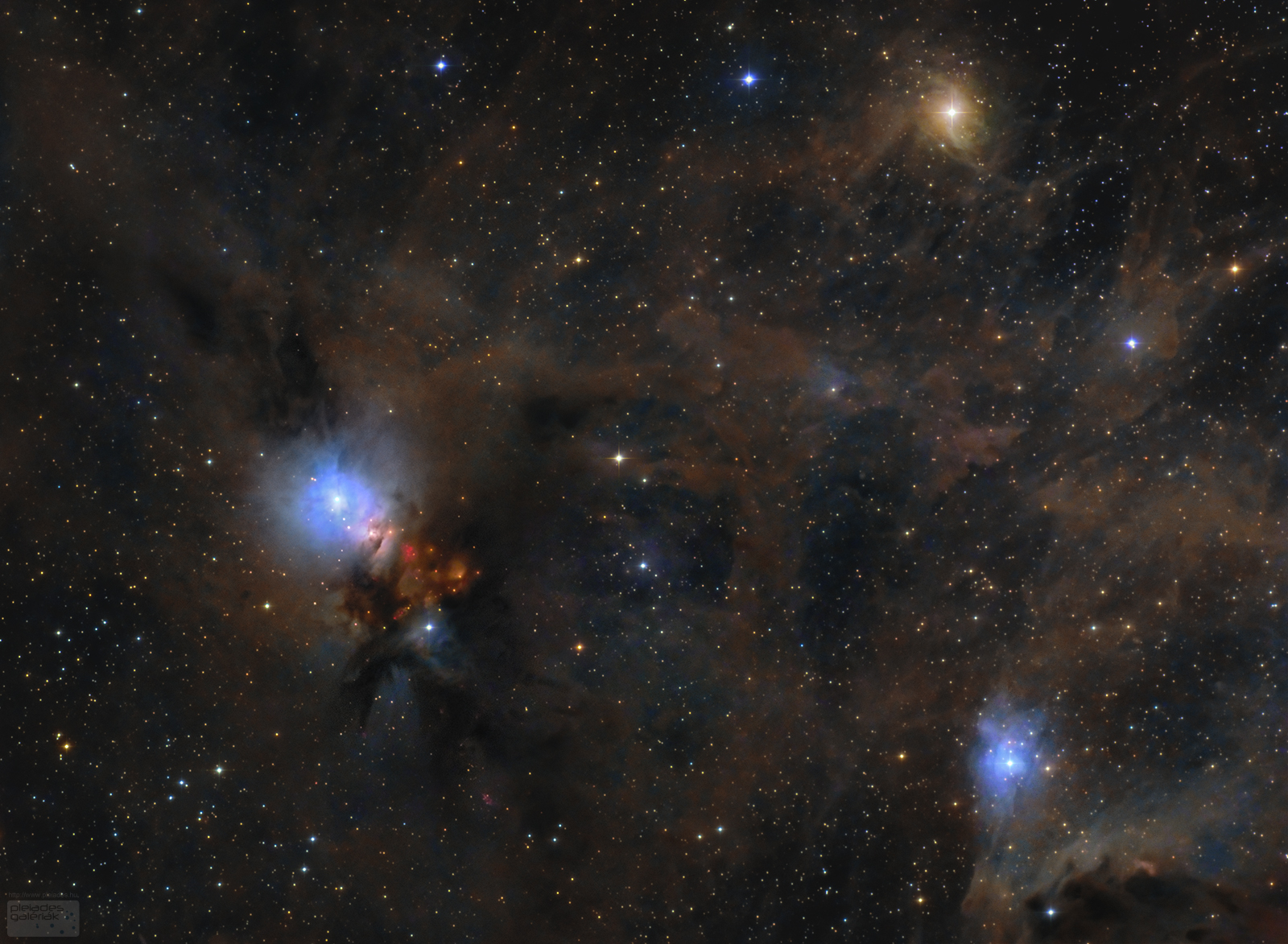
Astronomy picture of the day - 2017 January 14 - Stardust in the Perseus Molecular Cloud

Image Credit & Copyright: Lorand Fenyes
Explanation: Clouds of stardust drift through this deep skyscape. The cosmic scene spans nearly 2 degrees across the Perseus molecular cloud some 850 light-years away. A triangle of dusty nebulae reflecting light from embedded stars is captured in the telescopic field of view. With a characteristic bluish color reflection nebula NGC 1333 is at left, vdB13 at bottom right, and rare yellowish reflection nebula vdB12 lies at the top. Stars are forming in the Perseus molecular cloud, though most are obscured at visible wavelengths by the pervasive dust. Still, hints of contrasting red emission from Herbig-Haro objects, the jets and shocked glowing gas emanating from recently formed stars, are evident in NGC 1333. At the estimated distance of the molecular cloud, legs of the triangle formed by the reflection nebulae would be about 20 light-years long.
2017-01-13
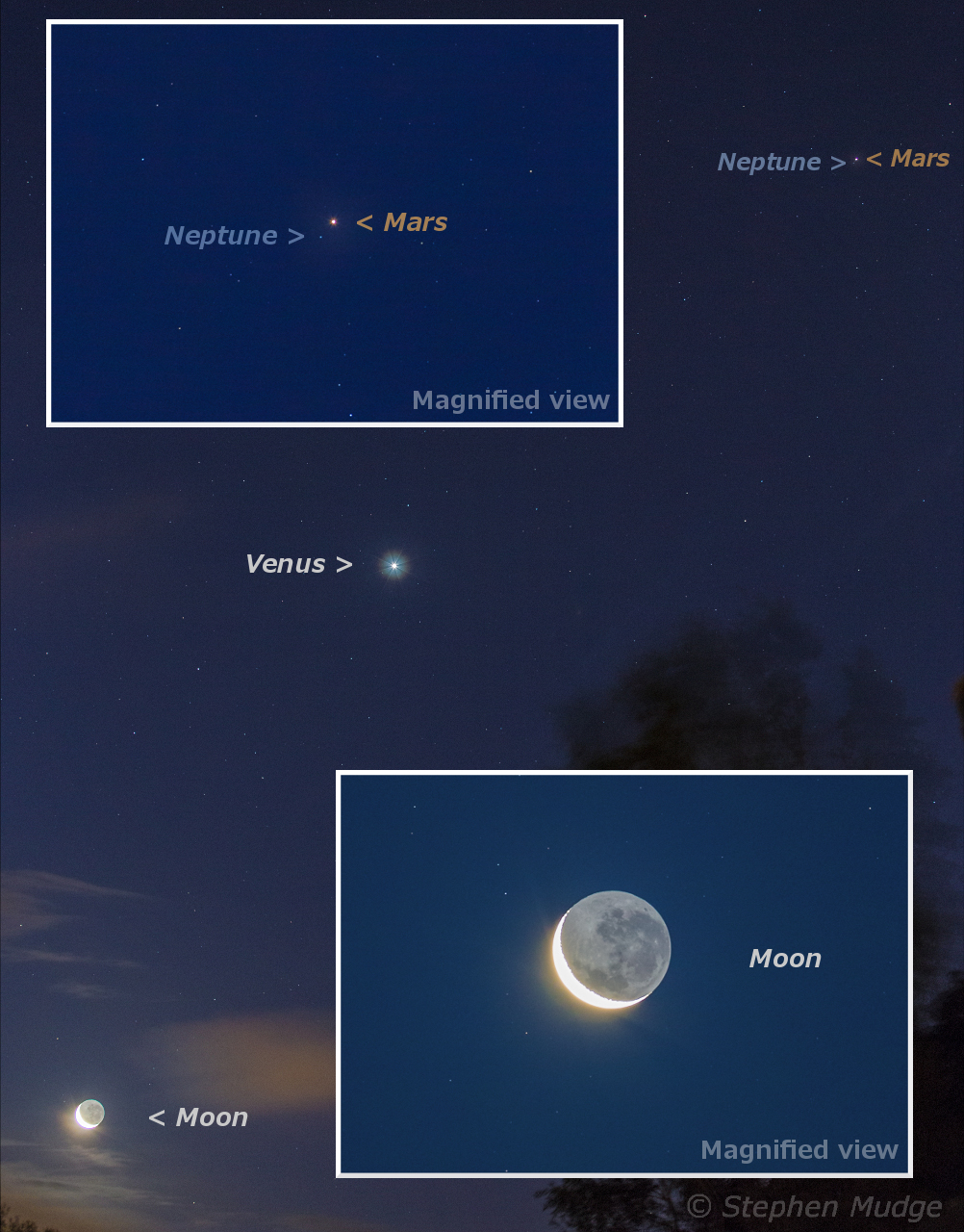
Astronomy picture of the day - 2017 January 13 - When Mars met Neptune

Image Credit & Copyright: Stephen Mudge
Explanation: On January 1, a Mars-assisted viewing opportunity allowed binocular-equipped skygazers to cross an ice giant off their life list. Remarkably, the line-of-sight to the bright Red Planet could guide you to within 0.02 degrees of a faint, pale Neptune in Earth's night skies. Taken within 3 hours of their closest conjunction, these panels capture the odd couple's appearance in skies over Brisbane, Australia. A wide field view includes the new year'sslender crescent moon near the western horizon and Venus as the brilliant evening star. Mars and Neptune are indicated at the upper right. The two inset magnified views were taken with the same telephoto lens and so do show the Mars-Neptune conjunction and the apparent size of the crescent moon at the same scale. This week Neptune hangs out near Venus on the western sky.
2017-01-12
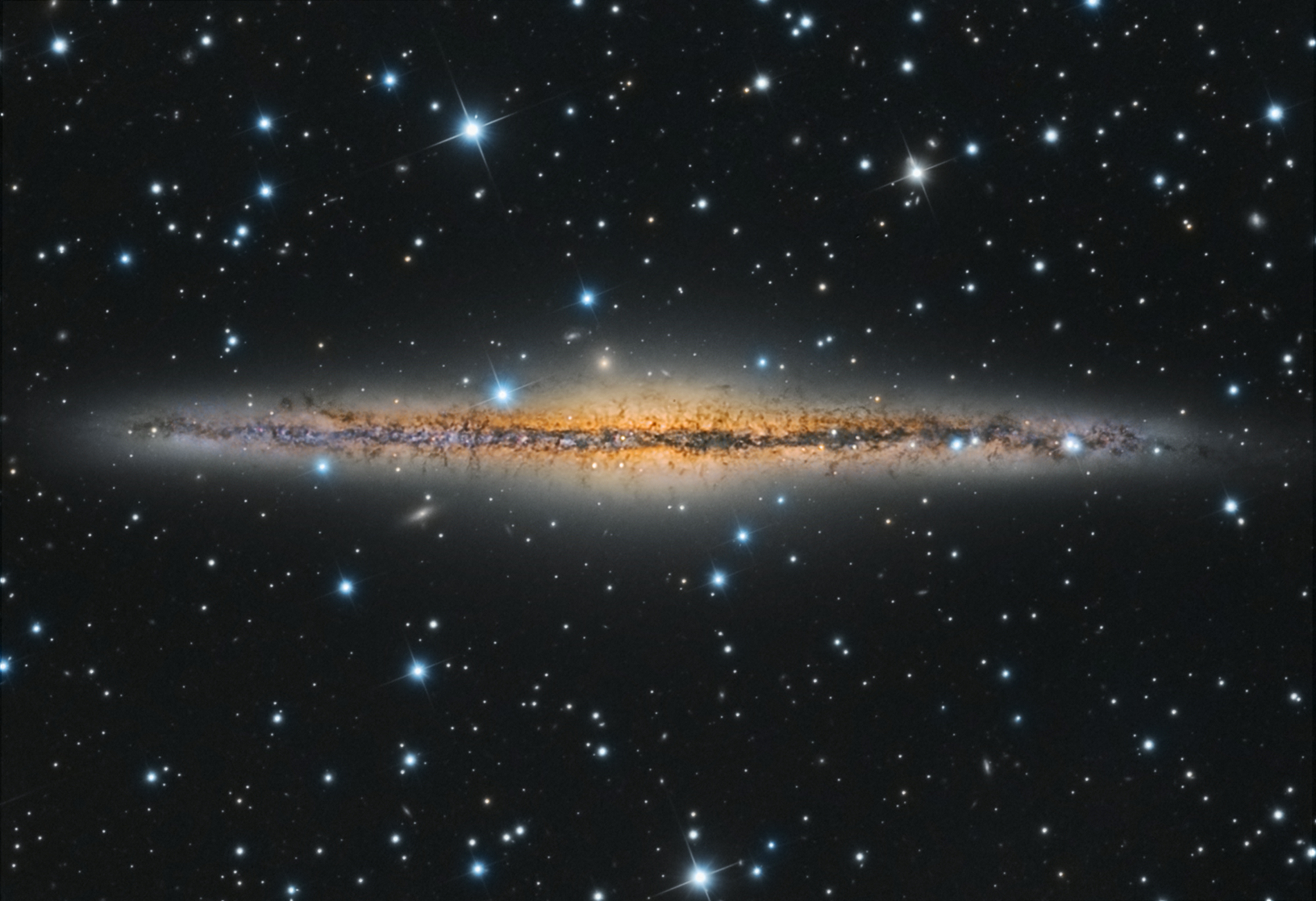
Astronomy picture of the day - 2017 January 12 - Edge-On NGC 891

Image Credit & Copyright: Alessandro Falesiedi
Explanation: Large spiral galaxy NGC 891 spans about 100 thousand light-years and is seen almost exactly edge-on from our perspective. In fact, about 30 million light-years distant in the constellation Andromeda, NGC 891 looks a lot like our Milky Way. At first glance, it has a flat, thin, galactic disk of stars and a central bulge cut along the middle by regions of dark obscuring dust. But remarkably apparent in NGC 891's edge-on presentation are filaments of dust that extend hundreds of light-years above and below the center line. The dust has likely been blown out of the disk by supernova explosions or intense star formation activity. Fainter galaxies can also be seen near the edge-on disk in this deep portrait of NGC 891.
2017-01-11
Astronomy picture of the day - 2017 January 11 - Mimas, Crater, and Mountain

Image Credit: Cassini Imaging Team, SSI, JPL, ESA, NASA
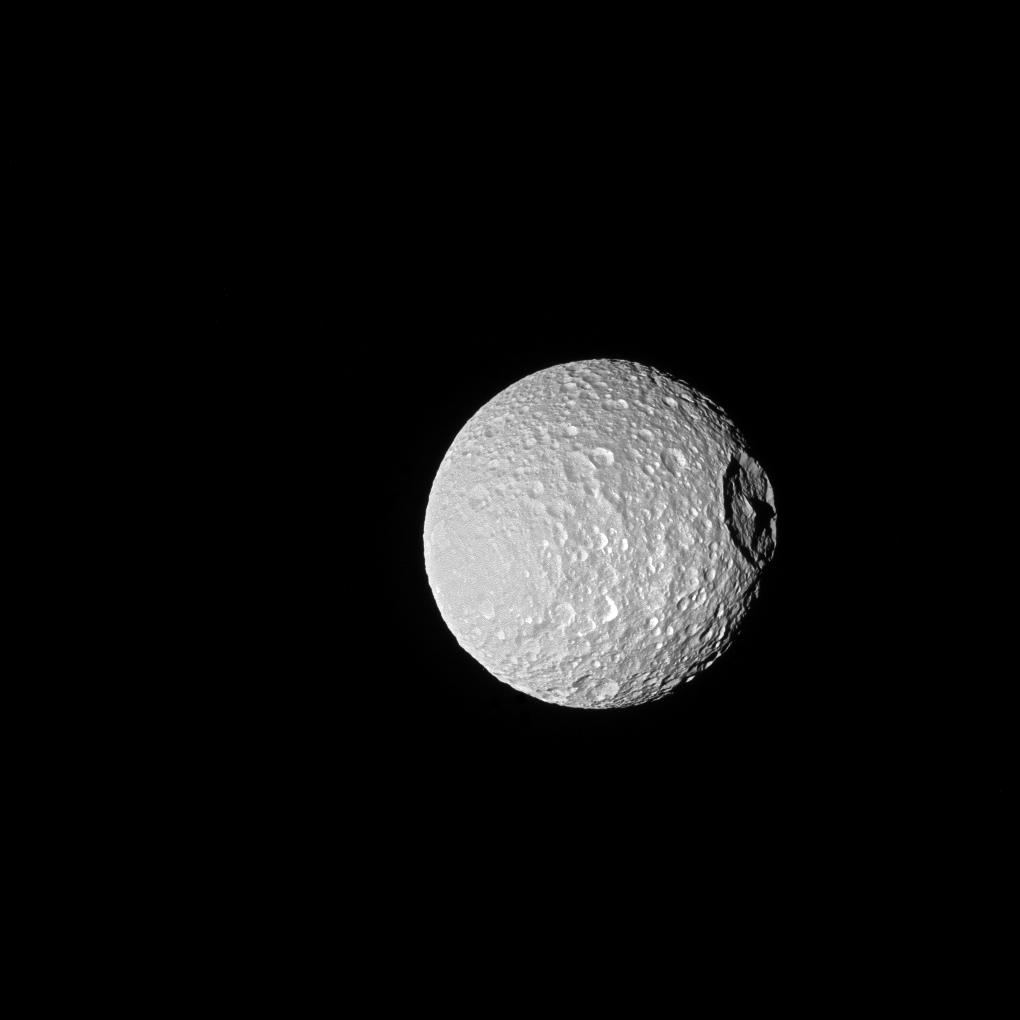
Explanation: Mimas is an icy, crater-pocked moon of Saturn a mere 400 kilometers (250 miles) in diameter. Its largest crater Herschel is nearly 140 kilometers wide. About a third the diameter of Mimas itself, Herschel crater gives the small moon an ominous appearance, especially for scifi fans of the Death Star battlestation of Star Wars fame. In fact, only a slightly bigger impact than the one that created such a large crater on a small moon could have destroyed Mimas entirely. In this Cassini image from October 2016, the anti-Saturn hemisphere of the synchronously rotating moon is bathed in sunlight, its large crater near the right limb. Casting a long shadow across the crater floor, Herschel's central mountain peak is nearly as tall as Mount Everest on planet Earth.
2017-01-10
Astronomy picture of the day - 2017 January 10 - Sentinels of a Northern Sky

Image Credit & Copyright: Pierre Destribats
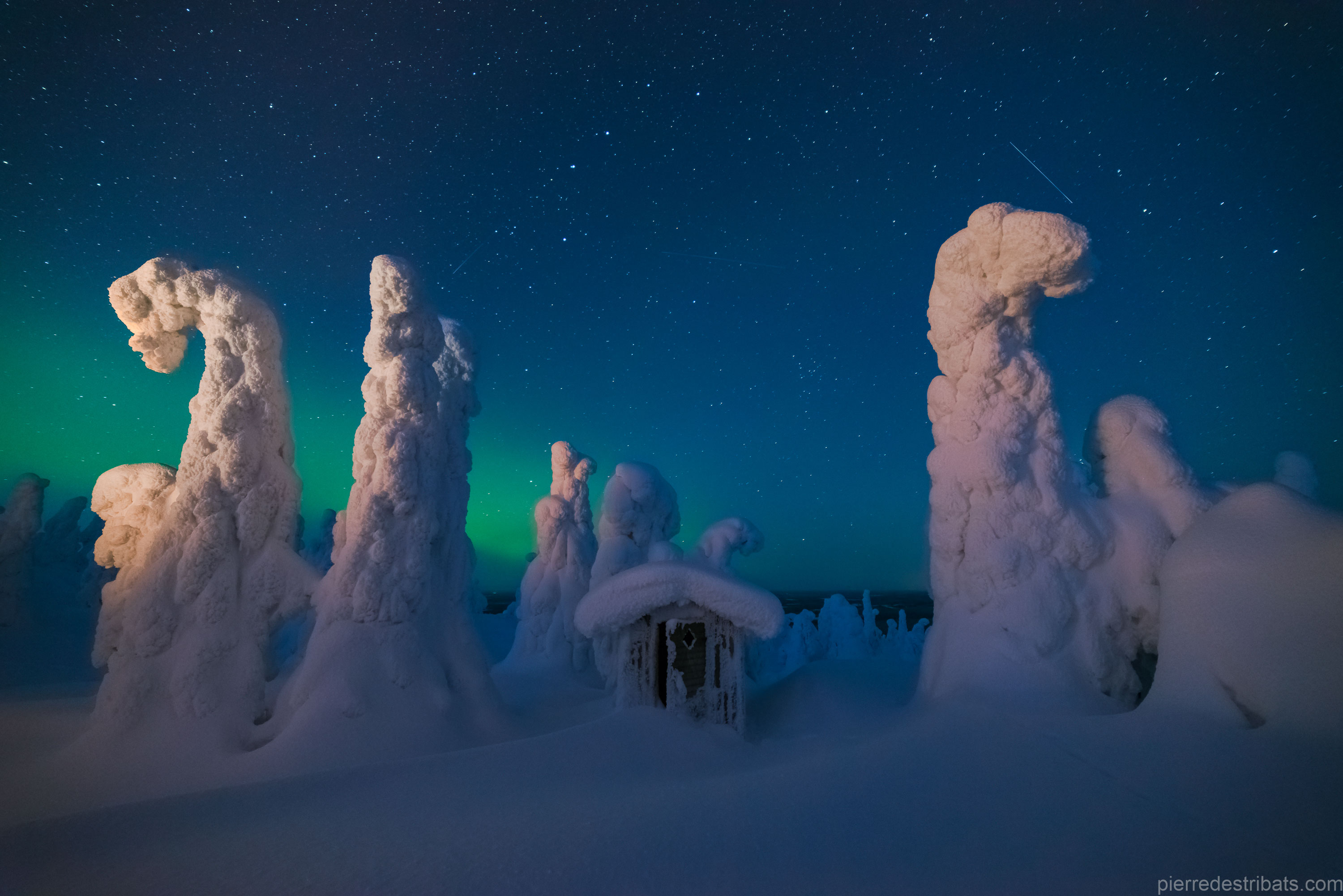
Explanation: Who guards the north? The featured picture was taken last March in Finnish Lapland where weather can include sub-freezing temperatures and driving snow. Surreal landscapes sometimes result, where white alien-looking sentinels seem to patrol the landscape. In actuality though, the aliens are snow-covered trees, and the red hut they seem to be guarding is an outhouse. Far in the distance, behind this uncommon Earthly vista, is a beautiful night sky which includes a green aurora, bright stars, and streaks of orbiting satellites. Of course, in the spring, the trees thaw and Lapland looks much different.
Inscription à :
Commentaires (Atom)