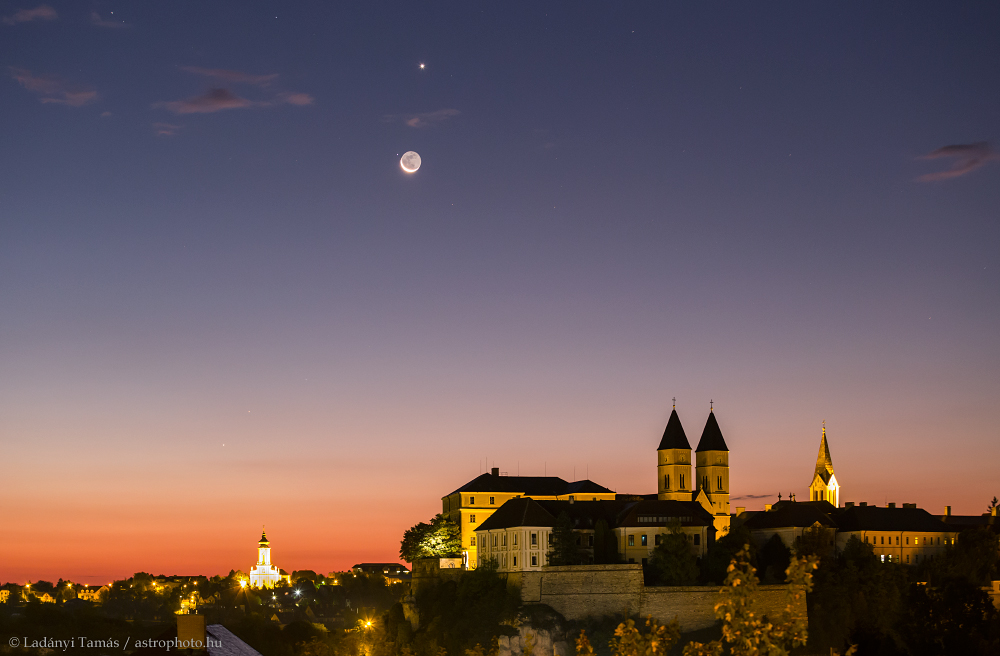
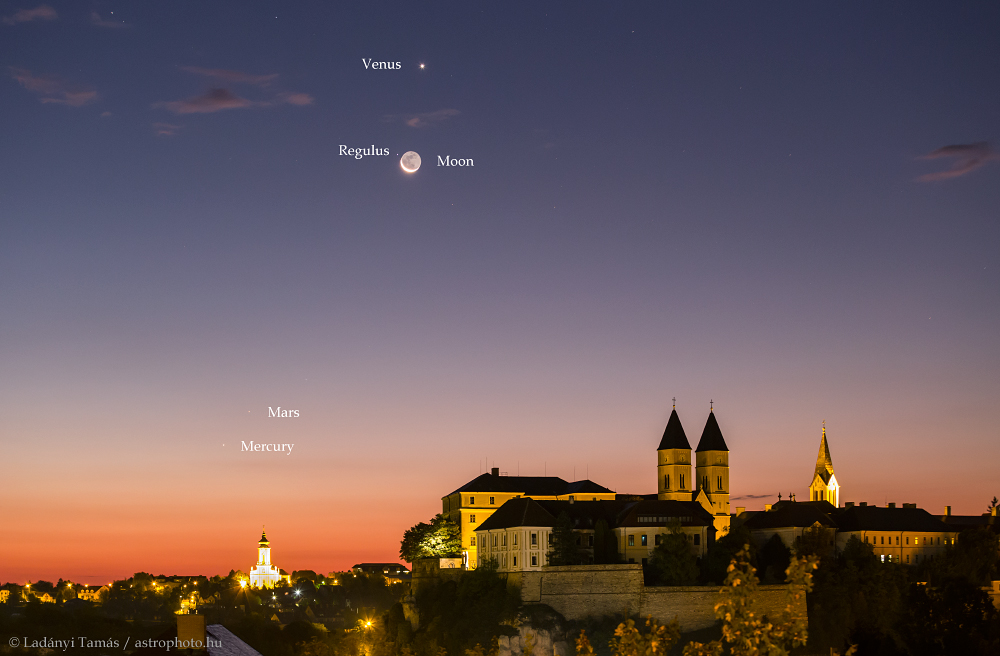
Explanation: The Moon, three planets, and a bright star gathered near the ecliptic plane in the September 18 morning sky over Veszprem Castle, Hungary. In this twilight skyscape, Mercury and Mars still shine close to the eastern horizon, soon to disappear in the glare of the Sun. Regulus, alpha star of the constellation Leo, is the bright point next to a waning crescent Moon, with brilliant Venus near the top of the frame. The beautiful morning conjunction of Moon, planets, and bright star could generally be followed by early morning risers all around planet Earth. But remarkably, the Moon also occulted, or passed directly in front of, Regulus and each of the three planets within 24 hours, all on September 18 UT. Visible from different locations, timing and watching the lunar occultations was much more difficult though, and mostly required viewing in daytime skies.
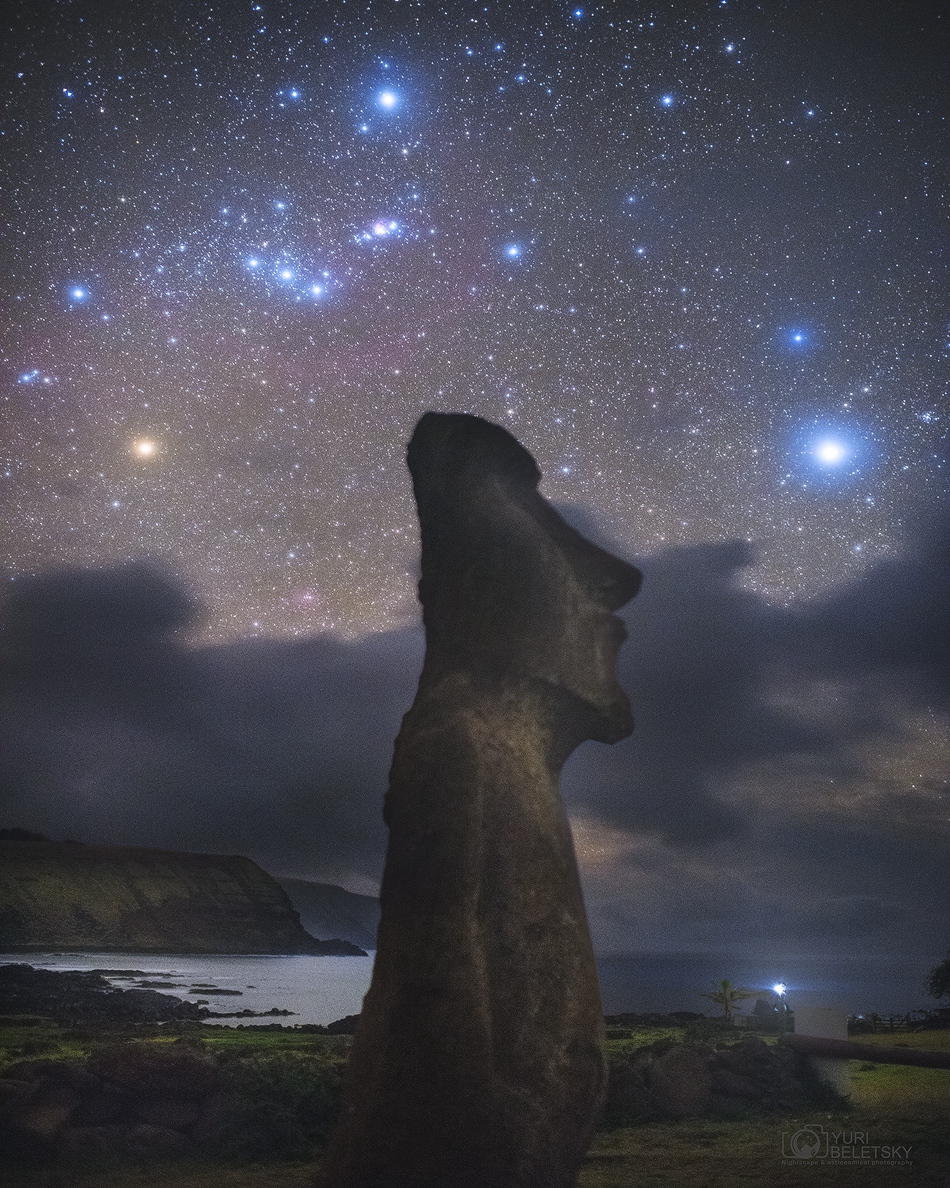
Explanation: Why were the statues on Easter Island built? No one is sure. What is sure is that over 800 large stone statues exist there. The Easter Island statues, stand, on the average, over twice as tall as a person and have over 200 times as much mass. Few specifics are known about the history or meaning of the unusual rock sculptures, but many believe that they were created about 700 years ago in the images of local leaders of a lost civilization. Featured here, one of the ancient Moai sculptures was imaged in 2016 before the constellation of Orion, including the famous line of three belt stars and brilliant stars Betelgeuse (far left in red) and Rigel (upper center). The stonegiant appears, however, to be inspecting the brightest star in the night sky (far right): Sirius.
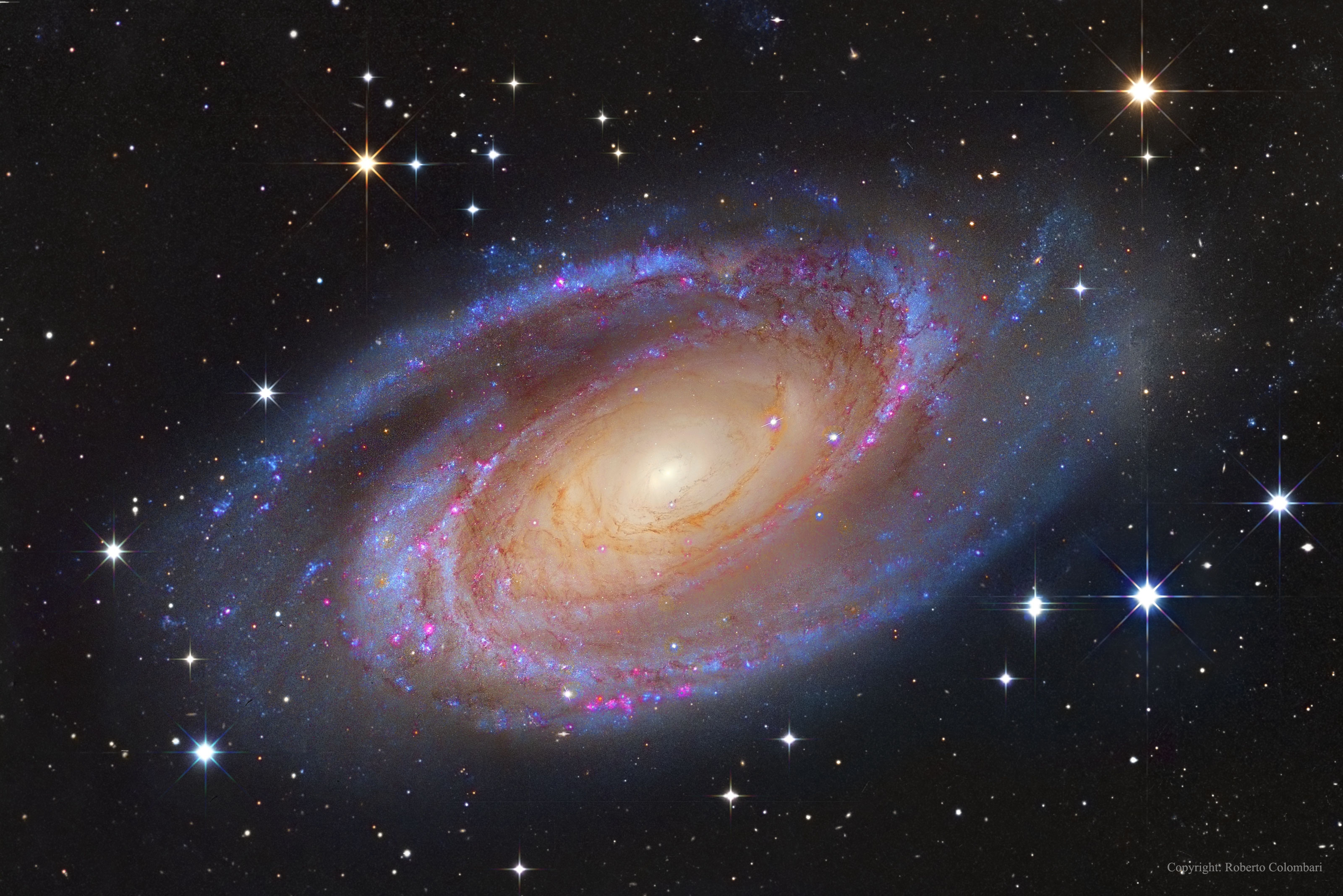
Explanation: One of the brightest galaxies in planet Earth's sky is similar in size to our Milky Way Galaxy: big, beautiful M81. This grand spiral galaxy can be found toward the northern constellation of the Great Bear (Ursa Major). This superbly detailed view reveals M81's bright yellow nucleus, blue spiral arms, and sweeping cosmic dust lanes with a scale comparable to the Milky Way. Hinting at a disorderly past, a remarkable dust lane actually runs straight through the disk, to the left of the galactic center, contrary to M81's other prominent spiral features. The errant dust lane may be the lingering result of a close encounter between M81 and its smaller companion galaxy, M82. Scrutiny ofvariable stars in M81 has yielded one of the best determined distances for an external galaxy -- 11.8 million light-years.
Explanation: As planned, the Cassini spacecraft impacted the upper atmosphere of Saturn on September 15, after a 13 year long exploration of the Saturnian System. With spacecraft thrusters firing until the end, its atmospheric entry followed an unprecedented series of 22 Grand Finale dives between Saturn and rings. Cassini's final signal took 83 minutes to reach planet Earth and the Deep Space Network antenna complex in Canberra Australia where loss of contact with the spacecraft was recorded at 11:55 UT. For the spacecraft, Saturn was bright and the Sun was overhead as it plowed into the gas giant planet's swirling cloud tops at about 70,000 miles (113,000 kilometers) per hour. But Cassini's final image shows the impact site hours earlier and still on the planet's night side, the cloud tops illuminated by ringlight, sunlight reflected from Saturn's rings.