"I was born to love you"
2018-04-10
Dragon Aurora over Norway - Astronomy picture of the day - 2018 April 10
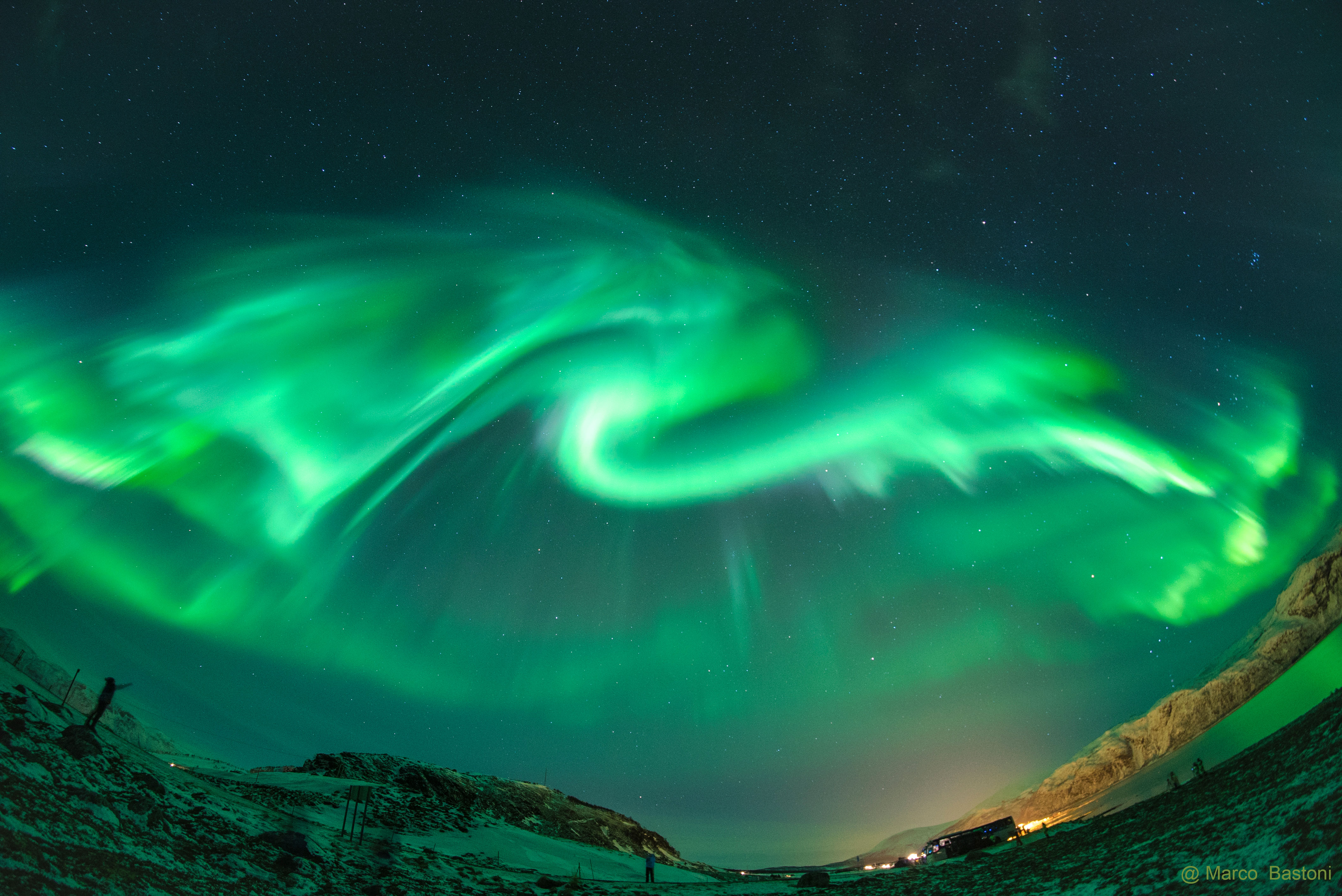
Image Credit & Copyright: Marco Bastoni
Explanation: What's that in the sky? An aurora. A large coronal hole opened last month, a few days before this image was taken, throwing a cloud of fast moving electrons, protons, and ions toward the Earth. Some of this cloud impacted our Earth's magnetosphere and resulted in spectacular auroras being seen at high northern latitudes. Featured here is a particularly photogenic auroral curtain captured above Tromsø Norway. To the astrophotographer, thisshimmering green glow of recombining atmospheric oxygen appeared as a large dragon, but feel free to share what it looks like to you. Although now past Solar Maximum, our Sun continues to show occasional activity creatingimpressive auroras on Earth visible even last week.

2018-04-09

The Sun Unleashed: Monster Filament in Ultraviolet - Astronomy picture of the day - 2018 April 9
Video Credit: NASA GSFC's Scientific Visualization Studio, Solar Dynamics Obs.
Explanation: One of the most spectacular solar sights is an explosive flare. In 2011 June, the Sun unleashed somewhat impressive, medium-sized solar flare as rotation carried active regions of sunpots toward the solar limb. That flare, though, was followed by an astounding gush of magnetized plasma -- a monster filament seen erupting at the Sun's edge in this extreme ultraviolet image from NASA's Solar Dynamics Observatory. Featured here is a time-lapse video of that hours-long event showing darker, cooler plasma raining down across a broad area of the Sun's surface, arcing along otherwise invisible magnetic field lines. An associated coronal mass ejection, a massive cloud of high energy particles, was blasted in the general direction of the Earth,and made a glancing blow to Earth's magnetosphere.



2018-04-08
The Witch's Broom Nebula - Astronomy picture of the day - 2018 April 8
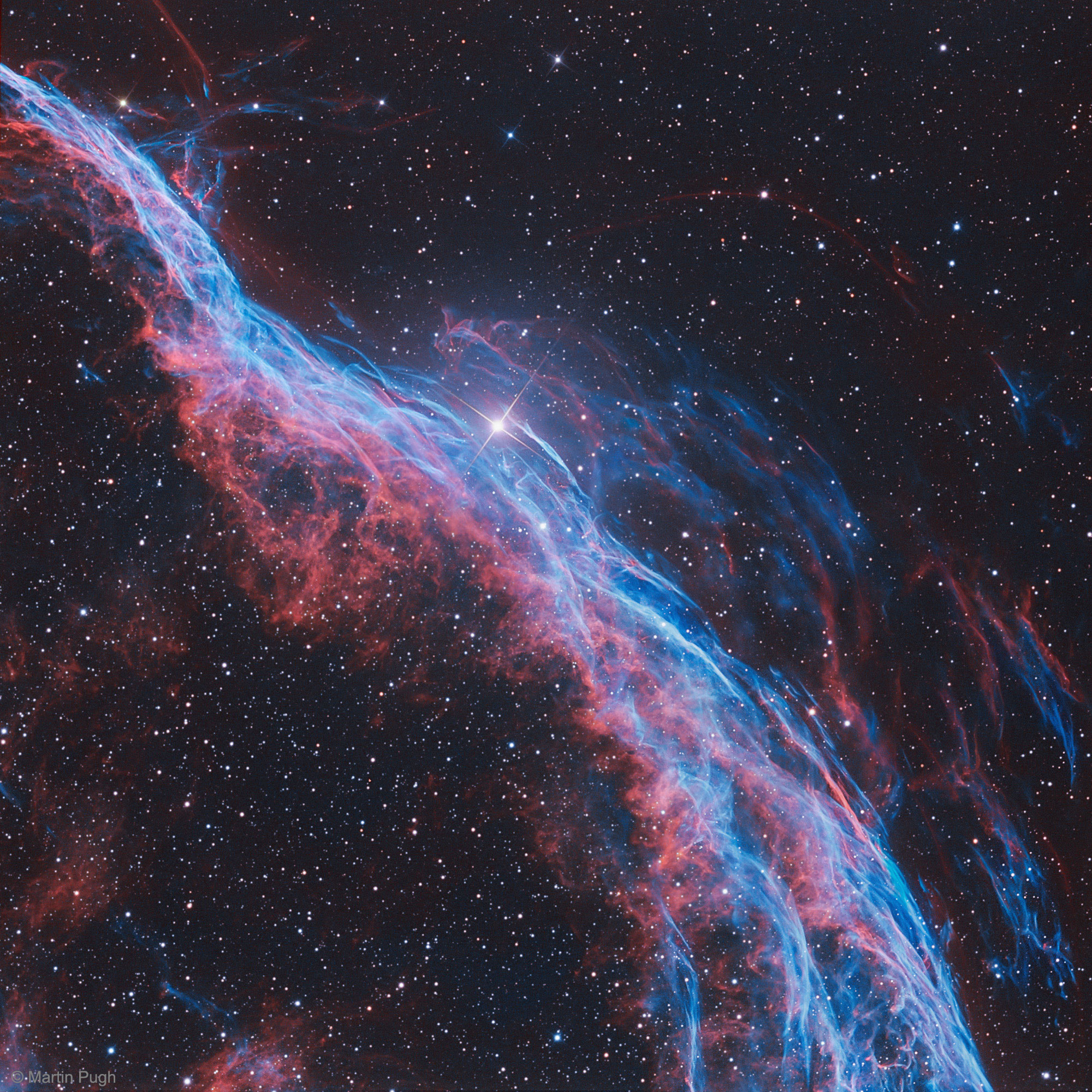
Image Credit & Copyright: Martin Pugh (Heaven's Mirror Observatory)
Explanation: Ten thousand years ago, before the dawn of recorded human history, a new light would have suddenly have appeared in the night sky and faded after a few weeks. Today we know this light was from a supernova, or exploding star, and record the expanding debris cloud as the Veil Nebula, a supernova remnant. This sharp telescopic view is centered on a western segment of the Veil Nebula cataloged as NGC 6960 but less formally known as the Witch's Broom Nebula. Blasted out in the cataclysmic explosion, the interstellar shock wave plows through space sweeping up and exciting interstellar material. Imaged with narrow band filters, the glowing filaments are like long ripples in a sheet seen almost edge on, remarkably well separated into atomic hydrogen (red) and oxygen (blue-green) gas. The complete supernova remnant lies about 1400 light-years away towards the constellation Cygnus. This Witch'sBroom actually spans about 35 light-years. The bright star in the frame is 52 Cygni, visible with the unaided eye from a dark location but unrelated to the ancient supernova remnant.

Panorama sur la plaine de Thrace (Bulgarie) - L'image du jour - 08-04-2018

Panorama sur la plaine de Thrace et la ville de Sliven (Bulgarie) d’un promontoire du Grand Balkan.
2018-04-07
Sebastião Ribeiro Salgado Júnior - "Etiópia, 1984" - Fotografia
 "Etiópia, 1984"
Sebastião Ribeiro Salgado Júnior (Aimorés, 8 de fevereiro de 1944) é um fotógrafo brasileiro reconhecido mundialmente por seu estilo único de fotografar. Nascido em Minas Gerais, é um dos mais respeitados fotojornalistas da atualidade.
Astronomy picture of the day - 2018 April 7 - Painting with Jupiter
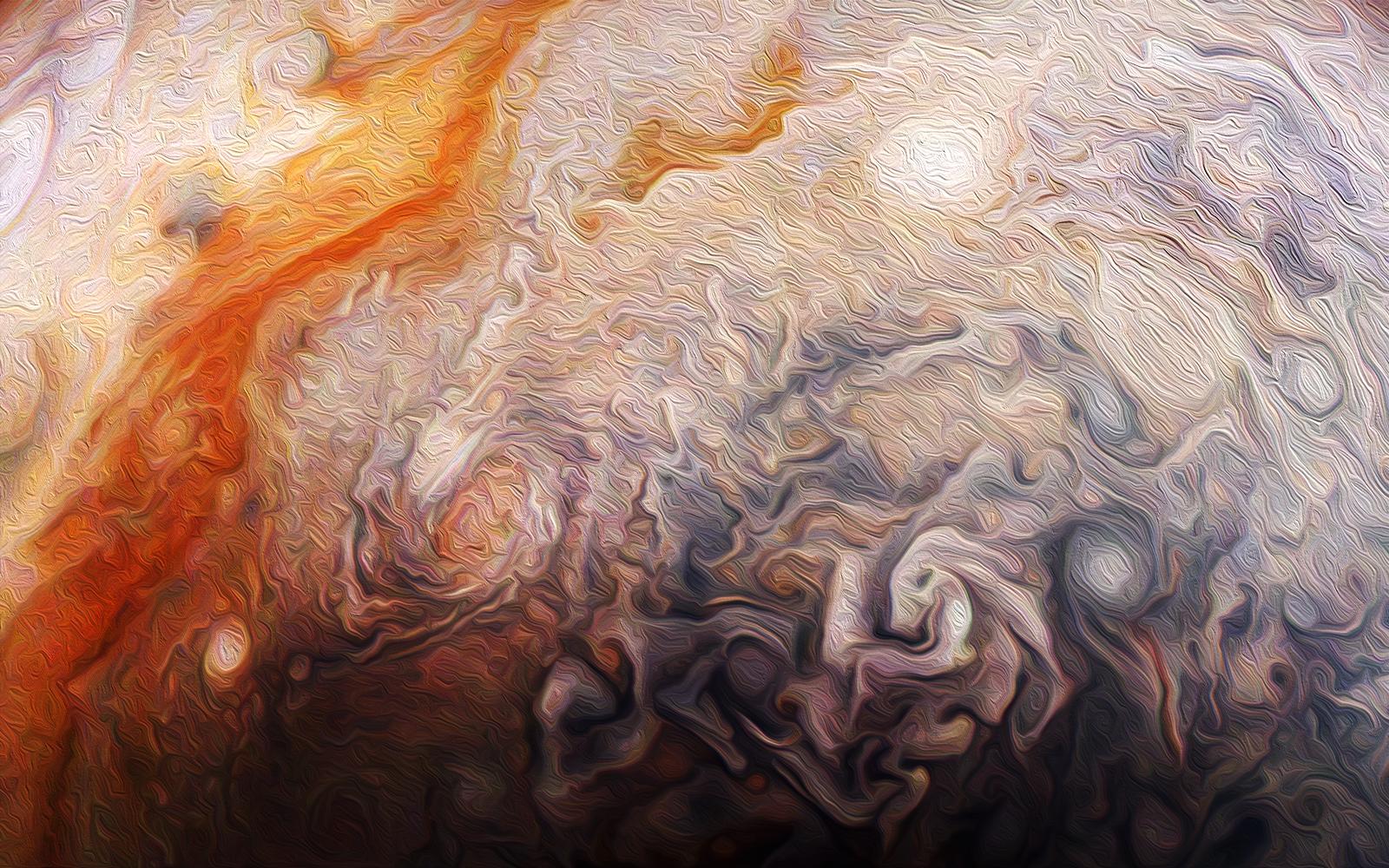
Image Credit: NASA, JPL-Caltech, SwRI, MSSS; Processing: Rick Lundh
Explanation: Brush strokes of Jupiter's signature atmospheric bands and vortices form this planetary post-impressionist work of art. The creative image uses actual data from the Juno spacecraft's JunoCam. To paint on the digital canvas, a image with light and dark tones was chosen for processing and an oil-painting software filter applied. The image data was captured during perijove 10, Juno's December 16, 2017 close encounter with the solar system's ruling gas giant. At the time the spacecraft was cruising about 13,000 kilometers above northern Jovian cloud tops.
Inscription à :
Articles (Atom)