Geminid Fireball over Mount Balang Image Credit: Alvin Wu
Explanation: This was a sky to remember. While viewing the Geminids meteor shower a few days ago, a bright fireball was captured over Mt. Balang, China with particularly picturesque surroundings. In the foreground, a sea of light clouds slowly floated between dark mountain peaks. In the background, the constellation of Orion shone brightly, with the familiar three stars of Orion's belt visible near the image top right. Sirius, the brightest star in the night sky, is visible near the image center. The bright fireball flashed for only a fraction of second on the lower right. The source of the fireball was a pebble that intersected the protective atmosphere of Earth, originally expelled by the Sun-orbiting asteroid-like object 3200 Phaethon.
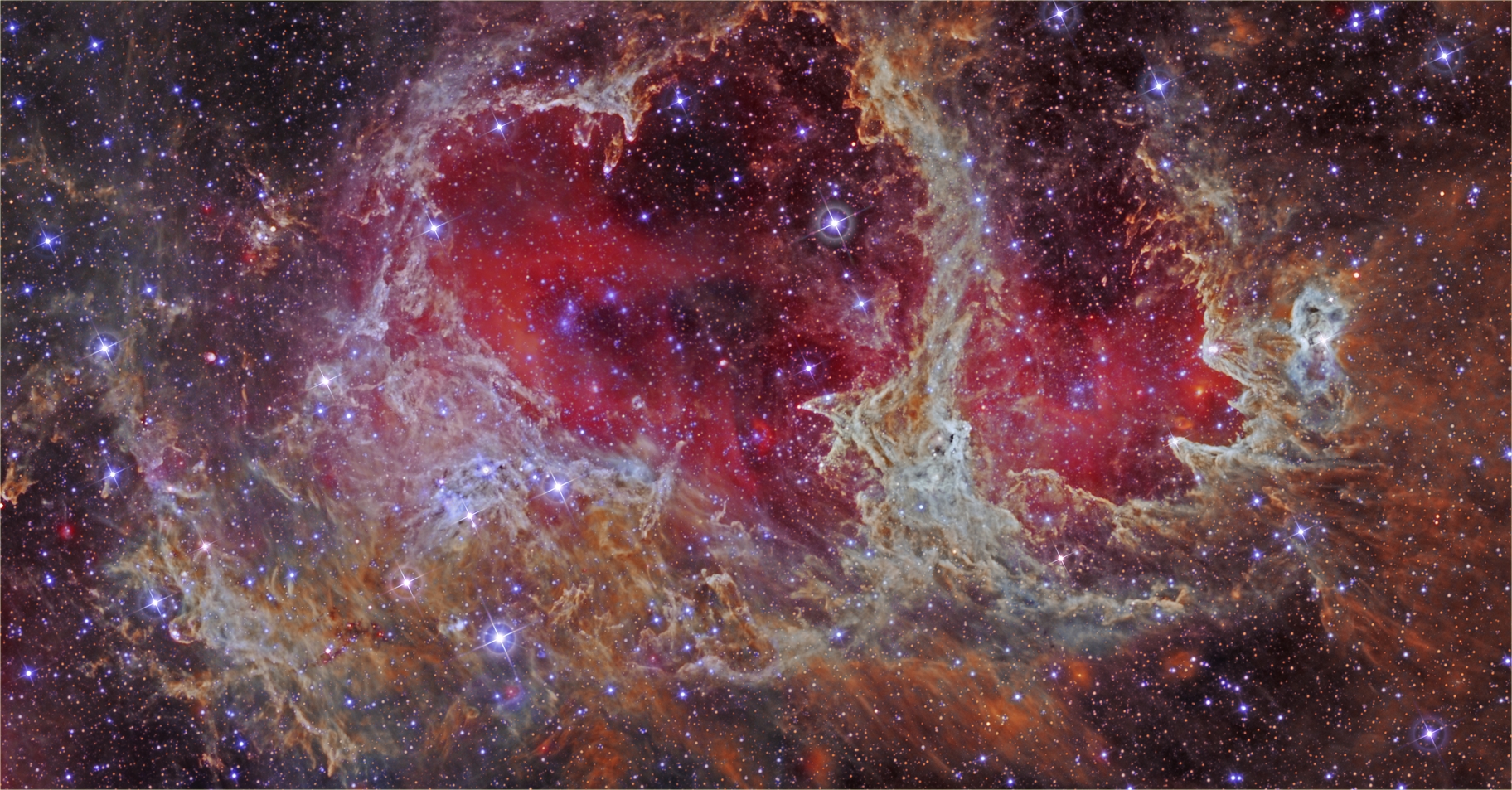
Explanation: How do stars form? Images of the star forming region W5 like those in the infrared by NASA's Wide Field Infrared Survey Explorer (WISE) satellite provide clear clues with indications that massive stars near the center of empty cavities are older than stars near the edges. A likely reason for this is that the older stars in the center are actually triggering the formation of the younger edge stars. The triggered star formation occurs when hot outflowing gas compresses cooler gas into knots dense enough to gravitationally contract into stars. In the featuredscientifically-colored infrared image, spectacular pillars, left slowly evaporating from the hot outflowing gas, provide further visual clues.W5 is also known as IC 1848, and together with IC 1805 form a complex region of star formation popularly dubbed the Heart and Soul Nebulas. The above image highlights a part of W5 spanning about 2,000 light years that is rich instar forming pillars. W5 lies about 6,500 light years away toward the constellation of Cassiopeia.
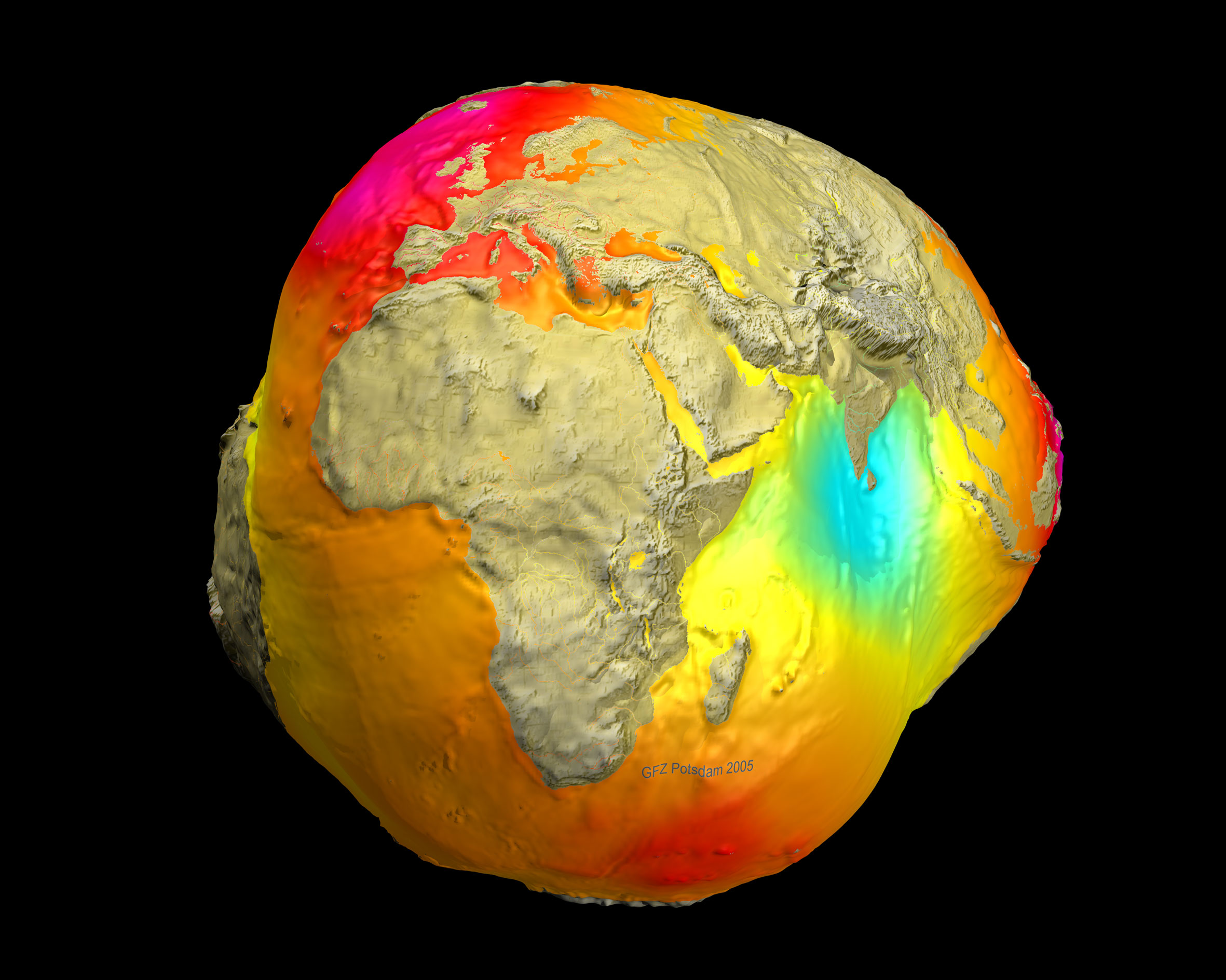
Explanation: Why do some places on Earth have higher gravity than others? Sometimes the reason is unknown. To help better understand the Earth's surface, sensitive measurments by the orbiting satellites GRACE and CHAMPwere used to create a map of Earth's gravitational field. Since a center for studying this data is in Potsdam, Germany, and since the result makes the Earth look somewhat like a potato, the resulting geoid has been referred to as the Potsdam Gravity Potato. High areas on this map, colored red, indicate areas where gravity is slightly stronger than usual, while in blue areas gravity is slightly weaker. Many bumps and valleys on the Potsdam Gravity Potato can be attributed to surface features, such as the North Mid-Atlantic Ridge and the Himalayan Mountains, but others cannot, and so might relate to unusually high or low sub-surface densities. Maps like this also help calibrate changes in the Earth's surface including variable ocean currents and the melting of glaciers. The above map was made in 2005, but more recent and more sensitive gravity maps of Earth was produced in 2011.
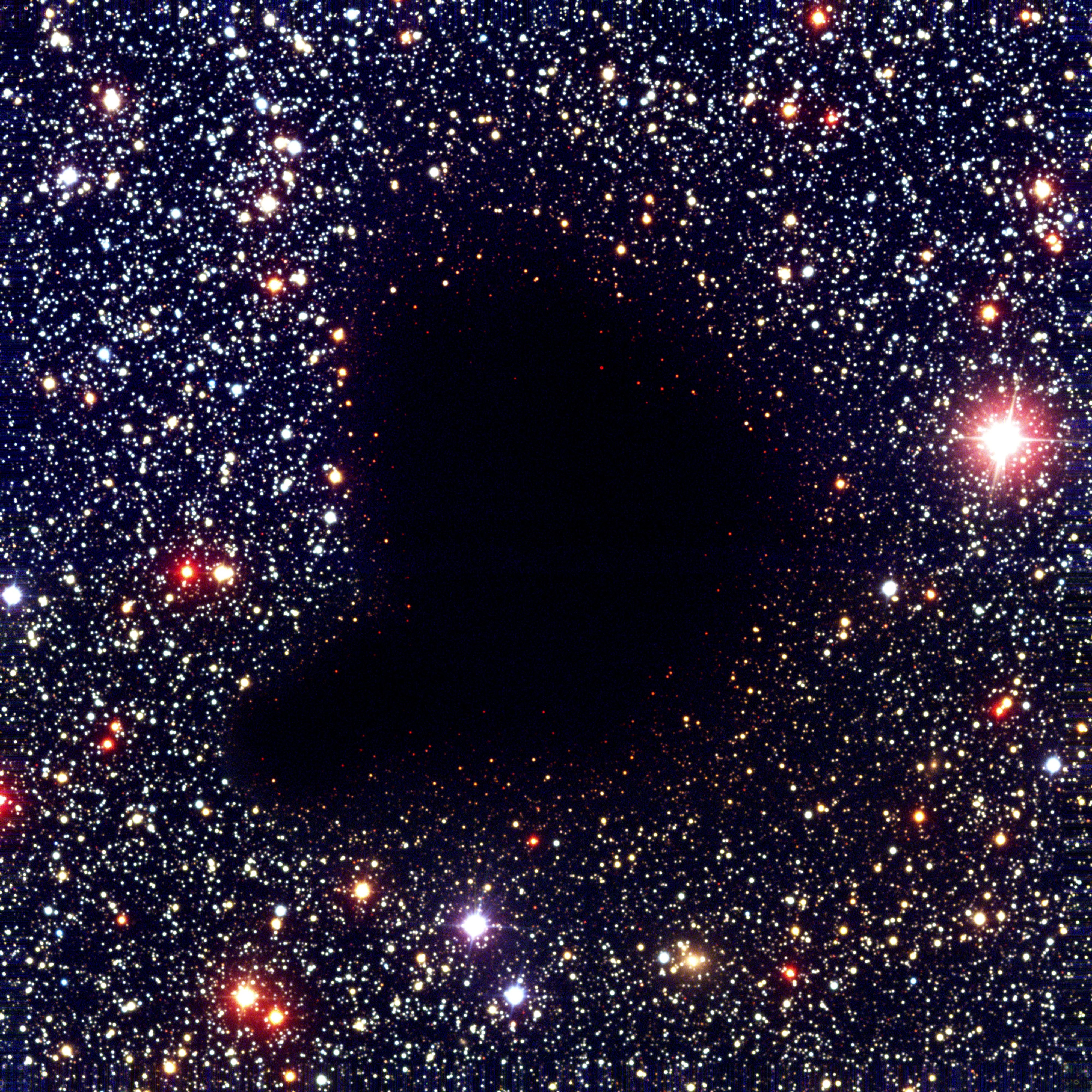
Explanation: Where did all the stars go? What used to be considered a hole in the sky is now known to astronomers as a dark molecular cloud. Here, a high concentration of dust and molecular gas absorb practically all the visible light emitted from background stars. The eerily dark surroundings help make the interiors of molecular clouds some of the coldest and most isolated places in the universe. One of the most notable of these dark absorption nebulae is a cloud toward the constellation Ophiuchus known as Barnard 68, pictured above. That no stars are visible in the center indicates that Barnard 68 is relatively nearby, with measurements placing it about 500 light-years away and half a light-year across. It is not known exactly how molecular clouds like Barnard 68 form, but it is known that these clouds are themselves likely places for new stars to form. In fact, Barnard 68 itself has been found likely to collapse and form a new star system. It is possible to look right through the cloud in infrared light.
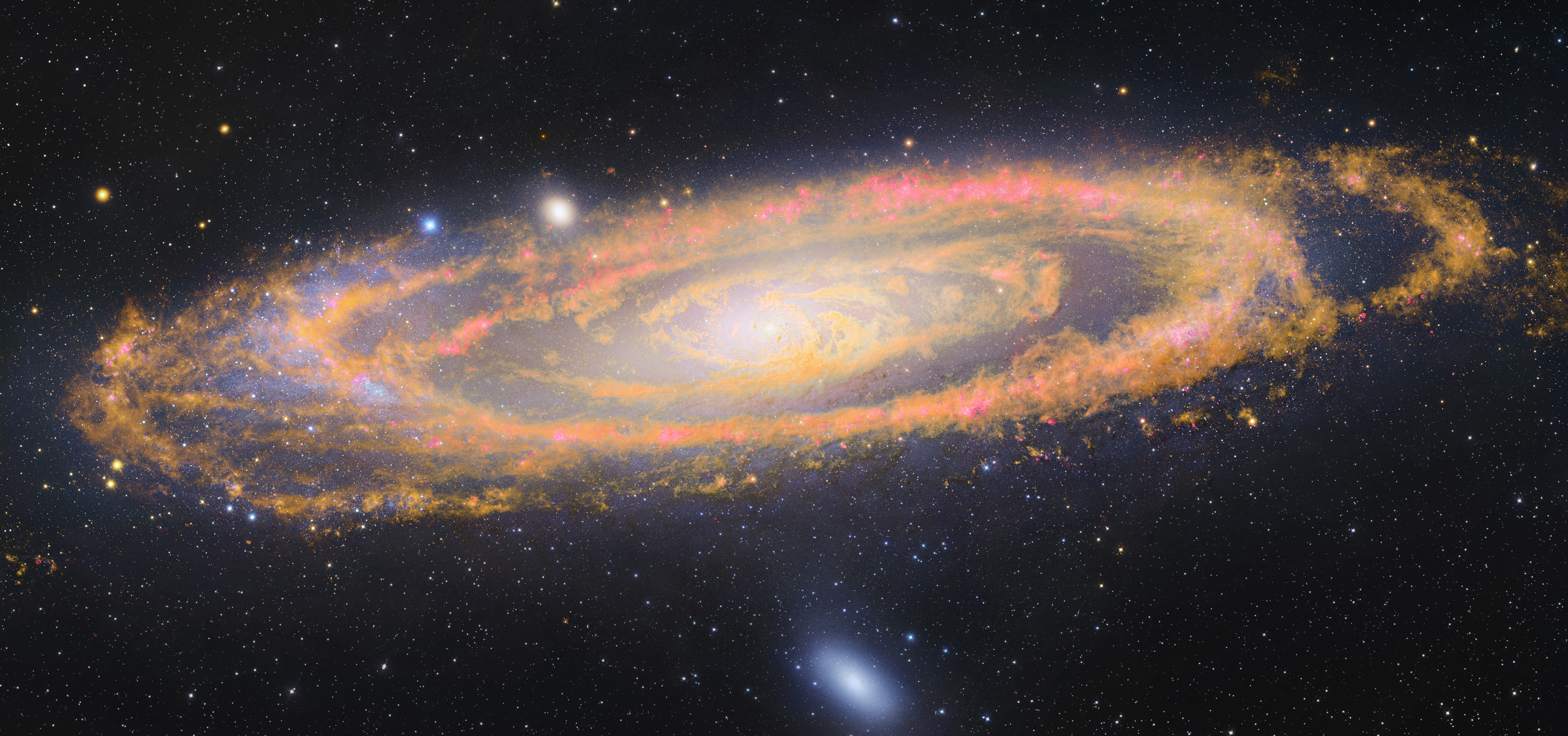
Explanation: This remarkable synthetic color composite image was assembled from archives of visible light and infrared astronomy image data. The field of view spans the Andromeda Galaxy (M31), a massive spiral a mere 2.5 million light-years away. In fact, with over twice the diameter of our own Milky Way, Andromeda is the largest nearby galaxy. Andromeda's population of bright young blue stars lie along its sweeping spiral arms, with the telltale reddish glow of star forming regions traced in space- and ground-based visible light data. But infrared data from the Spitzer Space Telescope, also blended directly into the detailed composite's red and green color channels, highlight the the lumpy dust lanes warmed by the young stars as they wind even closer to the galaxy's core. Otherwise invisible at optical wavelengths, the warm dust takes on orange hues. Two smaller companion galaxies, M110 (below) and M32 (above) are also included in the frame.
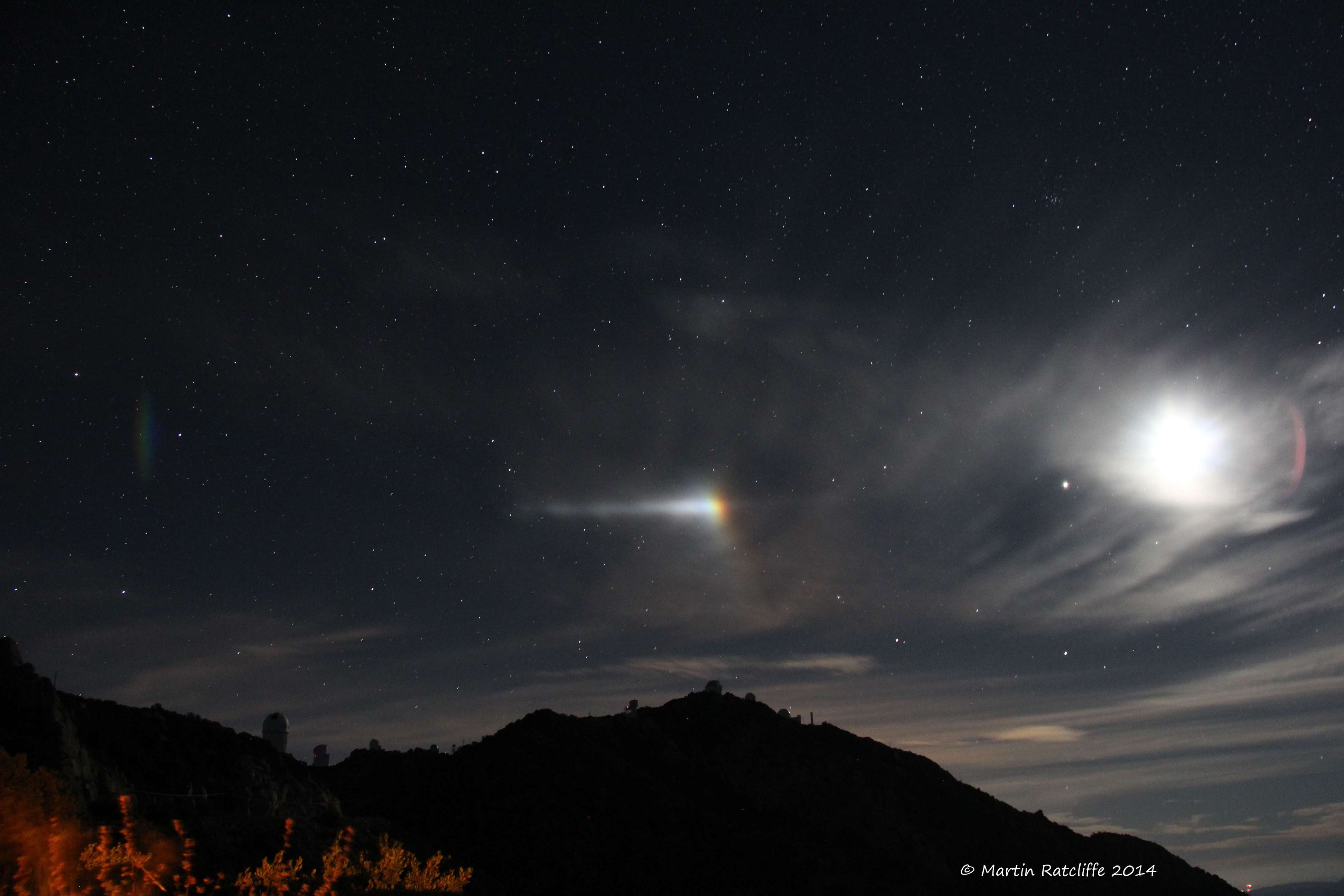
Explanation: In this night scene from the early hours of November 14, light from a last quarter Moon illuminates clouds above the mountaintop domes of Kitt Peak National Observatory near Tucson, Arizona. Bright Jupiter is just left of the overexposed lunar disk with a streak of camera lens flare immediately to the right, but that's no fireball meteor exploding near the center of the picture. Instead, from the roadside perspective a stunningly bright moondog or paraselene stands directly over Kitt Peaks's WIYN telescope. Analogous to a sundog or parhelion, a paraselene is produced by moonlight refracted through thin, hexagonal, plate-shaped ice crystals in high cirrus clouds. As determined by the crystal geometry, paraselenae (plural) are seen at an angle of 22 degrees or more from the Moon. Compared to the bright lunar disk they are more often faint and easier to spot when the Moon is low. About 10 minutes after the photograph even this bright moondog had faded from the night.