2015-01-31

Podemos : El cambio es posible!


La dirección de Podemos ha convertido este sábado la movilización convocada en Madrid en un multitudinario mitin para intentar afianzar uno de sus principales mensajes políticos: “El cambio es posible”. Pablo Iglesias, Íñigo Errejón, Carolina Bescansa, Juan Carlos Monedero, Irene Montero y Luis Alegre se han dirigido a los miles de ciudadanos que abarrotaban la Puerta del Sol después de un recorrido de menos de un kilómetro, entre Cibeles y la plaza que simboliza los entusiasmos del 15-M. Según la delegación del Gobierno, el número de manifestantes alcanzó los 100.000. Los organizadores los elevaron a 300.000, mientras que los cálculos realizados por EL PAÍS, sostienen que la participación se cifró en 153.000 personas...

El secretario general de Podemos ha apelado al patriotismo. “Algunos dicen que España es una marca, creen que se puede comprar y vender. Malditos sean los que quieren convertir nuestra cultura en mercancía”, ha enfatizado. “Somos un país de ciudadanos, soñamos como Quijote pero nos tomamos muy en serio nuestros sueños”, ha agregado. "La soberanía no está en Davos", ha continuado Iglesias para contraponer a los poderosos que "viajen en jets" con los desahuciados, enfermos de hepatitis C, yayoflautas, estafados por las preferentes y otros colectivos que han sufrido de forma especial los embates de la crisis. "Han querido humillar a nuestro país con esa estafa que llaman austeridad", ha indicado al tiempo que ha abogado por "desplegar un plan de rescate ciudadano". También ha abordado el problema de la corrupción, un fenómeno que no ha limitado a quienes meten la mano en la caja: "Corrupción es que el 1% más rico tiene lo mismo que el 73% de los españoles" y que desde que comenzó la crisis "el número de ricos ha crecido al mismo ritmo que el de los ciudadanos en riesgo de pobreza"...
El Pais - España

Foto - Toulouse (France) - 31-01-2015

Toulouse - 31-01-2015

31-01-2015
JoanMira

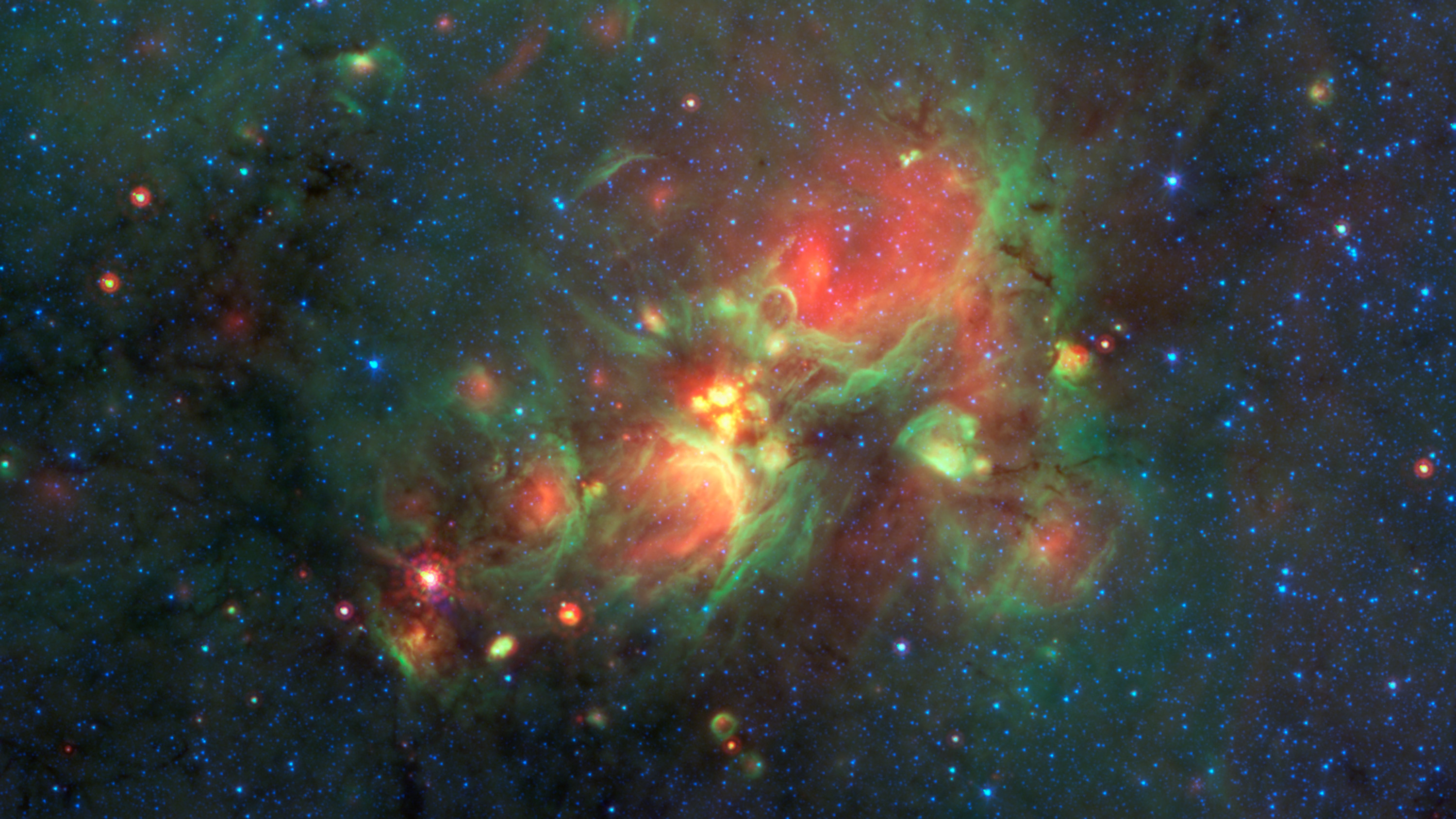
Astronomy picture of the day - 31-01-2015 - Yellow Balls in W33

See Explanation.  Clicking on the picture will download
 the highest resolution version available.
Yellow Balls in W33 
Image Credit: NASA/JPL-Caltech
Explanation: Infrared wavelengths of 3.6, 8.0, and 24.0 microns observed by the Spitzer Space Telescope are mapped into visible colors red, green, and blue in this striking image. The cosmic cloud of gas and dust is W33, a massive starforming complex some 13,000 light-years distant, near the plane of our Milky Way Galaxy. So what are all those yellow balls? Citizen scientists of the web-based Milky Way Project found the features they called yellow balls as they scanned many Spitzer images and persistently asked that question of researchers. Now there is an answer. The yellow balls in Spitzer images are identified as an early stage of massive star formation. They appear yellow because they are overlapping regions of red and green, the assigned colors that correspond to dust and organic molecules known as PAHs at Spitzer wavelengths. Yellow balls represent the stage before newborn massive stars clear out cavities in their surrounding gas and dust and appear as green-rimmed bubbles with red centers in the Spitzer image. Of course, the astronomical crowdsourcing success story is only part of the Zooniverse. The Spitzer image spans 0.5 degrees or about 100 light-years at the estimated distance of W33.

2015-01-30

Playing For Change - "Reggae got soul" - Video - Music - Around the world

"Reggae Got Soul"

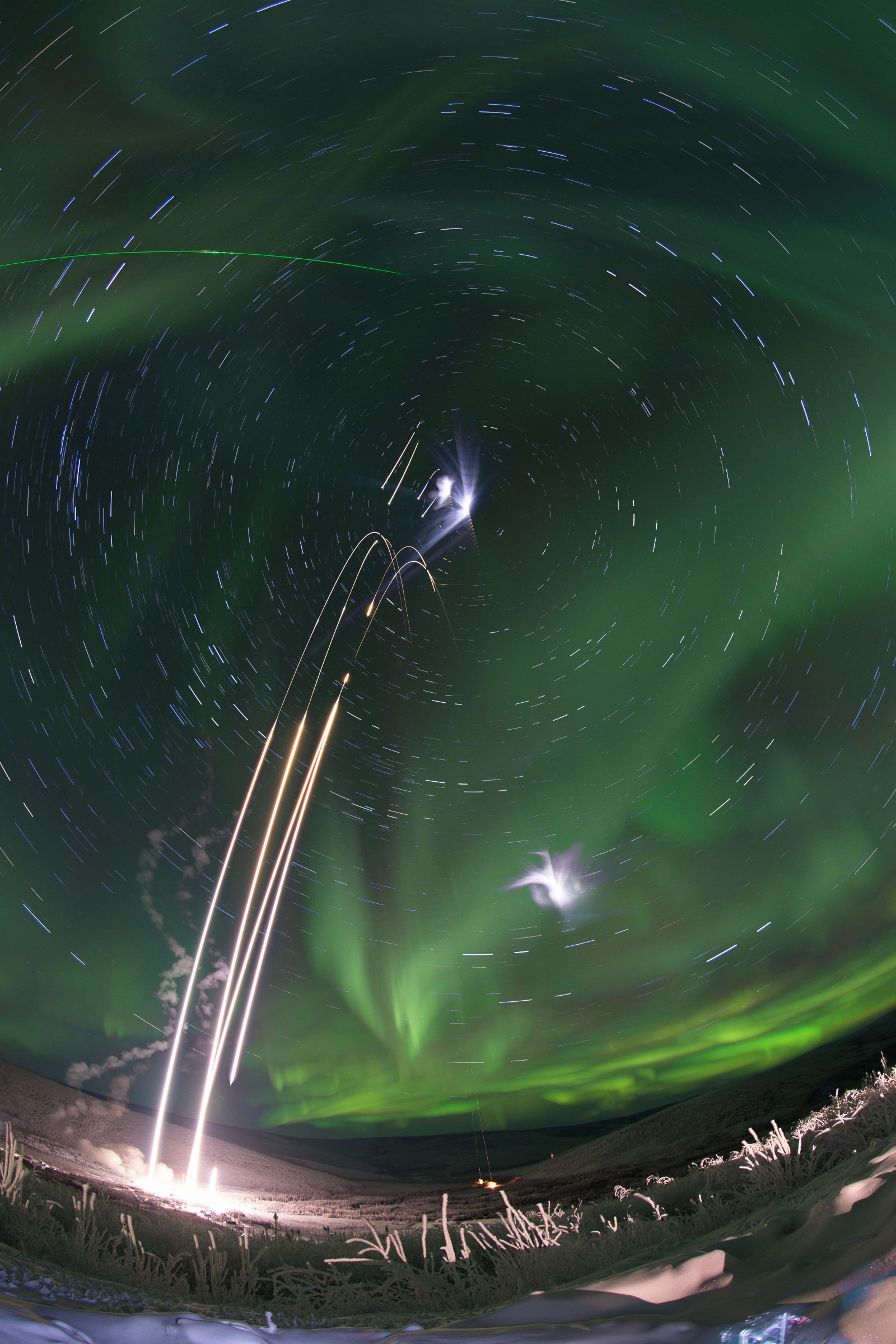
Astronomy picture of the day - 30-01-2015 - A Night at Poker Flat

See Explanation.  Clicking on the picture will download
 the highest resolution version available.
A Night at Poker Flat 
Image Credit: NASA / Jamie Adkins
Explanation: Four NASA suborbital sounding rockets leapt into the night on January 26, from the University of Alaska's Poker Flat Research Range. This time lapse composite image follows all four launches of the small, multi-stage rockets to explore winter's mesmerizing, aurora-filled skies. During the exposures, stars trailed around the North Celestial Pole, high above the horizon at the site 30 miles north of Fairbanks, Alaska. Lidar, beams of pulsed green lasers, also left traces through the scene. Operating successfully, the payloads lofted were two Mesosphere-Lower Thermosphere Turbulence Experiments (M-TeX) and two Mesospheric Inversion-layer Stratified Turbulence (MIST) experiments, creating vapor trails at high altitudes to be tracked by ground-based observations.

2015-01-29

Tempestades eléctricas no Espaço


La Agencia Espacial Europea (ESA) reveló una vista diferente de las tormentas eléctricas en una pequeña producción de siete segundos de duración registrada desde la Estación Espacial Internacional (ISS). Bajo la técnica time-lapse (como muchos otros registros de este tipo), el video armado con 49 imágenes tomadas en 2012 a 400 kilómetros de la Tierra muestra cómo se ilumina una área ubicada al este de Rumania.
Para evitar cualquier otra toma borrosa debido al movimiento que tiene la ISS, que viaja alrededor de la Tierra a 28.800 kilómetros por hora, la ESA dijo que este video no podría haber sido registrado sin la ayuda de su cámara Nightpod, montada sobre una estructura especial para que los astronautas puedan obtener retratos en foco.
La Nacion - Argentina

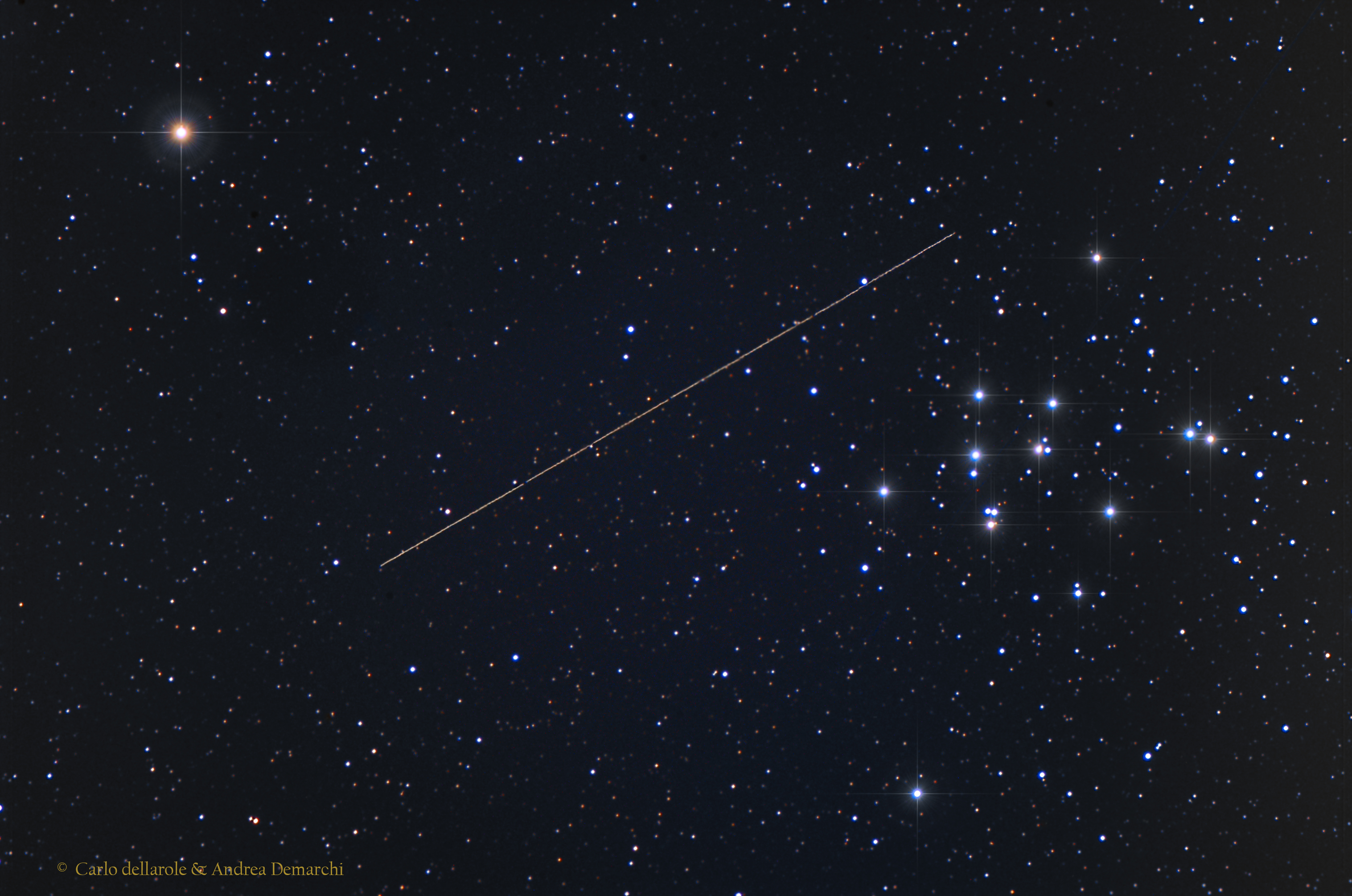
Astronomy picture of the day - 29-01-2015 - Close Encounter with M44

See Explanation.  Clicking on the picture will download
 the highest resolution version available.
Close Encounter with M44 
Image Credit & Copyright: Carlo Dellarole, Andrea Demarchi
Explanation: On Monday, January 26, well-tracked asteroid 2004 BL86 made its closest approach, a mere 1.2 million kilometers from our fair planet. That's about 3.1 times the Earth-Moon distance or 4 light-seconds away. Moving quickly through Earth's night sky, it left this streak in a 40 minute long exposure on January 27 made from Piemonte, Italy. The remarkably pretty field of view includes M44, also known as the Beehive or Praesepe star cluster in Cancer. Of course, its close encounter with M44 is only an apparent one, with the cluster nearly along the same line-of-sight to the near-earth asteroid. The actual distance between star cluster and asteroid is around 600 light-years. Still, the close approach to planet Earth allowed detailed radar imaging from NASA's Deep Space Network antenna at Goldstone, California and revealed the asteroid to have its own moon.

2015-01-28

Fotografia - André Kertész - "Le Pont des Arts"

A Ponte des Arts vista através do relogio do Instituto Francés (1929).

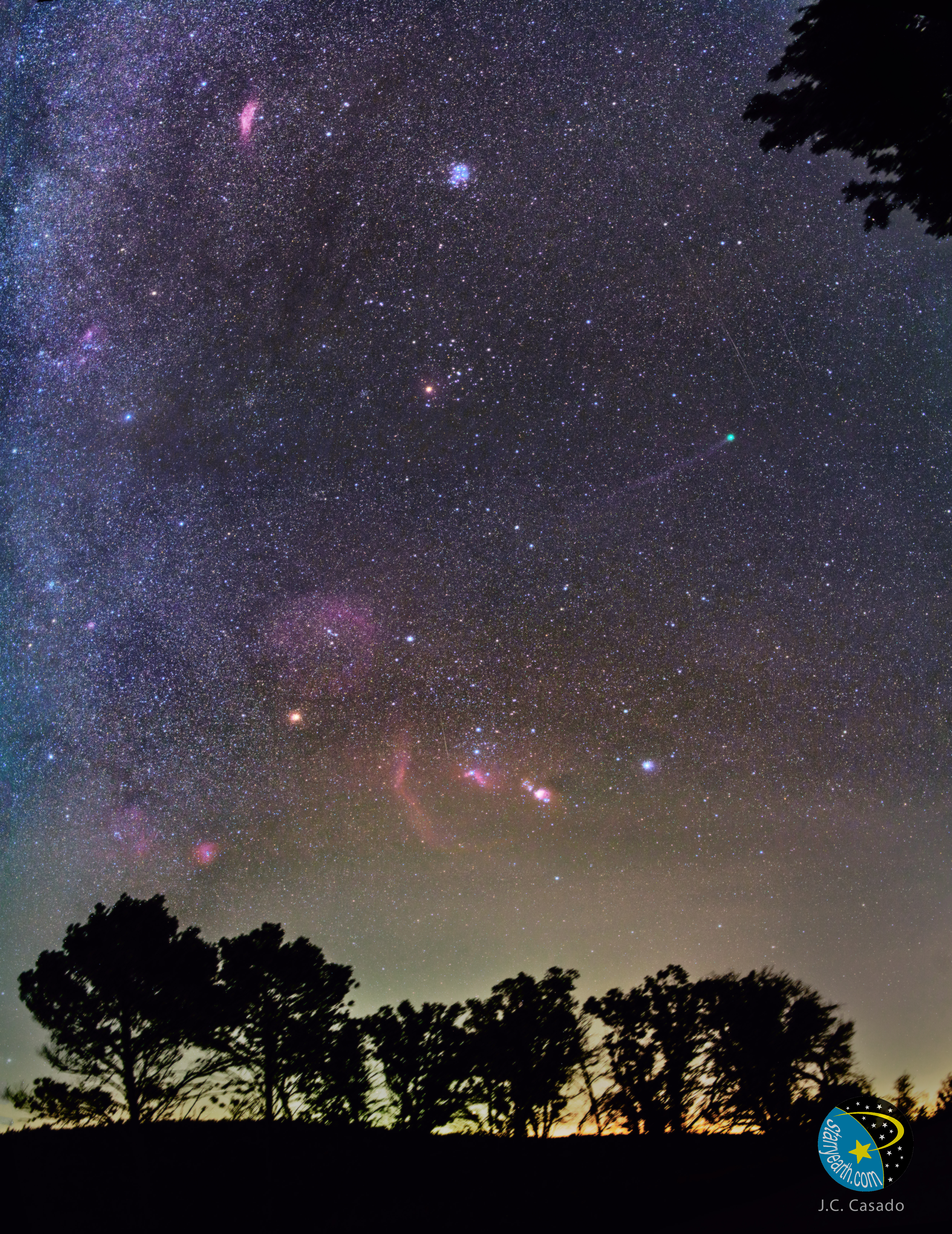
Astronomy picture of the day - 28-01-2015 - Comet Lovejoy in a Winter Sky

See Explanation.
Moving the cursor over the image will bring up an annotated version.
Clicking on the image will bring up the highest resolution version
available.
Comet Lovejoy in a Winter Sky 
Image Credit & BY-NC-2 LicenseJuan Carlos Casado (TWANEarth and Stars)
Explanation: Which of these night sky icons can you find in this beautiful and deep exposure of the northern winter sky? Skylights include the stars in Orion's belt, the Orion Nebula, the Pleiades star cluster, the bright stars Betelgeuseand Rigel, the California NebulaBarnard's Loop, and Comet Lovejoy. The belt stars of Orion are nearly vertical in the central line between the horizon and the image center, with the lowest belt star obscured by the red glowing Flame Nebula. To the belt's left is the red arc of Barnard's Loop followed by the bright orange star Betelgeuse, while to the belt's right is the colorful Orion Nebula followed by the bright blue star Rigel. The blue cluster of bright stars near the top center is the Pleiades, and the red nebula to its left is the California nebula. The bright orange dot above the image center is the star Aldebaran, while the green object with the long tail to its right is Comet C/2014 Q2 (Lovejoy). Thefeatured image was taken about two weeks ago near Palau village in Spain.