2015-10-17

Astronomy picture of the day - 2015 October 17 - Bright Spiral Galaxy M81

See Explanation.  Clicking on the picture will download
 the highest resolution version available.
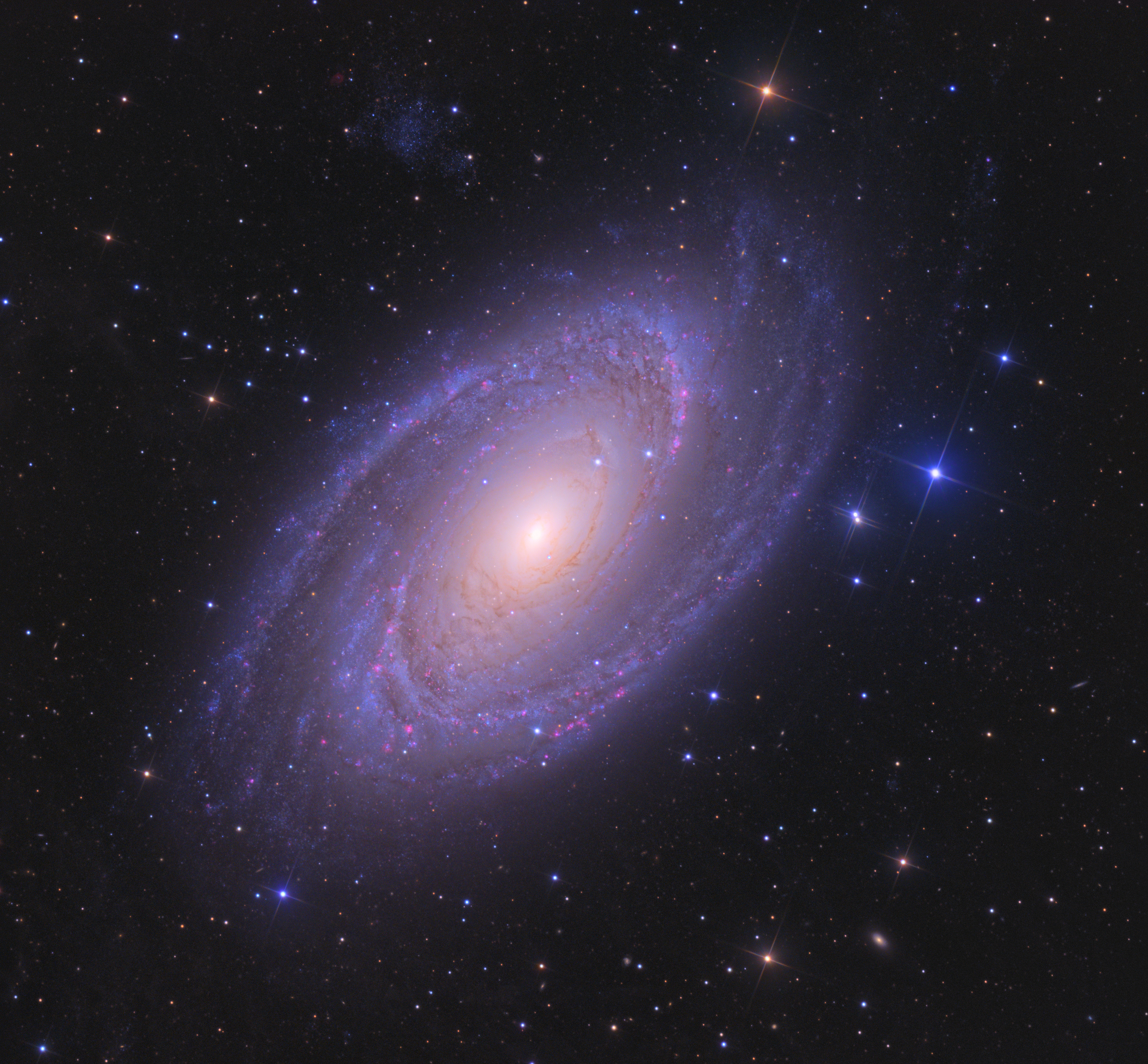
Bright Spiral Galaxy M81 
Image Credit & CopyrightKen Crawford (Rancho Del Sol Observatory)
Explanation: One of the brightest galaxies in planet Earth's sky is similar in size to our Milky Way Galaxy: big, beautiful M81. The grand spiral galaxy can be found toward the northern constellation of the Great Bear (Ursa Major). This superbly detailed image reveals M81's bright yellow nucleus, blue spiral arms, tell tale pinkish star forming regions, and sweeping cosmic dust lanes with a scale comparable to the Milky Way. Hinting at a disorderly past, a remarkable dust lane actually runs straight through the disk, to the left of the galactic center, contrary to M81's other prominent spiral features. The errant dust lane may be the lingering result of a close encounter between between M81 and its smaller companion galaxy, M82. Scrutiny of variable stars in M81 has yielded one of the best determined distances for an external galaxy -- 11.8 million light-years. M81's dwarf companion galaxy Holmberg IX can be seen just above the large spiral.

2015-10-16

Astronomy picture of the day - 2015 October 16 - Night Hides the World

See Explanation.  Clicking on the picture will download
 the highest resolution version available.
Night Hides the World 
Image Credit & CopyrightBabak Tafreshi (TWAN)
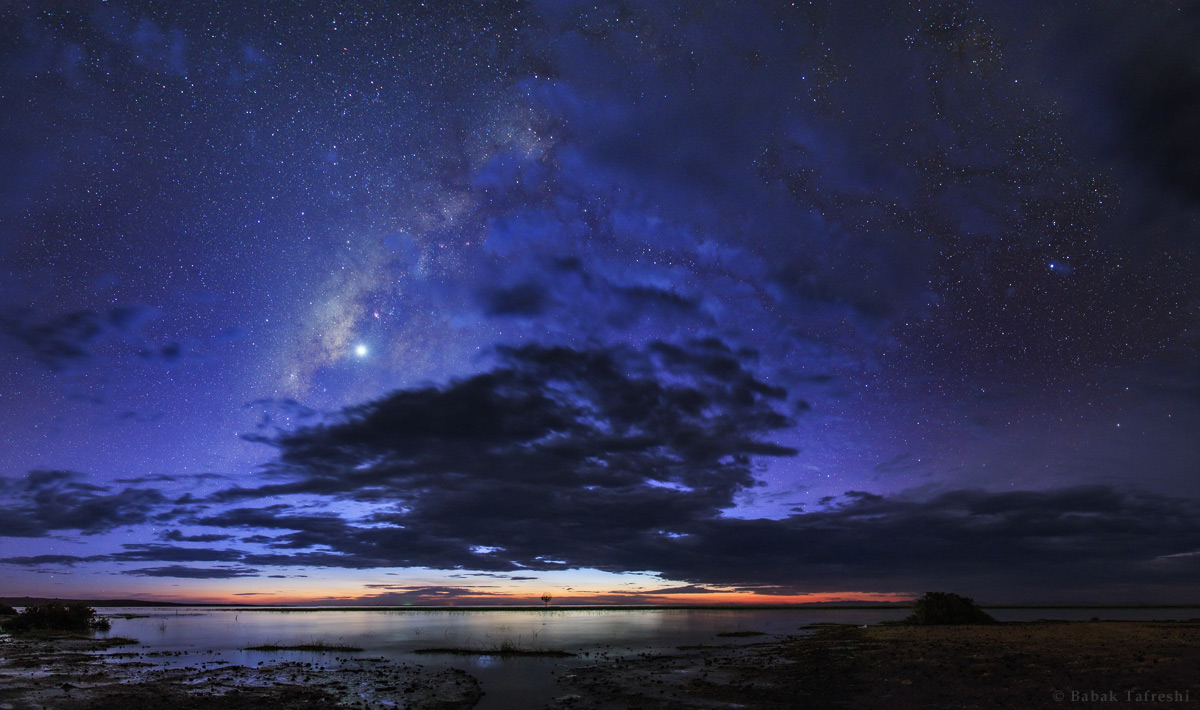
Explanation: Stars come out as evening twilight fades in this serene skyscape following the Persian proverb "Night hides the world, but reveals a universe." The scene finds the Sun setting over northern Kenya and the night will soon hide the shores of Lake Turkana, home to many Nile crocodiles. The region is also known for its abundance of hominid fossils. On that past November night, a brilliant Venus, then the world's evening star, dominates the starry skies above. But also revealed are faint stars, cosmic dust clouds, and glowing nebulae along the graceful arc of our own Milky Way galaxy.

2015-10-15

Texto - “Tacho e “Panela”


Afficher l'image d'origine 

Vive-se actualmente em Portugal um clima de grande incerteza politica.

O “socialista” o Assis, que andava a ruminar uma qualquer maquiavélica vingança desde que foi preterido da liderança do PS, aproveitou o resultado das eleições para “botar” fora o fel que lhe corre nas veias.

E assim jorrou o: “Contranatura” na eventualidade de os partidos de esquerda poderem vir a formar governo; como se a maioria dos eleitores não tivesse maioritariamente votado PS/BE/CDU…,ao ponto de se situar tão à direita do seu partido que pode parecer legitimo e oportuno alvitrar se o artolas não deveria migrar quanto antes para junto de Peter Steps Rabbit e Paul Doors, com a bênção de Cavacuo Silva.

Qual a diferença entre Assis, Coelho e Portas?

Do menino frustrado, desiludido, ávido e birrento já falamos. De Pedro Passos Coelho nada vamos adiantar pois todos temos em memoria as promessas feitas antes de ser “prime”, traduzidas em mil mentiras dignas do Pinóquio Sócrates. Resta-nos Paulo Portas para nos divertirmos um pouco.

Pelo semblante carregado que tem apresentado nos últimos dias, parece que as coisas não lhe estão a correr la muito de feição.   Aparenta todos os sintomas de alguma  angustia, de breve “des-coligação”, de perda do “tacho” com que, irrevogavelmente, foi prendado.

E para ele, como é obvio, um bom “tacho” não pode ser substituído por uma grande “Panela”! Paciência caro, por enquanto ainda atrás  dele estão muitos tubarões com muito mais legitimidade para ocuparem o cargo!

Depois de se “por a milhas” da governação, pode ser, ainda, que volte seriamente à baila o caso dos submarinos “rotos”…é “irrevogável” né?

Bordeaux, 15 de Outubro de 2015.

JoanMira


Pictures from my mind - "Fantasma deambulando" - Aufrery - 18-03-2015

"Fantasma deambulando com dementes à espreita"

Aufrery, 18-03-2015
JoanMira

Fotos - Fonte da Telha - Portugal - 16-09-2014

"Fonte da Telha"

Costa de Caparica, 16-09-2014
JoanMira

Portugal. Vers un gouvernement anti-austérité ?


Afficher l'image d'origine

Malgré la victoire de la droite aux élections législatives, le prochain gouvernement portugais pourrait être… de gauche.

Même si la coalition de droite au pouvoir à Lisbonne (PSD et CDS-PP) a nettement remporté les élections législatives du 4 octobre, elle est loin – avec seulement 38 % des votes – d’atteindre la majorité parlementaire.
De fait, le reste du Parlement portugais sera presque exclusivement constitué de députés du Parti socialiste (PS) et de la gauche radicale. Une situation nouvelle qui a ouvert une période de tractations entre les différentes formations politiques.


Le président Aníbal Cavaco Silva et l’actuel Premier ministre Pedro Passos Coelho, tout deux membres du Parti social-démocrate (PSD), ont rapidemment réagi en faisant, dès le lendemain des élections, un appel du pied au PS pour former un gouvernement au centre. C’était sans compter avec la pression de la gauche de la gauche, qui a totalisé près de 20 % des votes et qui menace, selon un article du journal portugais Público“de bloquer tout gouvernement qui défendrait l’austérité”.

Un gouvernement de gauche

António Costa, le leader du PS, qui pourrait finalement former un gouvernement marqué à gauche, a rencontré le Parti communiste portugais (PCP) le 7 octobre et s’entretiendra avec le Bloc de gauche (BE) le 12 octobre prochain. 
“[António] Costa et Jerónimo [de Sousa, PCP] mettent la droite sous pression” titrait le 8 octobre Público. Le leader du PCP a ainsi garanti à António Costa qu’il “rendrait viable un gouvernement PS et que “le PCP est prêt à assumer toutes les responsabilités, y compris au gouvernement” .
Le Parti socialiste s’est montré beaucoup plus prudent dans ses déclarations, expliquant que c’était “au PCP et au BE de démontrer l’existence de conditions pour un gouvernement de gauche majoritaire”.
Courrier International - France

Astronomy picture of the day - 2015 October 15 - M16 and the Eagle Nebula

See Explanation.  Clicking on the picture will download
 the highest resolution version available.
M16 and the Eagle Nebula 
Image Credit & CopyrightJimmy Walker
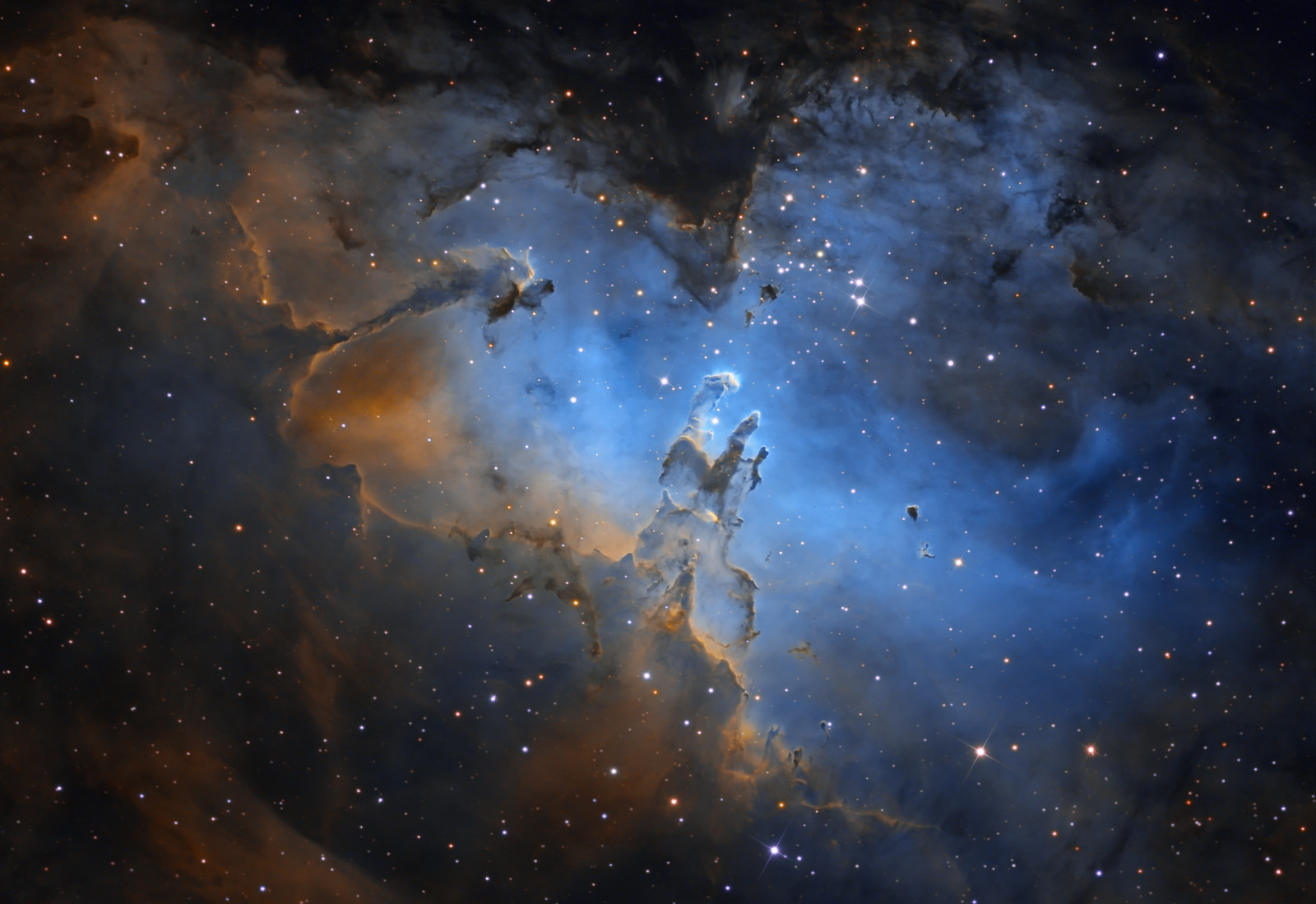
Explanation: A star cluster around 2 million years young surrounded by natal clouds of dust and glowing gas, M16 is also known as The Eagle Nebula. This beautifully detailed image of the region includes cosmic sculptures made famous in Hubble Space Telescope close-ups of the starforming complex. Described as elephant trunks or Pillars of Creation, dense, dusty columns rising near the center are light-years in length but are gravitationally contracting to form stars. Energetic radiation from the cluster stars erodes material near the tips, eventually exposing the embedded new stars. Extending from the ridge of bright emission left of center is another dusty starforming column known as the Fairy of Eagle Nebula. M16 and the Eagle Nebula lie about 7,000 light-years away, an easy target for binoculars or small telescopes in a nebula rich part of the sky toward the split constellation Serpens Cauda (the tail of the snake).

2015-10-14

And now, it's time to say goodnight. Ciao, Ciao, Ciao

CIAO, CIAO, CIAO!!!

Fotos - "Janela para Lisboa" - Barreiro - 18-07-2011

"Janela para Lisboa"

Barreiro, 18-07-2011
JoanMira

Astronomy picture of the day - 2015 October 14 - A Gegenschein Lunar Eclipse

See Explanation.
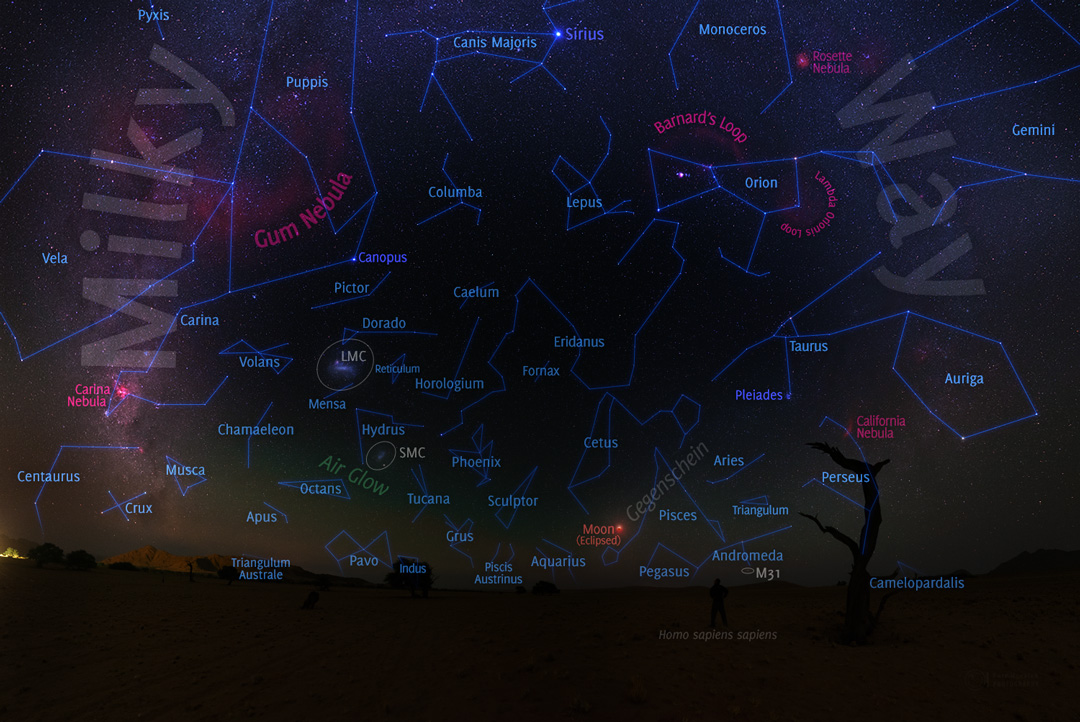
Moving the cursor over the image will bring up an annotated version.
Clicking on the image will bring up the highest resolution version
available.
A Gegenschein Lunar Eclipse 
Image Credit & Copyright: Petr HorálekRollover Annotation: Judy Schmidt
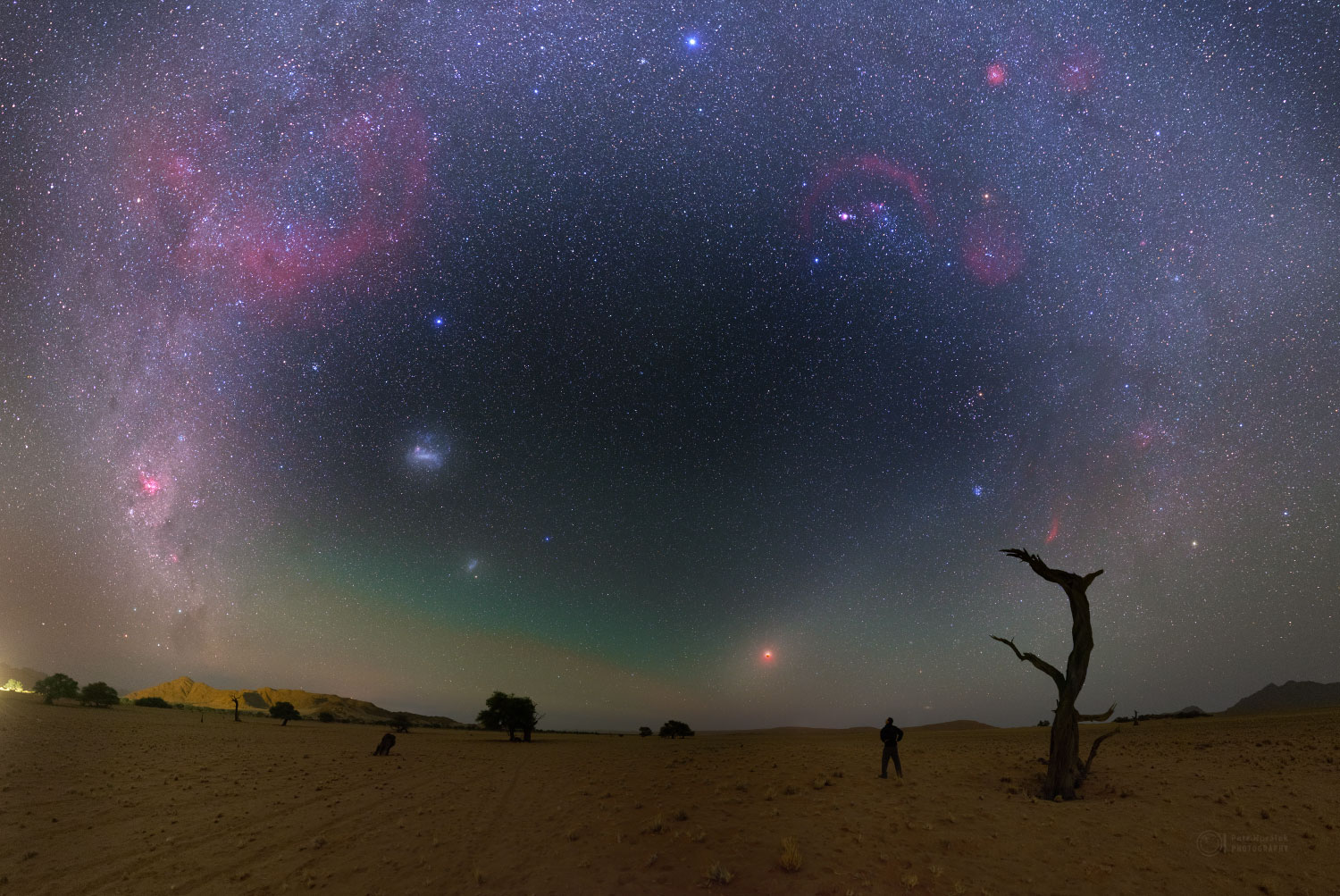
Explanation: Is there anything interesting to see in the direction opposite the Sun? One night last month, there were quite a few things. First, the red-glowing orb on the lower right of the featured image is the full moon, darkened and reddened because it has entered Earth's shadow. Beyond Earth's cone of darkness are backscattering dust particles orbiting the Sun that standout with a diffuse glow called the gegenschein, visible as a faint band rising from the central horizon and passing behind the Moon. A nearly horizontal stripe of green airglow is also discernable just above the horizon, partly blocked by blowing orange sand. Visible in the distant sky as the blue dot near the top of the image is the star Sirius, while the central band of our Milky Way Galaxy arches up on the image left and down again on the right. The fuzzy light patches just left of center are the Large and Small Magellanic Clouds. Red emission nebulas too numerous to mention are scattered about the sky, but are labelled in a companion annotated image. In the image foreground is the desolate Deadvlei region of the Namib-Naukluft National Park in Namibia, featuring the astrophotographer himself surveying a land and sky so amazing that he described it as one of the top experiences of his life.