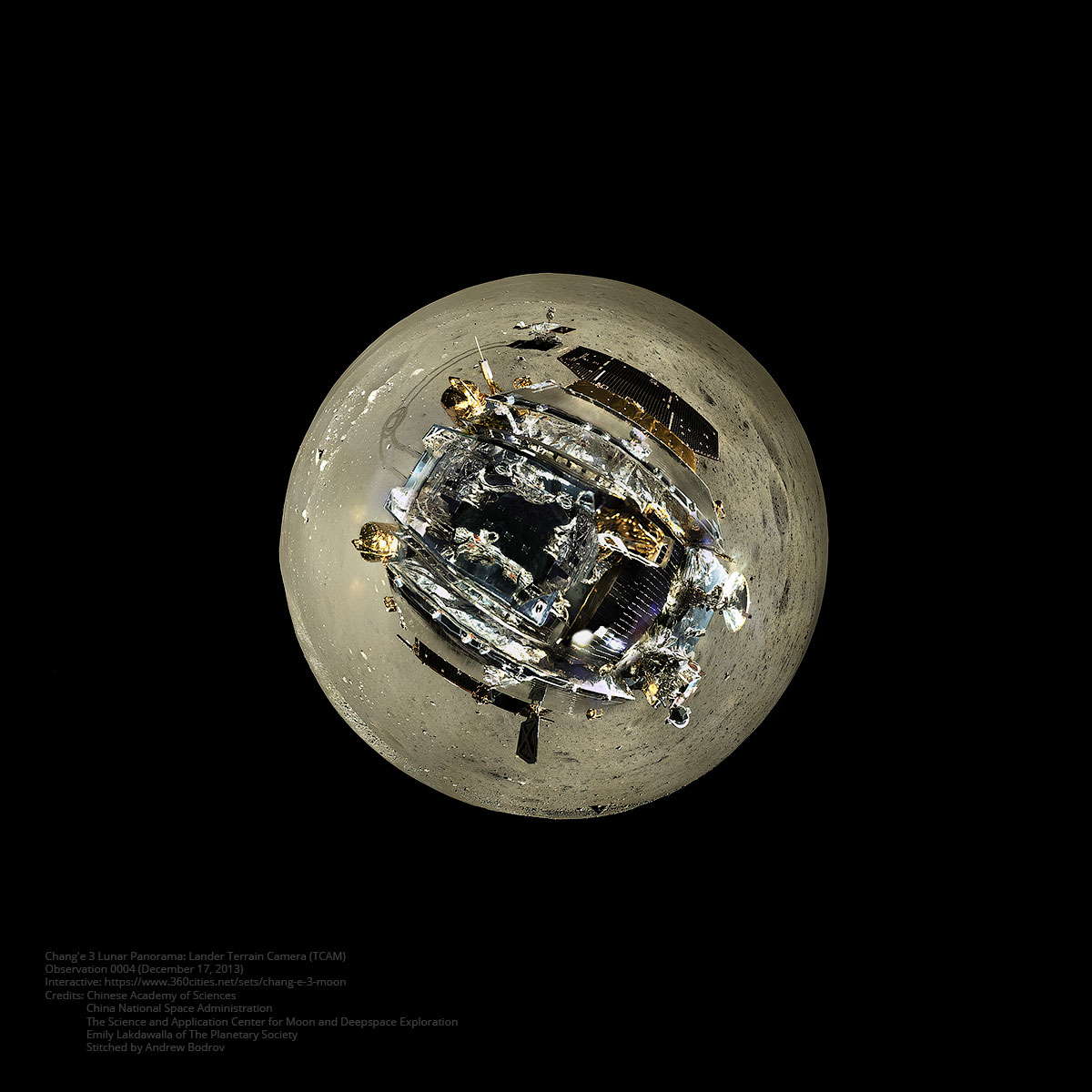
Explanation: Tracks lead to a small robot perched near the top of this bright little planet. Of course, the planet is really the Moon. The robot is the desk-sized Yutu rover, leaving its looming Chang'e 3 lander after a after a mid-December 2013 touch down in the northern Mare Imbrium. The little planet projection is a digitally warped and stitched mosaic of images from the lander's terrain camera covering 360 by 180 degrees. Ultimately traveling over 100 meters, Yutu came to a halt in January 2014. The lander's instruments are still working though, after more than two years on the lunar surface. Meanwhile, an interactive panoramic version of this little planet is available here.
Explanation: Just press play to watch two black holes merge. Inspired by the first direct detection of gravitational waves by LIGO, this simulation video plays in slow motion but would take about one third of a second if run in real time. Set on a cosmic stage the black holes are posed in front of stars, gas, and dust. Their extreme gravity lenses the light from behind them into Einstein rings as they spiral closer and finally merge into one. The otherwise invisible gravitational waves generated as the massive objects rapidly coalesce cause the visible image to ripple and slosh both inside and outside the Einstein rings even after the black holes have merged. Dubbed GW150914, the gravitational waves detected by LIGO are consistent with the merger of 36 and 29 solar mass black holes at a distance of 1.3 billion light-years. The final, single black hole has 62 times the mass of the Sun, with the remaining 3 solar masses converted into energy in gravitational waves.
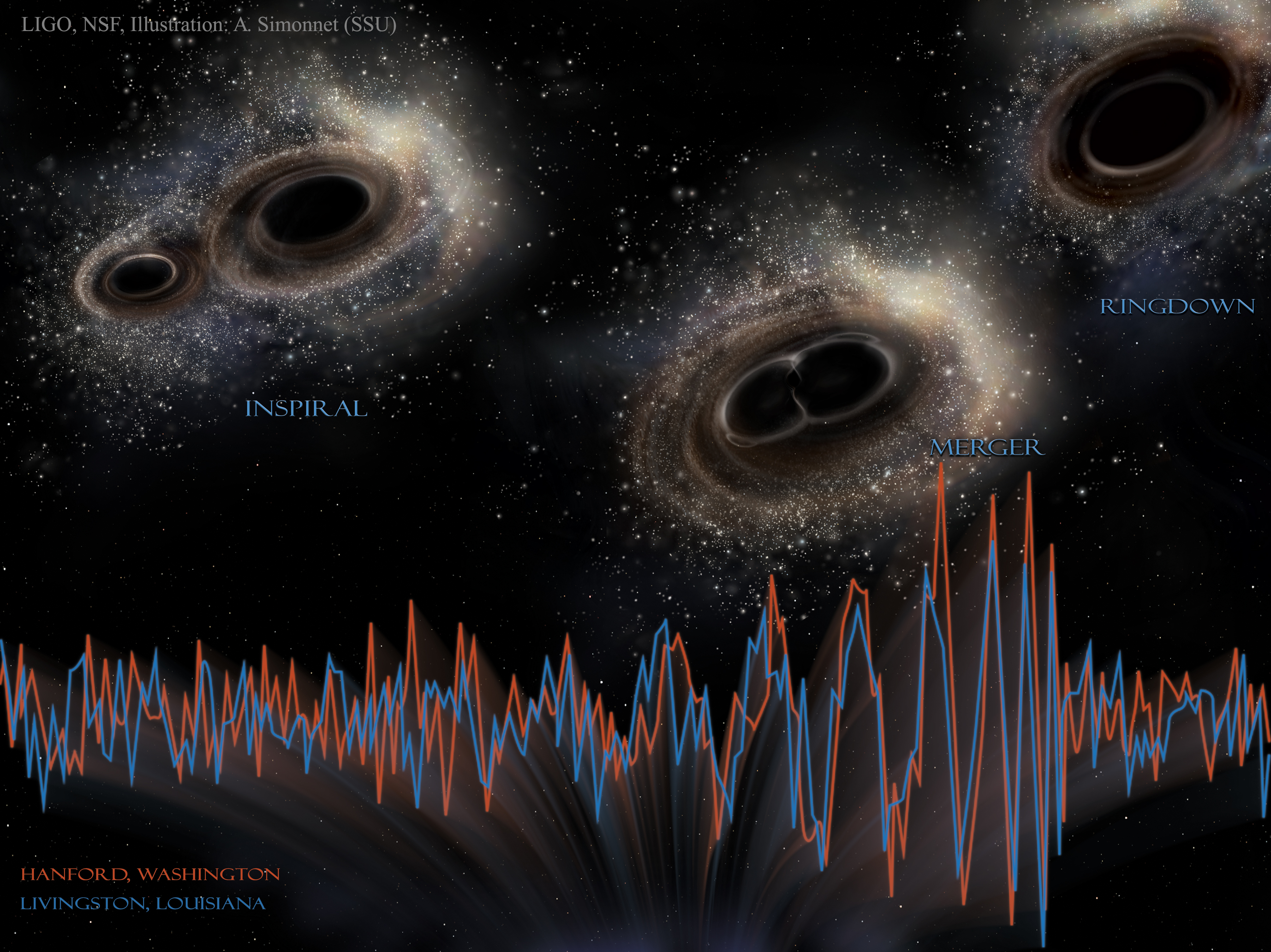
Explanation: Gravitational radiation has been directly detected. The first-ever detection was made by both facilities of the Laser Interferometer Gravitational-Wave Observatory (LIGO) in Washington and Louisiana simultaneously last September. After numerous consistency checks, the resulting 5-sigma discovery was published today. The measured gravitationalwaves match those expected from two large black holes merging after a death spiral in a distant galaxy, with the resulting new black hole momentarily vibrating in a rapid ringdown. A phenomenon predicted by Einstein, the historic discovery confirms a cornerstone of humanity's understanding of gravity and basic physics. It is also the most direct detection of black holes ever. The featured illustration depicts the two merging black holes with the signal strength of the two detectors over 0.3 seconds superimposed across the bottom. Expected future detections by Advanced LIGO and other gravitational wave detectors may not only confirm the spectacular nature of this measurement but hold tremendous promise of giving humanity a new way to see and explore our universe.