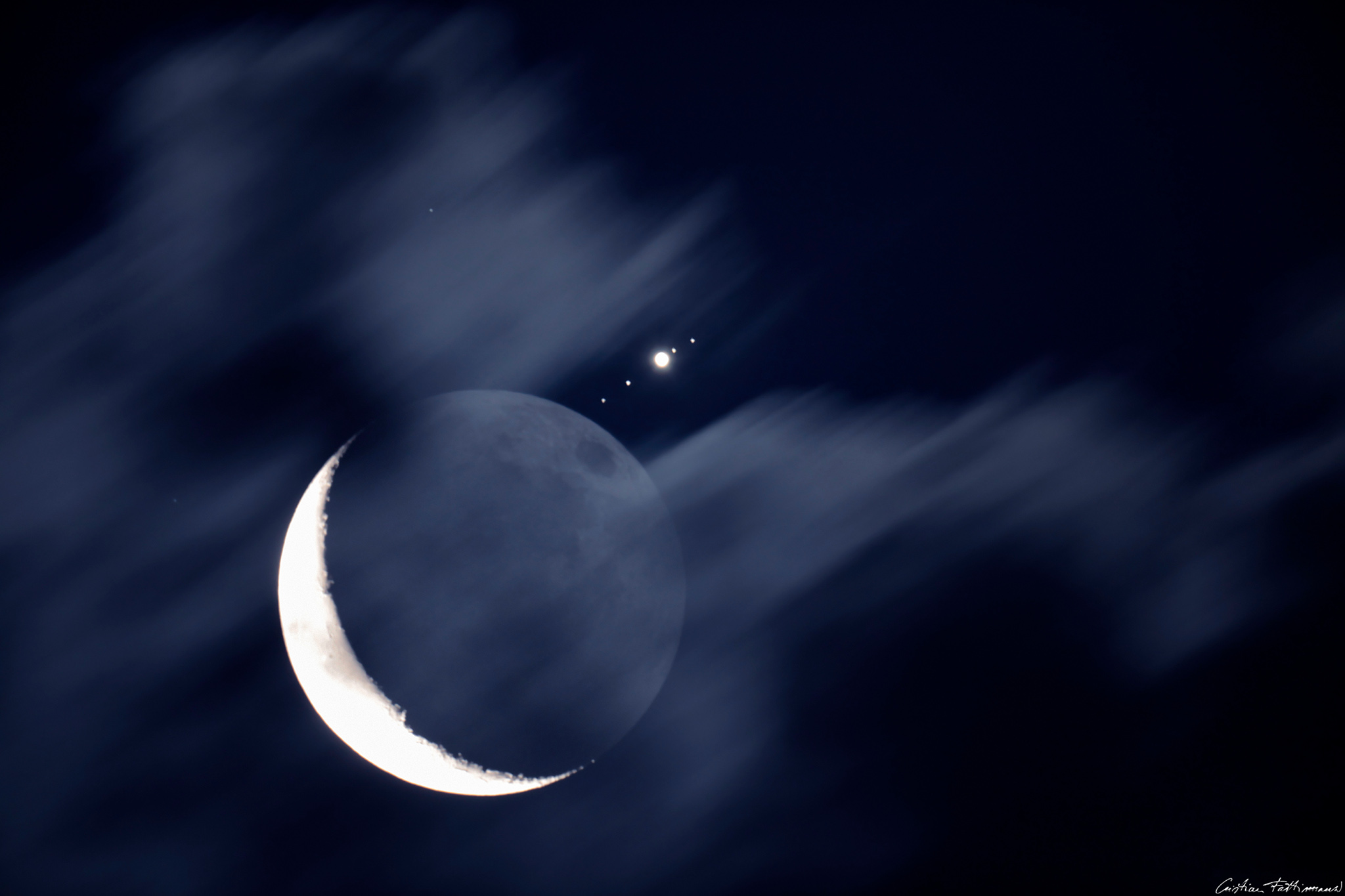
Explanation: What's that next to the Moon? Jupiter -- and its four largest moons. Skygazers around planet Earth enjoyed the close encounter of planets and Moon in 2012 July 15's predawn skies. And while many saw bright Jupiter next to the slender, waning crescent, Europeans also had the opportunity to watch the ruling gas giant pass behind the lunar disk, occulted by the Moon as it slid through the night. Clouds threaten in this telescopic view fromMontecassiano, Italy, but the frame still captures Jupiter after it emerged from the occultation along with all four of its large Galilean moons. The sunlit crescent is overexposed with the Moon's night side faintly illuminated by Earthshine. Lined up left to right beyond the dark lunar limb are Callisto, Ganymede, Jupiter, Io, and Europa. In fact, Callisto, Ganymede, and Io are larger than Earth's Moon, while Europa is only slightly smaller. Last week, NASA's Juno became the second spacecraft ever to orbit Jupiter.
Inauguración de las nuevas instalaciones del Zoo Aquarium de Madrid dedicadas al lince ibérico, con motivo de la llegada de una pareja de estos felinos procedentes del centro de cría cacereño de Granadilla.
Vista aérea de una pareja paseando con su perro cerca de las dunas protegidas y salinas que se extienden a lo largo de la playa de Sankt-Peter-Ording, Alemania.
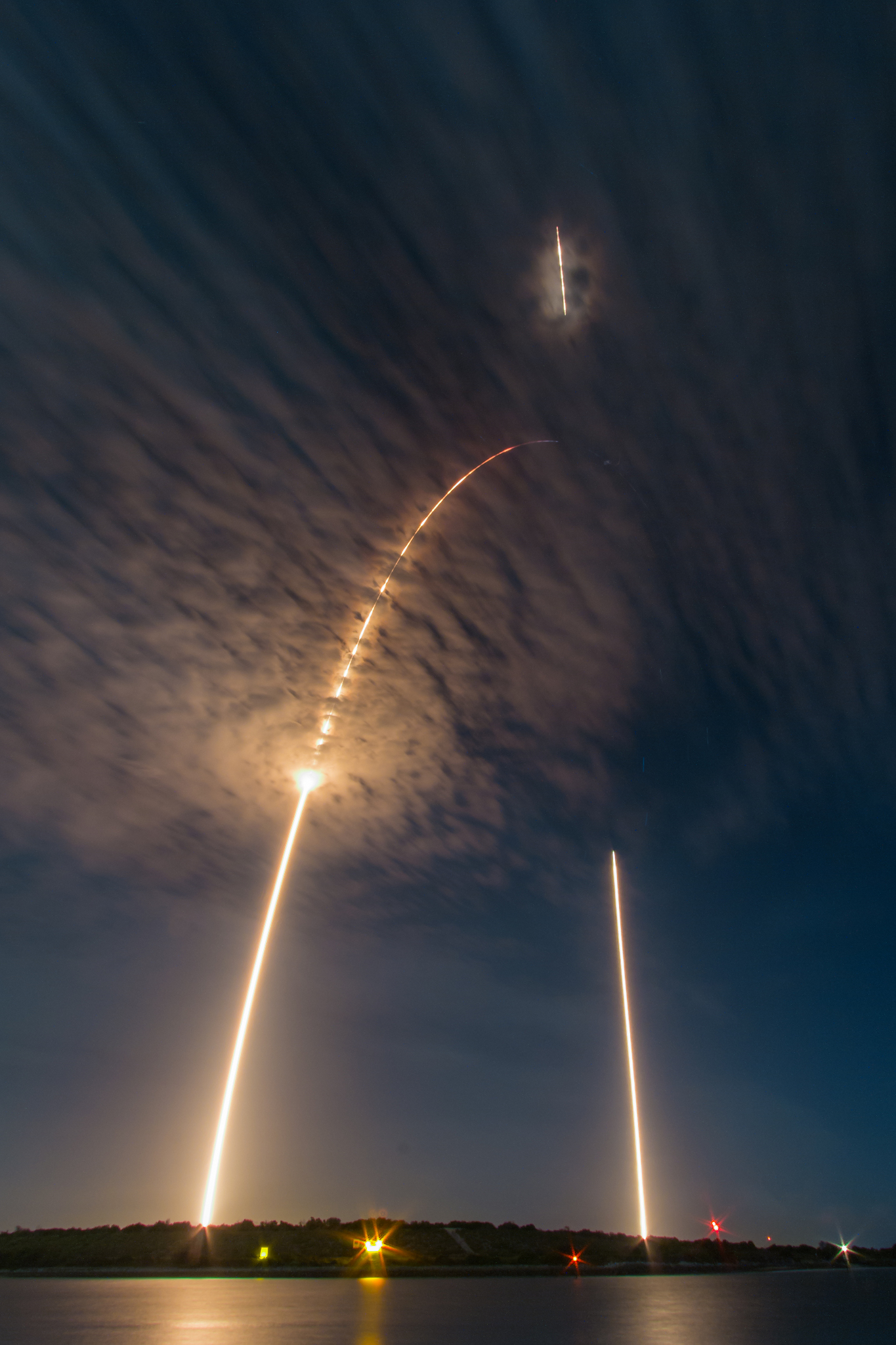
Explanation: Shortly after midnight on July 18 a SpaceX Falcon 9 rocket launched from Space Launch Complex 40 at Cape Canaveral Air Force Station, Florida, planet Earth. About 9 minutes later, the rocket's first stage returned to the spaceport. This single time exposure captures the rocket's launch arc and landing streak from Jetty Park only a few miles away. Along a climbing, curving trajectory the launch is traced by the initial burn of the first stage, ending near the top of the bright arc before stage separation. Due to perspective the next bright burn appears above the top of the launch arc in the photo, the returning first stage descending closer to the Cape. The final landing burn creates a long streak as the first stage slows and comes to rest at Landing Zone 1. Yesterday the Dragon cargo spacecraft delivered to orbit by the rocket's second stage was attached to the International Space Station.
Na rota dos Templarios fica esta aldeia construida sobre uma pequena peninsula formada pelo rio Zêzere. Magnificas paisagens naturais conservam vestigios das lutas medievais, como a torre templaria pentagonal e a igreja de Nossa Pranto.Senhora do Pranto.
Dark Dunes on Mars (Horizontally Compressed) Image Credit: NASA, JPL-Caltech, MSSS
Explanation: How does wind affect sand on Mars? To help find out if it differs significantly from Earth, the robotic Curiosity rover on Mars was directed to investigate the dark Namib Dune in the Bagnold Dune Field in Gale Crater. Namib is the first active sand dune investigated up close outside of planet Earth. Wind-created ripples on Earth-bound sand dunes appear similar to ripples on Mars, with one exception. The larger peaks visible on dark Namib dune, averaging about 3 meters apart, are of a type seen only underwater on Earth. They appear to arise on Mars because of the way the thin Martian wind drags dark sand particles. The featured image was taken last December and ishorizontally compressed to show context. In the distance, a normal dusty Martian landscape slopes up in light orange, while a rock-strewn landscape is visible on the far right. Curiosity unexpectedly went into safe mode in early July, but it was brought out last week and has now resumed exploring the once lake-filled interior of Gale Crater for further signs that it was once habitable by microbial life.
John Philip Sousa (Washington, 6 de novembro de 1854 — Reading, 6 de março de 1932) foi um compositor e maestro de banda norte-americano, do romantismo tardio, popularmente conhecido como O Rei das Marchas, como The Stars and Stripes Forever, marcha oficial dos Estados Unidos. A sua produção musical inclui cerca de 15 operetas e várias canções. Conhecido por ter idealizado e dado nome ao Sousafone.
O célebre compositor John Philip Sousa, autor do famoso "stars and stripes" nasceu nos Estados Unidos da América, terceiro de dez filhos e filhas de pai português de origem açoriana e mãe bávara,[1] de nome: João António de Sousa (John Anthony Sousa) (Sevilha, 22 de Setembro de 1824 - 27 de Abril de 1892) e Maria Elisabeth Trinkhaus (Darmstadt, 20 de Maio de 1826 - 25 de Agosto de 1908). Os seus pais eram descendentes de portugueses, espanhóis e hessianos (alemães); seus avós paternos eram portugueses e espanhois refugiados.[2]. Sousa iniciou a sua educação musical, tocando violino, como pupilo de João Esputa e G.F. Benkert de harmonia e composição musical com seis anos.
Com a sua própria banda, entre 1892-1931, realizou 15623 concertos..[3] Em 1900, a sua banda representa os Estados Unidos na Exposição Universal de Paris (1900).
Morreu de insuficiência cardíaca com 78 anos em 6 de março de 1932, no seu quarto no Hotel Abraham Lincoln, em Reading, Pensilvânia. Tinha conduzido um ensaio de "Stars and Stripes Forever". E ncontra-se sepultado em Washington, DC no Cemitério do Congresso.