
2016-07-29


Imagenes del Mundo - Galeria Tretyakov de Krymsky Val, en Moscú, Rusia.

PAVEL GOLOVKIN AP
Astronomy picture of the day - 2016 July 29 - Blue Danube Analemma
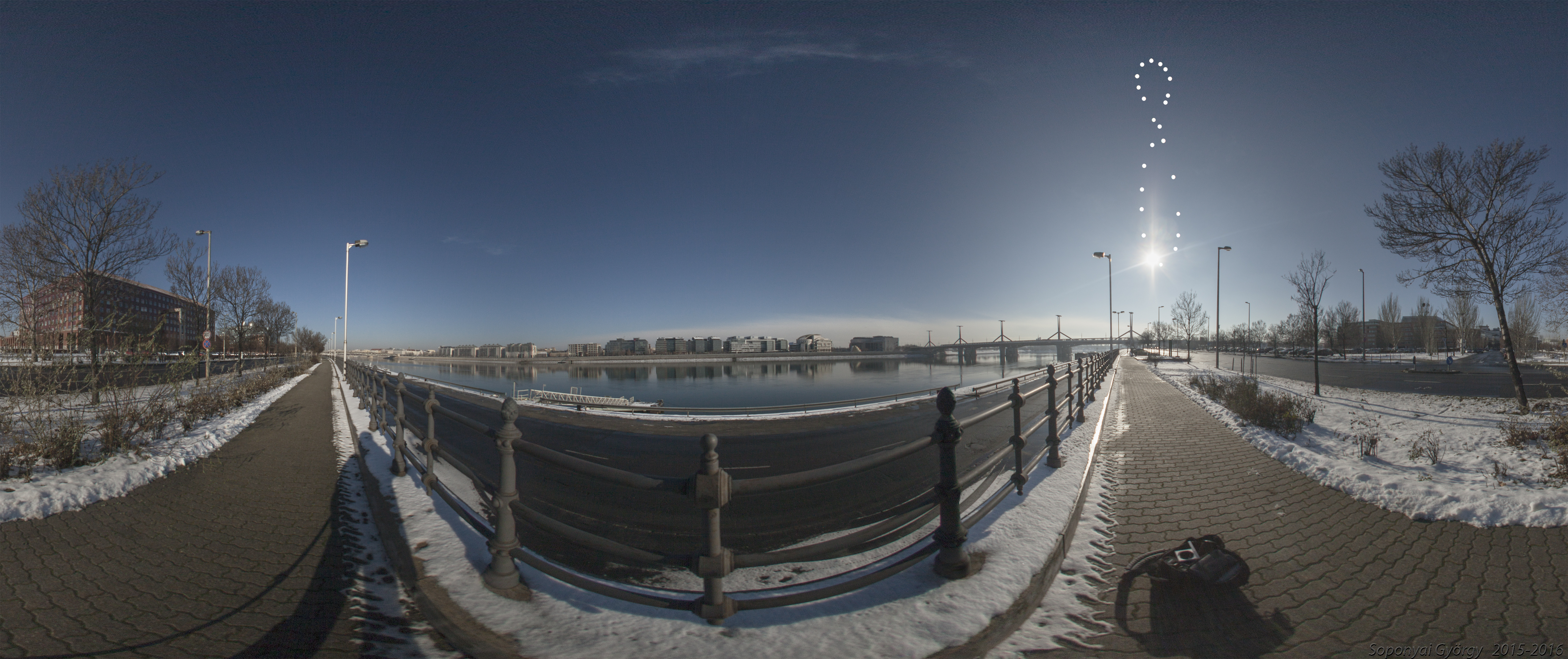
Image Credit & Copyright: György Soponyai
Explanation: The Sun's annual waltz through planet Earth's sky forms a graceful curve known as an analemma. The analemma's figure 8 shape is tipped vertically at far right in this well-composed fisheye view from Budapest, Hungary. Captured at a chosen spot on the western bank of the Danube river, the Sun's position was recorded at 11:44 Central European Time on individual exposures over days spanning 2015 July 23 to 2016 July 4. Of course, on the northern summer solstice the Sun is at the top of the curve, but at the midpoints for the autumn and spring equinoxes. With snow on the ground, the photographer's shadow and equipment bag also appear in the base picture used for the composite panorama, taken on 2016 January 7. On that date, just after the winter solstice, the Sun was leaving the bottom of the beautiful curve over the blue Danube.
2016-07-28


Astronomy pictures of the day - 2016 July 28 - Herschel's Eagle Nebula
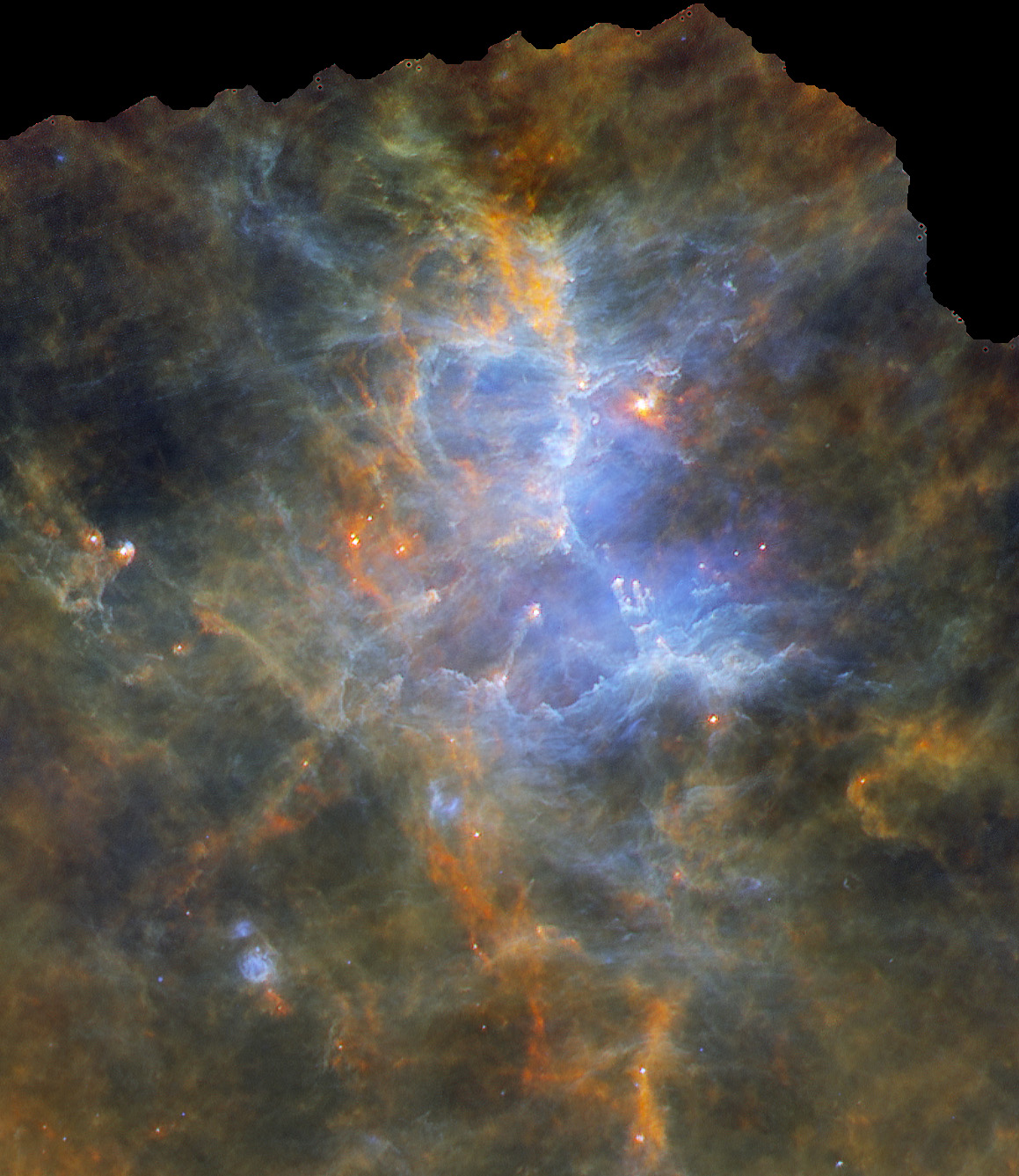
Image Credit & Copyright: ESA/Herschel/PACS, SPIRE/Hi-GAL Project
Acknowledgment: G. Li Causi, IAPS/INAF
Explanation: A now famous picture from the Hubble Space Telescope featured Pillars of Creation, star forming columns of cold gas and dust light-years long inside M16, the Eagle Nebula. This false-color composite image views the nearby stellar nursery using data from the Herschel Space Observatory's panoramic exploration of interstellar clouds along the plane of our Milky Way galaxy. Herschel's far infrared detectors record the emission from the region's cold dust directly. The famous pillars are included near the center of the scene. While the central group of hot young stars is not apparent at these infrared wavelengths, the stars' radiation and winds carve the shapes within the interstellar clouds. Scattered white spots are denser knots of gas and dust, clumps of material collapsing to form new stars. The Eagle Nebula is some 6,500 light-years distant, an easy target for binoculars or small telescopes in a nebula rich part of the sky toward the split constellation Serpens Cauda (the tail of the snake).
2016-07-27


Astronomy picture of the day - 2016 July 27 - M13: A Great Globular Cluster of Stars
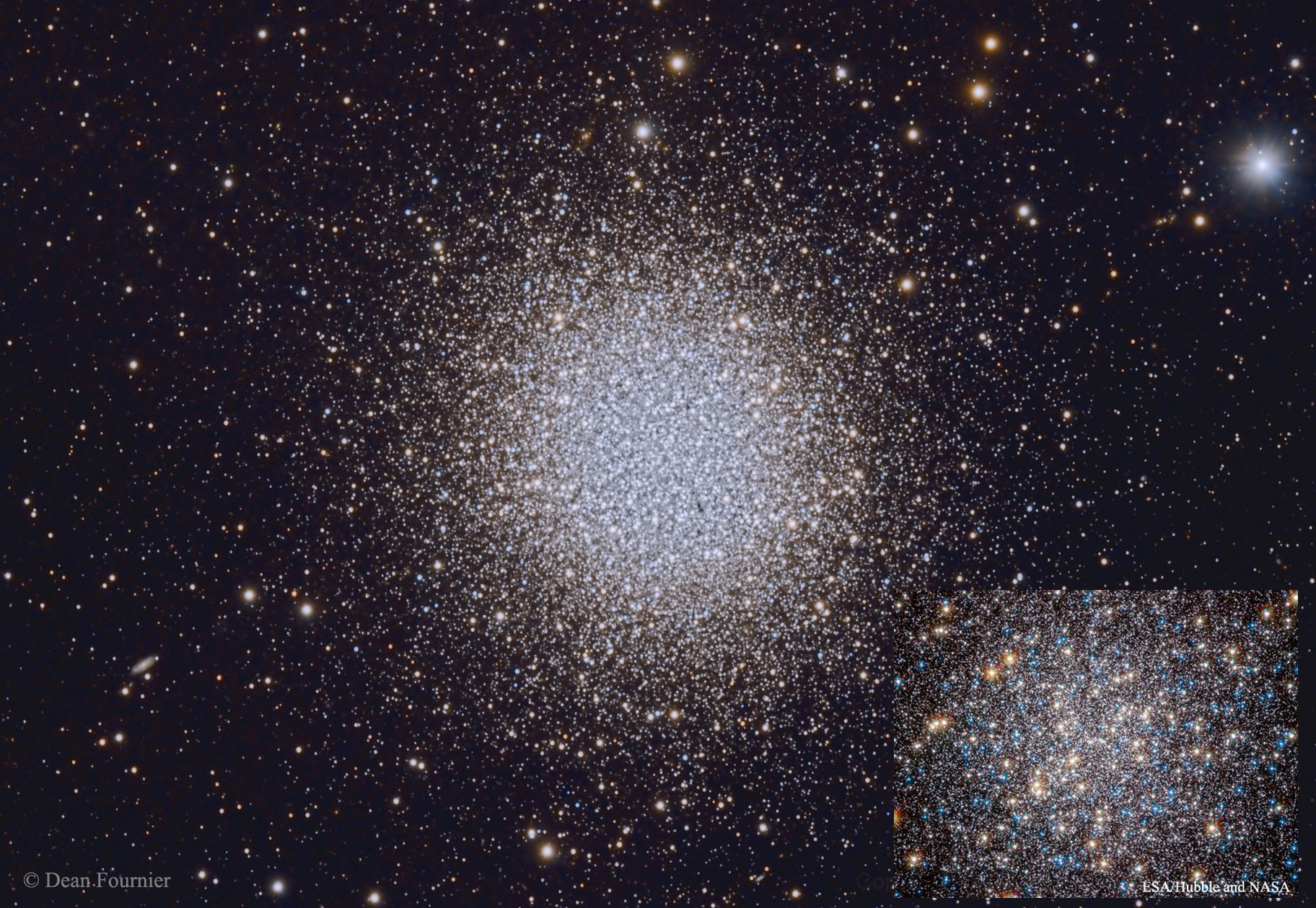
Image Credit & Copyright: Dean Fournier; Inset: ESA/Hubble & NASA
Explanation: M13 is one of the most prominent and best known globular clusters. Visible with binoculars in the constellation of Hercules, M13 is frequently one of the first objects found by curious sky gazers seeking celestials wonders beyond normal human vision. M13 is a colossal home to over 100,000 stars, spans over 150 light years across, lies over 20,000 light years distant, and is over 12 billion years old. At the 1974 dedication of Arecibo Observatory, a radio message about Earth was sent in the direction of M13. The featured image in HDR, taken through a small telescope, spans an angular size just larger than a full Moon, whereas the inset image, taken by Hubble Space Telescope, zooms in on the central 0.04 degrees.
Inscription à :
Articles (Atom)