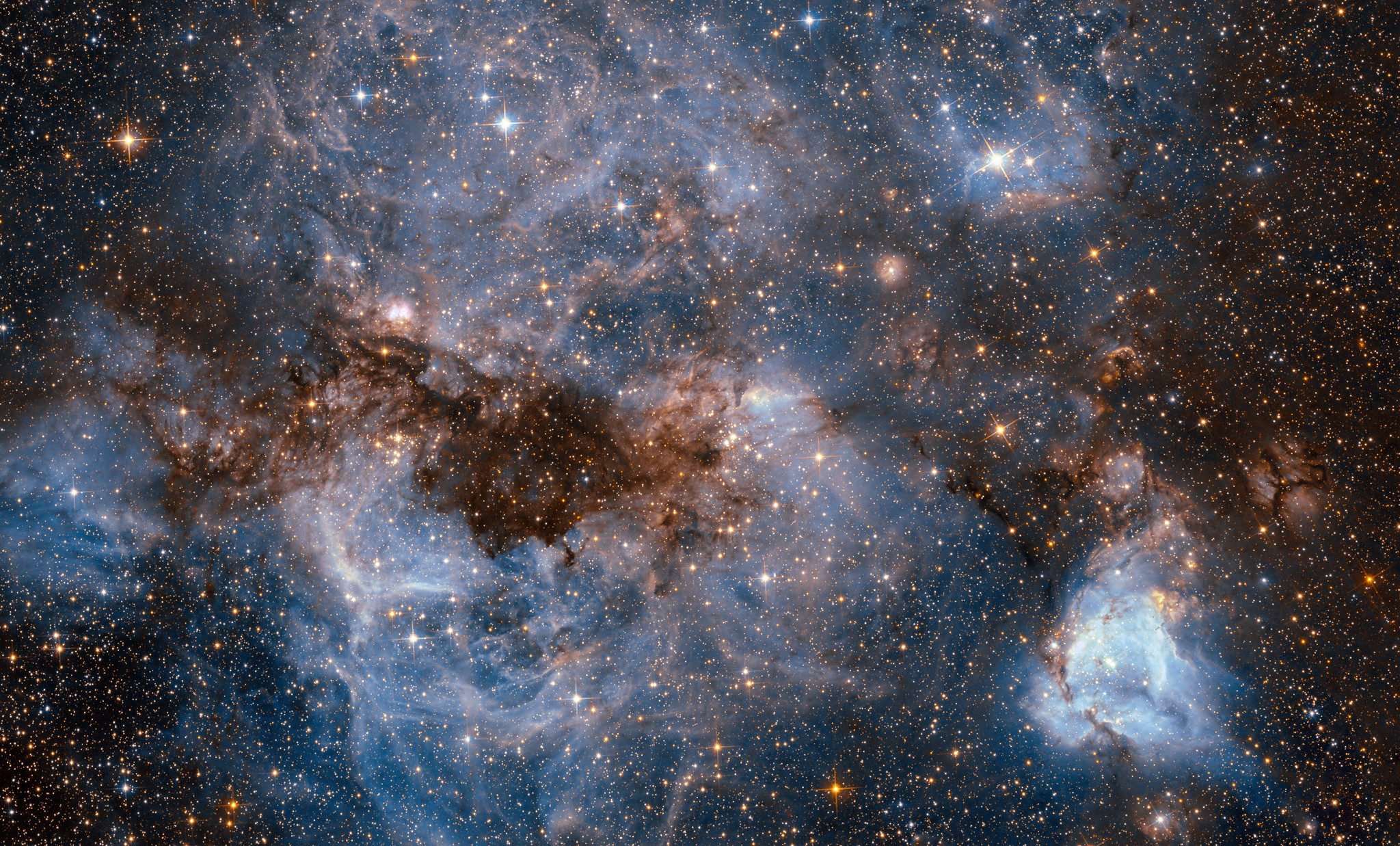
Explanation: Over 150 light-years across, this cosmic maelstrom of gas and dust is not too far away. It lies south of the Tarantula Nebula in our satellite galaxy the Large Magellanic Cloud a mere 180,000 light-years distant. Massive stars have formed within. Their energetic radiation and powerful stellar winds sculpt the gas and dust and power the glow of this HII region, entered into the Henize catalog of emission stars and nebulae in the Magellanic Clouds as N159. The bright, compact, butterfly-shaped nebula above and left of center likely contains massive stars in a very early stage of formation. Resolved for the first time in Hubble images, the compact blob of ionized gas has come to be known as the Papillon Nebula.
El volcán guatemalteco 'Fuego', uno de los más activos del país, inició la primera erupción del 2017 con explosiones "constantes, moderadas y fuertes", en Alotenango, Sacatepéquez (Guatemala).
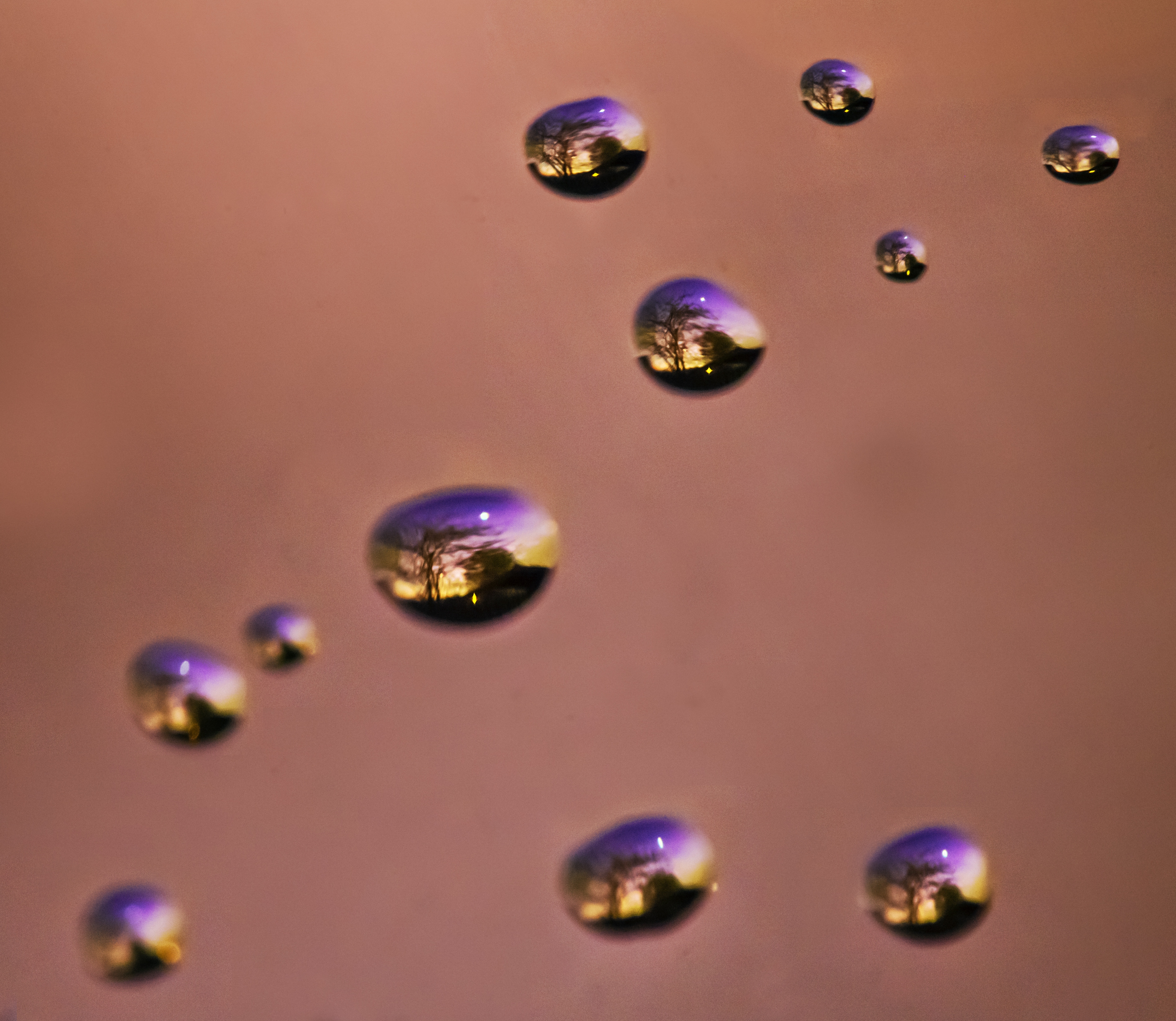
Explanation: Now the brilliant "star" in planet Earth's evening skies, Venus is captured in this creative astrophotograph. Taken with a close-focusing lens on January 18 from Milton Keynes, UK, it shows multiple images of the sky above the western horizon shortly after sunset. The images were created by water drops on a glass pane fixed to a tree. Surface tension has drawn the water drops into simple lens-like shapes. Refracting light, the drops create images that are upside-down, so the scene has been rotated to allow comfortable right-side up viewing of a macro-multiple-skyscape.
GOES-16: Moon over Planet Earth Image Credit: NOAA, NASA
Explanation: Launched last November 19 from Cape Canaveral Air Force Station, the satellite now known as GOES-16 can now observe planet Earth from a geostationary orbit 22,300 miles above the equator. Its Advanced Baseline Imager captured this contrasting view of Earth and a gibbous Moon on January 15. The stark and airless Moon is not really the focus of GOES-16, though. Capable of providing a high resolution full disk image of Earth every 15 minutes in 16 spectral channels, the new generation satellite's instrumentation is geared to provide sharper, more detailed views of Earth's dynamic weather systems and enable more accurate weather forecasting. Like previous GOES weather satellites, GOES-16 will use the moon over our fair planet as a calibration target.
O crocodilo, quando ingere um alimento, faz forte pressão contra o céu da boca, comprimindo as
glândulas lacrimais. Assim, ele chora enquanto devora a vítima.
 Significado: