2017-04-11

Article - Médecine. Portugal - Soulever 40 kg ? Facile, avec ce gant intelligent


Un jeune entrepreneur portugais a mis au point un gant destiné à aider les blessés à la main. 

Une blessure à la main, même légère, peut gravement limiter son usage. Filipe Quinaz en a fait l’amère expérience après une fracture, lorsqu’il était étudiant en biomédecine à l’université de Beira Interior (centre du Portugal). Le jeune homme a alors commencé à réfléchir à des solutions pour aider les personnes dans son cas.
Suivi en temps réel

Quelques années plus tard, le résultat est un gant qui permet de soulever jusqu’à 40 kg sans effort. Composé de textiles intelligents truffés de capteurs électroniques, il permet également aux soignants de suivre en temps réel l’évolution de l’état de la main de leurs patients. Le produit s’adresse en priorité “aux accidentés, aux personnes atteintes d’arthrite ou ayant souffert d’un AVC”, détaille le Diário de Notícias.

Nuada, la start-up fondée par Filipe Quinaz, a intégré début 2017 l’accélérateur Uten (University Technology Enterprise Network), fruit d’un partenariat entre le gouvernement portugais et l’université du Texas à Austin. L’entreprise espère pouvoir réaliser les premières préventes de son gant à l’été.

Courrier International - France

Imagens - Maravilhas de Cuba - Cayo Guillermo

Playas de Cuba
Uma praia paradisíaca en Cayo Guillermo.
GETTY

Astronomy picture of the day - 2017 April 11 - Man, Dog, Sun

See Explanation.  Clicking on the picture will download
 the highest resolution version available.
Man, Dog, Sun 
Image Credit & Copyright: Jens Hackmann
Explanation: This was supposed to be a shot of trees in front of a setting Sun. Sometimes, though, the unexpected can be photogenic. During some planning shots, a man walking his dog unexpected crossed the ridge. The result was so striking that, after cropping, it became the main shot. The reason the Sun appears so large is that the image was taken from about a kilometer away through a telephoto lens. Scattering of blue light by the Earth's atmospheremakes the bottom of the Sun appear slightly more red that the top. Also, if you look closely at the Sun, just above the man's head, a large group of sunspots is visible. The image was taken just last week in Bad Mergentheim,Germany.

2017-04-10

Astronomy picture of the day - 2017 April 10 - Galaxy Cluster Gas Creates Hole in Microwave Background

See Explanation.  Clicking on the picture will download
 the highest resolution version available.
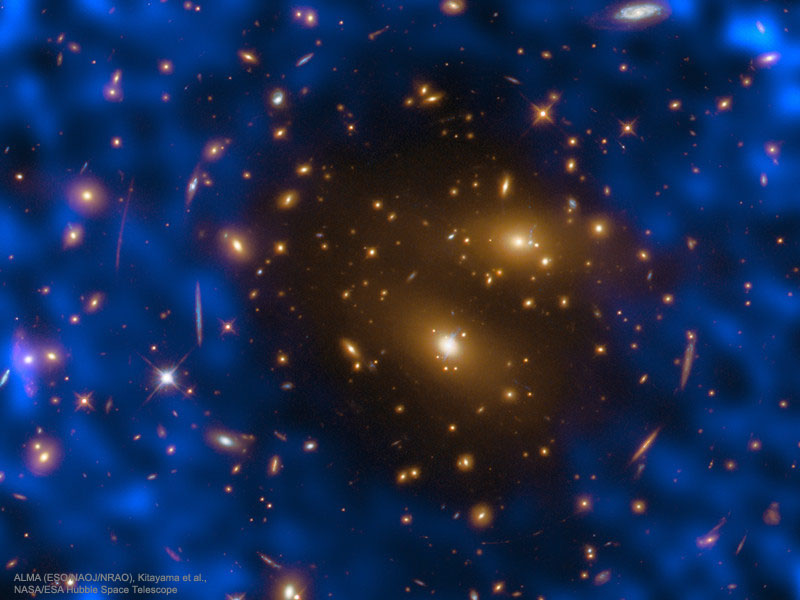
Galaxy Cluster Gas Creates Hole in Microwave Background 
Image Credit: ALMA (ESO/NAOJ/NRAO), Kitayama et al.NASA/ESA Hubble Space Telescope
Explanation: Why would this cluster of galaxy punch a hole in the cosmic microwave background (CMB)? First, the famous CMB was created by cooling gas in the early universe and flies right through most gas and dust in the universe. It is all around us. Large clusters of galaxies have enough gravity to contain very hot gas -- gas hot enough to up-scatter microwave photons into light of significantly higher energy, thereby creating a hole in CMB maps. ThisSunyaev–Zel'dovich (SZ) effect has been used for decades to reveal new information about hot gas in clusters and even to help discover galaxy clusters in a simple yet uniform way. Pictured is the most detailed image yet obtained of the SZ effect, now using both ALMA to measure the CMB and the Hubble Space Telescope to measure the galaxies in the massive galaxy cluster RX J1347.5-1145False-color blue depicts light from the CMB, while almost every yellow object is a galaxy. The shape of the SZ hole indicates not only that hot gas is present in this galaxy cluster, but also that it is distributed in a surprisingly uneven manner.

2017-04-09

Astronomy picture of the day - 2017 April 9 - Comet Hale-Bopp Over Val Parola Pass

See Explanation.  Clicking on the picture will download
 the highest resolution version available.
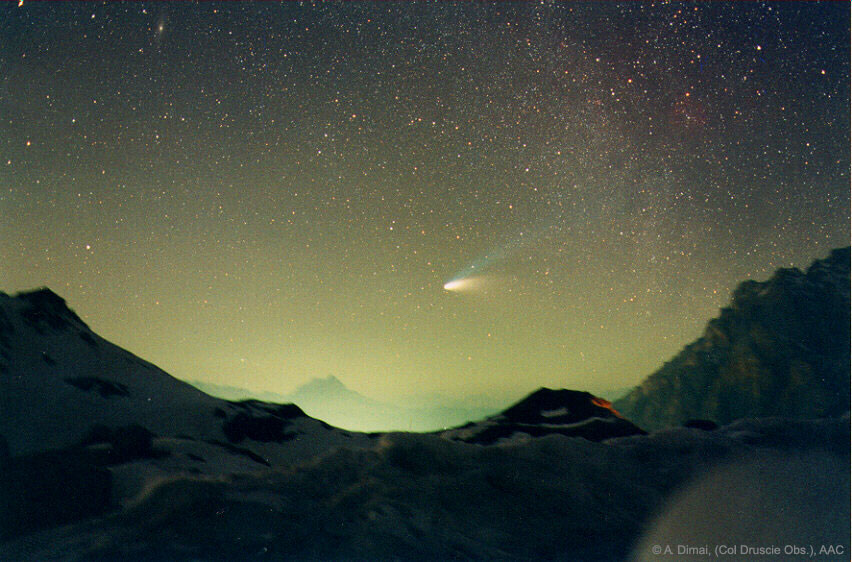
Comet Hale-Bopp Over Val Parola Pass 
Image Credit & Copyright: A. Dimai, (Col Druscie Obs.), AAC
Explanation: Comet Hale-Bopp, the Great Comet of 1997, became much brighter than any surrounding stars. It was seen even over bright city lights. Away from city lights, however, it put on quite a spectacular show. Here Comet Hale-Bopp was photographed above Val Parola Pass in the Dolomite mountains surrounding Cortina d'AmpezzoItalyComet Hale-Bopp's blue ion tail, consisting of ions from the comet's nucleus, is pushed out by the solar wind. The white dust tail is composed of larger particles of dust from the nucleus driven by the pressure of sunlight, that orbit behind the comet. Comet Hale-Bopp (C/1995 O1) remained visible to the unaided eye for 18 months -- longer than any other comet in recorded history. This year marks the 20th anniversary of Comet Hale-Bopp's last trip to the inner Solar System. The large comet is next expected to return around the year 4385.

2017-04-08

Astronomy picture of the day - 2017 April 8 - Zeta Oph: Runaway Star

See Explanation.  Clicking on the picture will download
 the highest resolution version available.
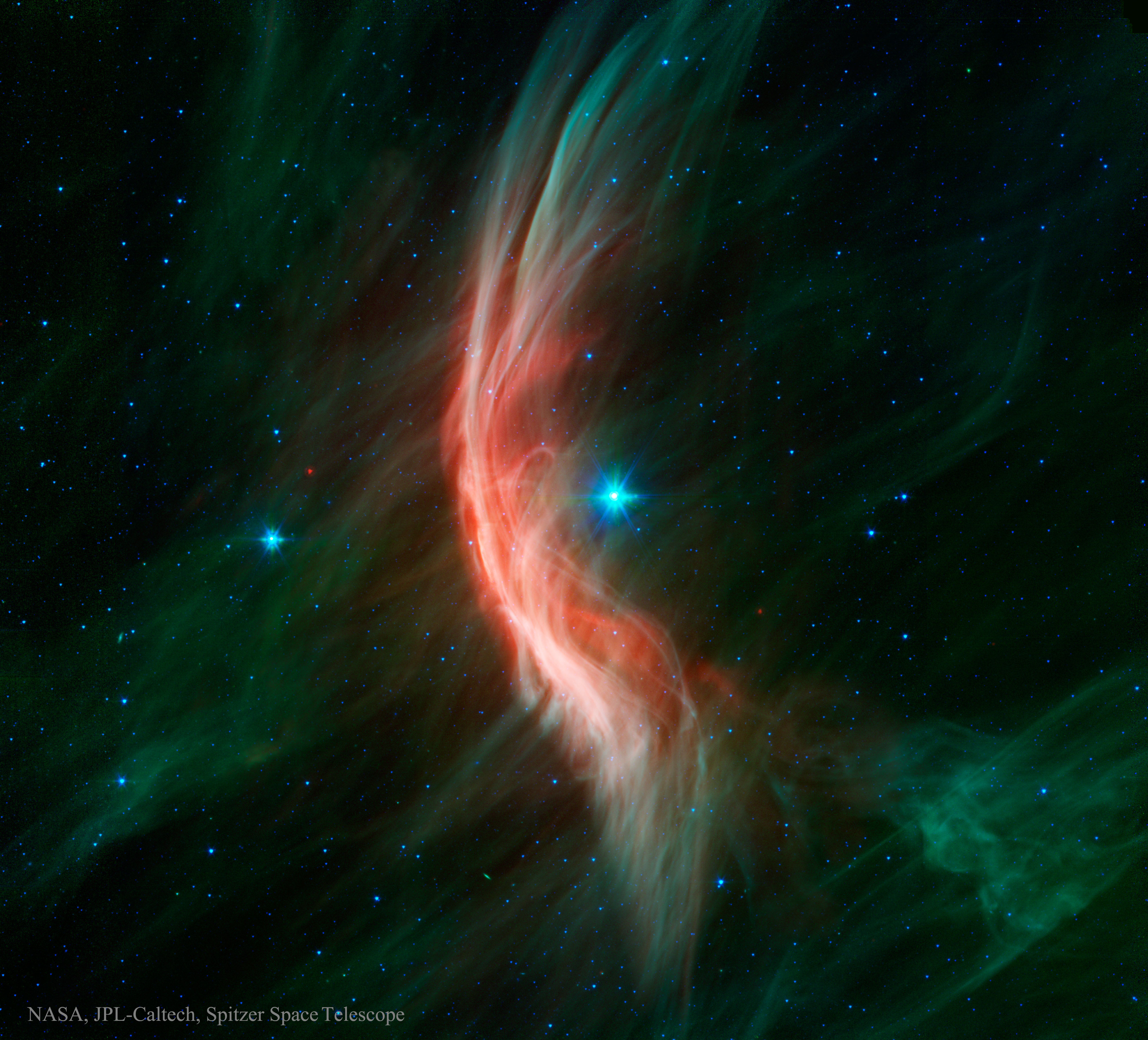
Zeta Oph: Runaway Star 
NASAJPL-CaltechSpitzer Space Telescope


Explanation: Like a ship plowing through cosmic seas, runaway star Zeta Ophiuchi produces the arcing interstellar bow wave or bow shock seen in this stunning infrared portrait. In the false-color view, bluish Zeta Oph, a star about 20 times more massive than the Sun, lies near the center of the frame, moving toward the left at 24 kilometers per second. Its strong stellar wind precedes it, compressing and heating the dusty interstellar material and shaping the curved shock front. What set this star in motion? Zeta Oph was likely once a member of a binary star system, its companion star was more massive and hence shorter lived. When the companion exploded as a supernova catastrophically losing mass, Zeta Oph was flung out of the system. About 460 light-years away, Zeta Oph is 65,000 times more luminous than the Sun and would be one of the brighter stars in the sky if it weren't surrounded by obscuring dust. The image spans about 1.5 degrees or 12 light-years at the estimated distance of Zeta Ophiuchi.

2017-04-07

Astronomy picture of the day - 2017 April 7 - Castle Eye View

See Explanation.
Moving the cursor over the image will bring up an annotated version.
Clicking on the image will bring up the highest resolution version
available.
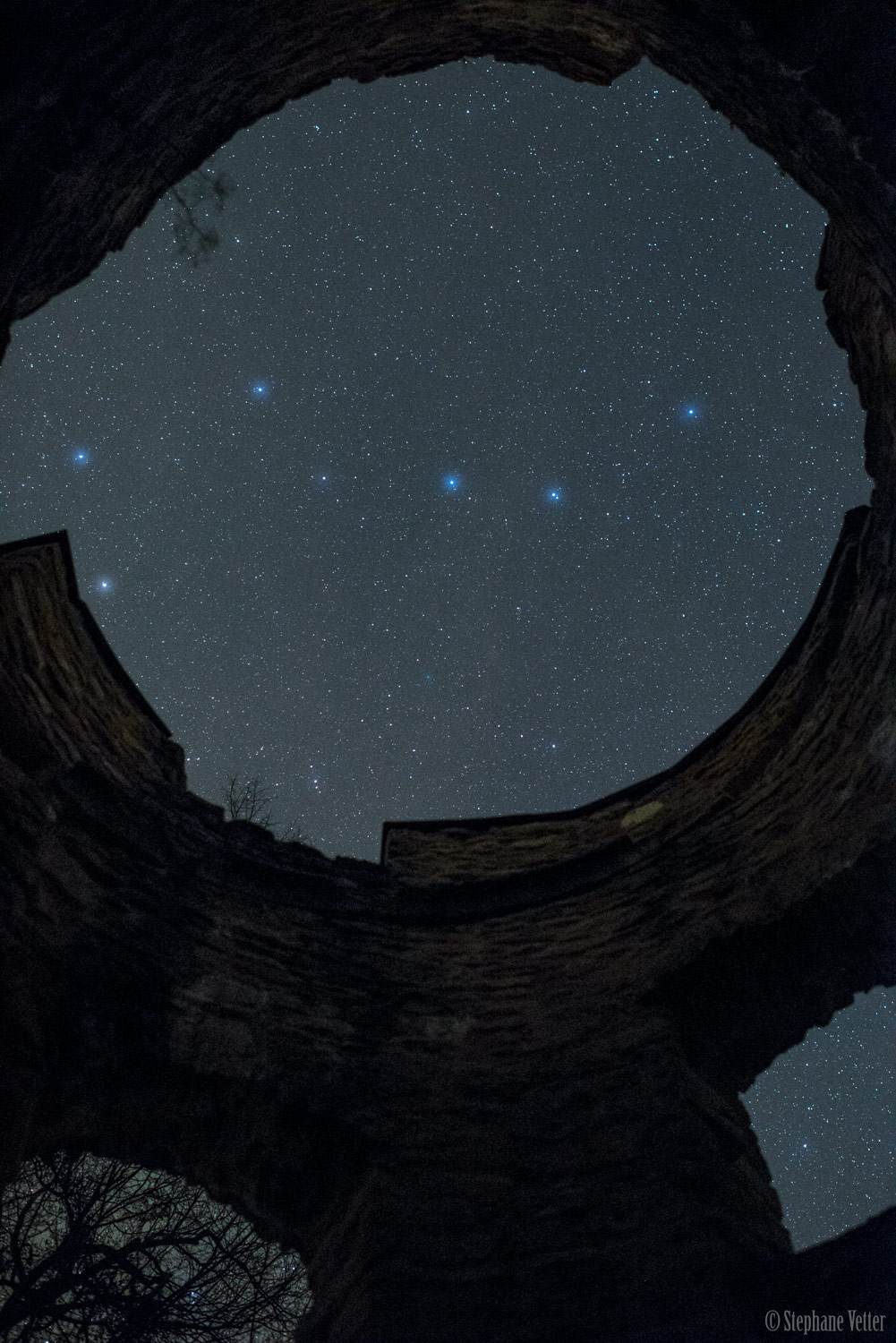
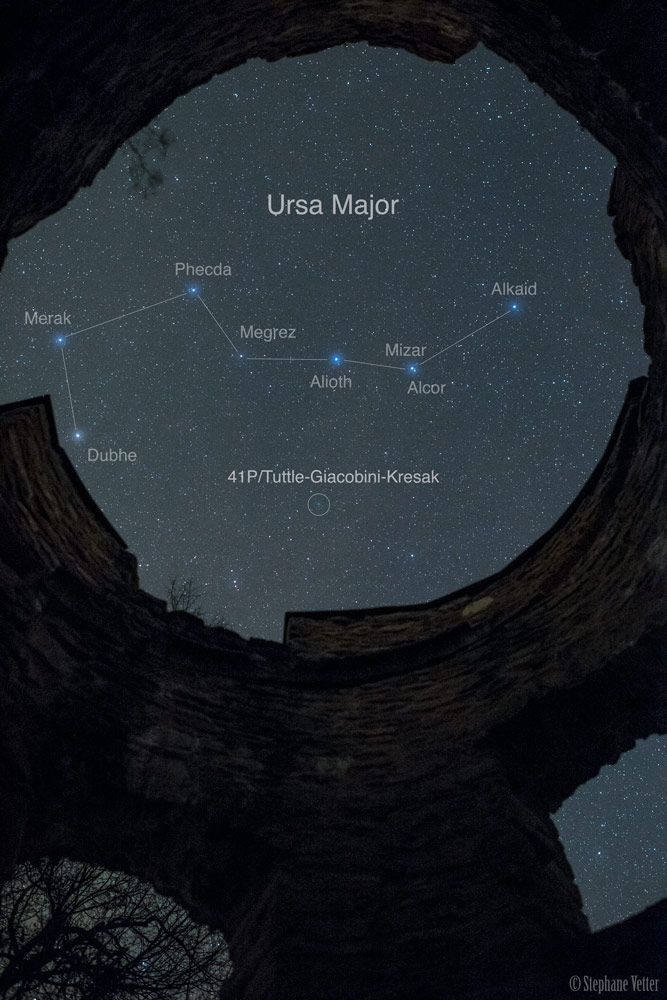
Castle Eye View 
Image Credit & CopyrightStephane Vetter (Nuits sacrees, TWAN)
Explanation: The best known asterism in northern skies, The Big Dipper is easy to recognize, even when viewed upside down, though some might see a plough or wagon. The star names and the familiar outlines appear framed in the ruined tower walls of the French Chateau du Morimont if you just slide your cursor over the image or follow this linkDubhe, alpha star of the dipper's parent constellation Ursa Major is at the lower left. Together with beta star Merakthe two form a line pointing the way to Polaris and the North Celestial Pole, hidden from view by the stones. Since the image was captured on March 30, you can follow a line from dipper stars Phecda and Megrez to spot the faint greenish glow of Comet 41P/Tuttle-Giacobini-Kresak below center, still within the castle eye view. The periodic comet made a remarkable close approach to planet Earth on April 1.

Pedro Abrunhosa - "Se eu fosse um dia o teu olhar" - Video - Musica - Ao vivo

Résultat de recherche d'images pour "imagens pedro abrunhosa"
"Se eu fosse um dia o teu olhar"

2017-04-06

Astronomy picture of the day - 2017 April 6 - Filaments of Active Galaxy NGC 1275

See Explanation.  Clicking on the picture will download
 the highest resolution version available.
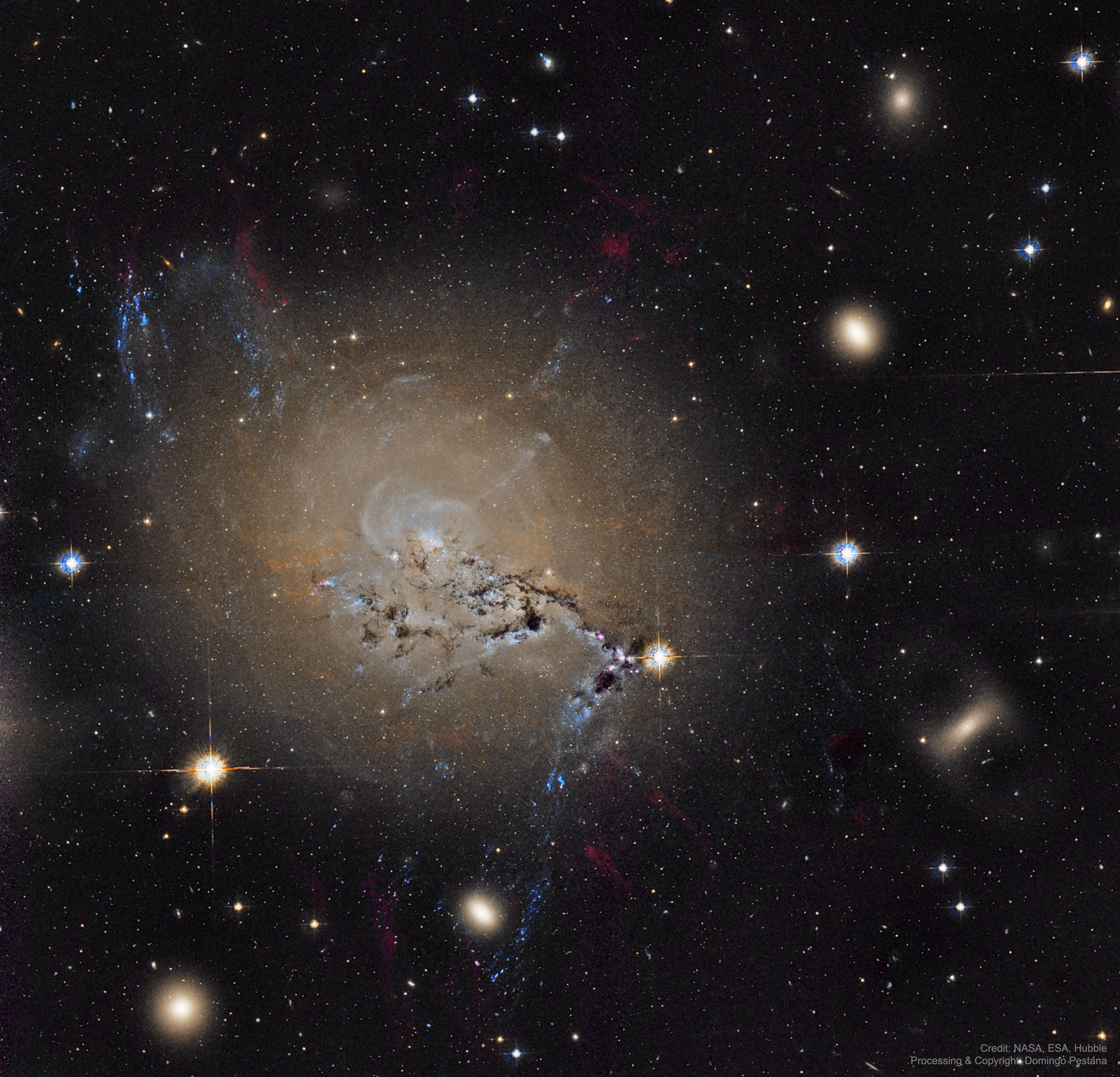
Filaments of Active Galaxy NGC 1275 
Image Credit: Hubble Legacy ArchiveESANASAProcessing & Copyright: Domingo Pestana
Explanation: What keeps these filaments attached to this galaxy? The filaments persist in NGC 1275 even though the turmoil of galactic collisions should destroy them. First, active galaxy NGC 1275 is the central, dominant member of the large and relatively nearby Perseus Cluster of Galaxies. Wild-looking at visible wavelengths, the active galaxy is also a prodigious source of x-rays and radio emission. NGC 1275 accretes matter as entire galaxies fall into it, ultimately feeding a supermassive black hole at the galaxy's core. This composite image, recreated from archival Hubble Space Telescope data, highlights the resulting galactic debris and filaments of glowing gas, some up to 20,000 light-years long. Observations indicate that the structures, pushed out from the galaxy's center by the black hole's activity, are held together by magnetic fields. Also known as Perseus A, NGC 1275 spans over 100,000 light years and lies about 230 million light years away.

2017-04-05

Astronomy picture of the day - 2017 April 5 - Plane Contrail and Sun Halo

See Explanation.  Clicking on the picture will download
 the highest resolution version available.
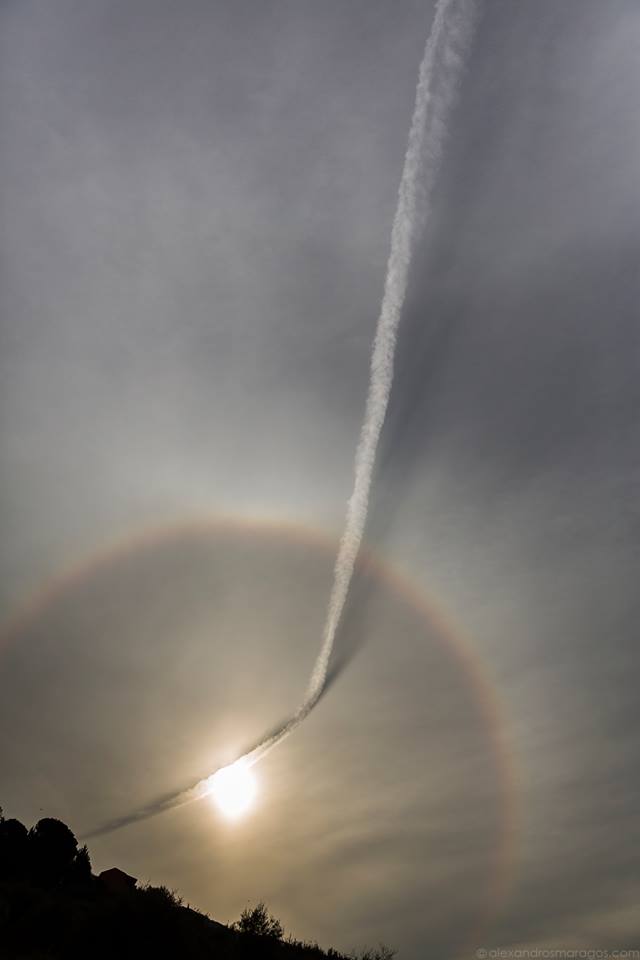
Plane Contrail and Sun Halo 
Image Credit & Copyright: Alexandros Maragos
Explanation: What's happened to the sky? Several common features of the daytime sky are interacting in uncommon ways. First, well behind the silhouetted hills, is the typically bright Sun. In front of the Sun are thin clouds, possibly the home to a layer of hexagonal ice crystals that together are creating the 22 degree halo of light surrounding the Sun. The unusual bent line that crosses the image is a contrail -- a type of cloud created by a passing airplane. Much of the contrail must actually be further away than the thin cloud because it casts a shadow onto the cloud, giving an unusual three-dimensional quality to the featured image. The featured image was taken in late January in the city of Patrasin West Greece.