2018-03-01
Film of Claude Monet painting - 1915 - Peinture impressionniste
This is unique film of French Impressionist painter Claude Monet (1840-1926), painting outdoors, 'en plein air', in his garden at Giverny.
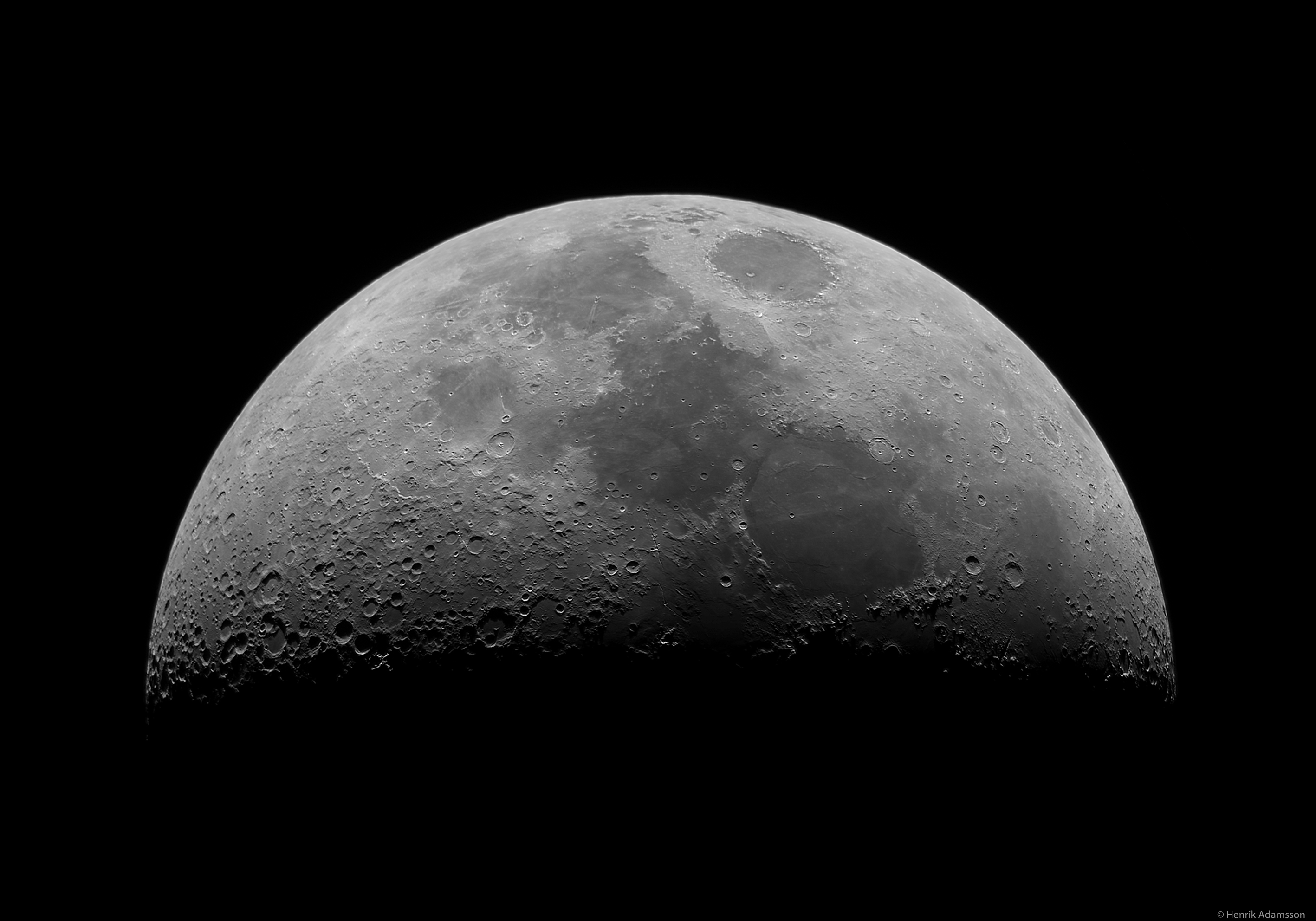
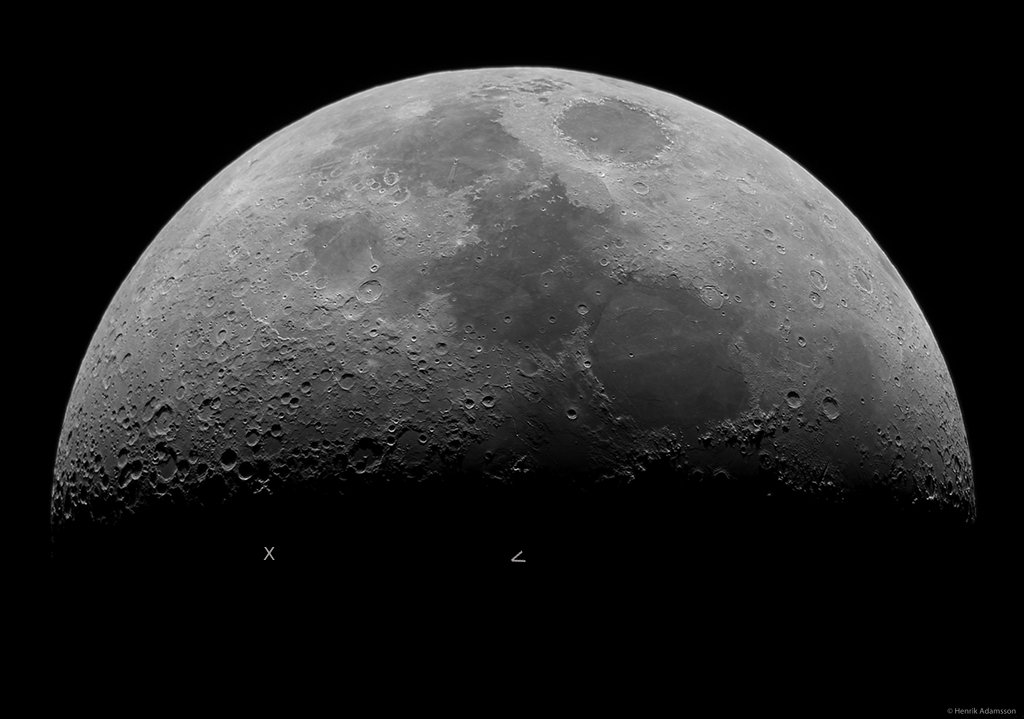
Astronomy picture of the day - 2018 March 1 - The Lunar X (V)

Image Credit & Copyright: Henrik Adamsson
Explanation: The striking X in this lunarscape is easily visible in binoculars or a small telescope, but not too many have seen it. The catch is, this lunar X is fleeting and only apparent in the hours before the Moon's first quarter phase. Along the shadow line between lunar day and night, the X illusion is produced by a configuration of craters seen here toward the left, Blanchinus, La Caille and Purbach. Near the Moon's first quarter phase, an astronaut standing close to the craters' position would see the slowly rising Sun very near the horizon. Temporarily, crater walls would be in sunlight while crater floors would still be in darkness. Seen from planet Earth, contrasting sections of bright walls against the dark floors by chance look remarkably like an X. This sharp image of the Lunar X was captured on February 22nd. For extra credit, sweep your gaze along the lunar terminator and you can also spot the Lunar V.
2018-02-28
Bairros de Lisboa - Igreja de São Miguel, Alfama, Lisboa - Fotos
Igreja de São Miguel, Alfama, Lisboa
A Igreja de São Miguel foi construída entre meados dos séculos XVII e XVIII, mas no local tinha já existido uma velha ermida, construída logo após a conquista de Lisboa aos mouros, em 1147. Era por essa altura uma zona onde os lisboetas se reuniam e que fervilhava de actividade.
O edifício que hoje vemos foi construído sob a orientação do arquitecto João Nunes Tinoco. Sofreu alguns danos aquando do terramoto de 1755, mas logo foi reparada e em 1880 recebeu novas obras de restauro. Classificada como Monumento Nacional desde 1982. Infelizmente encontra-se encerrada ao público, abrindo apenas aos Domingos de manhã e, por vezes, num curto espaço de duas horas às Quartas e Sextas-feiras.
Astronomy picture of the day - 2018 February 28 - NGC 613 in Dust, Stars, and a Supernova

Image Credit: NASA, ESA, Hubble, S. Smartt (QUB); Acknowledgement: Robert Gendler; Insets: Victor Buso
Explanation: Where did that spot come from? Amateur astronomer Victor Buso was testing out a new camera on his telescope in 2016 when he noticed a curious spot of light appear -- and remain. After reporting this unusual observation, this spot was determined to be light from a supernova just as it was becoming visible -- in an earlier stage than had ever been photographed optically before. The discovery before and after images, taken about an hour apart, are shown in the inset of a more detailed image of the same spiral galaxy, NGC 613, taken by the Hubble Space Telescope. Follow-up observations show that SN 2016gkg was likely the explosion of a supergiant star, and Buso likely captured the stage where the outgoing detonation wave from the stellar core broke through the star's surface. Since astronomers have spent years monitoring galaxies for supernovas without seeing such a "break out" event, the odds of Buso capturing this have been compared to winning a lottery.
2018-02-27
Bairros de Lisboa - Largo das Portas do Sol, Alfama - Fotos
Largo das Portas do Sol, Alfama, Lisboa
O Largo das Portas do Sol é um dos pontos que atrai mais turistas em Lisboa. Localiza-se no bairro de Alfama, um dos mais antigos da cidade, e por ele passam os eléctricos da carreira 28, a mais clássica de todas.
O seu nome deve-se a uma antiga porta da cidade que por ali existia à data do grande terramoto de 1755, a que o povo chamava de Porta do Sol.
Para além dos diversos edifícios históricos que ali se encontram, do lado que enfrenta o Tejo está implantado um bonito miradouro com vistas para o rio e para parte de Alfama, com especial destaque para a Igreja de São Vicente de Fora.
2018-02-26
Astronomy picture of the day - 2018 February 26 - Passing Jupiter
Video Credit & License: NASA, Juno, SwRI, MSSS, Gerald Eichstadt; Music: Moonlight Sonata (Ludwig van Beethoven)
Explanation: Here comes Jupiter! NASA's robotic spacecraft Juno is continuing on its 53-day, highly-elongated orbits around our Solar System's largest planet. The featured video is from perijove 11, the eleventh time Juno has passed near Jupiter since it arrived in mid-2016. This time-lapse, color-enhanced movie covers about four hours and morphs between 36 JunoCam images. The video begins with Jupiter rising as Juno approaches from the north. As Juno reaches its closest view -- from about 3,500 kilometers over Jupiter's cloud tops -- the spacecraft captures the great planet in tremendous detail. Juno passes light zones and dark belt of clouds that circle the planet, as well as numerous swirling circular storms, many of which are larger than hurricanes on Earth. After the perijove, Jupiter recedes into the distance, now displaying the unusual clouds that appear over Jupiter's south. To get desired science data, Juno swoops so close to Jupiter that its instruments may soon fail due to exposure to high levels of radiation. Because of this, in part, the Juno mission is currently schedule to conclude in mid-2018, at perijove 14, when the spacecraft will be directed to dive into Jupiter's atmosphere and melt.
2018-02-25
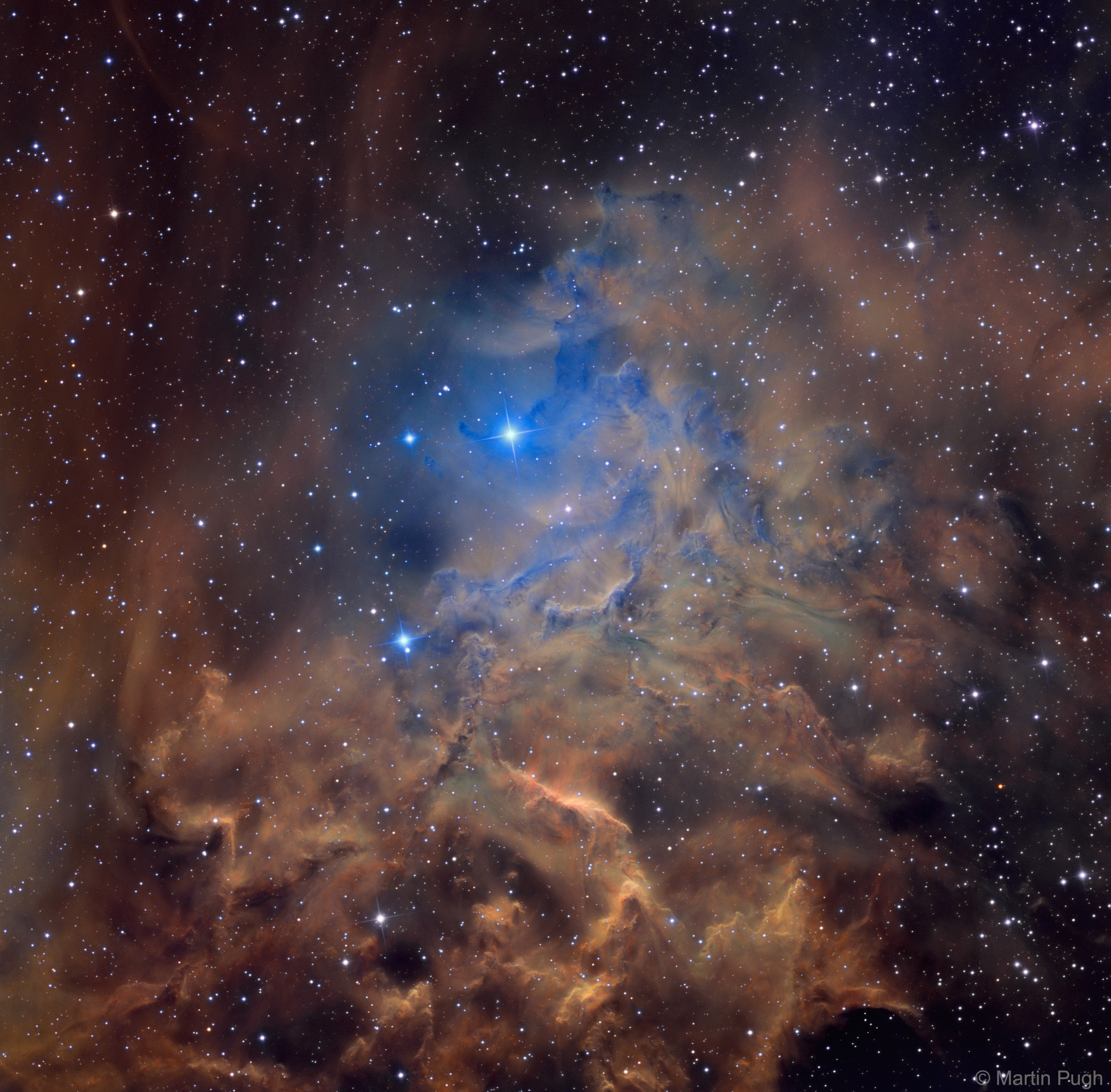
Asdtronomy picture of the day - 2018 February 25 - AE Aurigae and the Flaming Star Nebula

Image Credit & Copyright: Martin Pugh
Explanation: Why is AE Aurigae called the flaming star? For one reason, the surrounding nebula IC 405 is named the Flaming Star Nebula because the region seems to harbor smoke, even though nothing is on fire, including interior star AE Aurigae. Fire, typically defined as the rapid molecular acquisition of oxygen, happens only when sufficient oxygen is present and is not important in such high-energy, low-oxygen environments. The material that appears assmoke is mostly interstellar hydrogen, but does contain smoke-like dark filaments of carbon-rich dust grains. The bright star AE Aurigae is visible near the nebula center and is so hot it is blue, emitting light so energetic it knockselectrons away from atoms in the surrounding gas. When an atom recaptures an electron, light is emitted creating the surrounding emission nebula. The Flaming Star nebula lies about 1,500 light years distant, spans about 5 light years, and is visible with a small telescope toward the constellation of the Charioteer (Auriga).
Inscription à :
Commentaires (Atom)