2018-03-13

Astronomy picture of the day - 2018 March 13 - The Complete Galactic Plane: Up and Down

See Explanation.  Clicking on the picture will download
 the highest resolution version available.
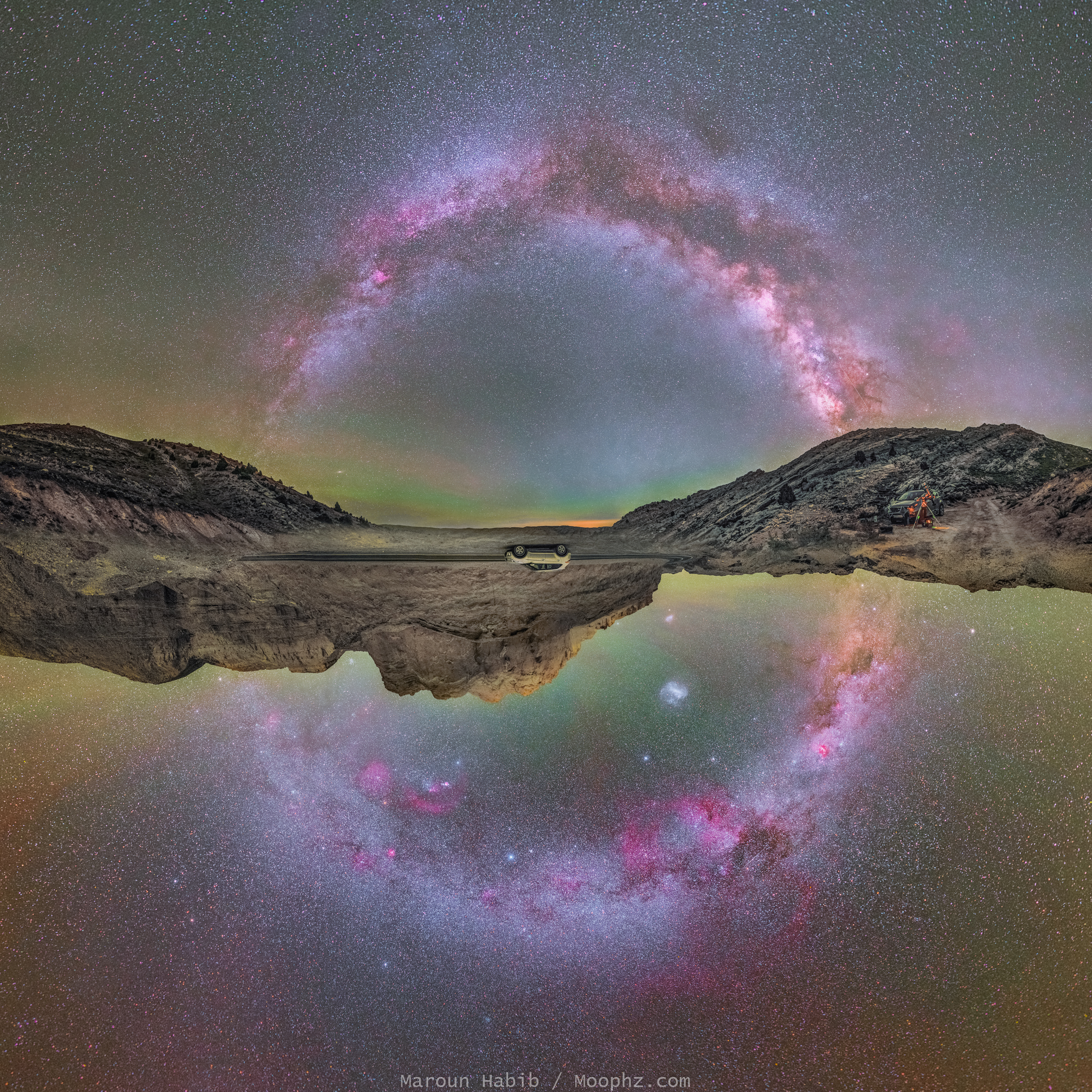
The Complete Galactic Plane: Up and Down 
Image Credit & Copyright: Moophz Himself (Maroun Habib)
Explanation: Is it possible to capture the entire plane of our galaxy in a single image? Yes, but not in one exposure -- and it took some planning to do it in two. The top part of the featured image is the night sky above Lebanon, north of the equator, taken in 2017 June. The image was taken at a time when the central band of the Milky Way Galaxy passed directly overhead. The bottom half was similarly captured six months later in latitude-opposite Chile, south ofEarth's equator. Each image therefore captured the night sky in exactly the opposite direction of the other, when fully half the Galactic plane was visible. The southern half was then inverted -- car and all -- and digitally appended to the top half to show the entire central band of our Galaxy, as a circle, in a single image. Many stars and nebulas are visible, with the Large Magellanic Cloud being particularly notable inside the lower half of the complete galactic circle.

Bob Dylan - "Cross the green mountain" - Video - Music

"Cross the green mountain"

2018-03-12

Inês Dourado - "Beco das Cruzes" - Aguarela

"Beco das Cruzes" (Alfama's neighborhood, Lisbon,Portugal) - Peinture,  30x25x2 cm ©2013 par Inês Dourado -  
                                                                                                                
    Art figuratif, Peinture contemporaine, Réalisme, Toile, Lieux, Architecture, Histoire, Paysage urbain, portugal, lisboa, holidays, alfama, arte, pintura, oil paintings, fado, arte figurativa, história, art history, lisbon
"Beco das Cruzes"

Astronomy picture of the day - 2018 March 12 - Flying over the Earth at Night II

Flying over the Earth at Night II 
Video Credit: NASAGateway to Astronaut PhotographyMusic: The Low Seas (The 126ers)
Explanation: What would it be like to orbit the Earth? The International Space Station (ISS) does this every 90 minutes, and sometimes the astronauts on board take image sequences that are made into videos. The featured time-lapse video shows many visual spectacles of the dark Earth below. First, as the video begins, green and red auroras are visible on the upper left above white clouds. Soon city lights come into view, and it becomes clear you are flying overNorth America, eventually passing over Florida. In the second sequence you fly over Europe and Africa, eventually passing over the Nile River. Brief flashes of light are lightning in storms. Stars far in the distance can be seen rising through the greenish-gold glow of the Earth's atmosphere.

2018-03-11

Astronomy picture of the day - 2018 March 11 - Dual Particle Beams in Herbig-Haro 24

See Explanation.  Clicking on the picture will download
 the highest resolution version available.
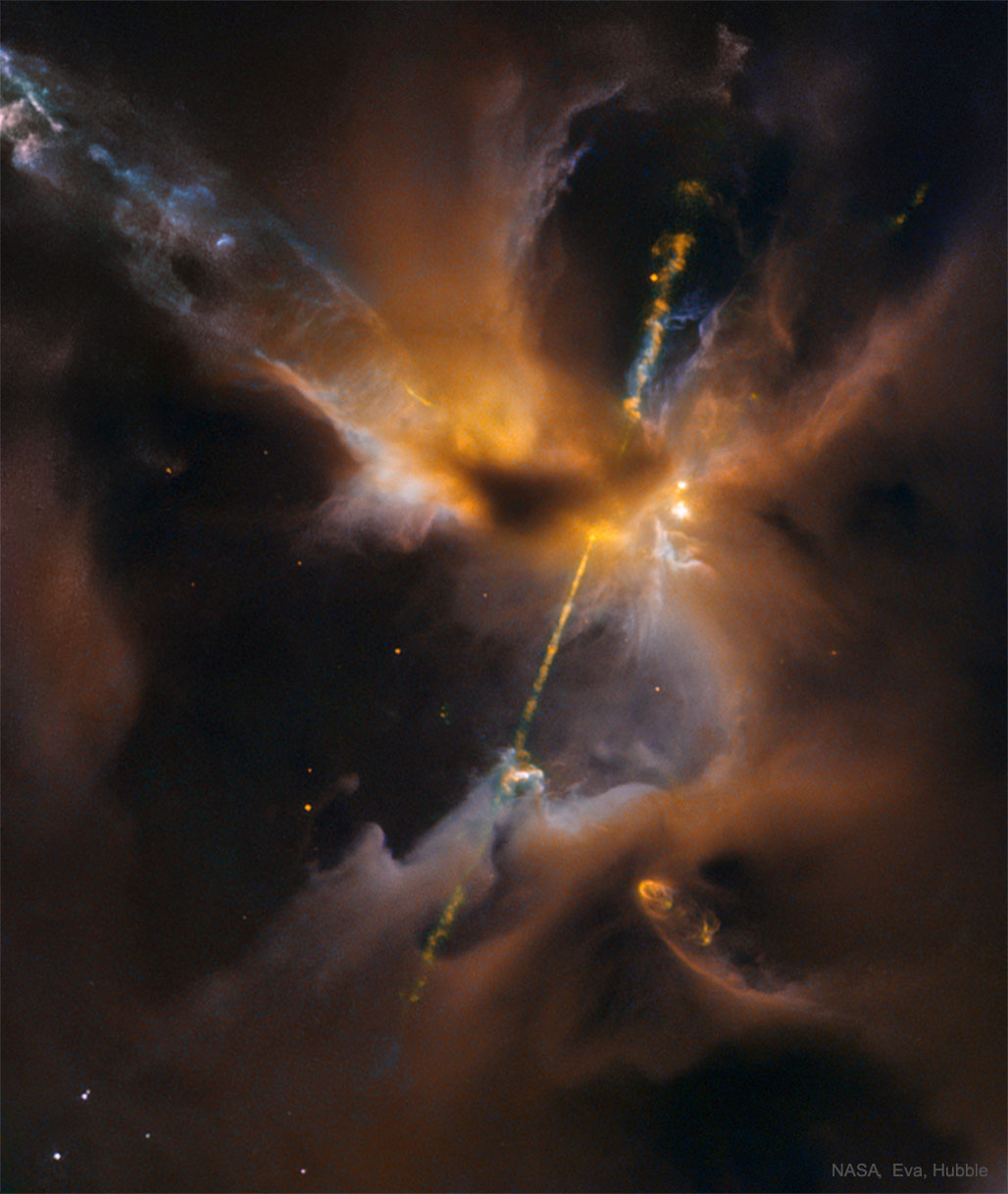
Dual Particle Beams in Herbig-Haro 24 
Image Credit: NASAESAHubble Heritage (STScI/AURA)/Hubble-Europe Collaboration;
Acknowledgment: D. Padgett (NASA's GSFC), T. Megeath (U. Toledo), B. Reipurth (U. Hawaii)
Explanation: This might look like a double-bladed lightsaber, but these two cosmic jets actually beam outward from a newborn star in a galaxy near you. Constructed from Hubble Space Telescope image data, the stunning scene spans about half a light-year across Herbig-Haro 24 (HH 24), some 1,300 light-years away in the stellar nurseries of the Orion B molecular cloud complex. Hidden from direct view, HH 24's central protostar is surrounded by cold dust and gas flattened into a rotating accretion disk. As material from the disk falls toward the young stellar object it heats up. Opposing jets are blasted out along the system's rotation axis. Cutting through the region's interstellar matter, the narrow, energetic jets produce a series of glowing shock fronts along their path.

2018-03-10

Astronomy picture of the day - 2018 March 10 - Phases of the Moon

See Explanation.  Clicking on the picture will download
 the highest resolution version available.
Phases of the Moon 
Image Credit & CopyrightJean-Francois GoutTom Polakis
Explanation: Look at the Moon every night and its visible sunlit portion gradually changes. In phases progressing from New Moon to Full Moon to New Moon again, a lunar cycle or lunation is completed in about 29.5 days. Top left to bottom right, these frames show the range of lunar phases for 25 consecutive nights beginning on January 18, following an almost complete lunation. They skip the 2 days just after and 2 days before New Moon, when the lunar phase is at best a narrow crescent, close to the Sun and really hard to see. Of course, mostly clear Arizona night skies and a little help from a friend were required to complete this lunar cycle project, imaging in early evening for the first half and late evening and early morning for the second half of the lunation. For extra credit, the cycle was centered on the Full Moon of January 31. That was the second Full Moon in January, when the Moon was near lunar orbit perigee and took on reddish hues during a total lunar eclipse.

2018-03-09

Monet with Beethovens Symphony Nr. 7 - Slides - Pintura

"Monet with Beethovens Symphony Nr. 7" 

Status Quo - "In the Army now" - Video - Music

"In the Army now"

Astronomy picture of the day - 2018 March 9 - Horsehead: A Wider View

See Explanation.  Clicking on the picture will download
 the highest resolution version available.
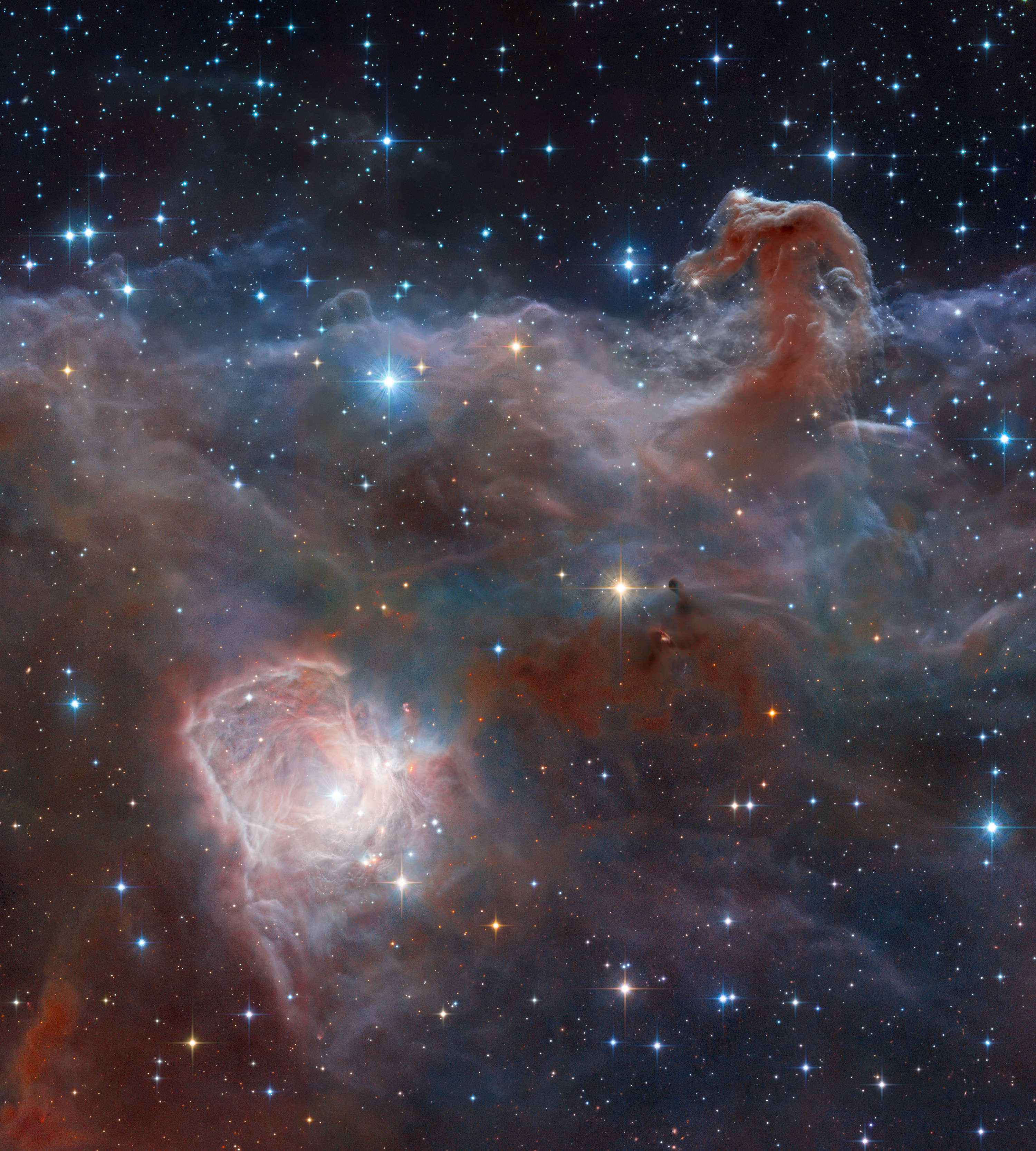
Horsehead: A Wider View 
Composition and Processing: Robert Gendler
Image Data: ESOVISTAHLAHubble Heritage Team (STScI/AURA)
Explanation: Combined image data from the massive, ground-based VISTA telescope and the Hubble Space Telescope was used to create this wide perspective of the interstellar landscape surrounding the famous Horsehead Nebula. Captured at near-infrared wavelengths, the region's dusty molecular cloud sprawls across the scene that covers an angle about two-thirds the size of the Full Moon on the sky. Left to right the frame spans just over 10 light-years at the Horsehead's estimated distance of 1,600 light-years. Also known as Barnard 33, the still recognizable Horsehead Nebula stands at the upper right, the near-infrared glow of a dusty pillar topped with newborn stars. Below and left, the bright reflection nebula NGC 2023 is itself the illuminated environs of a hot young star. Obscuring clouds below the base of the Horsehead and on the outskirts of NGC 2023 show the tell-tale far red emission of energetic jets, known as Herbig-Haro objects, also associated with newborn stars.

2018-03-08

Astronomy pictures of the day - 2018 March 8 - Cyclones at Jupiter's North Pole

See Explanation.  Clicking on the picture will download
 the highest resolution version available.
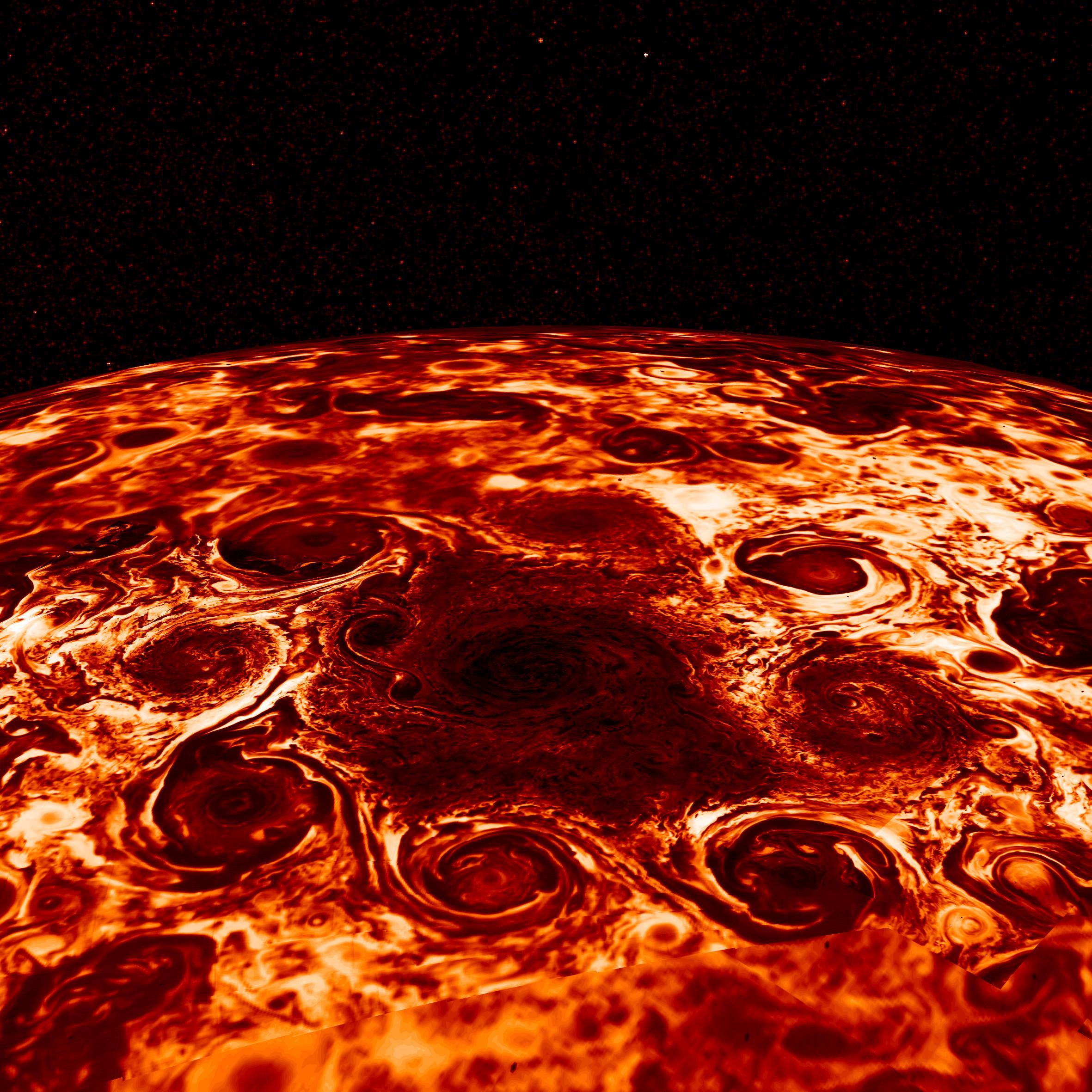
Cyclones at Jupiter's North Pole 
Image Credit: NASAJPL-CaltechSwRIASIINAFJIRAM
Explanation: Juno's Jovian Infrared Auroral Mapper data was used to construct this stunning view of cyclones at Jupiter's North Pole. Measuring the thermal emission from Jovian cloud tops, the infrared the observations are not restricted to the hemisphere illuminated by sunlight. They reveal eight cyclonic features that surround a cyclone about 4,000 kilometers in diameter, just offset from the giant planet's geographic North Pole. Similar data show a cyclone at the Jovian South Pole with five circumpolar cyclones. The South Pole cyclones are slightly larger than their northern cousins. Cassini data has shown that gas giant Saturn's north and south poles each have a single cyclonic storm system.