Nombre total de pages vues

2015-03-06

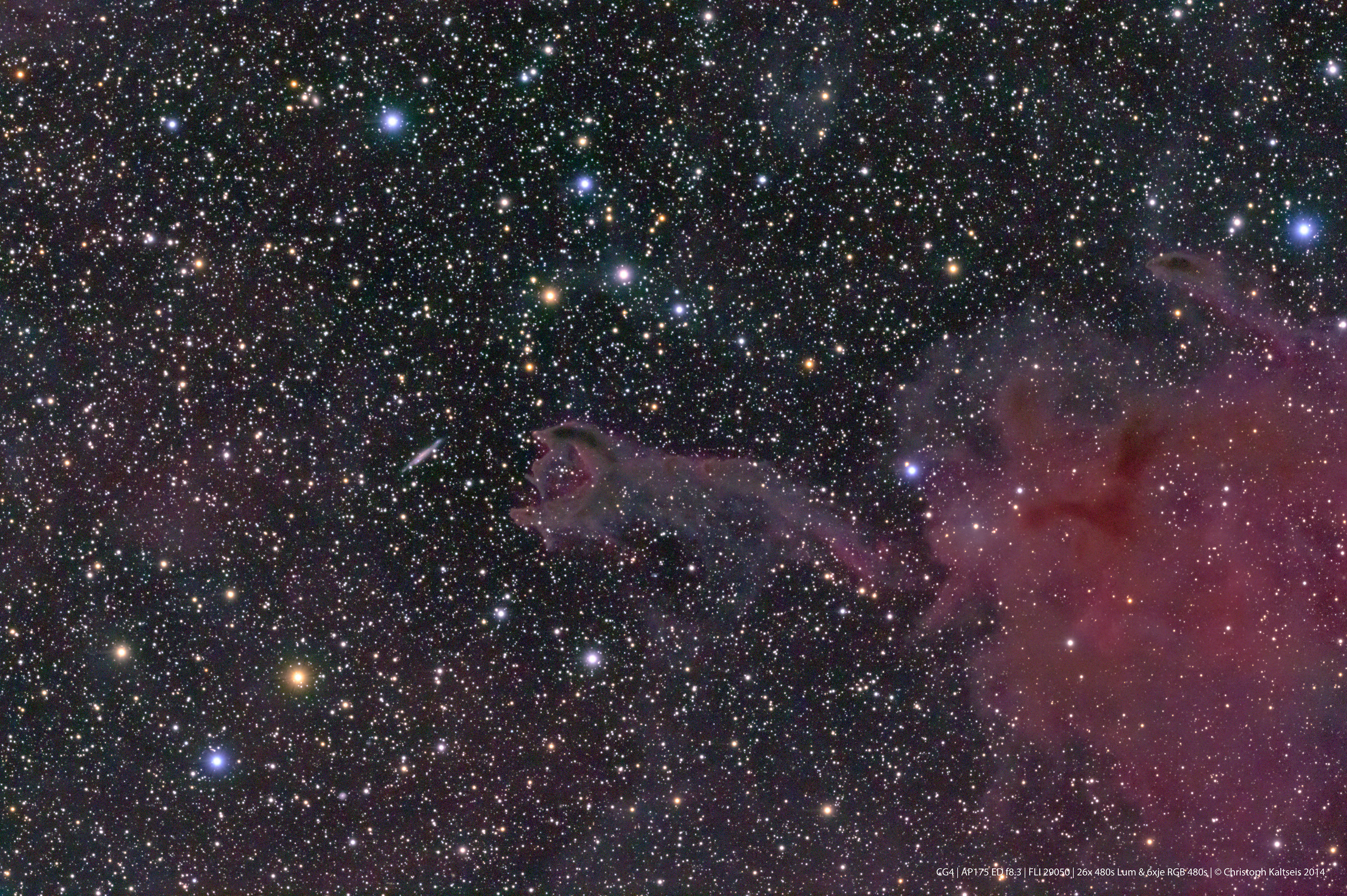
Astronomy picture of the day - 06-03-2015 - Cometary Globule CG4

See Explanation.  Clicking on the picture will download
 the highest resolution version available.
Cometary Globule CG4 
Image Credit & CopyrightCEDIC Team - Processing: Christoph Kaltseis
Explanation: The faint and somehow menacing cometary globule CG4 reaches through the center of this deep southern skyscape. About 1,300 light-years from Earth toward the constellation Puppis, its head is about 1.5 light-years in diameter and its tail about 8 light-years long. That's far larger than the Solar System's comets that it seems to resemble. In fact, the dusty cloud contains enough material to form several Sun-like stars and likely has ongoing star formation within. How its distinctive form came about is still debated, but its long tail trails away from the Vela Supernova remnant near the center of the Gum Nebula, while its head could represent the rupture of an originally more spherical cloud. Still, the edge-on spiral galaxy also near picture center is not actually being threatened by CG4. The galaxy lies in the distant background more than 100 million light-years away.

2015-03-05

Now, it's time to say goodbye - 05-03-2015

CIAO, CIAO, CIAO...

Foto - "Deambulando pela rua St. Ursule" - Toulouse - France

"Deambulando pela rua St. Ursule" - Toulouse

05-03-2015
JoanMira

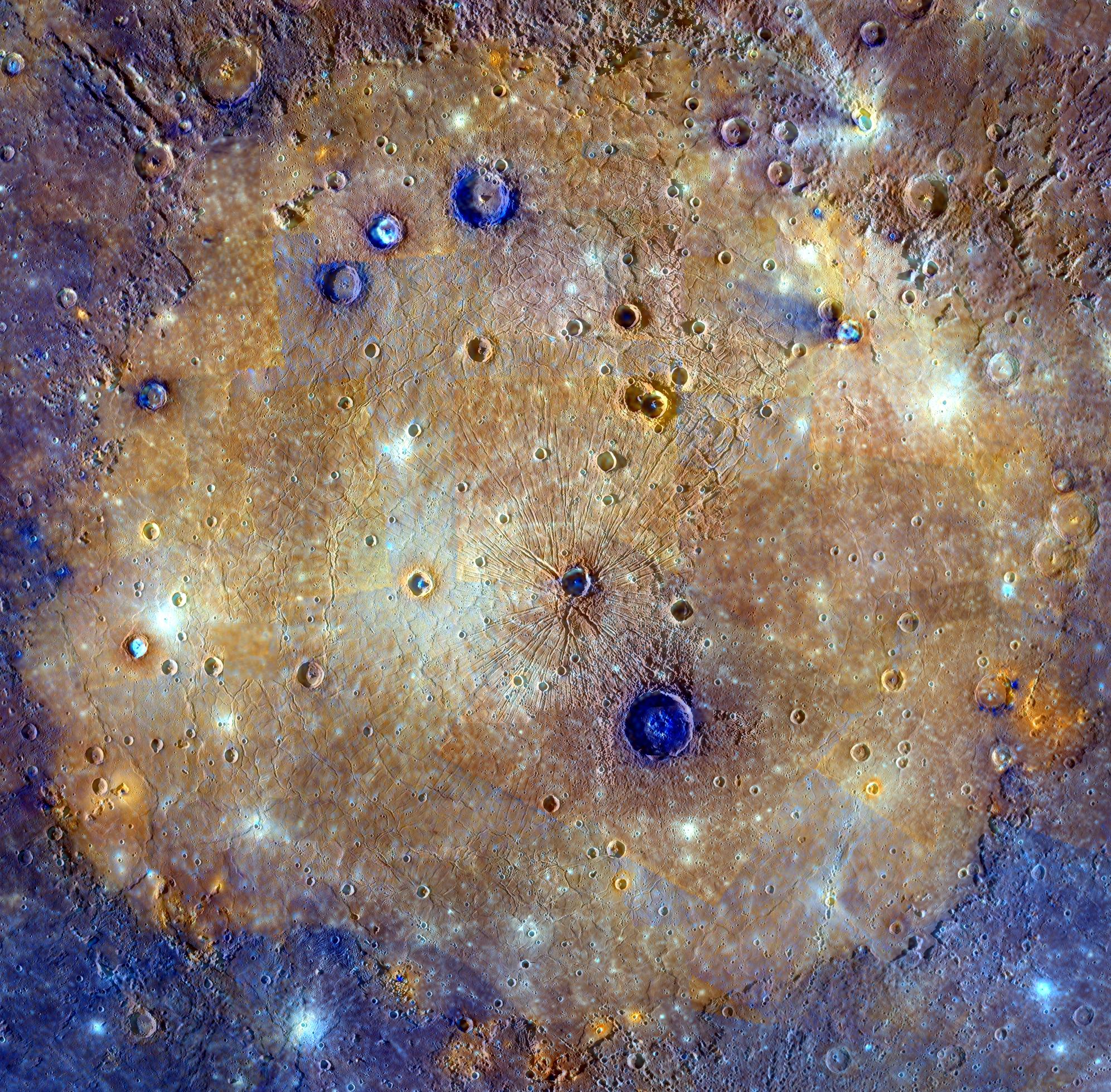
Astronomy picture of the day - 05-03-2015 - Enhanced Color Caloris

See Explanation.  Clicking on the picture will download
 the highest resolution version available.
Enhanced Color Caloris 
Image Credit: NASAJohns Hopkins Univ. APL, Arizona State U., CIW
Explanation: The sprawling Caloris basin on Mercury is one of the solar system's largest impact basins, created during the early history of the solar system by the impact of a large asteroid-sized body. The multi-featured, fracturedbasin spans about 1,500 kilometers in this enhanced color mosaic based on image data from the Mercury-orbiting MESSENGER spacecraft. Mercury's youngest large impact basin, Caloris was subsequently filled in by lavas that appear orange in the mosaic. Craters made after the flooding have excavated material from beneath the surface lavas. Seen as contrasting blue hues, they likely offer a glimpse of the original basin floor material. Analysis of these craters suggests the thickness of the covering volcanic lava to be 2.5-3.5 kilometers. Orange splotches around the basin's perimeter are thought to be volcanic vents.

2015-03-04

Now, it's time to say goodbye - 04-03-2015

CIAO, CIAO, CIAO...

Peter Steps Rabbit terá sido alvo de cinco processos de execução fiscal


Para além de uma dívida já regularizada à Segurança Social, Pedro Passos Coelho terá tido, entre 2003 e 2007, cinco processos de execução fiscal.
Dados sobre estes cinco processos circulam na blogosfera desde 2011, nomeadamente, em blogues como o Verdadeiro Lápis Azul.
...
Questionado pelo Observador, o gabinete do primeiro-ministro não esclareceu as razões que levaram à abertura destes processos, que podem dizer respeito tanto a situações de atraso na entrega da declaração de IRS como pagamentos fora do prazo.
O Público revela esta quarta-feira que desde segunda-feira que está a questionar Passos Coelho sobre processos de execução fiscal.
...
Observador - Portugal

Aconteceu a 4 de março - Nasce o Infante D. Henrique


A 4 de Março de 1394, nasce, no Porto, o Infante Dom Henrique, impulsionador dos descobrimentos portugueses.

Pintura digital - "Primeiro dia"

"Primeiro dia"

01-01-2015
JoanMira

Foto - "Promessa de Primavera" - Aufrery - Toulouse - 04-03-2015

"Promessa de Primavera"

Aufrery - Toulouse - 04-03-2015
JoanMira

Astronomy picture of the day - 04-03-2015 - Pillars and Jets in the Pelican Nebula

See Explanation.  Clicking on the picture will download
 the highest resolution version available.
Pillars and Jets in the Pelican Nebula 
Image Credit & Copyright: Larry Van Vleet (LVVASTRO)
Explanation: What dark structures arise from the Pelican Nebula? Visible as a bird-shaped nebula toward the constellation of a bird (Cygnus, the Swan), the Pelican Nebula is a place dotted with newly formed stars but fouled with dark dust. These smoke-sized dust grains formed in the cool atmospheres of young stars and were dispersed by stellar winds and explosions. Impressive Herbig-Haro jets are seen emitted by a star on the right that is helping to destroythe light year-long dust pillar that contains it. The featured image was scientifically-colored to emphasize light emitted by small amounts of ionized nitrogenoxygen, and sulfur in the nebula made predominantly of hydrogen and helium. The Pelican Nebula (IC 5067 and IC 5070) is about 2,000 light-years away and can be found with a small telescope to the northeast of the bright star Deneb.