2015-08-21

Imagenes del Mundo - La cria de elefante


Presentación al público de una cría de elefante nacida en el Zoo de Chester (Reino Unido).

Foto - "Quinta das Carvalhas" - Douro - 02-09-2014

"Quinta das Carvalhas"

Douro, 02-09-2014
JoanMira

Corruption au Brésil


Nouveau rebondissement dans le scandale de corruption qui ébranle le pays. Cette fois-ci c’est Eduardo Cunha, président de la Chambre des députés et l’un des principaux ennemis du gouvernement au Congrès, qui pourrait être mis en examen.

Le président de la Chambre des députés Eduardo Cunha fait face à une demande de mise en examen pour “blanchiment d’argent et corruption passive”, annonce le quotidien brésilien O Globo.  Il aurait reçu l’équivalent de 5 milliards de dollars (4,4 millions d’euros) en pots-de-vin dans le scandale qui touche le groupe pétrolier brésilien Petrobras.

Conservateur, évangélique, Cunha s’est retiré il y a plusieurs semaines de la coalition gouvernementale pour se transformer en l’un des ennemis acharnés du gouvernement au Congrès et rejoindre les députés de l’opposition qui demandent la destitution de la présidente Dilma Rousseff.
Il nie toutes les accusations qui sont portées contre lui et a affirmé qu’il ne démissionnerait pas. La Cour suprême, seule institution habilitée à juger les parlementaires qui bénéficient de l’immunité, doit encore accepter sa mise en examen. Il sera alors le premier parlementaire de ce rang en exercice mis en examen dans l’énorme dossier de corruption Petrobras qui ébranle le Brésil depuis plusieurs mois. La justice a aussi demandé la mise en examen de l’ancien président et actuel sénateur Fernando Collor, mais on ne connaît pas encore les chefs d’accusation, souligne le quotidien de Rio de Janeiro.
Courrier International - France

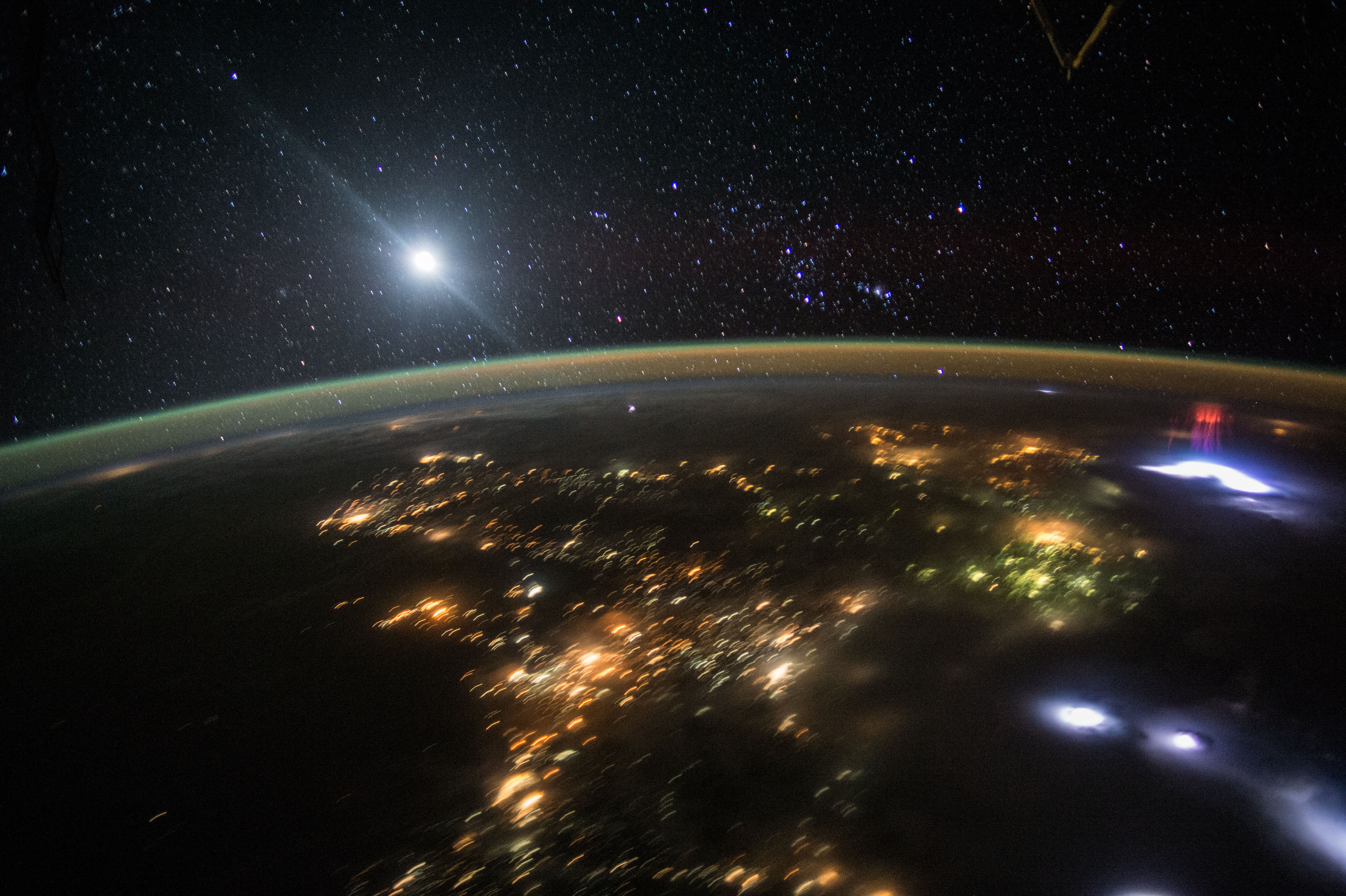
Astronomy picture of the day - 2015 August 21 - Sprites from Space

See Explanation.  Clicking on the picture will download
 the highest resolution version available.
Sprites from Space 
Image Credit: NASAExpedition 44
Explanation: An old Moon and the stars of Orion rose above the eastern horizon on August 10. The Moon's waning crescent was still bright enough to be overexposed in this snapshot taken from another large satellite of planet Earth, the International Space Station. A greenish airglow traces the atmosphere above the limb of the planet's night. Below, city lights and lightning flashes from thunderstorms appear over southern Mexico. The snapshot also captures the startling apparition of a rare form of upper atmospheric lightning, a large red sprite caught above a lightning flash at the far right. While the space station's orbital motion causes the city lights to blur and trail during the exposure, the extremely brief flash of the red sprite is sharp. Now known to be associated with thunderstorms, much remains a mystery about sprites including how they occur, their effect on the atmospheric global electric circuit, and if they are somehow related to other upper atmospheric lightning phenomena such as blue jets or terrestrial gamma flashes.

2015-08-20

Foto - Rue Lenternières - Toulouse - 05-03-2015

"Rue Lenternières"

Toulouse, 05-03-2015
JoanMira

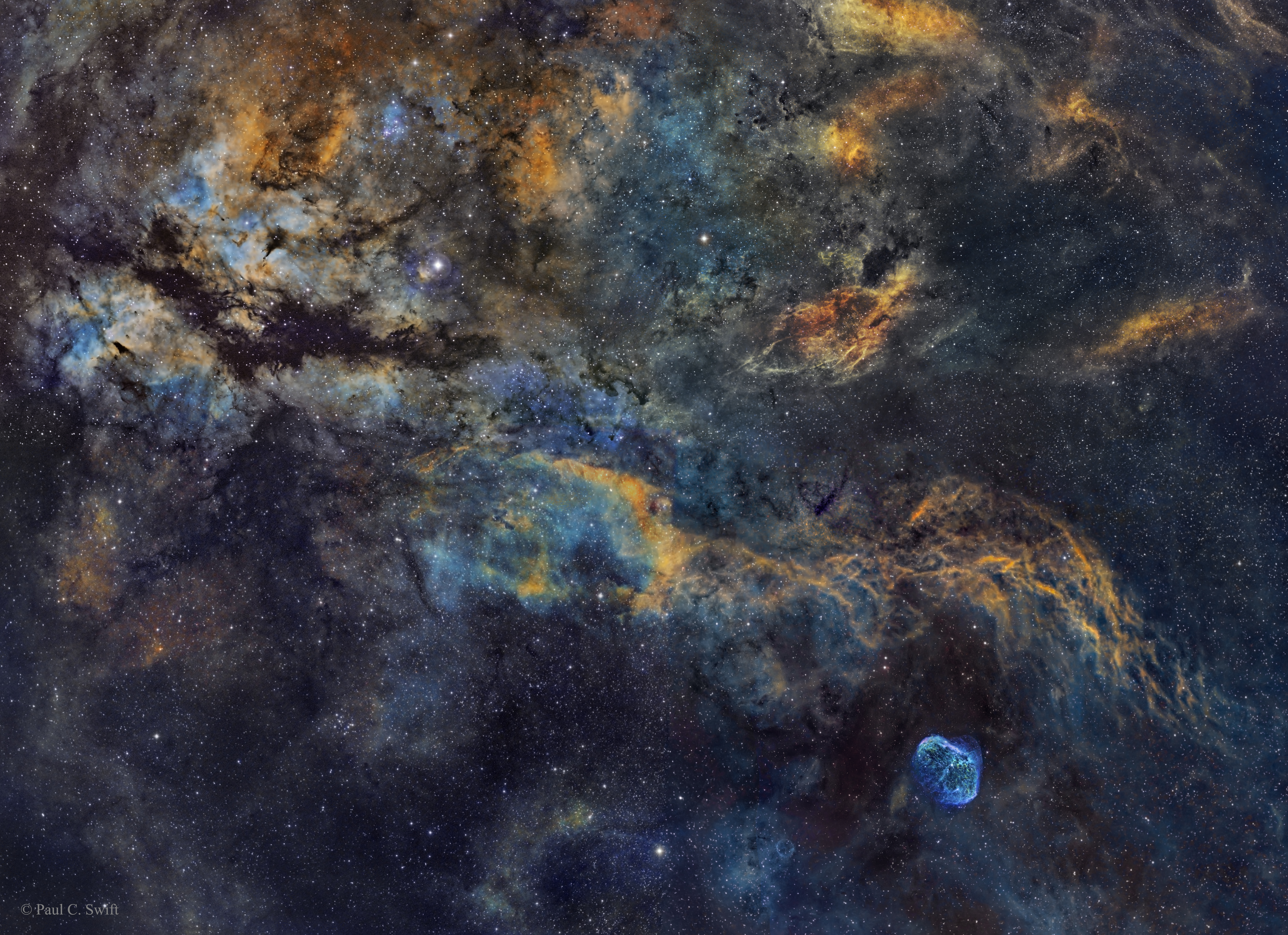
Astronomy picture of the day - 2015 August 19 - Central Cygnus Skyscape

See Explanation.  Clicking on the picture will download
 the highest resolution version available.
Central Cygnus Skyscape 
Image Credit & Copyright: Paul C. Swift
Explanation: In cosmic brush strokes of glowing hydrogen gas, this beautiful skyscape unfolds across the plane of our Milky Way Galaxy and the center of the northern constellation Cygnus the Swan. The featured image spans about six degrees. Bright supergiant star Gamma Cygni (Sadr) to the upper left of the image center lies in the foreground of the complex gas and dust clouds and crowded star fields. Left of Gamma Cygni, shaped like two luminous wings divided by a long dark dust lane is IC 1318, whose popular name is understandably the Butterfly Nebula. The more compact, bright nebula at the lower right is NGC 6888, the Crescent Nebula. Some distance estimates for Gamma Cygni place it at around 1,800 light-years while estimates for IC 1318 and NGC 6888 range from 2,000 to 5,000 light-years.

2015-08-18

Imagenes del Mundo - Un hombre en la Plaza Roja - Moscu

Un hombre se refleja en un charco mientras camina por la Plaza Roja de Moscú (Rusia).

25 miradouros em Lisboa - Santo Estêvão

Miradouro de Santo Estêvão, Lisboa
Still undiscovered by many locals and guidebooks, this viewpoint is found next to St. Stephen’s Church. It’s a quiet spot for a break after a stroll through the narrow streets of Alfama.
Ainda desconhecido de muitos lisboetas e dos guias turísticos, este miradouro fica junto à Igreja de Santo Estêvão. É um local tranquilo, para uma pausa depois de um passeio pelas ruelas de Alfama.

Astronomy picture of the day - 2015 August 18 - M1: The Crab Nebula from Hubble

See Explanation.  Clicking on the picture will download
 the highest resolution version available.
M1: The Crab Nebula from Hubble 
Image Credit: NASAESA, J. Hester, A. Loll (ASU)


Explanation: This is the mess that is left when a star explodes. The Crab Nebula, the result of a supernova seen in 1054 AD, is filled with mysterious filaments. The filaments are not only tremendously complex, but appear to have less mass than expelled in the original supernova and a higher speed than expected from a free explosion. The featured image, taken by the Hubble Space Telescope, is presented in three colors chosen for scientific interest. The Crab Nebula spans about 10 light-years. In the nebula's very center lies a pulsar: a neutron star as massive as the Sun but with only the size of a small town. The Crab Pulsar rotates about 30 times each second.

Astronomy picture of the day - 2015 August 17 - Andromeda Rising over the Alps

2015 August 17
See Explanation.  Clicking on the picture will download
 the highest resolution version available.
Andromeda Rising over the Alps 
Image Credit & Copyright: Matteo Dunchi
Explanation: Have you ever seen the Andromeda galaxy? Although M31 appears as a faint and fuzzy blob to the unaided eye, the light you see will be over two million years old, making it likely the oldest light you ever will see directly. Now rising near a few hours after sunset from mid-latitude northern locations, Andromeda is rising earlier each night and will be visible to northerners all night long starting in September. The featured image capturedAndromeda rising above the Italian Alps last month. As cool as it may be to see this neighboring galaxy to our Milky Way with your own eyes, long duration camera exposures can pick up many faint and breathtaking details. Recent data indicates that our Milky Way Galaxy will collide and coalesce with the slightly larger Andromeda galaxy in a few billion years.