Explanation: Point or tilt to see a spectacular view of Mars visible to the Curiosity rover last December. In the foreground, part of Curiosity itself is visible, including its dusty sundial. Starting about seven meters back, the robotic rover is seen posing in front of a 5-meter tall dark sand dune named Namib, one of many dunes that span Bagnold field. Further in the distance is the summit of Mt. Sharp, the 5.5-kilometer peak at the center of 150-km wide Gale crater, the crater where Curiosity landed a few years ago. The featured composite spans a full 360-degrees around by combining several images taken on the same day, while the result has been color adjusted to mimic Earth lighting. Mostrecently, Curiosity is crossing the rocky and uneven Naukluft Plateau as it continues to make its way around and up Mt. Sharp.
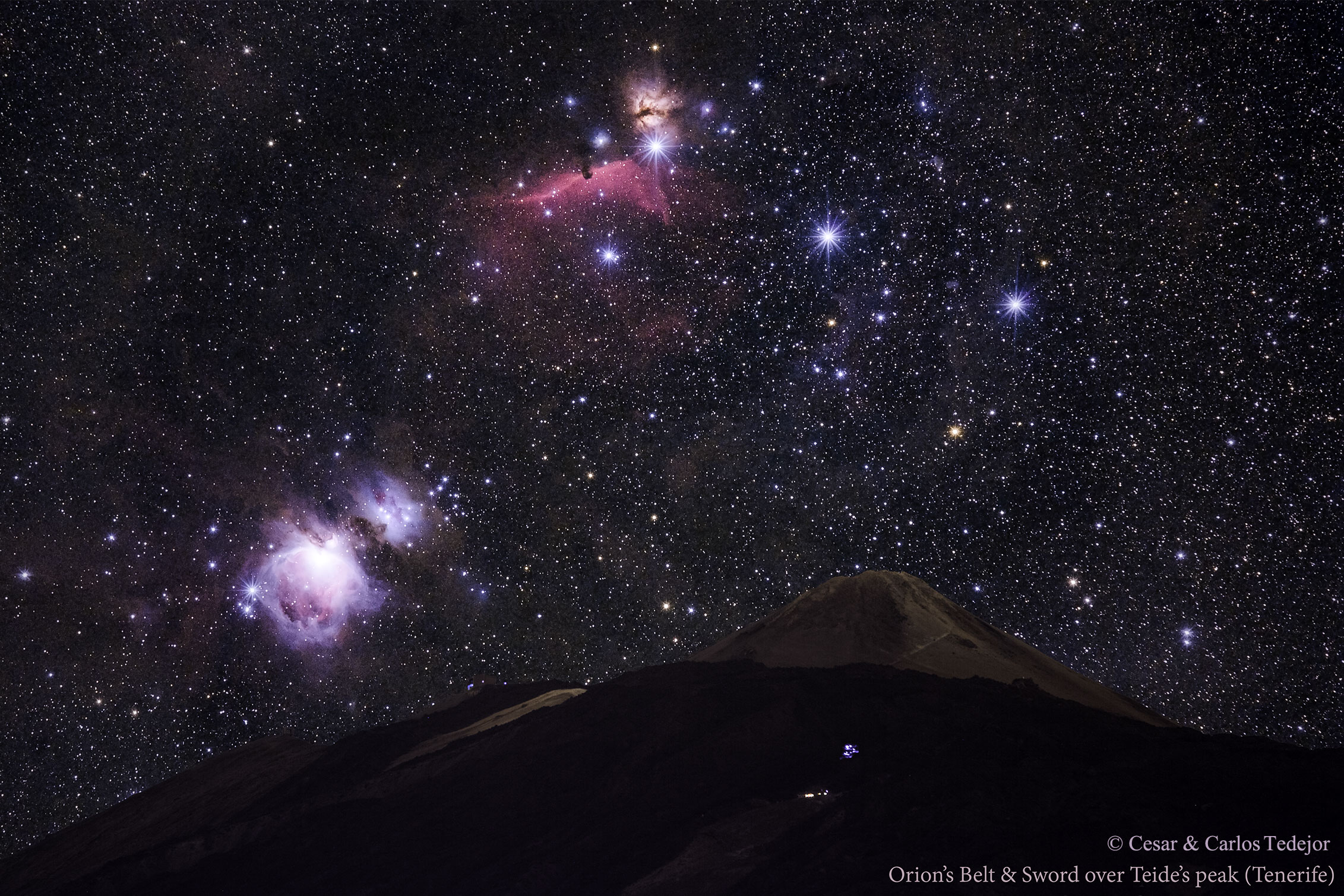
Orion's Belt and Sword over Teide's Peak Image Credit & Copyright: Cesar & Carlos Tejedor
Explanation: The southern part of Orion, the famous constellation and mythical hunter, appears quite picturesque posing here over a famous volcano. Located in the Canary Islands off the northwest coast of Africa, the snow-peakedTeide is one of the largest volcanoes on Earth. Lights from a group planning to summit Teide before dawn are visible below the volcano's peak. In this composite of exposures taken from the same location one night last month, the three iconicbelt stars of Orion are seen just above the peak, while the famous Orion Nebula and the rest of Orion's sword are visible beyond the volcano's left slope. Also visible in the long duration sky image are the Horsehead Nebula, seen as a dark indentation on the red emission nebula to the belt's left, and the Flame Nebula, evident just above and to the right of the Horsehead.
Passeando no "Calçadão" junto ao Posto 6, em Copacabana, tirei esta imagem que para sempre fica na minha recordação como reliquia de felicidade do tempo maravilhoso que la vivi. Sim, sou carioca para sempre...
Quelques heures après la fin de la visite de Barack Obama à Cuba, un autre événement a marqué l’histoire du pays : le premier concert des Rolling Stones. Ce vendredi 25 mars, devant plus de 500 000 spectateurs, Mick Jagger a saisi le micro, ouvrant le show (gratuit) en espagnol :
“Nous savons qu’il fut un temps où il était difficile d’écouter notre musique à Cuba, mais nous sommes ici […]. Je pense que, finalement, les temps changent, n’est-ce pas ?”
Face aux papys du rock venus conclure en beauté leur tournée America Latina Olé : des Cubains, des touristes, des fans de la première heure, des jeunes, se sont massés dans la Ciudad Deportiva (Cité sportive) de la Havane. Une enceinte symbolique, située à quelques kilomètres du centre-ville et inaugurée avant la révolution castriste de 1959, représentant le début de l’exclusion de la musique rock à Cuba
Aujourd’hui, les temps changent : entouré de Keith Richards, Ronnie Wood, Charlie Watts et le bassiste Darryl Jones, Mick Jagger, 72 ans, a entonné 18 des plus grands classiques des Stones pour l’un des concerts les plus mémorables jamais organisés sur l’île.
Après “Jumping Jack Flash” en introduction du concert et avant l’incontournable “Satisfaction” en conclusion, le groupe fondé en 1962 a interprété ”It’s Only Rock ‘n Roll”, hymne symbolique au regard de cette musique anciennement considérée comme l’instrument de l’impérialisme américain.
Un genre musical progressivement toléré dans le pays au cours de ces 30 dernières années, ouvrant les portes de l’île, et ce malgré l’embargo, à des artistes américains comme Billy Joel en 1979, Audioslave en 2005 ou encore au jazz-funk Kool and the Gang en 2009.
Cette fois-ci, c’est au tour des Stones de se produire à Cuba. Là où seuls les Beatles avaient droit de cité. Et là où, jusqu’à la fin des années 70, les résidents écoutaient en toute discrétion le groupe britannique – alors banni au même titre que la musique anglo-saxonne – grâce à des cassettes audio échangées sous le manteau.
NGC 6357: Cathedral to Massive Stars Image Credit: NASA, ESA and Jesús Maíz Apellániz (IAA, Spain); Acknowledgement: Davide De Martin (ESA/Hubble)
Explanation: How massive can a normal star be? Estimates made from distance, brightness and standard solar models had given one star in the open cluster Pismis 24 over 200 times the mass of our Sun, making it one of the most massive stars known. This star is the brightest object located just above the gas front in the featured image. Close inspection of images taken with the Hubble Space Telescope, however, have shown that Pismis 24-1 derives its brilliant luminosity not from a single star but from three at least. Component stars would still remain near 100 solar masses, making them among the more massive stars currently on record. Toward the bottom of the image, stars are still forming in the associated emission nebulaNGC 6357. Appearing perhaps like a Gothic cathedral, energetic stars near the center appear to be breaking out and illuminating a spectacular cocoon.