Nombre total de pages vues

2016-04-17

Astronomy picture of the day - 2016 April 17 - Asperatus Clouds Over New Zealand

See Explanation.  Clicking on the picture will download
 the highest resolution version available.
Asperatus Clouds Over New Zealand 
Image Credit & Copyright: Witta Priester
Explanation: What kind of clouds are these? Although their cause is presently unknown, such unusual atmospheric structures, as menacing as they might seem, do not appear to be harbingers of meteorological doom. Known informally as Undulatus asperatus clouds, they can be stunning in appearance, unusual in occurrence, are relatively unstudied, and have even been suggested as a new type of cloud. Whereas most low cloud decks are flat bottomedasperatus clouds appear to have significant vertical structure underneath. Speculation therefore holds that asperatus clouds might be related to lenticular clouds that form near mountains, or mammatus clouds associated with thunderstorms, or perhaps a foehn wind -- a type of dry downward wind that flows off mountains. Such a wind called the Canterbury arch streams toward the east coast of New Zealand's South Island. The featured image, taken above Hanmer Springsin CanterburyNew Zealand, in 2005, shows great detail partly because sunlight illuminates the undulating clouds from the side.

Fotos - Lisboa antiga - Rua dos Caminhos de Ferro - 1958


Rua dos Caminhos de Ferro - de (Conjunto de casas nos anos cinquenta do século vinte)


1958
Eduardo Portugal

Joe Bel - "Hit the roads" - Video - Music

Afficher l'image d'origine
"Hit the roads"

2016-04-16

Chico Buarque - "Roda viva" - Video - Musica - Ao vivo

Afficher l'image d'origine
"Roda viva"

Novos Baianos - "Preta, pretinha" - Video - Musica - Ao vivo

"Preta, pretinha"

Raul Seixas - "Maluco beleza" - Video - Musica

Afficher l'image d'origine
"Maluco beleza"

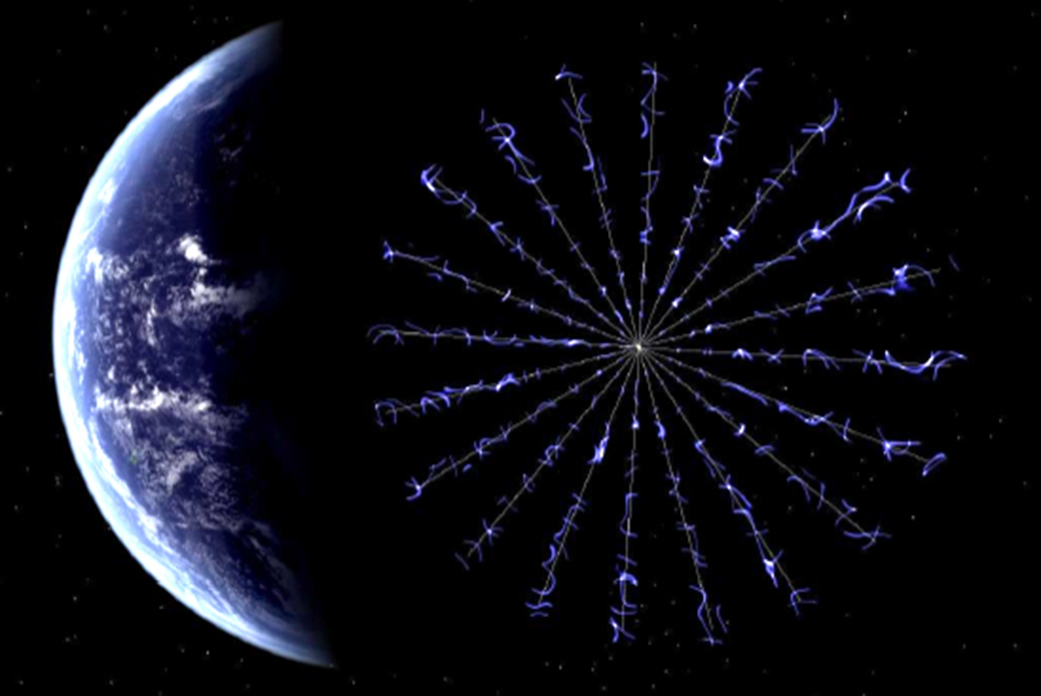
Astronomy picture of the day - 2016 April 16 - Heliopause Electrostatic Rapid Transit System

See Explanation.  Clicking on the picture will download
 the highest resolution version available.
Heliopause Electrostatic Rapid Transit System 
Illustration Credit: NASAMarshall Space Flight Center 
Explanation: Want to take a fast trip to the edge of the Solar System? Consider a ride on a Heliopause Electrostatic Rapid Transit System (HERTS). The concept is currently being tested and it might take only 10 to 15 years to make the trip of over 100 Astronomical Units (15 billion kilometers). That's fast compared to the 35 years it took Voyager 1, presently humanity's most distant spacecraft, to approach the heliopause or outer boundary of the influence of the solar wind. HERTS would use an advanced electric solar sail that works by extending multiple, 20 kilometer or so long, 1 millimeter thin, positively charged wires from a rotating spacecraft. The electrostatic force generated repels fast moving solar wind protons to create thrust. Compared to a reflective solar light sail, another propellantless deep space propulsion system, the electric solar wind sail could continue to accelerate at greater distances from the Sun, still developing thrust as it cruised toward the outer planets.

Roberto Carlos - "Detalhes" - Video - Musica - Ao vivo

Afficher l'image d'origine
"Detalhes"

Fotos - Passeando por Toulouse - "Rue Bouquinières" - 10-04-2015

"Rue Bouquinières"

Toulouse, 10-04-2015
JoanMira