Mercúrio vai passar hoje diante do Sol, um fenómeno raro que só volta a acontecer em 2019, e que, esta tarde, pode ser observado em Portugal, através de telescópios com filtros solares, se o estado do tempo ajudar.
O trânsito de Mercúrio, o planeta do Sistema Solar mais próximo do 'astro-rei', durará mais de sete horas: começa pelas 12:12 (hora de Lisboa), atinge o ponto máximo às 15:56 e termina pelas 19:41, de acordo com o Observatório Astronómico de Lisboa.
O planeta, que, aos olhos de quem o observa, surgirá como um pequeno círculo escuro, move-se lentamente ao atravessar o disco solar. À deslocação dá-se o nome de 'trânsito', porque Mercúrio passa entre o Sol e a Terra.
O fenómeno ocorre, na sua plenitude, na Europa Ocidental, no leste da América do Norte, no norte da América do Sul, no Ártico, na Gronelândia, no extremo noroeste de África e no Oceano Atlântico.
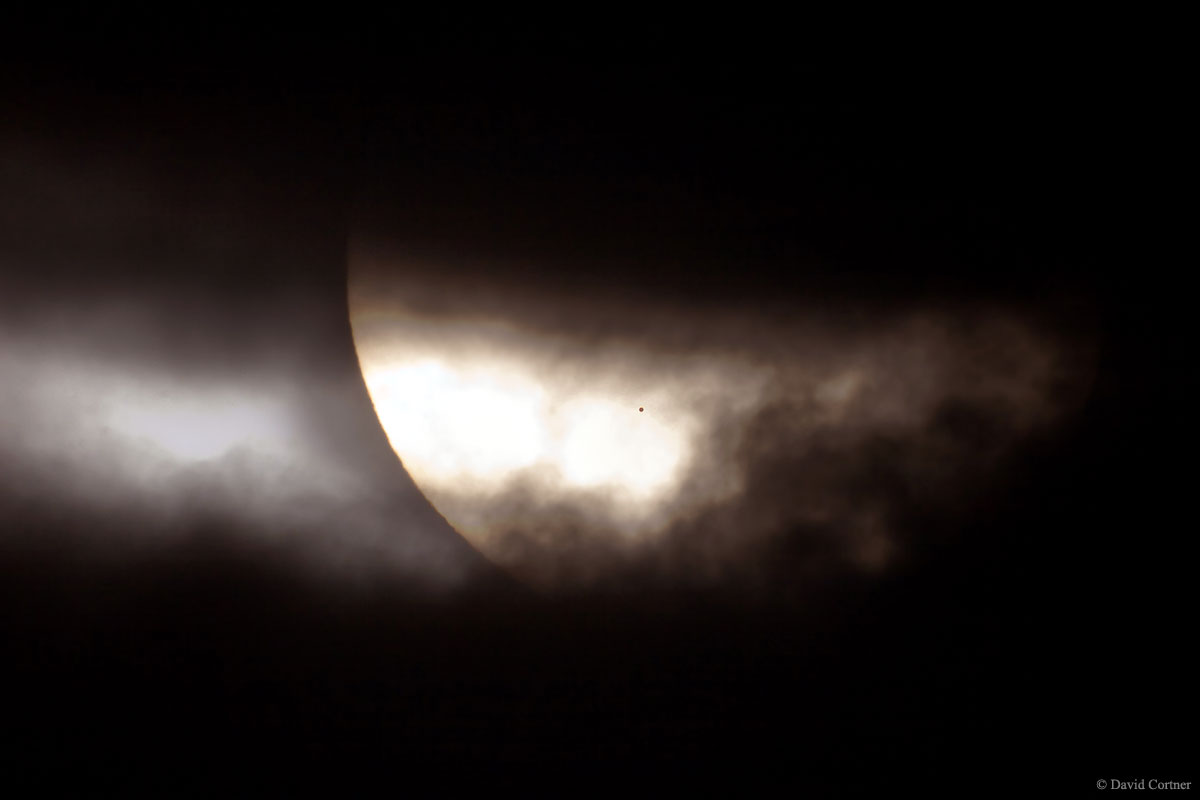
Mercury's Transit: An Unusual Spot on the Sun Image Credit & Copyright: David Cortner
Explanation: What's that dot on the Sun? If you look closely, it is almost perfectly round. The dot is the result of an unusual type of solar eclipse that occurred in 2006. Usually it is the Earth's Moon that eclipses the Sun. This time, the planet Mercury took a turn. Like the approach to New Moon before a solar eclipse, the phase of Mercury became a continually thinner crescent as the planet progressed toward an alignment with the Sun. Eventually the phase ofMercury dropped to zero and the dark spot of Mercury crossed our parent star. The situation could technically be labeled a Mercurian annular eclipse with an extraordinarily large ring of fire. From above the cratered planes of the night side of Mercury, the Earth appeared in its fullest phase. Hours later, as Mercury continued in its orbit, a slight crescent phase appeared again. This was ten years ago -- the next Mercurian solar eclipse will occur tomorrow.
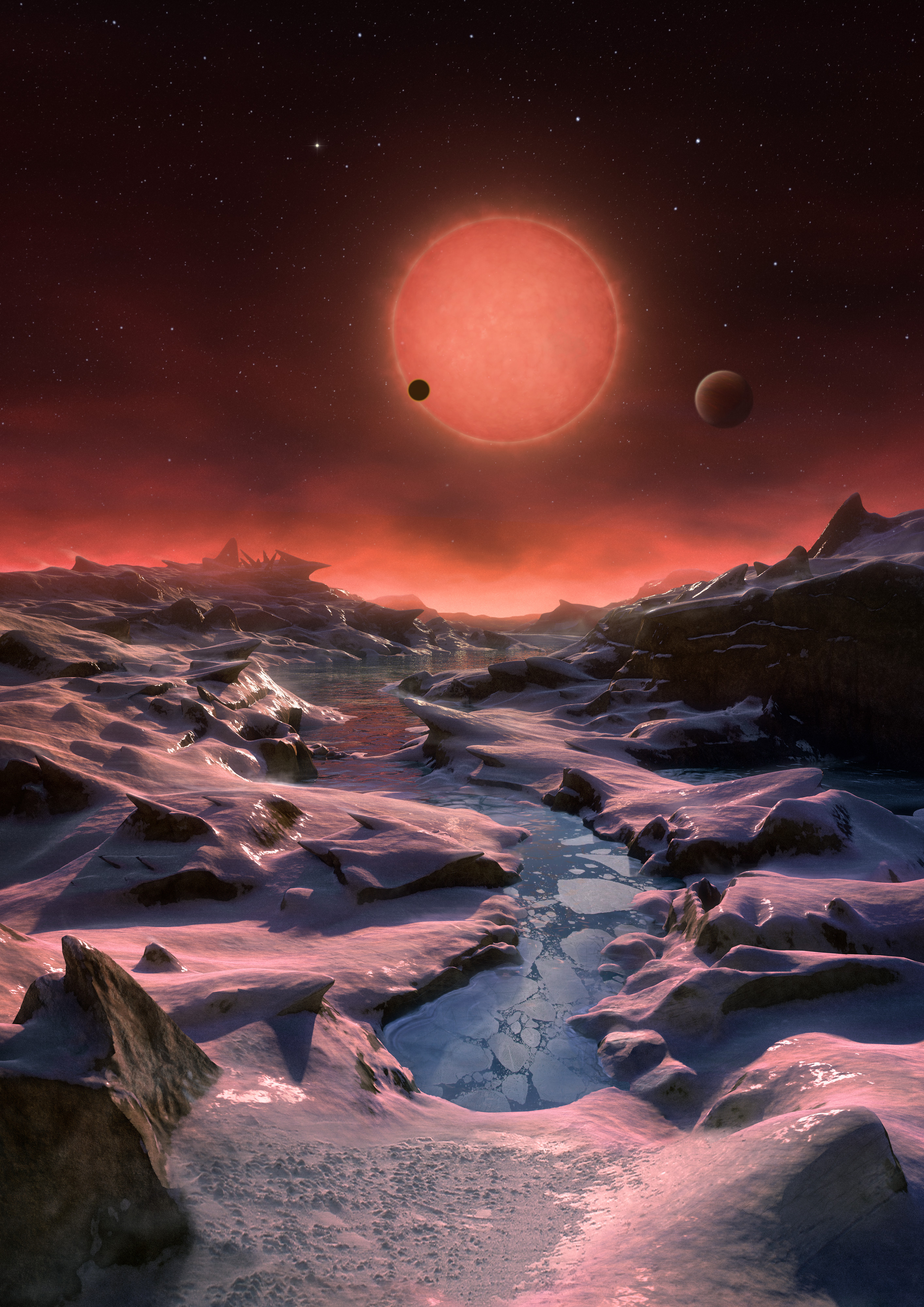
Three Worlds for TRAPPIST-1 Illustration Credit: ESO / M. Kornmesser
Explanation: Three new found worlds orbit the ultracool dwarf star TRAPPIST-1, a mere 40 light-years away. Their transits were first detected by the Belgian robotic TRAnsiting Planets and Planetesimals Small Telescope,TRAPPIST, at ESO's La Silla Observatory in Chile. The newly discovered exoplanets are all similar in size to Earth. Because they orbit very close to their faint, tiny star they could also have regions where surface temperatures allow for the presence of liquid water, a key ingredient for life. Their tantalizing proximity to Earth makes them prime candidates for future telescopic explorations of the atmospheres of these potentially habitable planets. All three worlds appear in this artist's vision, an imagined scene near the horizon of the system's outermost planet. Of course, the inner planet is transiting the dim, red, nearly Jupiter-sized parent star.
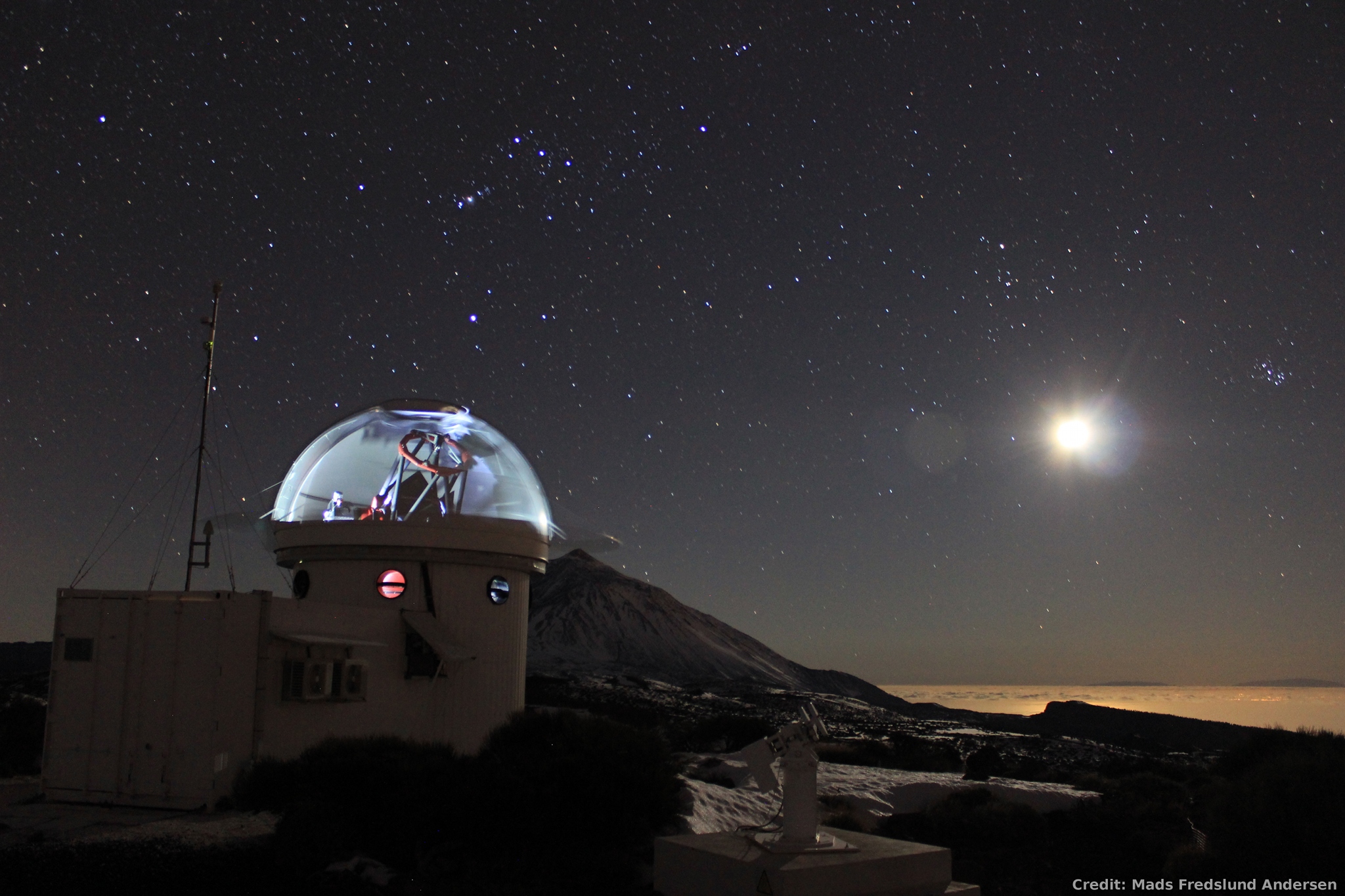
Explanation: Near first quarter, the Moon in March lights this snowy, rugged landscape, a view across the top of Tenerife toward La Palma in the Canary Islands Spanish archipelago. The large Teide volcano, the highest point in Spain, looms over the horizon. Shining above are familiar bright stars of Orion, the Hunter. Adding to the dreamlike scene is the 1 meter diameter prototype telescope of the global network project called the Stellar Observations Network Group or SONG. The SONG's fully robotic observatory was captured during the 30 second exposure while the observatory dome, with slit open, was rotated across the field of view.
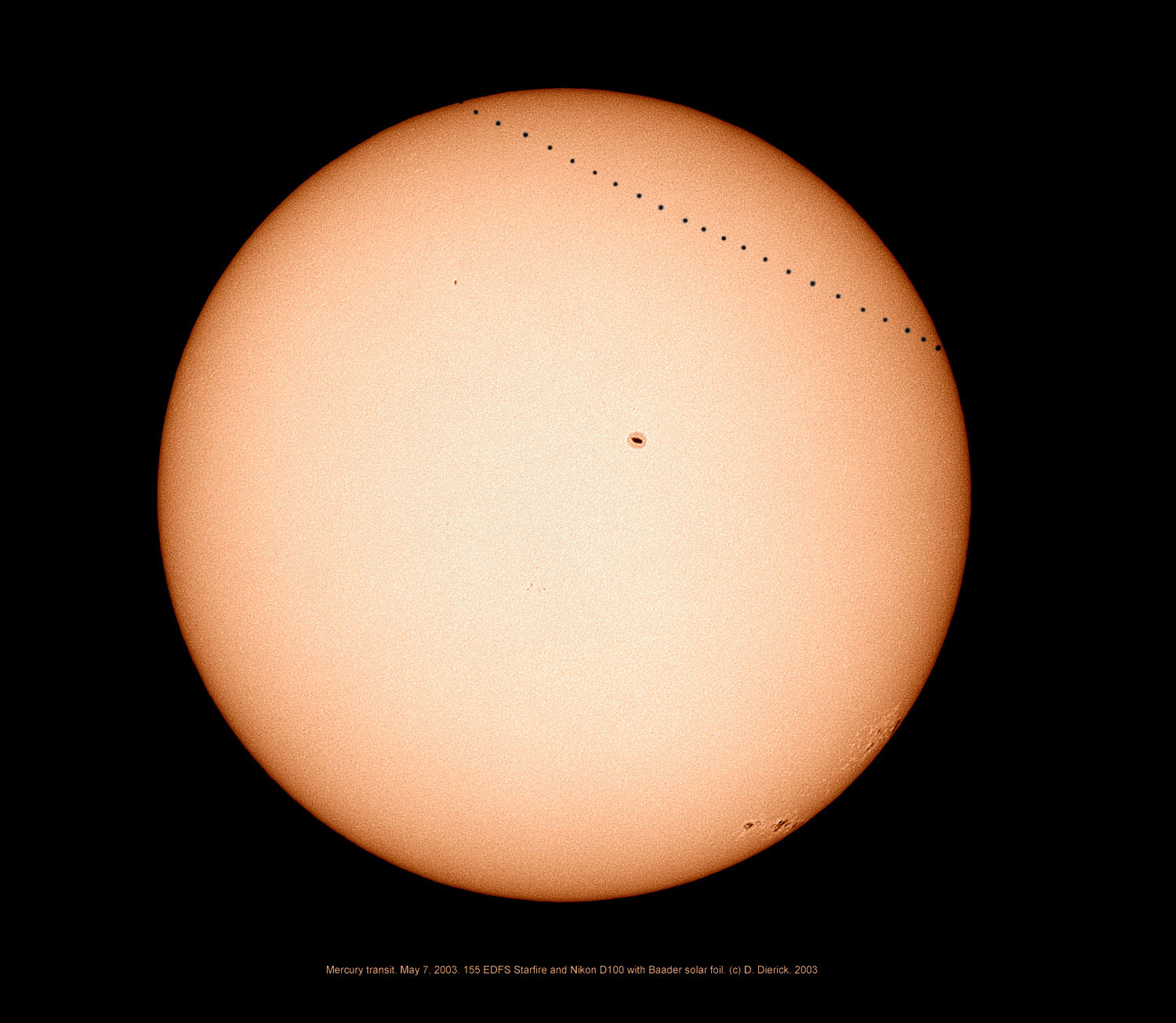
A Mercury Transit Sequence Image Credit & Copyright: Dominique Dierick
Explanation: This coming Monday, Mercury will cross the face of the Sun, as seen from Earth. Called a transit, the last time this happened was in 2006. Because the plane of Mercury's orbit is not exactly coincident with the plane of Earth's orbit, Mercury usually appears to pass over or under the Sun. The above time-lapse sequence, superimposed on a single frame, was taken from a balcony in Belgium shows the entire transit of 2003 May 7. The solar crossinglasted over five hours, so that the above 23 images were taken roughly 15 minutes apart. The north pole of the Sun, the Earth's orbit, and Mercury's orbit, although all different, all occur in directions slightly above the left of the image. Near the center and on the far right, sunspots are visible. After Monday, the next transit of Mercury will occur in 2019.
Mauvais tour pour les Magiciens. Comme annoncé sur leur page Facebook,le groupe ivoirien Magic Systemvient de perdre son batteur et chef d’orchestre Didier Bonaventure Deigna dit Pépito, à l’âge de 46 ans. Le musicien s’est noyé dimanche dans la petite ville balnéaire de Jacqueville, à côté d’Abidjan. Si les circonstances de son décès ne sont pas encore totalement connues, il aurait perdu la vie en tentant de secourir une personne de la noyade.
« C’est avec une grande tristesse et le cœur lourd que nous vous annonçons le décès de notre batteur Didier Bonaventure Deigna dit Pépito, ont ainsi écrit les Magiciens sur Facebook. Il profitait d’un petit repos suite aux préparatifs du Femua 9, avant la reprise de la tournée française. Pepito était notre choriste, batteur mais surtout le chef d’orchestre depuis 16 ans avec notre groupe Magic System. Il restera à jamais gravé dans nos cœurs. »

![Planeta Mercúrio [Foto: NASA]](https://lh3.googleusercontent.com/blogger_img_proxy/AEn0k_sVfMCtWeph94v19duy8Jw9nARTA9Odjn7s9C6vrymJsZbIcEL-mMdfkXJA9po9pCFiUkl2YDplncKUzXyngMCeAldHUfzNwczF2qR8ZbK5cCWJz5-jm95QupcEI-fQXvTvWl9KuQWnhw9U1V2fT6Pe3gRRcpFLh5U=s0-d)