"Chula do Douro"
2016-09-20
2016-09-19
A aguia voa mais alto! - Benfica 3 - Braga 1
O Benfica derrotou nesta segunda-feira o Sp. Braga, por 3-1, e assumiu a liderança isolada da I Liga. Os golos dos benfiquistas foram apontados pelo grego Mitroglou (27’ e 78’) e pelo internacional português Pizzi (74’). Os bracarenses reduziram no último minuto, por Rosic.
Num jogo de boa qualidade com oportunidades para ambos os lados, o Benfica revelou-se mais eficaz e acabou por justificar o triunfo. O primeiro golo da partida foi apontado pelo avançado grego Mitroglou, que regressou após lesão, aos 27': na zona da marca de grande penalidade, onde o “11” do Benfica rematou com o seu pé esquerdo à meia-volta, abrindo o marcador.
Na segunda parte, o desfecho da partida manteve-se em aberto até à entrada do quarto de hora final, quando o Benfica fez o 2-0 por Pizzi, num golo onde um ressalto num bracarense isolou o médio benfiquista que, com alguma sorte à mistura, bateu Marafona.
Menos de cinco minutos depois, os “encarnados” voltaram a festejar: Pizzi encostado à linha cruzou e Mitroglou encostou de cabeça para o fundo da baliza. O resultado final foi fixado no minuto 90, com um golo do defesa central bracarense Rosic, na sequência de um canto.
Com esta vitória, o Benfica ultrapassa o Sporting, e assume a liderança isolada do campeonato ao fim de cinco jornadas, com 13 pontos, mais um do que os “leões”.
Publico - Portugal
Imagens de Lisboa - Interiores secretos - Igreja do Convento da Encarnação
Despite being one of the country’s richest works of gilded art, the church of this convent remains a well-hidden treasure. It’s kept secret, allowing entry only once a month for early-morning Mass on the first Friday. Once inside, you may admire the monumental main altar created in 1719, survivor of the 1755 earthquake.
Apesar de ser uma das mais ricas obras em talha dourada do país, a igreja deste convento permanece um tesouro bem escondido. É mantido em segredo, permitindo entradas apenas uma vez por mês, para missa nas manhãs das primeiras sextas-feiras. Só assim é possível admirar o monumental altar-mor de 1719, que sobreviveu ao terramoto de 1755.
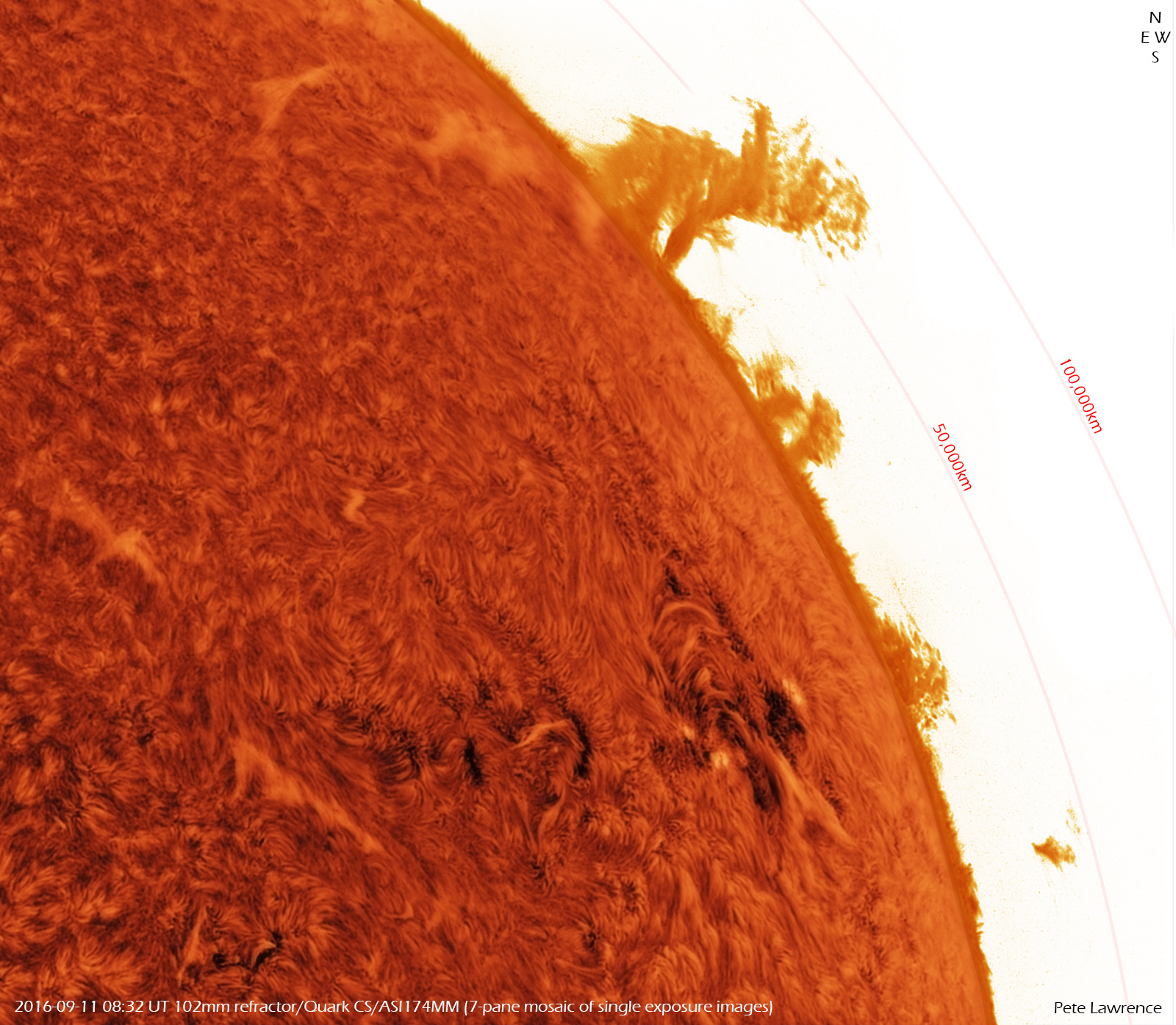
Astronomy picture of the day - 2016 September 19 - 50,000 Kilometers over the Sun
Image Credit & Copyright: Pete Lawrence
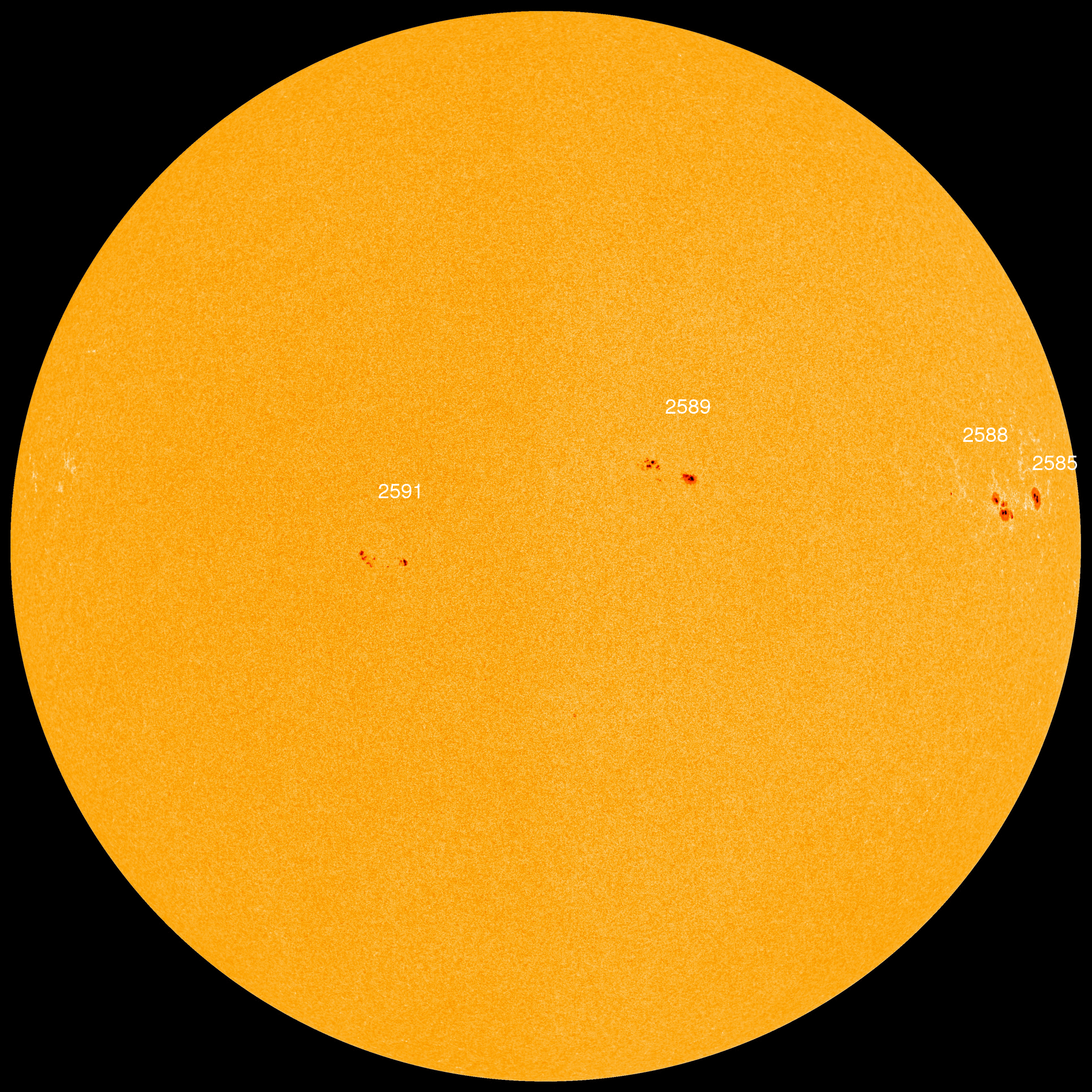
Explanation: What's happening at the edge of the Sun? Although it may look like a monster is rampaging, what is pictured is actually only a monster prominence -- a sheath of thin gas held above the surface by the Sun's magnetic field. The solar event was captured just this past weekend with a small telescope, with the resulting image then inverted and false-colored. As indicated with illustrative lines, the prominence rises over 50,000 kilometers above the Sun's surface, making even our 12,700-diameter Earth seem small by comparison. Below the monster prominence is active region 12585, while light colored filaments can be seen hovering over a flowing solar carpet of fibrils. Filaments are actually prominences seen against the disk of the Sun, while similarly, fibrils are actually spicules seen against the disk. Energetic events like this are becoming less common as the Sun evolves toward a minimum in its 11-year activity cycle.
2016-09-18
Fotografias do passado - Praça dos Restauradores, Lisboa
Estúdio Horácio Novais, Praça dos Restauradores, Lisboa, sem data Colecções da Fundação Calouste Gulbenkian, Lisboa, Portugal (Flickr Commons)
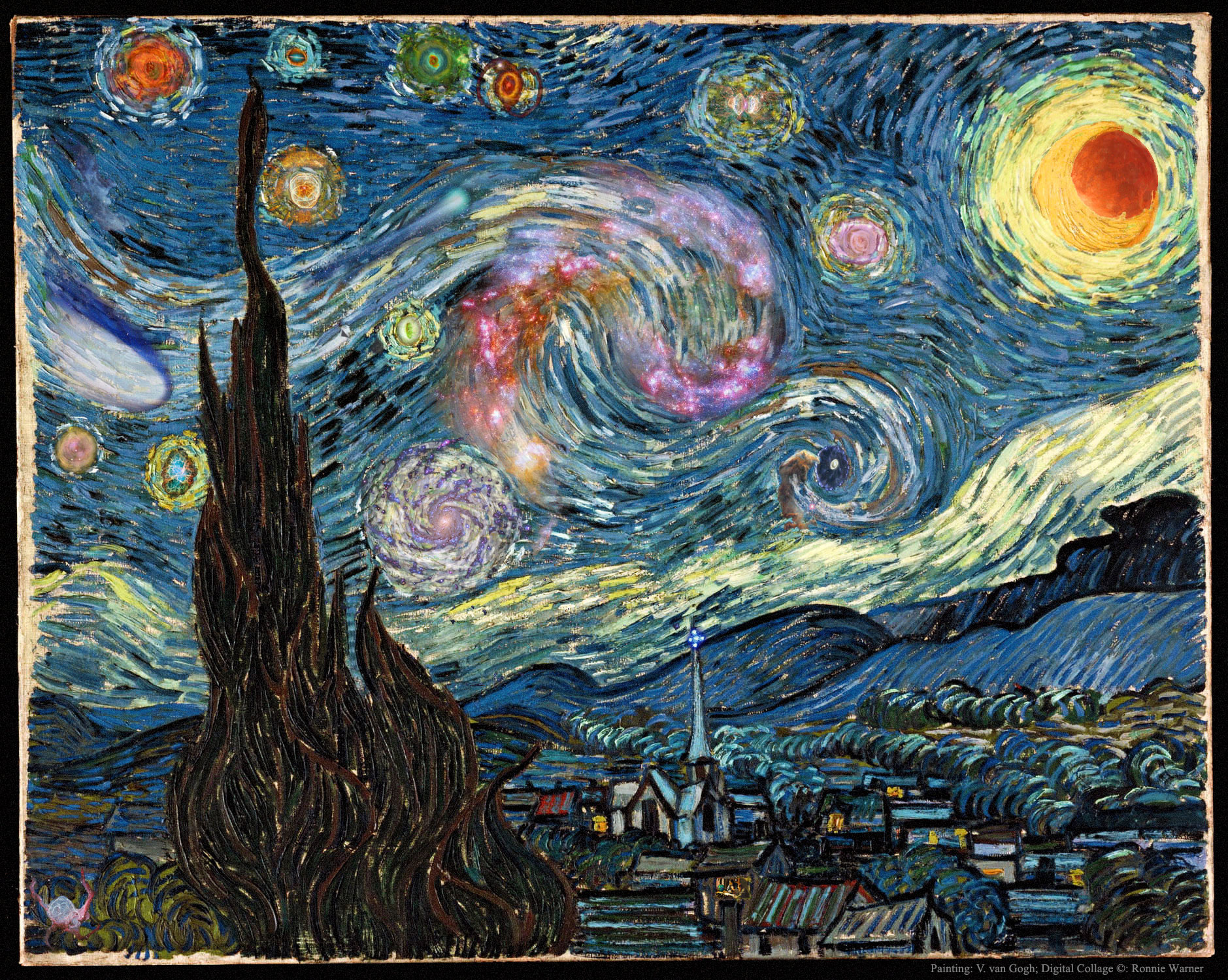
Astronomy picture of the day - 2016 September 18 - Starry Night Scavenger Hunt
Image Credit: Vincent van Gogh; Digital Collage & Copyright: Ronnie Warner
Explanation: Did you know that van Gogh's painting Starry Night includes Comet Hale-Bopp? Hopefully not, because it doesn't. But the featured image does. Although today's picture may appear at first glance to be a faithful digital reproduction of the original Starry Night, actually it is a modern rendition meant not only to honor one of the most famous paintings of the second millennium, but to act as a scavenger hunt. Can you find, in the featured image, a comet, aspiral galaxy, an open star cluster, and a supernova remnant? Too easy? OK, then find, the rings of Supernova 1987A, the Eskimo Nebula, the Crab Nebula, Thor's Helmet, the Cartwheel Galaxy, and the Ant Nebula. Still too easy? Then please identify any more hidden images not mentioned here -- and there are several -- on APOD's main discussion board: The Asterisk. Finally, the collagist has graciously hidden APOD's 10th anniversary Vermeer photomontagejust to honor APOD. (Thanks!)
2016-09-15
Imagens de Lisboa - Interiores secretos - Palacio das Necessidades
This palace was the only royal residence to survive the 1755 earthquake. Despite its cultural and architectural signirficance it’s not a tourist attraction, as is now occupied by the Ministry of Foreign Affairs and therefore closed to the public. Its precious collection of jewelry was transferred to the National Museum of Ancient Art, and many of the furnishings were placed in the palaces of Ajuda and Queluz. However, it still has an opulent regal interior, where heads of state are often received.
Este palácio foi a única residência real que sobreviveu ao terramoto de 1755. Apesar do seu valor cultural e arquitetónico, não é uma atração turística, pois é hoje ocupado pelo Ministério dos Negócios Estrangeiros, estando por isso fechado ao público. As suas preciosidades de ourivesaria foram transferidas para o Museu Nacional de Arte Antiga, e parte do mobiliário foi colocado nos palácios da Ajuda e de Queluz. No entanto, ainda possui um interior opulento, onde são muitas vezes recebidos chefes de estado.
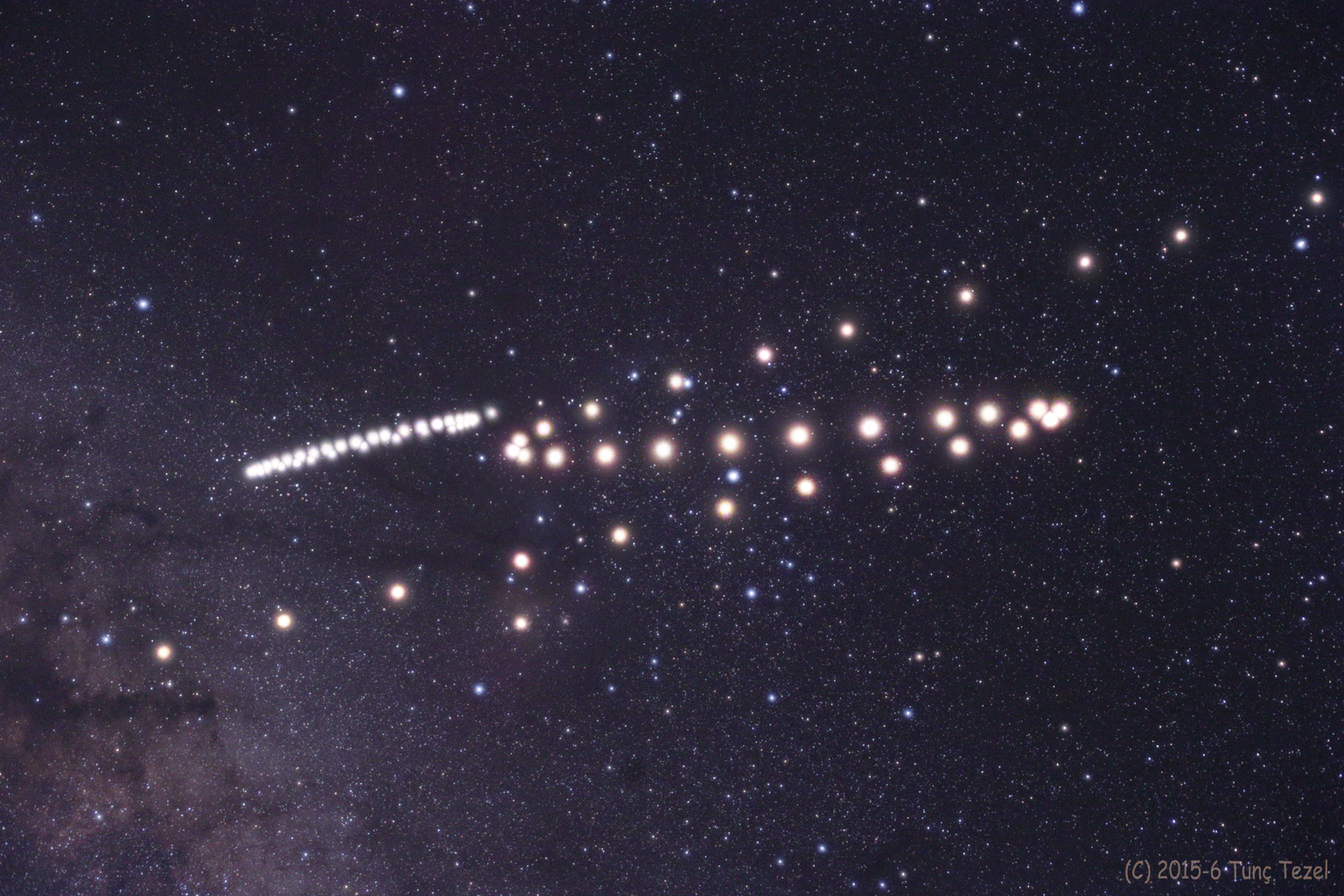
Astronomy picture of the day - 2016 September 15 - Retrograde Mars and Saturn
Image Credit & Copyright: Tunç Tezel (TWAN)
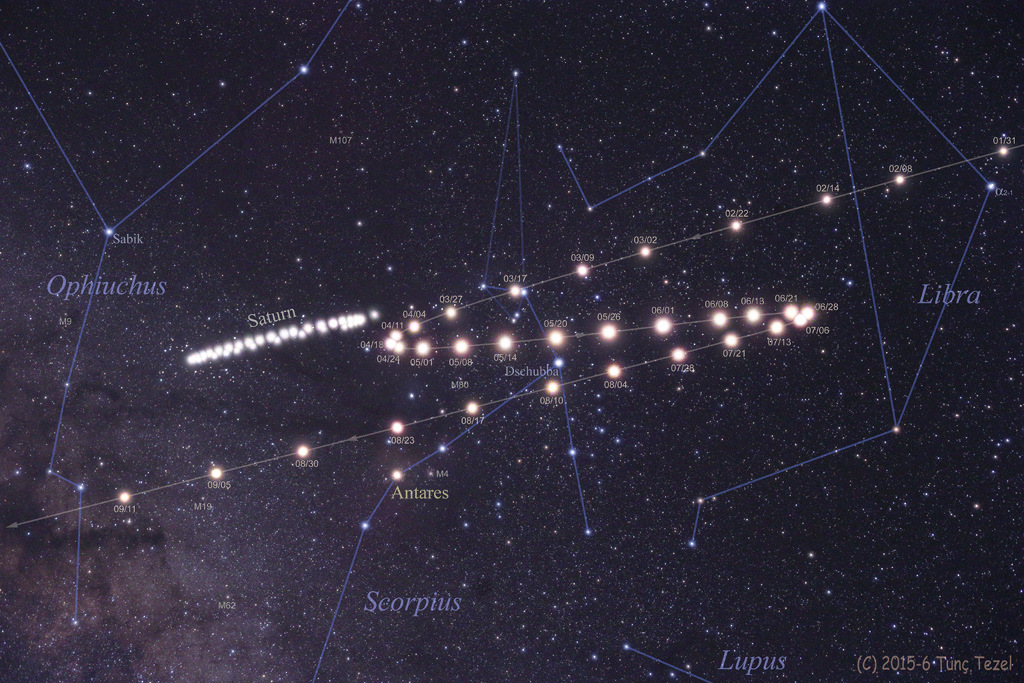
Explanation: Wandering Mars and Saturn have spent much of this year remarkably close in planet Earth's night sky. In a sequence of exposures spanning mid-December 2015 through the beginning of this week, this composited skyview follows their time together, including both near opposition, just north of bright star Antares near the Milky Way's central bulge. In the corresponding video, Saturn's apparent movement is seen to be back and forth along the flattened, compact loop, while Mars traces the wider, reversing S-shaped track from upper right to lower left through the frame. To connect the dots and dates just slide your cursor over the picture (or follow this link). It looks that way, but Mars and Saturn don't actually reverse direction along their orbits. Instead, their apparent backwards or retrograde motion with respect to the background stars is a reflection of the orbital motion of the Earth itself. Retrograde motion can be seen each time Earth overtakes and laps planets orbiting farther from the Sun, the Earth moving more rapidly through its own relatively close-in orbit.
Inscription à :
Commentaires (Atom)