2016-10-19

Article - Nations unies : Guterres, “missionnaire politique”


António Guterres a été officiellement élu secrétaire général de l’ONU jeudi 6 octobre, succédant ainsi au Sud-Coréen Ban Ki-moon. Beaucoup de journaux portugais ne cachent pas leur joie. “On a tous gagné”, exulte en une le journal Público. Dans un dossier consacré au membre du Parti socialiste et Premier ministre du pays de 1995 à 2002, le quotidien rappelle la défaite de la Bulgare Kristalina Georgevia, candidate de dernière heure et favorite de la chancelière Angela Merkel, avec un titre en forme de jeu de mots : “Une victoire cristalline”.

Pour le Diário de Notícias, cette défaite “est celle de Merkel”. Dans le même temps, le journal relaie les propos du ministre des Affaires étrangères, le très diplomate Augusto Santos Silva, affirmant que le processus de l’élection fut “exemplaire”. 

Mais qui est António Manuel de Oliveira Guterres ? Selon le Diário de Notícias, c’est “un missionnaire qui est devenu un missionnaire politique”, décrivant ainsi le parcours du socialiste catholique ancien haut-commissaire aux réfugiés. Un homme “de conviction, très intelligent, courageux et fin stratège”, explique le journal.

L’hebdomadaire Visão met en avant les deux mots forts du discours de Lisbonne du jeudi 6 octobre, dans lequel le “missionnaire” parle de“gratitude et d’humilité face aux défis qui l’attendent”.

À noter, un bémol de la part de l’éditorialiste de Público, João Miguel Tavares, qui assène : “Si bon à l’étranger, si mauvais chez nous.”Jugeant mauvaise la prestation de Guterres lors de son mandat à São Bento, siège du gouvernement de Lisbonne, le comparant à celles de José Manuel Barroso, l’ancien président de la Commission européenne et aussi Premier ministre de 2002 à 2004, il écrit :

Alors que mon côté patriotique éprouve de la joie pour António Guterres, et lui souhaite beaucoup de chance, mon côté réaliste ne peut pas s’empêcher de ressentir une grande tristesse de voir la disparité entre le fait que ces deux hommes ont atteint le sommet au niveau international, alors qu’en tant que Premiers ministres du Portugal, ils ont été très limités. Barroso et Guterres ne sont pas différents du plombier portugais au Luxembourg ou de la concierge portugaise à Paris : leurs qualités reconnues à l’étranger n’ont jamais été révélées chez nous.”

Courrier International - France

Astronomy picture of the day - 2016 October 19 - M45: The Pleiades Star Cluster

See Explanation.  Clicking on the picture will download
 the highest resolution version available.
M45: The Pleiades Star Cluster 
Image Credit & Copyright: Hermann von Eiff
Explanation: Have you ever seen the Pleiades star cluster? Even if you have, you probably have never seen it as dusty as this. Perhaps the most famous star cluster on the sky, the bright stars of the Pleiades can be seen without binoculars even from the heart of a light-polluted city. With a long exposure from a dark location, though, the dust cloud surrounding the Pleiades star cluster becomes very evident. The featured image was a long duration exposure taken last month from Namibia and covers a sky area many times the size of the full moon. Also known as the Seven Sisters and M45the Pleiades lies about 400 light years away toward the constellation of the Bull (Taurus). Acommon legend with a modern twist is that one of the brighter stars faded since the cluster was named, leaving only six stars visible to the unaided eye. The actual number of visible Pleiades stars, however, may be more or less than seven, depending on the darkness of the surrounding sky and the clarity of the observer's eyesight.

2016-10-18

Astronomy picture of the day - 2016 October 18 - Gemini Observatory North

See Explanation.  Clicking on the picture will download
 the highest resolution version available.
Gemini Observatory North 
Image Credit & CopyrightJoy Pollard (Gemini Observatory)
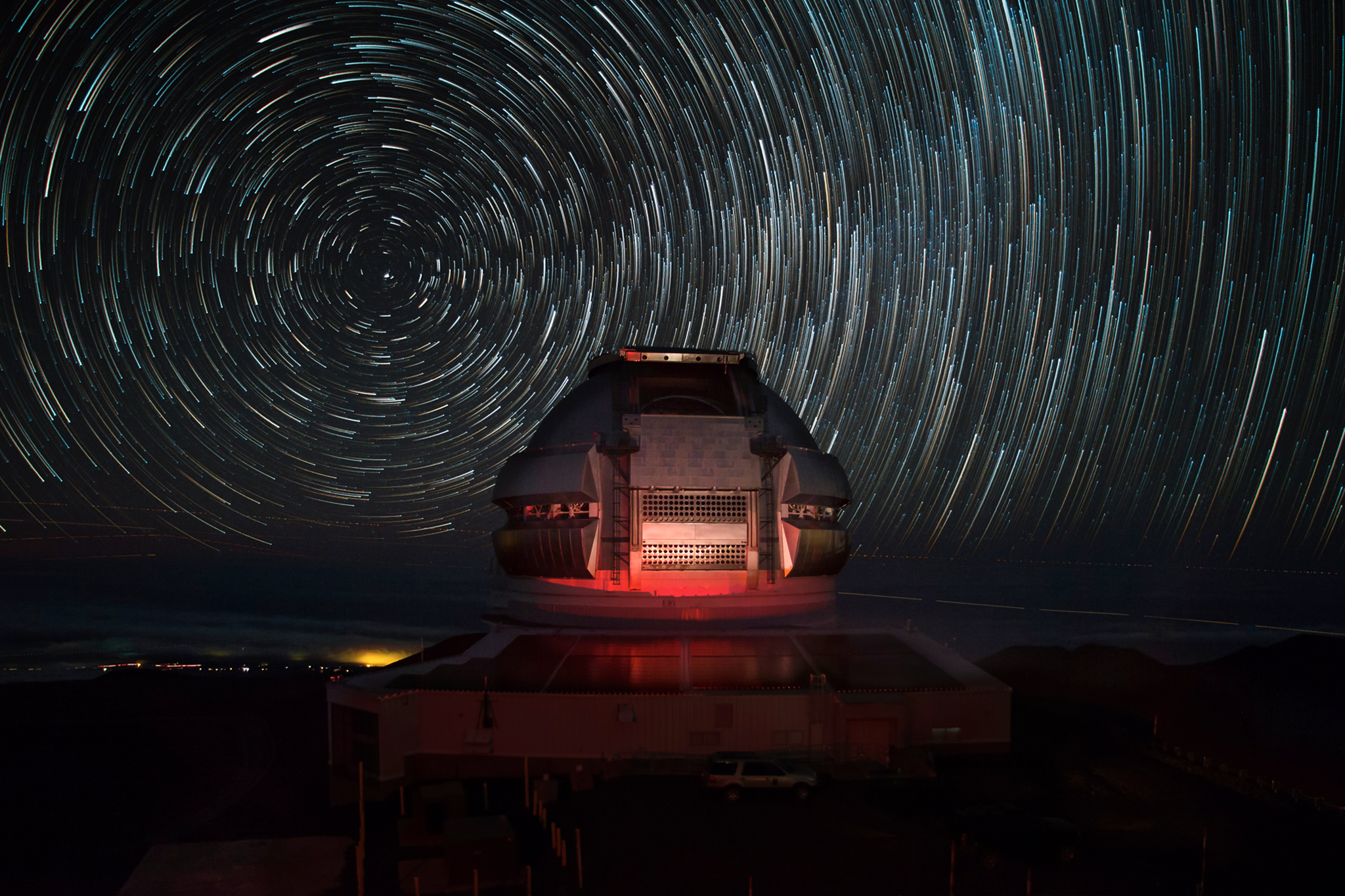
Explanation: It does look like a flying saucer, but this technologically advanced structure is not here to deliver the wise extraterrestrial from the scifi classic movie The Day the Earth Stood Still. It is here to advance our knowledge of the Universe though. Shown sitting near the top of a mountain in Hawaii, the dome of the Gemini Observatory North houses one of two identical 8.1-meter diameter telescopes. Used with its southern hemisphere twin observatory in Chile, the two can access the entire sky from planet Earth. Constructed from 85 exposures lasting 30 seconds each with camera fixed to a tripod, the image also clearly demonstrates that the Earth did not stand still. Adjusted to be brighter at the ends of their arcs, the concentric star trails centered on the North Celestial Pole are a reflection of Earth's rotation around its axis. Close to the horizon at Hawaiian latitdues, Polaris, the North Star, makes the shortest star trail. The fainter denser forest of star trails toward the right is part of the rising Milky Way.

2016-10-17

Grandes Pintores Impressionistas - Pierre-Auguste Renoir - "Retrato de Madame Claude Monet"

"Retrato de Madame Claude Monet" (c. 1872-74), Fundação Calouste Gulbenkian

Astronomy picture of the day - 2016 October 17 - An Atlas V Rocket Launches OSIRIS-REx

An Atlas V Rocket Launches OSIRIS-REx 
Video Credit & Copyright: United Launch AllianceNASA
Explanation: Have you ever seen a rocket launched into the Solar System? Last month a large Atlas V rocket blasted off from Launch Complex 41 in Florida carrying the ORISIX-REx spacecraft. This robotic spacecraft will attempt to land on Asteroid Bennu and return some of its soil to Earth. Asteroid 101955 Bennu orbits the Sun near the Earth, spans about 500-meters, is dark because its surface is covered with carbon, and has about a 1 in 2500 chance ofstriking the Earth in the next few thousand years. The exciting 2.5-minute video shows the Atlas V rocket being rolled out, prepared, and launched -- complete with a clip of side-boosters separating. If things go according to plan,ORISIS-REx will reach Bennu in 2018 and return samples to Earth in 2023. One science goal of OSIRIS-REx is to better determine whether ancient collisions between Earth and carbonaceous asteroids like Bennu provided Earth with a significant amount of the water and organic molecules necessary for the development of life.

2016-10-16

Imagens de Lisboa - Interiores secretos - Capela da Universidade Lusíada

A noble residence, built in 1740 on Rua da Junqueira in the Belém district, is now occupied by Lusíada University. It maintains a small chapel from 1740, with beautiful tile panels depicting Christ's crucifixion, and four stucco medallions on the ceiling with the images of the four Evangelists. In order to see these works of art that very few get to see, join the Thursday Mass at 1:10PM.
Capela da Universidade Lusíada, Lisboa
Uma casa nobre na Rua da Junqueira em Belém, construída em 1740, é hoje ocupada pela Universidade Lusíada. Mantém uma pequena capela, de 1740, com belíssimos painéis de azulejos ilustrando a crucificação de Cristo, e quatro medalhões no teto com as figuras em estuque dos quatro Evangelistas. Para poder admirar estas obras que muito poucos conhecem, assista à missa às quintas-feiras, às 13H10.

Pictures from my mind - "Bouquet"

"Bouquet"

07-03-2015
JoanMira

Astronomy picture of the day - 2016 October 16 - Cylindrical Mountains on Venus

See Explanation.  Clicking on the picture will download
 the highest resolution version available.
Cylindrical Mountains on Venus 
Image Credit: Magellan Spacecraft TeamUSGSNASA
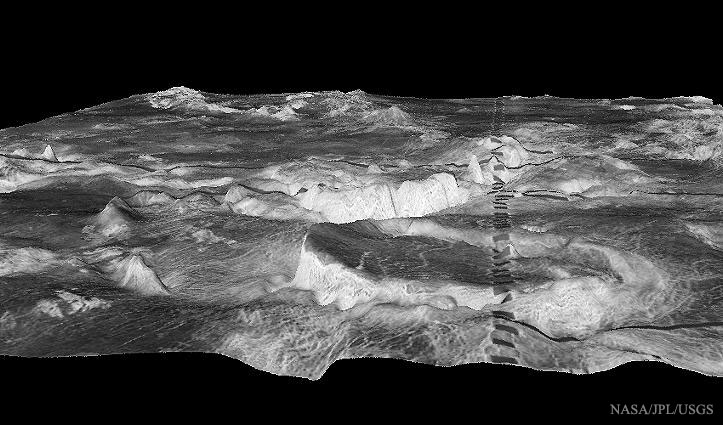
Explanation: What could cause a huge cylindrical mountain to rise from the surface of Venus? Such features that occur on Venus are known as coronas. Pictured here in the foreground is 500-kilometer wide Atete Corona found in a region of Venus known as the Galindo. The featured image was created by combining multiple radar maps of the region to form a computer-generated three-dimensional perspective. The series of dark rectangles that cross the image from top to bottom were created by the imaging procedure and are not real. The origin of massive coronas remains a topic of research although speculation holds they result from volcanism. Studying Venusian coronas help scientists better understand the inner structure of both Venus and Earth.

2016-10-15

Astronomy picture of the day - 2016 October 15 - Herschel's Orion

See Explanation.  Clicking on the picture will download
 the highest resolution version available.
Herschel's Orion 
Image Credit & CopyrightESA/Herschel/PACS/SPIRE
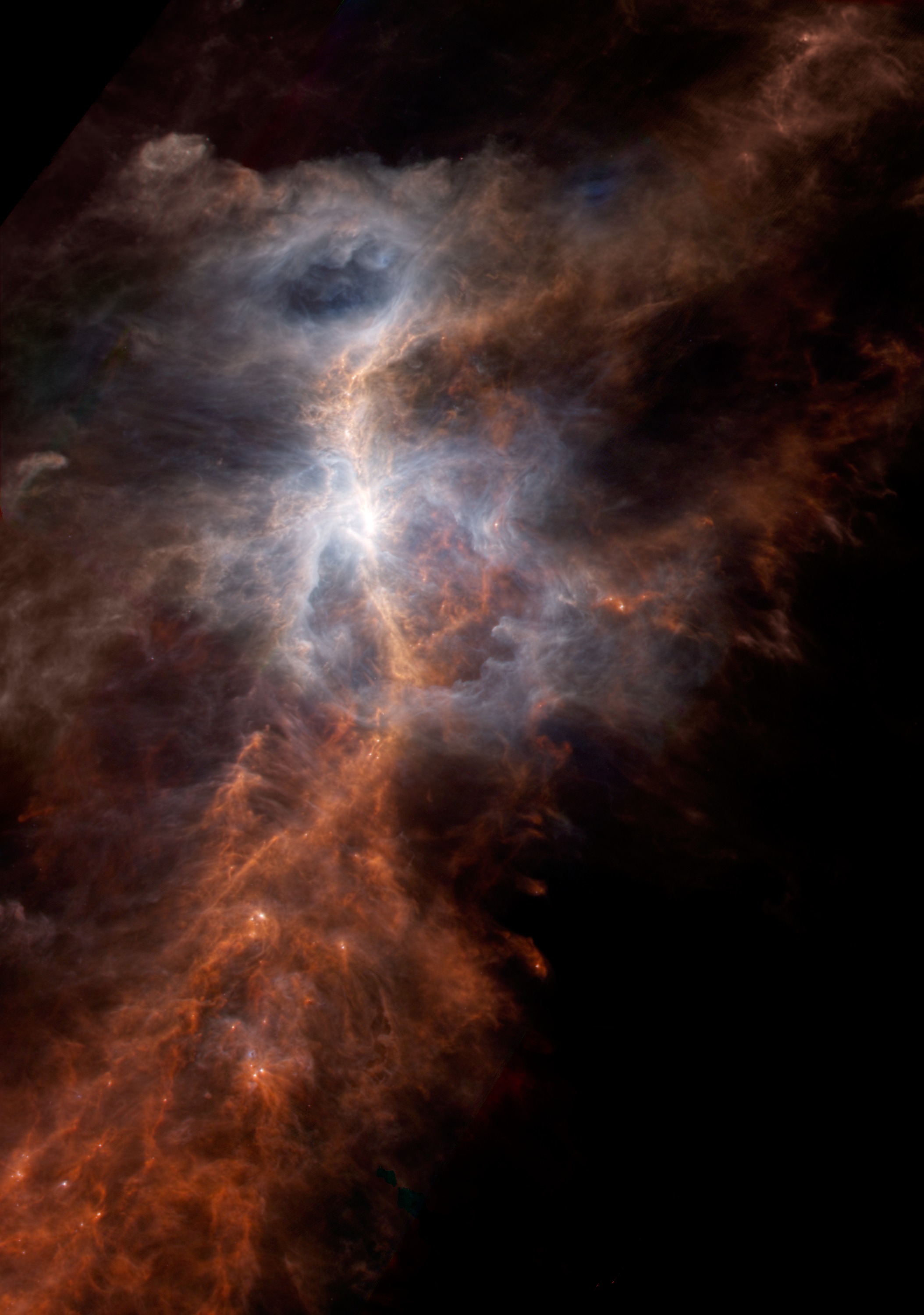
Explanation: This dramatic image peers within M42, the Orion Nebula, the closest large star-forming region. Using data at infrared wavelengths from the Herschel Space Observatory, the false-color composite explores the natal cosmic cloud a mere 1,500 light-years distant. Cold, dense filaments of dust that would otherwise be dark at visible wavelengths are shown in reddish hues. Light-years long, the filaments weave together bright spots that correspond to regions of collapsing protostars. The brightest bluish area near the top of the frame is warmer dust heated by the hot Trapezium cluster stars that also power the nebula's visible glow. Herschel data has recently indicated ultraviolet starlight from the hot newborn stars likely contributes to the creation of carbon-hydrogen molecules, basic building blocks of life. This Herschel image spans about 3 degrees on the sky. That's about 80 light-years at the distance of the Orion Nebula.

2016-10-14

Astronomy picture of the day - 2016 October 14 - Galaxies from the Altiplano

See Explanation.  Clicking on the picture will download
 the highest resolution version available.
Galaxies from the Altiplano 
Image Credit & CopyrightStéphane Guisard (Los Cielos de AmericaTWAN)
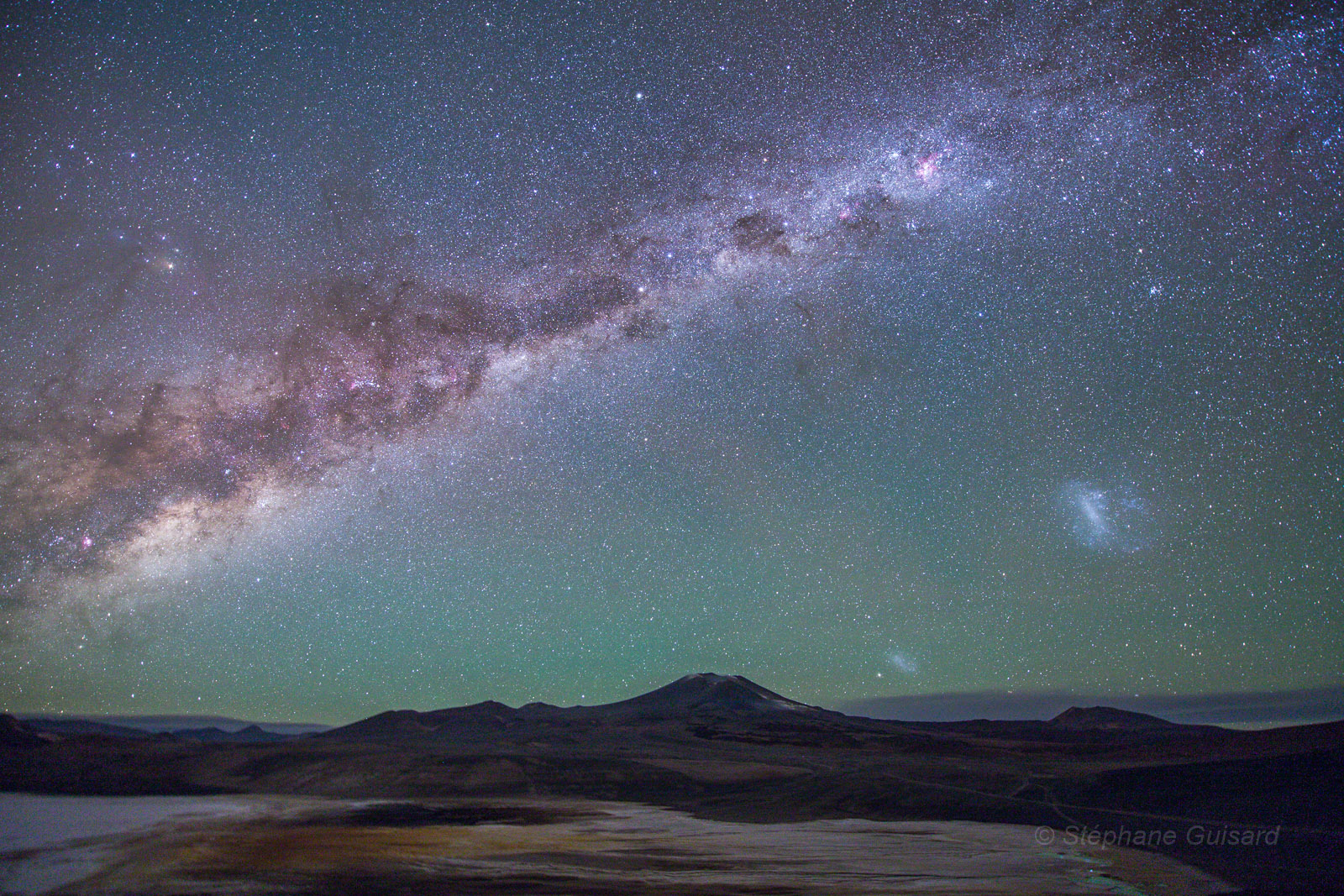
Explanation: The central bulge of our Milky Way Galaxy rises over the northern Chilean Atacama altiplano in this postcard from planet Earth. At an altitude of 4500 meters, the strange beauty of the desolate landscape could almost belong to another world though. Brownish red and yellow tinted sulfuric patches lie along the whitish salt flat beaches of the Salar de Aguas Calientes region. In the distance along the Argentina border is the stratovolcano Lastarria, its peak at 5700 meters (19,000 feet). In the clear, dark sky above, stars, nebulae, and cosmic dust clouds in the Milky Way echo the colors of the altiplano at night. Extending the view across extragalactic space, the Large and SmallMagellanic Clouds, satellite galaxies of the Milky Way, shine near the horizon through a faint greenish airglow.