2017-01-07

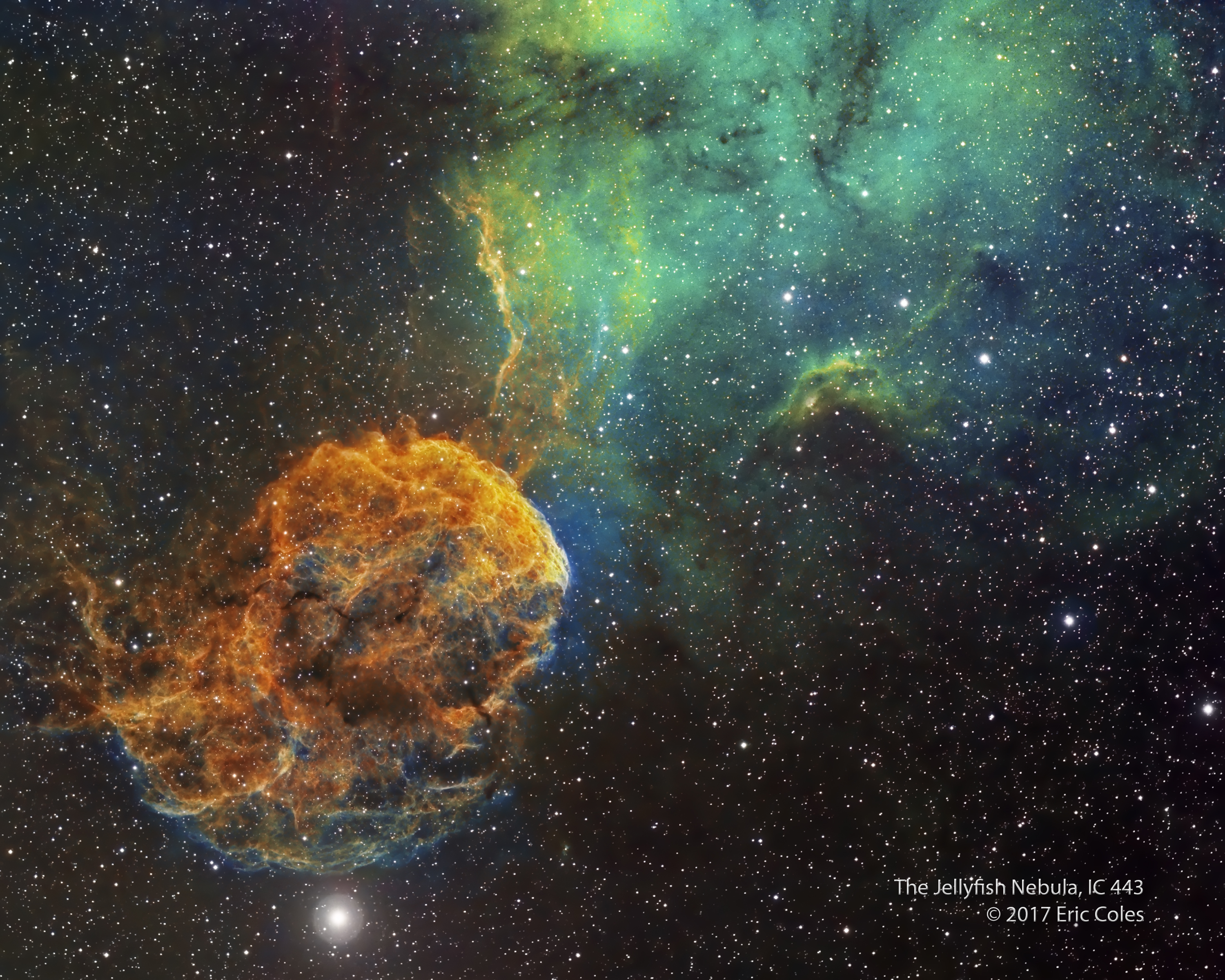
Astronomy picture of the day - 2017 January 7 - Sharpless 249 and the Jellyfish Nebula

See Explanation.  Clicking on the picture will download
 the highest resolution version available.
Sharpless 249 and the Jellyfish Nebula 
Image Credit & Copyright: Eric Coles
Explanation: Normally faint and elusive, the Jellyfish Nebula is caught in this alluring telescopic mosaic. The scene is anchored below by bright star Eta Geminorum, at the foot of the celestial twin, while the Jellyfish Nebula is the brighter arcing ridge of emission with tentacles dangling below and left of center. In fact, the cosmic jellyfish is part of bubble-shaped supernova remnant IC 443, the expanding debris cloud from a massive star that exploded. Light from the explosion first reached planet Earth over 30,000 years ago. Like its cousin in astrophysical waters the Crab Nebula supernova remnant, the Jellyfish Nebula is known to harbor a neutron star, the remnant of the collapsed stellar core. An emission nebula cataloged as Sharpless 249 fills the field at the upper right. The Jellyfish Nebula is about 5,000 light-years away. At that distance, this narrowband composite image presented in the Hubble Palette would be about 300 light-years across.

2017-01-06

Astronomy picture of the day - 2017 January 6 - New York Harbor Moonset

See Explanation.  Clicking on the picture will download
 the highest resolution version available.
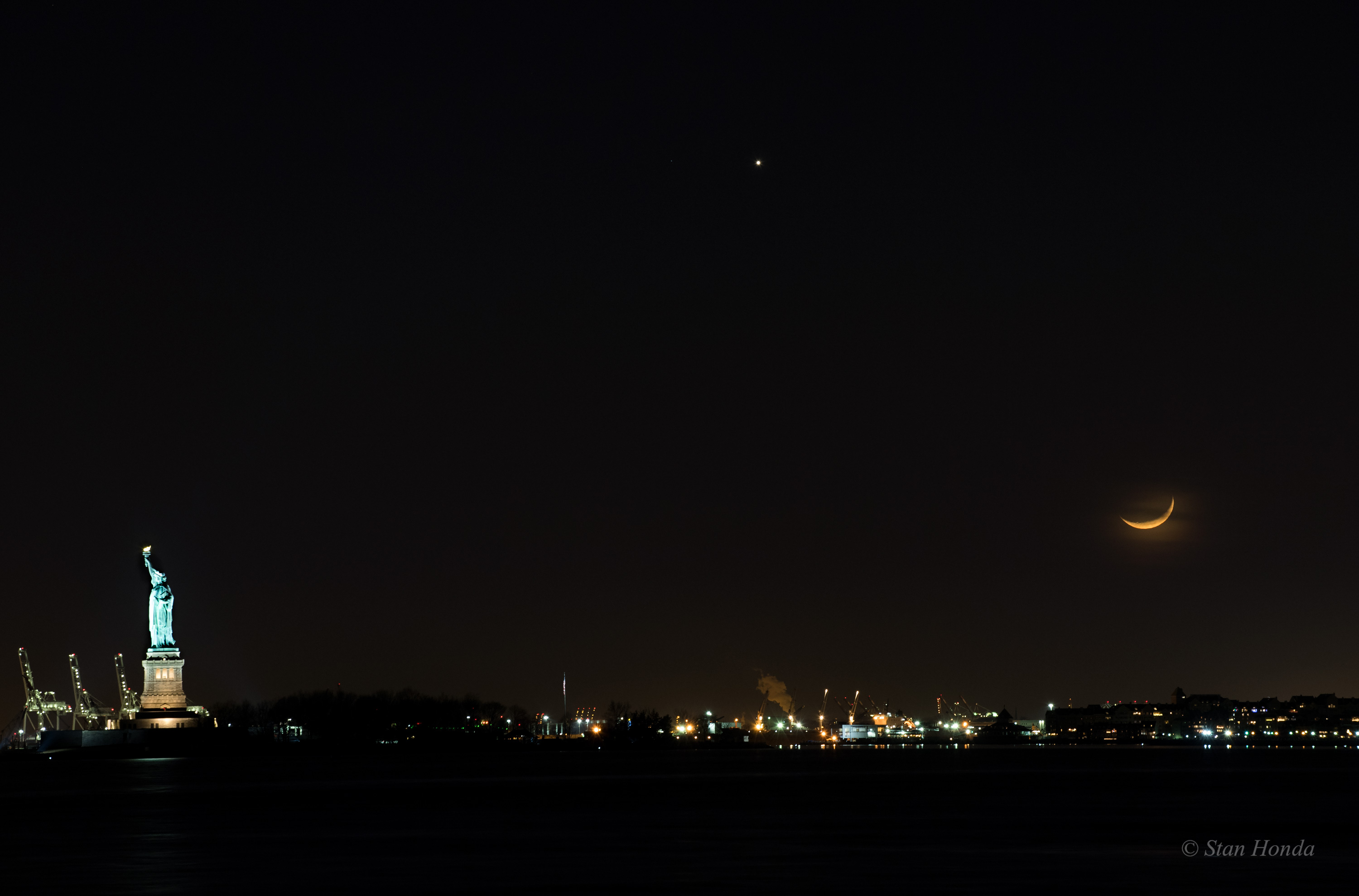
New York Harbor Moonset 
Image Credit & Copyright: Stan Honda
Explanation: Moonset on January 1 is captured in this sea and night sky snapshot from the port city of New York. Its warm moonlight shining through haze and thin clouds, this New Year's Moon was about 3 days old, in a waxingcrescent phase. The visible lunar disk is about 10 percent illuminated. Also easy to spot in hazy urban skies, Venus blazes forth over the western horizon, begining the year as Earth's evening star. Like the Moon, Venus goes through a range of phases as seen from planet Earth. As the year began, telescopic views of the brilliant inner planet's disk would show it about 50 percent illuminated, growing into a larger but thinner crescent by early March. New York Harbor's welcoming beacon, the Statue of Liberty, anchors a terrestrial corner of the night's triangle at the far left.

2017-01-05

Astronomy picture of the day - 2017 January 5 - Peculiar Galaxies of Arp 273

See Explanation.  Clicking on the picture will download
 the highest resolution version available.
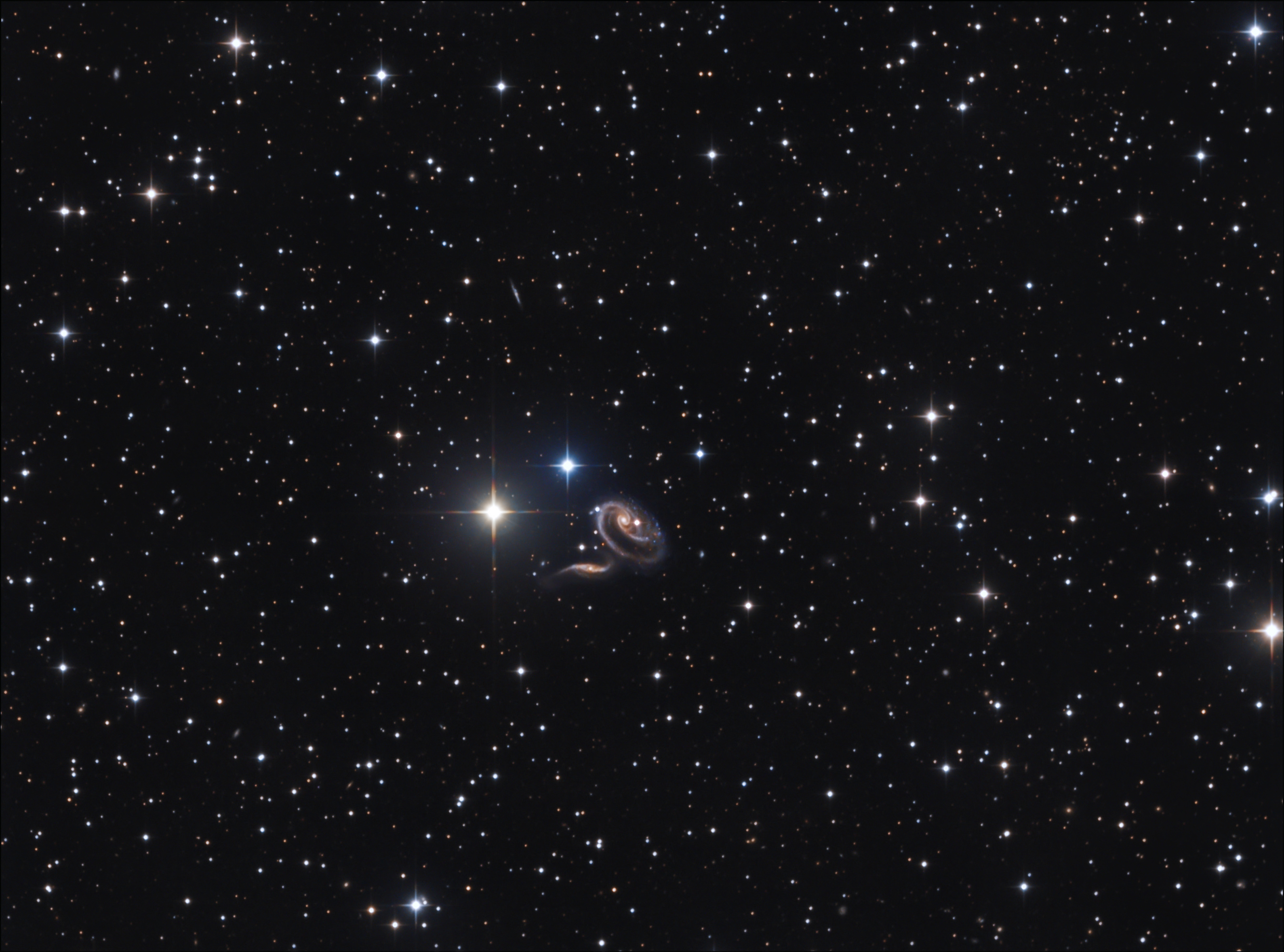
Peculiar Galaxies of Arp 273 
Image Credit & Copyright: Wolfgang Ries/Stefan Heutz (Astrokooperation)
Explanation: The spiky stars in the foreground of this sharp cosmic portrait are well within our own Milky Way Galaxy. The two eye-catching galaxies lie far beyond the Milky Way, at a distance of over 300 million light-years. Their distorted appearance is due to gravitational tides as the pair engage in close encounters. Cataloged as Arp 273 (also as UGC 1810), the galaxies do look peculiar, but interacting galaxies are now understood to be common in the universe. In fact, the nearby large spiral Andromeda Galaxy is known to be some 2 million light-years away and approaching the Milky Way. Arp 273 may offer an analog of their far future encounter. Repeated galaxy encounters on acosmic timescale can ultimately result in a merger into a single galaxy of stars. From our perspective, the bright cores of the Arp 273 galaxies are separated by only a little over 100,000 light-years.

2017-01-04

Astronomy picture of the day - 2017 January 4 - Clouds of Andromeda

See Explanation.  Clicking on the picture will download
 the highest resolution version available.
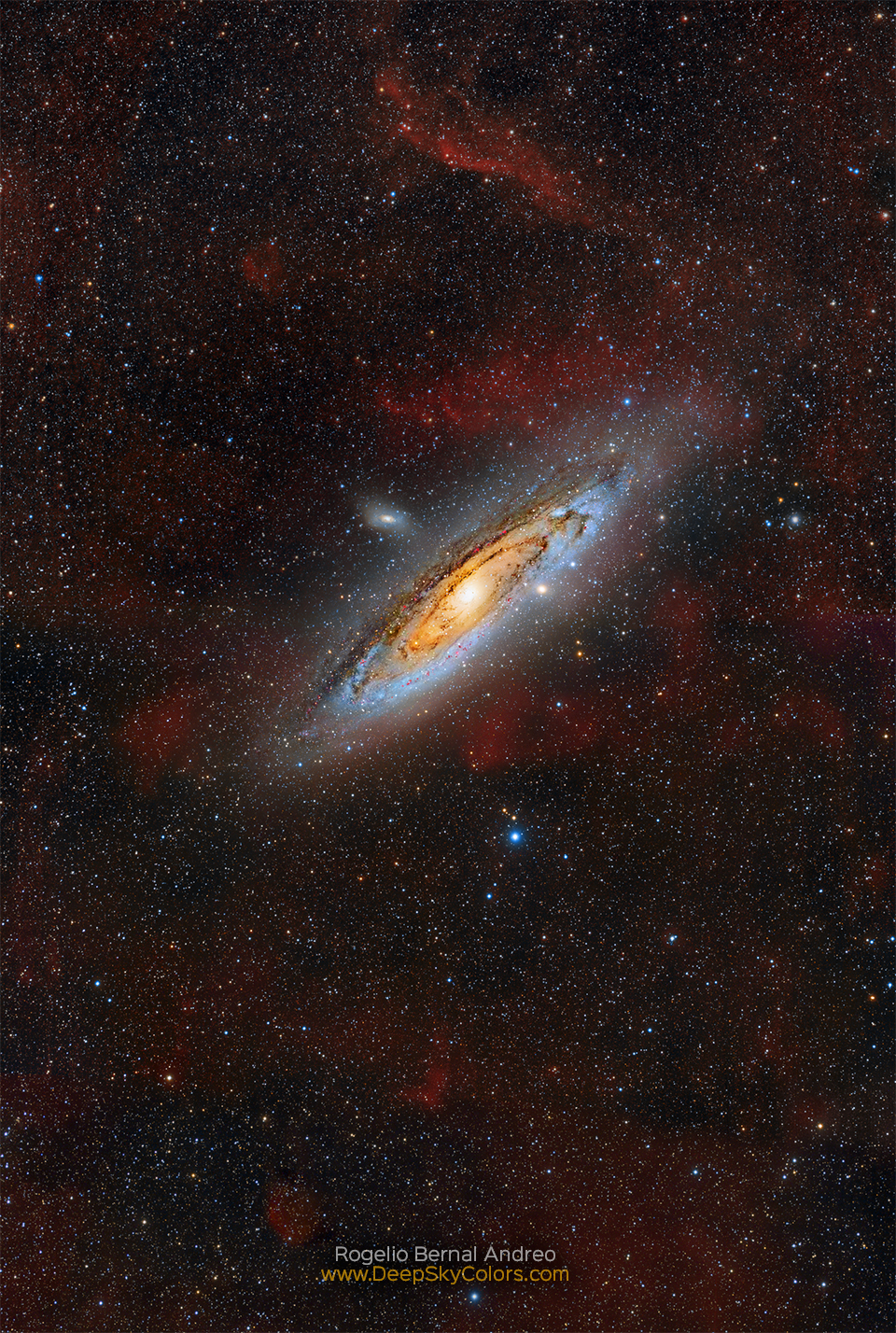
Clouds of Andromeda 
Image Credit & Copyright: Rogelio Bernal Andreo (Deep Sky Colors)
Explanation: The beautiful Andromeda Galaxy is often imaged by planet Earth-based astronomers. Also known as M31, the nearest large spiral galaxy is a familiar sight with dark dust lanes, bright yellowish core, and spiral arms traced by blue starlight. A mosaic of well-exposed broad and narrow-band image data, this colorful, premier portrait of our neighboring island universe offers strikingly unfamiliar features though, faint reddish clouds of glowing ionized hydrogen gas in the same wide field of view. Still, the ionized hydrogen clouds likely lie in the foreground of the scene, well within our Milky Way Galaxy. They could be associated with the pervasive, dusty interstellar cirrus clouds scattered hundreds of light-years above our own galactic plane. If they were located at the 2.5 million light-year distance of the Andromeda Galaxy they would be enormous, since the Andromeda Galaxy itself is 200,000 or so light-years across.

Now it's time to say goodbye - Ciao, ciao, ciao!

 :
CIAO, CIAO, CIAO!!!

2017-01-03

Texto - O essencial

Nesta vida tão breve gostaríamos que no seu pobre escasso, ela fosse tanto quanto possível, igual a muitos segundos que durassem séculos e séculos (Ámen…!)  e a segundos vividos apos muito outros seguidos, podesse-mos dar a volta à essência e regressarmos aos nostálgicos, velhos e belos tempos da nossa infância feliz.

Que os familiares e amigos não desviassem da rota que pelos anciãos lhes foi traçada; seria uma pena.

Quanto tempo pensam viver com a fortuna acumulada?

A morte aproxima-se a ineluctavemente… E que vai deixar de positivo aos seus descentes? Bens materiais, que os tenha ou não, pouco interessa. Fundamental é  deixar-lhes, a eles e aos amigos,  a imagem positiva de um homem que sempre pugnou pela honestidade, justiça, amor e amizade sincera!

Hasta siempre!

Algures no Planeta, 03-01-2017


JoanMira       

Kaleo - "Way down we go" - Video - Music

Afficher l'image d'origine
"Way down we go"

Artigo - Tornado faz voar telhados em Gouveia, Portugal


Résultat de recherche d'images pour "image tornado"

"Eu estava dentro de casa e só ouvi um estardalhaço enorme. Quando cheguei à rua, já estava tudo no chão". Carlos Cabral descreve assim a ventania que se fez sentir na tarde desta segunda-feira em São Paio, freguesia de Gouveia. Voaram telhados, caíram árvores, pelo menos um poste de eletricidade caiu sobre a estrada. "Aconteceu tudo num instante. Eu nem tive tempo de ver nada, mas um vizinho falou-me que parecia um tornado. A minha casa ficou com danos no telhado, tenho vizinhos que estão pior. Voaram-me um vasos enormes que tinha na varanda e foram cair na rua", conta Carlos Cabral. O CDOS da Guarda confirma ter recebido várias denúncias de uma situação meteorológica fora do normal durante a tarde desta segunda-feira. Os bombeiros de Gouveia confirmam a ocorrência de "um mini-tornado" que causou "avultados prejuízos" nas freguesias de São Paio e Nespreira. Telhados que voaram, chaminés em desguarnecidas, postes e árvores no chão foi o cenário com que se depararm os operacionais que estiveram no terreno. A eletricidade chegou a estar cortada em diversas habitações e a queda de uma árvore de grande porte interrompeu a circulação na Estrada Nacional 17. Contactado Instituto do Português do Mar e da Atmosfera diz também ter recebido várias chamadas dando conta das existência de um tornado em Gouveia, mas os radares meteorológicos não deteram sinais que possa confirmar a ocorrência. Ainda assim, o caso está a ser analisado.

CM - Portugal

Astronomy picture of the day - 2017 January 3 - Pandora Close-up at Saturn

See Explanation.  Clicking on the picture will download
 the highest resolution version available.
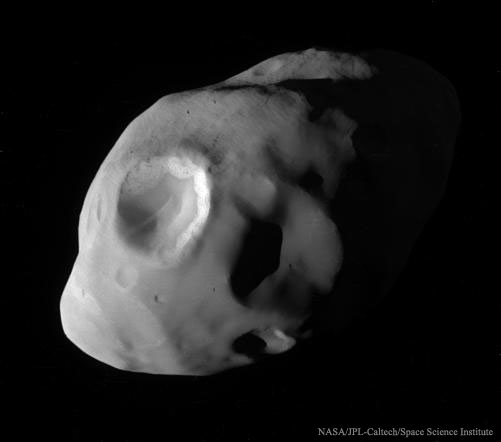
Pandora Close-up at Saturn 
Image Credit: NASAJPL-CaltechSpace Science Institute
Explanation: What do the craters of Saturn's small moon Pandora look like up close? To help find out, NASA sent the robotic Cassini spacecraft, now orbiting Saturn, past the unusual moon two weeks ago. The highest resolution image of Pandora ever taken was then captured from about 40,000 kilometers out and is featured here. Structures as small as 300 meters can be discerned on 80-kilometer wide Pandora. Craters on Pandora appear to be covered over by some sort of material, providing a more smooth appearance than sponge-like Hyperion, another small moon of Saturn. Curious grooves and ridges also appear to cross the surface of the small moon. Pandora is partly interesting because, along with its companion moon Prometheus, it helps shepherd the particles of Saturn's F ring into a distinct ring.