Split the Universe Image Credit: NASA, Erwin Schrödinger's Cat
Explanation: Just now, before you hit the button, two future universes are possible. After pressing the button, though, you will live in only one. A real-web version of the famous Schrödinger's cat experiment, clicking the red button in the featured astronaut image should transform that image into a picture of the same astronaut holding one of two cats -- one living, or one dead. The timing of your click, combined with the wiring of your brain and the millisecond timing of your device, will all conspire together to create a result dominated, potentially, by the randomness of quantum mechanics. Some believe that your personally-initiated quantum decision will split the universe in two, and that both the live-cat and dead-cat universes exist in separate parts of a larger multiverse. Others believe that the result of your click will collapse the two possible universes into one -- in a way that could not have been predicted beforehand. Yet others believe that the universe is classically deterministic, so that by pressing the button you did not really split the universe, but just carried out an action predestined since time began. We at APOD believe that however foolish you may feel clicking the red button, and regardless of the outcome, you should have a happy April Fool's Day.
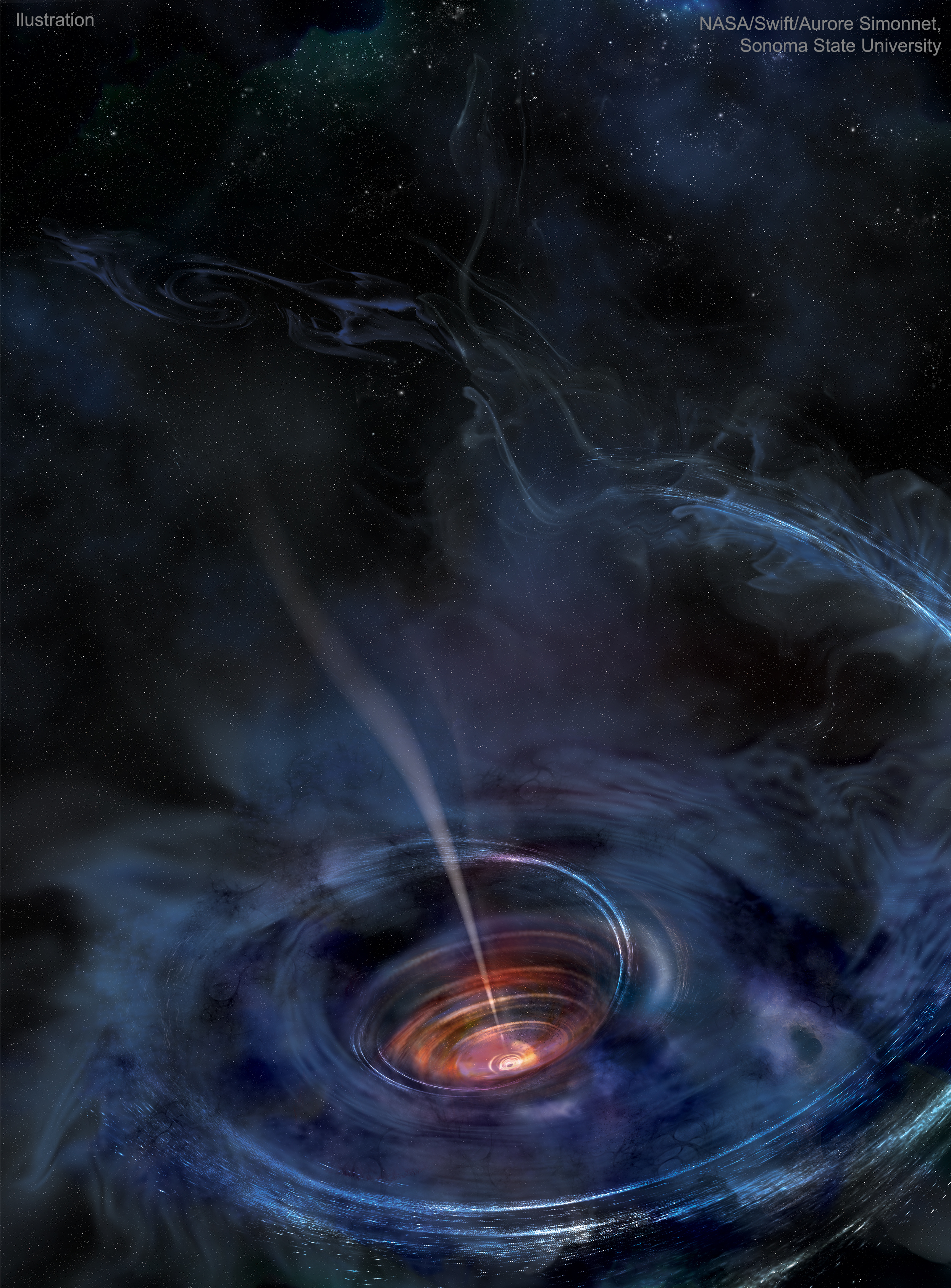
Explanation: What happens when a black hole devours a star? Many details remain unknown, but recent observations are providing new clues. In 2014, a powerful explosion was recorded by the ground-based robotic telescopes of the All Sky Automated Survey for SuperNovae (ASAS-SN) project, and followed up by instruments including NASA's Earth-orbiting Swift satellite. Computer modeling of these emissions fit a star being ripped apart by a distantsupermassive black hole. The results of such a collision are portrayed in the featured artistic illustration. The black hole itself is a depicted as a tiny black dot in the center. As matter falls toward the hole, it collides with other matter and heats up. Surrounding the black hole is an accretion disk of hot matter that used to be the star, with a jet emanating from the black hole's spin axis.
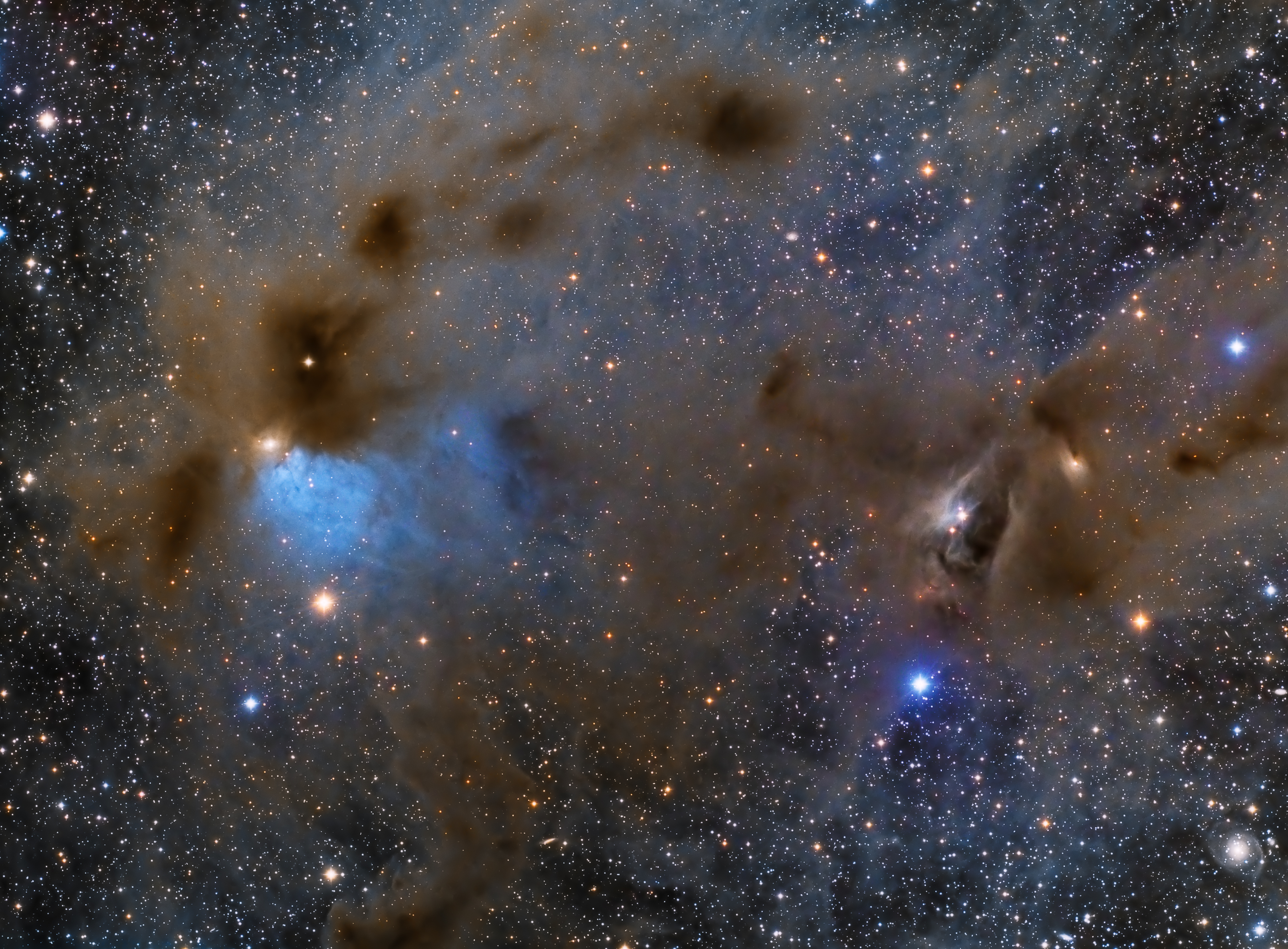
Explanation: This complex of dusty nebulae lingers along the edge of the Taurus molecular cloud, a mere 450 light-years distant. Stars are forming on the cosmic scene. Composed from almost 40 hours of image data, the 2 degree wide telescopic field of view includes some youthful T-Tauri class stars embedded in the remnants of their natal clouds at the right. Millions of years old and still going through stellar adolescence, the stars are variable in brightness and in the late phases of their gravitational collapse. Their core temperatures will rise to sustain nuclear fusion as they grow into stable, low mass, main sequence stars, a stage of stellar evolution achieved by our middle-aged Sun about 4.5 billion years ago. Another youthful variable star, V1023 Tauri, can be spotted on the left. Within its yellowish dust cloud, it lies next to the striking blue reflection nebula Cederblad 30, also known as LBN 782. Just above the bright bluish reflection nebula is dusty dark nebula Barnard 7.
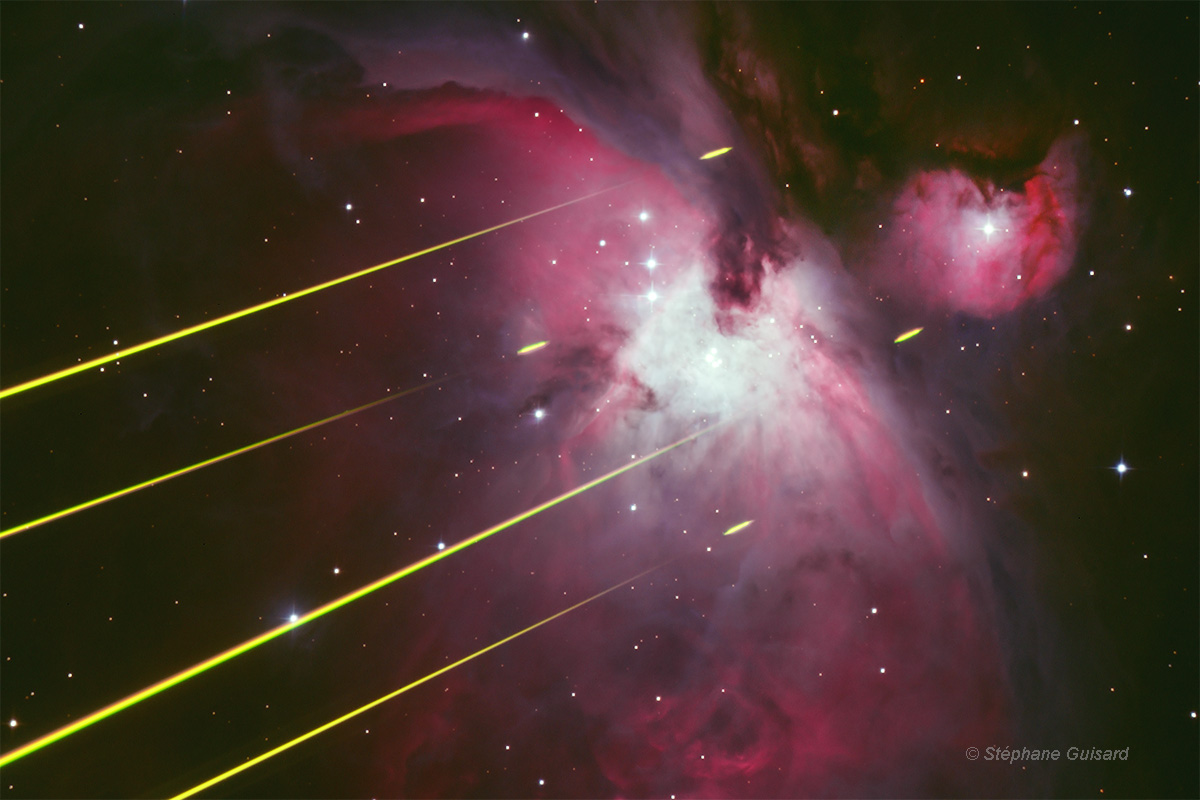
Explanation: Four laser beams cut across this startling image of the Orion Nebula, as seen from ESO's Paranal Observatory in the Atacama desert on planet Earth. Not part of an interstellar conflict, the lasers are being used for an observation of Orion by UT4, one of the observatory's very large telescopes, in a technical test of an image-sharpening adaptive optics system. This view of the nebula with laser beams was captured by a small telescope from outside the UT4 enclosure. The beams are visible from that perspective because in the first few kilometers above the observatory the Earth's dense lower atmosphere scatters the laser light. The four small segments appearing beyond the beams are emission from an atmospheric layer of sodium atoms excited by the laser light at higher altitudes of 80-90 kilometers. Seen from the perspective of the UT4, those segments form bright spots or artificial guide stars. Their fluctuations are used in real-time to correct for atmospheric blurring along the line-of-sight by controlling a deformable mirror in the telescope's optical path.
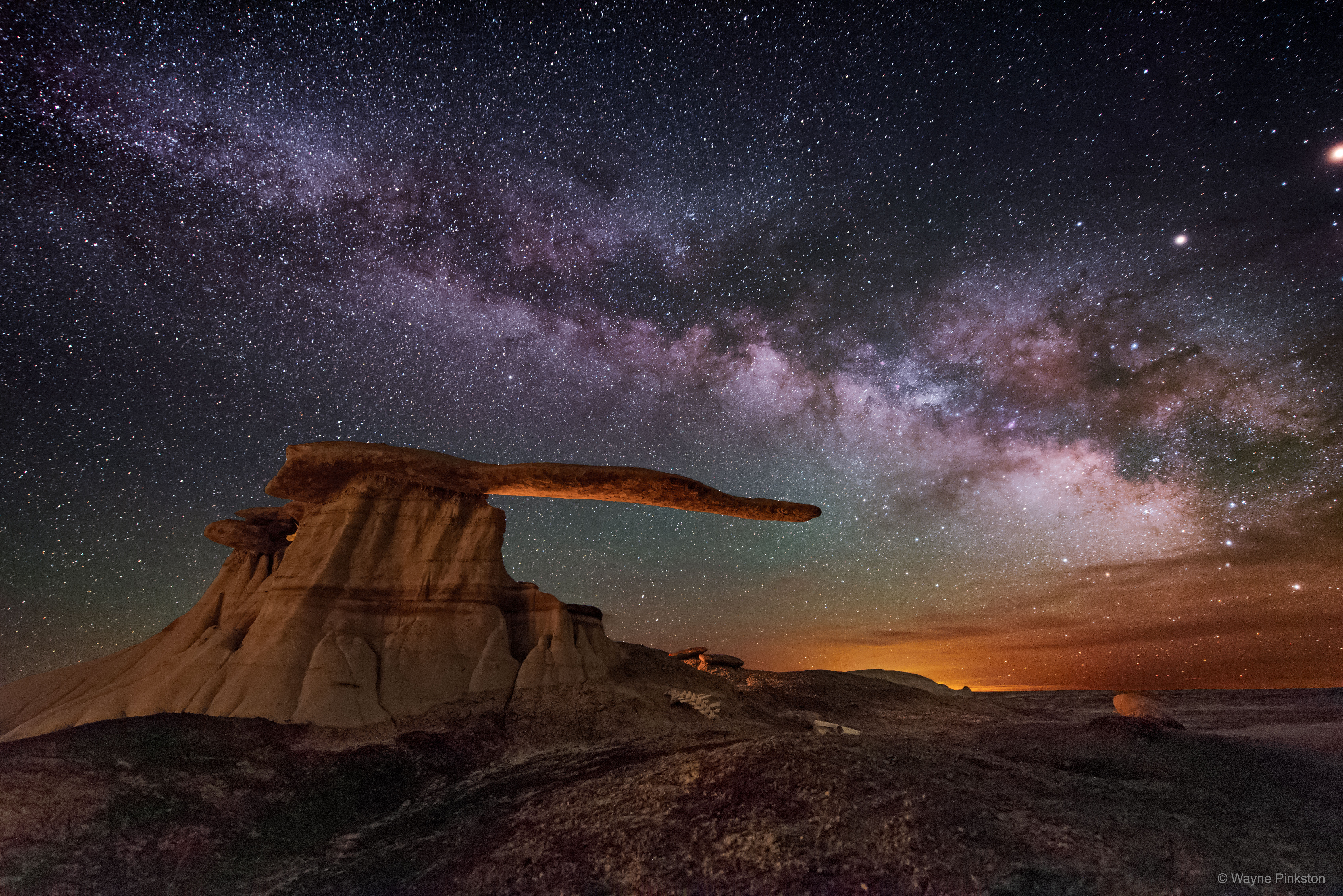
Explanation: This rock structure is not only surreal -- it's real. The reason it's not more famous is that it is, perhaps, smaller than one might guess: the capstone rock overhangs only a few meters. Even so, the King of Wings outcrop, located in New Mexico, USA, is a fascinating example of an unusual type of rock structure called a hoodoo. Hoodoos may form when a layer of hard rock overlays a layer of eroding softer rock. Figuring out the details of incorporatingthis hoodoo into a night-sky photoshoot took over a year. Besides waiting for a suitably picturesque night behind a sky with few clouds, the foreground had to be artificially lit just right relative to the natural glow of the background. After much planning and waiting, the final shot, featured here, was taken in May 2016. Mimicking the horizontal bar, the background sky features the band of our Milky Way Galaxy stretching overhead.