"Breathe easy"
2017-06-06

Astronomy picture of the day - 2017 June 6 - The Case of the Missing Star
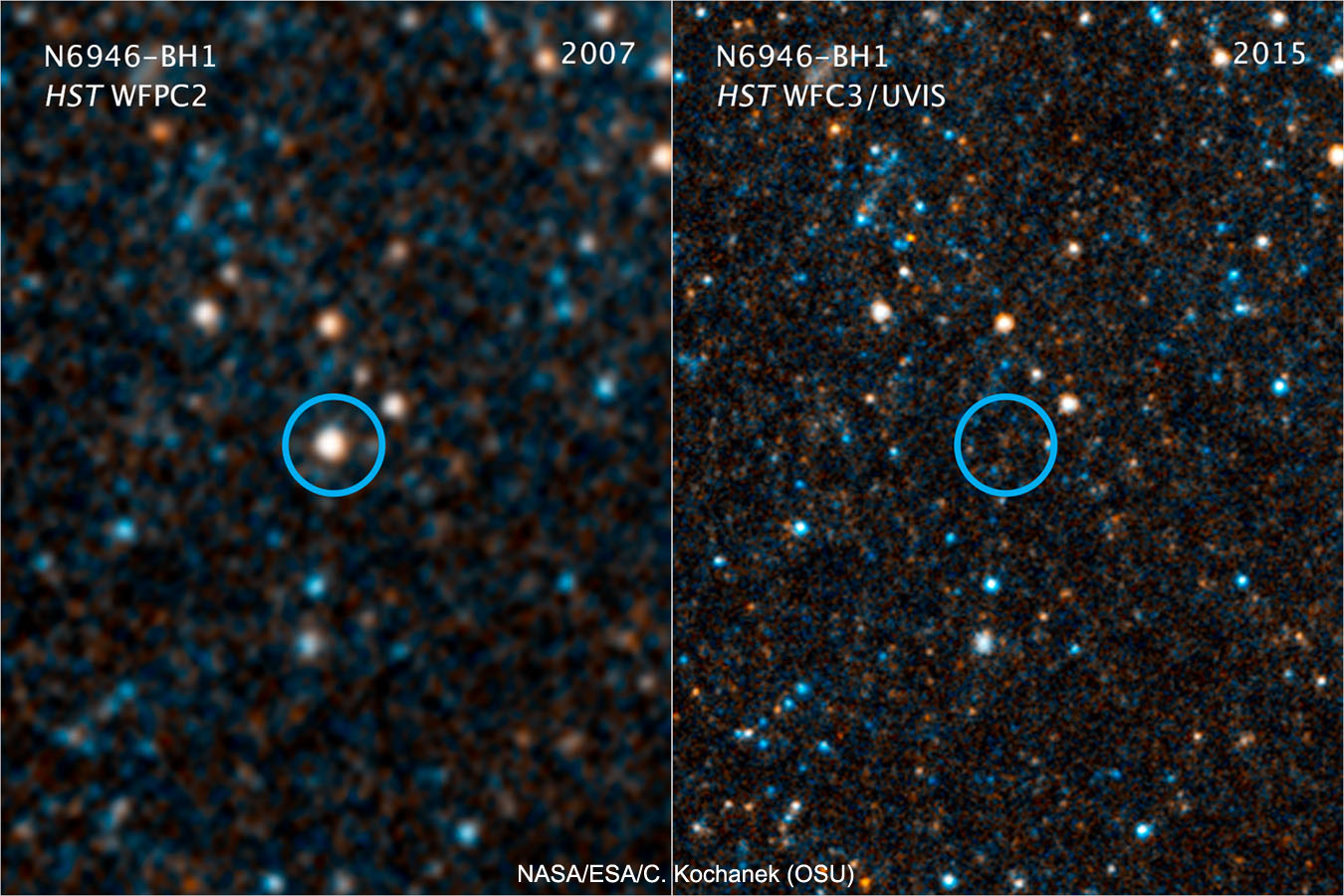
Image Credit: NASA, ESA, Hubble, C. Kochanek (OSU)
Explanation: What's happened to giant star N6946-BH1? It was there just a few years ago -- Hubble imaged it. Now there's only a faint glow. What's curiouser, no bright supernova occurred -- although the star did brightened significantly for a few months. The leading theory is that, at about 25 times the mass of our Sun, N6946-BH1's great gravity held much of the star together during its final tumultuous death throes, after which most the star sunk into ablack hole of its own making. If so, then what remained outside of the black hole likely then formed an accretion disk that emits comparatively faint infrared light as it swirls around, before falling in. If this mode of star death is confirmed with other stars, it gives direct evidence that a very massive star can end its life with a whimper rather than a bang.
2017-06-05
Astronomy picture of the day - 2017 June 5 - Highlights of the Summer Sky

Illustration Credit & Copyright: Universe2go.com
Explanation: What's up in the sky this summer? The featured graphic gives a few highlights for Earth's northern hemisphere. Viewed as a clock face centered at the bottom, early summer sky events fan out toward the left, while late summer events are projected toward the right. Objects relatively close to Earth are illustrated, in general, as nearer to the cartoon figure with the telescope at the bottom center -- although almost everything pictured can be seen without a telescope. Highlights of this summer's sky include that Jupiter will be visible after sunset during June, while Saturn will be visible after sunset during August. A close grouping of the Moon, Venus and the bright star Aldebaran will occur during mid-July. In early August, the Perseids meteor shower peaks. Surely the most famous pending astronomical event occurring this summer, though, will be a total eclipse of the Sun visible over a thin cloud-free swath across the USA on 21 August.

2017-06-04
Astronomy picture of the day - 2017 June 4 - Orion: Belt, Flame, and Horsehead
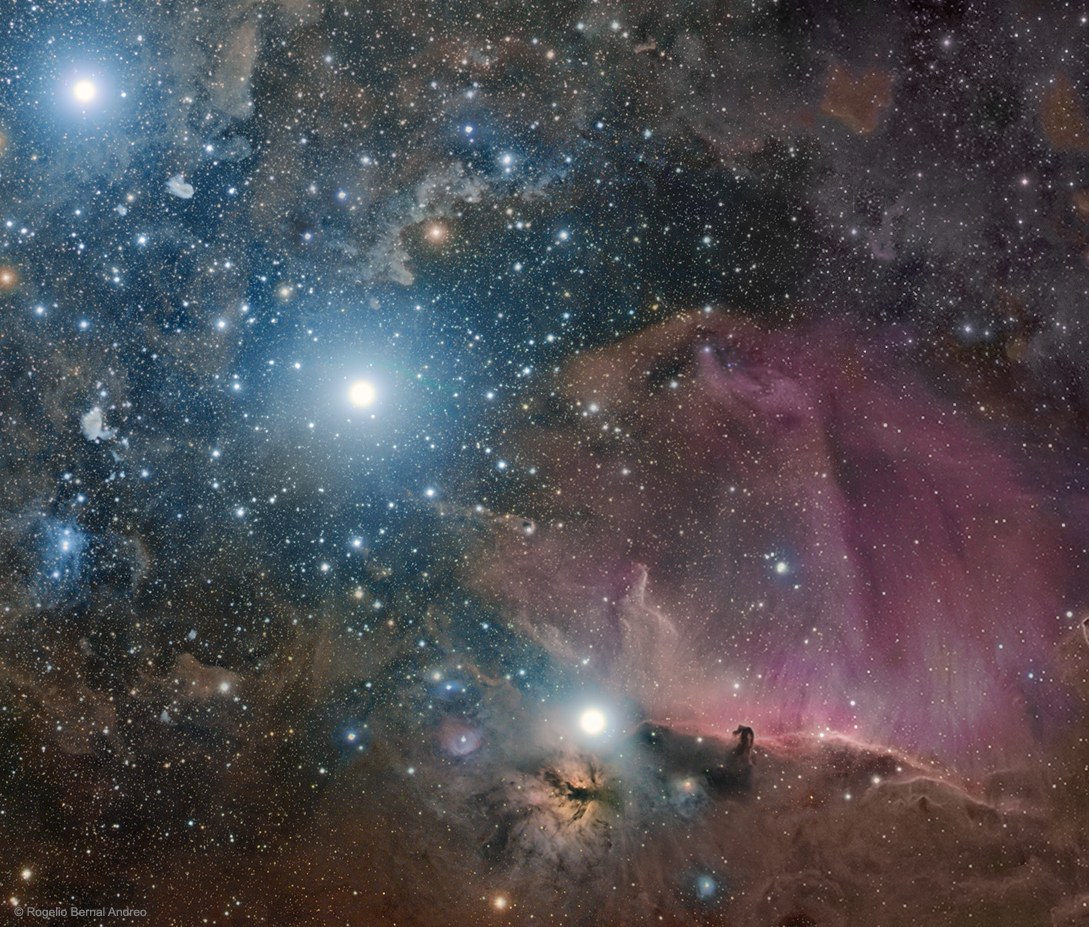
Image Credit & Copyright: Rogelio Bernal Andreo (Deep Sky Colors)
Explanation: What surrounds the famous belt stars of Orion? A deep exposure shows everything from dark nebula to star clusters, all embedded in an extended patch of gaseous wisps in the greater Orion Molecular Cloud Complex.The brightest three stars, appearing diagonally on the left of the featured image are indeed the famous three stars that make up the belt of Orion. Just below Alnitak, the lowest of the three belt stars, is the Flame Nebula, glowing withexcited hydrogen gas and immersed in filaments of dark brown dust. Just to the right of Alnitak lies the Horsehead Nebula, a dark indentation of dense dust that has perhaps the most recognized nebular shapes on the sky. The dark molecular cloud, roughly 1,500 light years distant, is cataloged as Barnard 33 and is seen primarily because it is backlit by the nearby massive star Sigma Orionis. The Horsehead Nebula will slowly shift its apparent shape over the next few million years and will eventually be destroyed by the high-energy starlight.
2017-06-03
Imagens - "La Terre vue de l'Espace" - Venise

"Venise, la cité des Doges – et des amoureux – dans sa lagune. On voit presque les gondoles !"
Thomas Pesquet
Thomas Pesquet
Astronomy picture of the day - 2017 June 3 - Perijove Passage

Image Credit: NASA, Juno, SwRI, MSSS, Gerald Eichstadt, Sean Doran
Explanation: On May 19, the Juno spacecraft once again swung by Jupiter in its looping 53 day orbit around the Solar System's ruling gas gaint. Beginning at the top, this vertical 14 frame sequence of enhanced-color JunoCam images follows the spacecraft's rapidly changing perspective during its two hour passage. They look down on Jupiter's north polar region, equatorial, and south polar region (bottom images). With the field-of-view shrinking, the seventh and eighth images in the sequence are close-up. Taken only 4 minutes apart above Jupiter's equator they were captured just before the spacecraft reached perijove 6, its closest approach to Jupiter on this orbit. Final images in the sequence pick up white oval storm systems, Jupiter's "String of Pearls", and the south polar region from the outward bound spacecraft.
2017-06-02
Astronomy picture of the day - 2017 June 2 - Black Holes of Known Mass
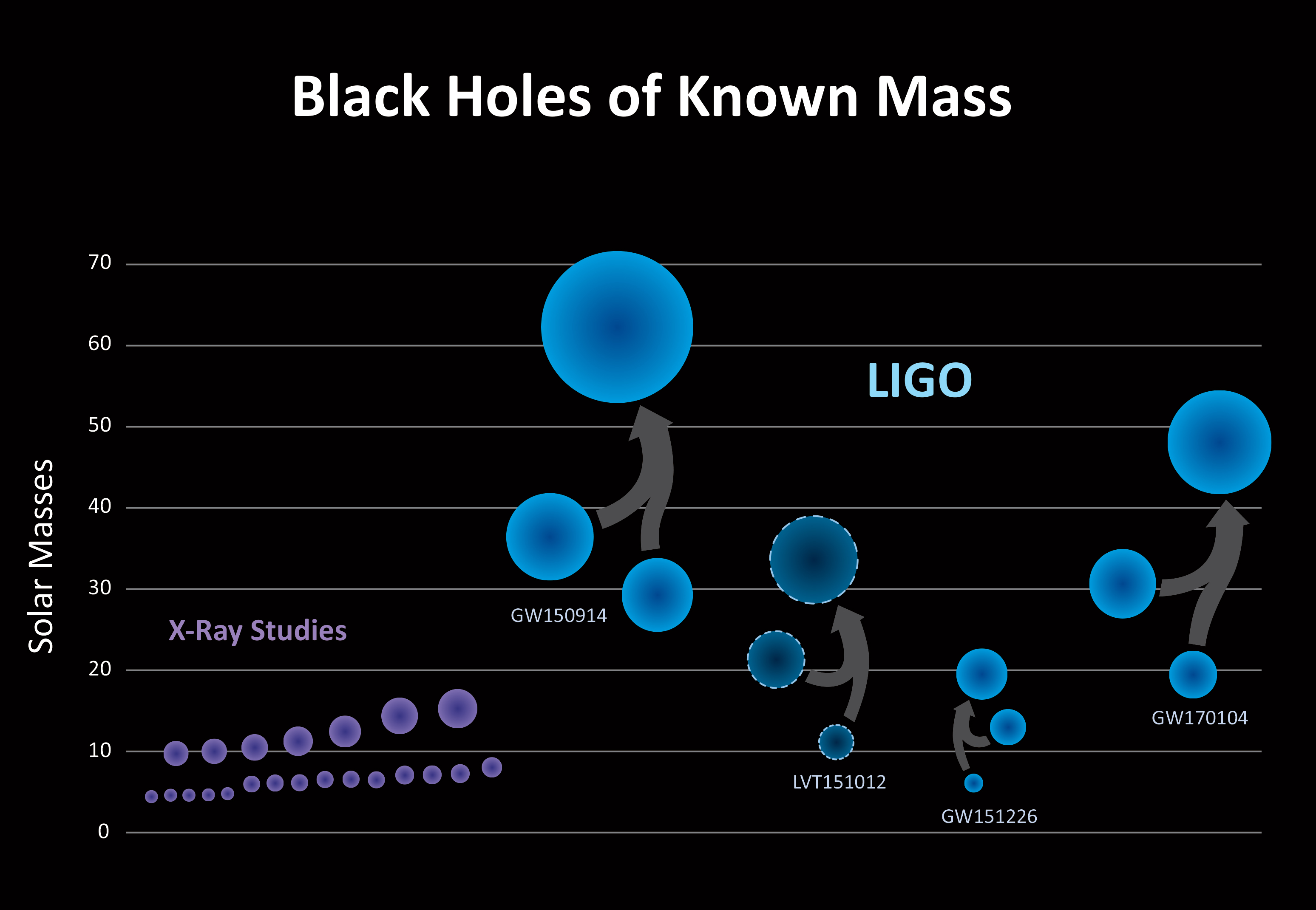
Illustration Credit: LIGO, NSF, Aurore Simonnet (Sonoma State U.)
Explanation: Add GW170104 to the chart of black holes with known mass. The extremely energetic merger of two smaller black holes corresponds to the Laser Interferometer Gravitational-wave Observatory's (LIGO) thirddetection of gravitational waves. The newfound black hole has a mass about 49 times that of the Sun, filling a gap between the masses of the two merged black holes detected previously by LIGO, with solar masses of 62 (GW150914) and 21 (GW151216). In all three cases, the signal in each of the twin LIGO detectors was unambiguously identified as coming from black hole mergers while a fourth case (LVT151012) resulted in a lower confidence detection. GW170104 is estimated to be some 3 billion light-years away, more distant than present estimates for GW150914 and GW151216. The ripples in spacetime were discovered during LIGO's current observing run, which began November 30, 2016 and will continue through the summer.
2017-06-01
Astronomy picture of the day - 2017 June 1 - Shadowrise and Sunset

Image Credit & Copyright: Göran Strand
Explanation: The road tracking through this stunning 360 degree view crosses a remote mountain area of Jämtland, Sweden, planet Earth. A 3x8 mosaic of still images, the panorama was taken on May 3rd from a small drone 200 meters above the ground. The scene records the warm light of the Sun setting in the northwest and the planet's dark shadow rising in the southeast. A small sun pillar gives away the Sun's position just below the horizon while the pinkishanti-twilight arch or belt of Venus outlines Earth's shadow. In the middle of the remarkably clear sky, the First Quarter Moon is visible above the mountains, its half illuminated disk separating sunset and shadowrise. A range of exposures were combined to cover the difference in sky brightness for sunset and Earth shadow. The tallest peak left of the sunset is Storsnasen, some 1400 meters above sea level.
2017-05-31
Astronomy picture of the day - 2017 May 31 - Approaching the Bubble Nebula

Visualization Credit: NASA, ESA, and F. Summers, G. Bacon, Z. Levay, and L. Frattare (Viz 3D Team, STScI);
Acknowledgment: T. Rector/University of Alaska Anchorage, H. Schweiker/WIYN and NOAO/AURA/NSF, NASA, ESA, and the Hubble Heritage Team (STScI/AURA)
Explanation: What would it look like to approach the Bubble Nebula? Blown by the wind and radiation from a massive star, this bubble now spans seven light-years in diameter. The hot star inside is thousands of times more luminous than our Sun, and is now offset from the nebula's center. The visualization starts with a direct approach toward the Bubble Nebula (NGC 7635) and then moves around the nebula while continuing the approach. The featured time-lapse visualization is extrapolated from images with the orbiting Hubble Space Telescope and the WIYN telescope on Kitt Peak in Arizona, USA. The 3D-computer model on which this visualization is based includes artistic interpretations, and distances are significantly compressed.

Astronomy picture of the day - 2017 May 30 - Beneath Jupiter
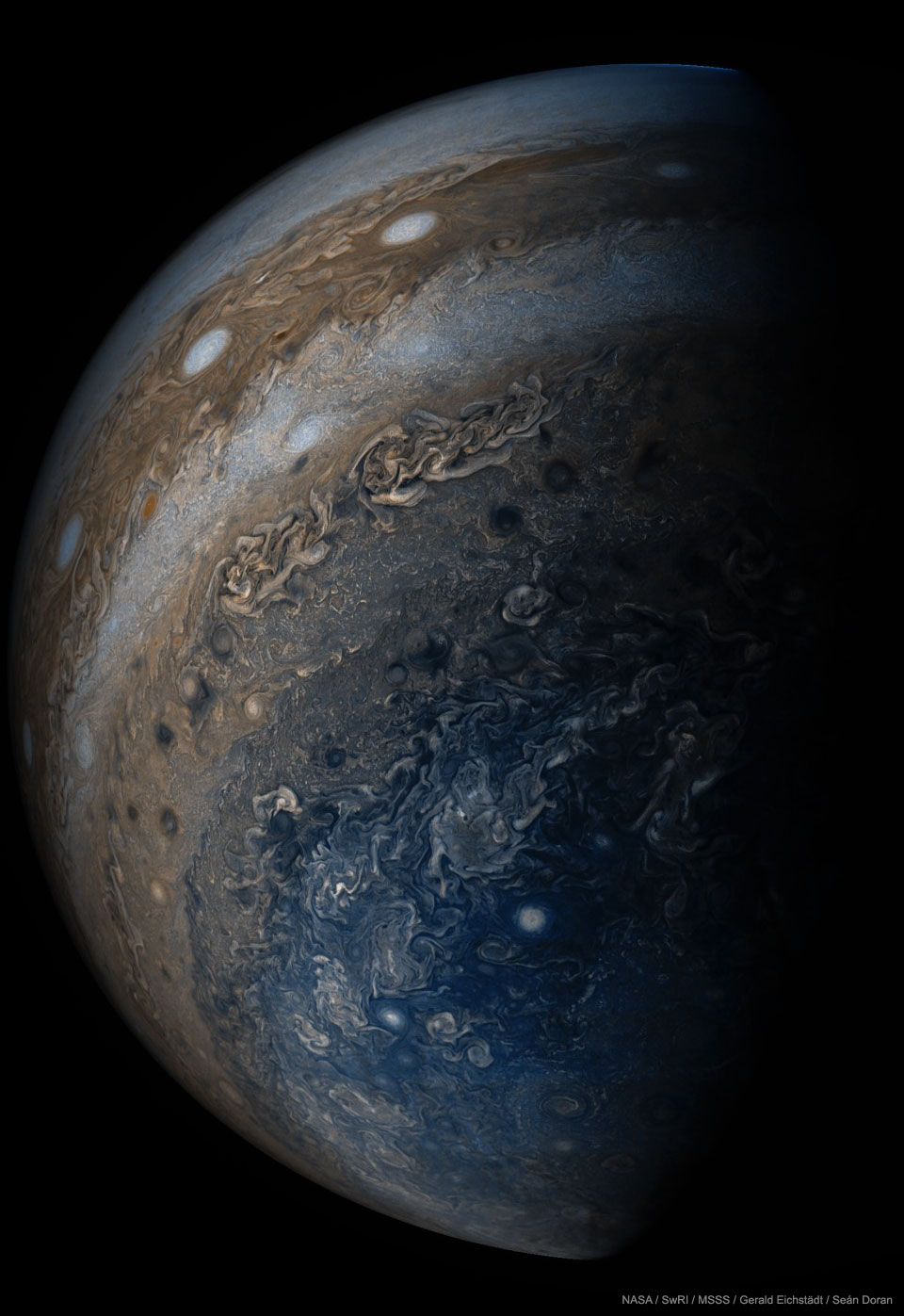
Image Credit: NASA, Juno, SwRI, MSSS, Gerald Eichstädt & Seán Doran
Explanation: Jupiter is stranger than we knew. NASA's Juno spacecraft has now completed its sixth swoop past Jupiter as it moves around its highly elliptical orbit. Pictured, Jupiter is seen from below where, surprisingly, the horizontal bands that cover most of the planet disappear into swirls and complex patterns. A line of white oval clouds is visible nearer to the equator. Recent results from Juno show that Jupiter's weather phenomena can extend deep below its cloud tops, and that Jupiter's magnetic field varies greatly with location. Juno is scheduled to orbit Jupiter 37 times with each orbit taking about six weeks.
Inscription à :
Articles (Atom)