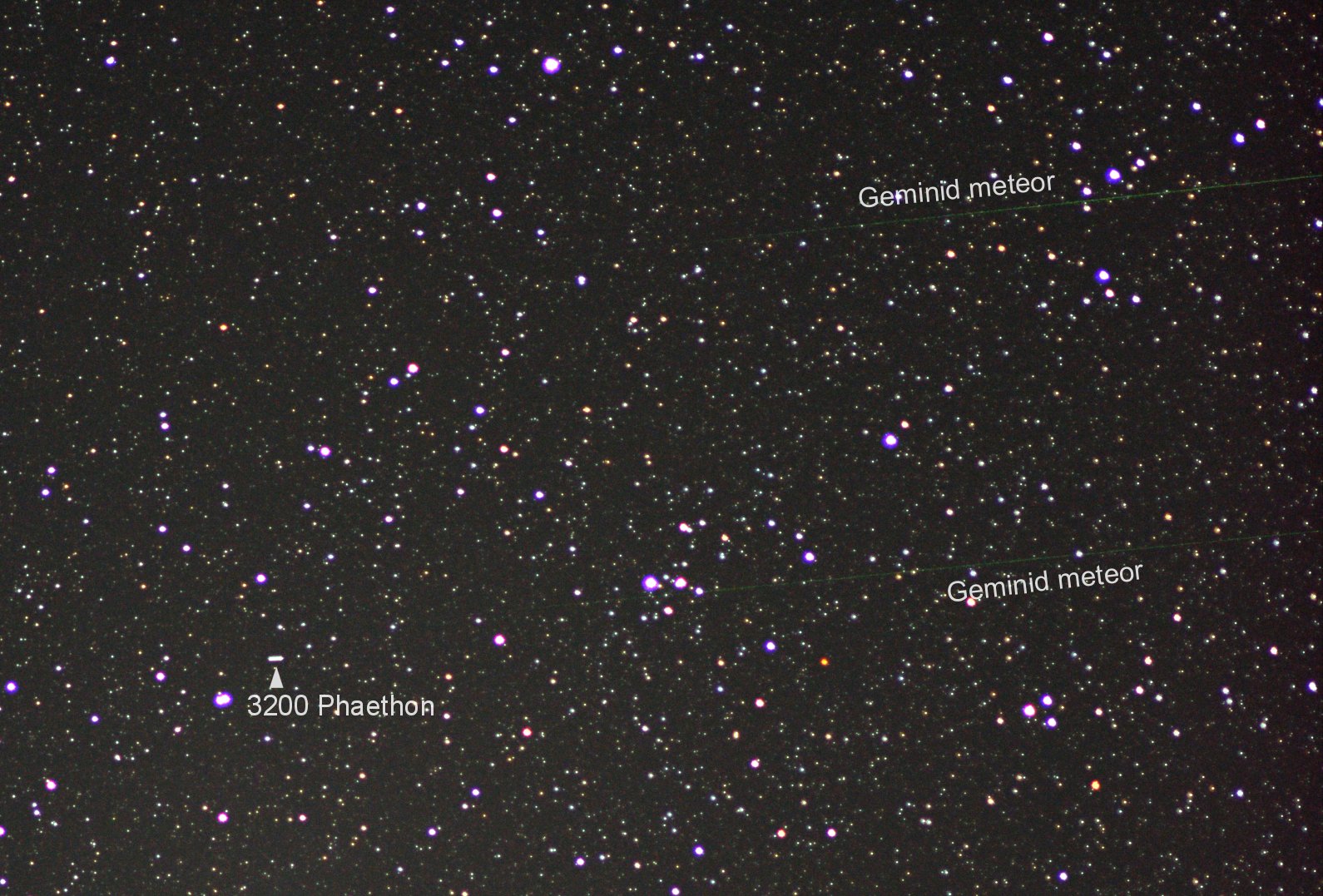
Explanation: Based on its well-measured orbit, 3200 Phaethon (sounds like FAY-eh-thon) is recognized as the source of the meteroid stream responsible for the annual Geminid meteor shower. Even though most meteor showers' parents are comets, 3200 Phaethon is a known and closely tracked near-Earth asteroid with a 1.4 year orbital period. Rocky and sun-baked, its perihelion or closest approach to the Sun is well within the orbit of innermost planet Mercury. In this telescopic field of view, the asteroid's rapid motion against faint background stars of the heroic constellation Perseus left a short trail during the two minute total exposure time. The parallel streaks of its meteoric children flashed much more quickly across the scene. The family portrait was recorded near the Geminid meteor shower's very active peak on December 13. That was just before 3200 Phaethon's historic December 16 closest approach to planet Earth.
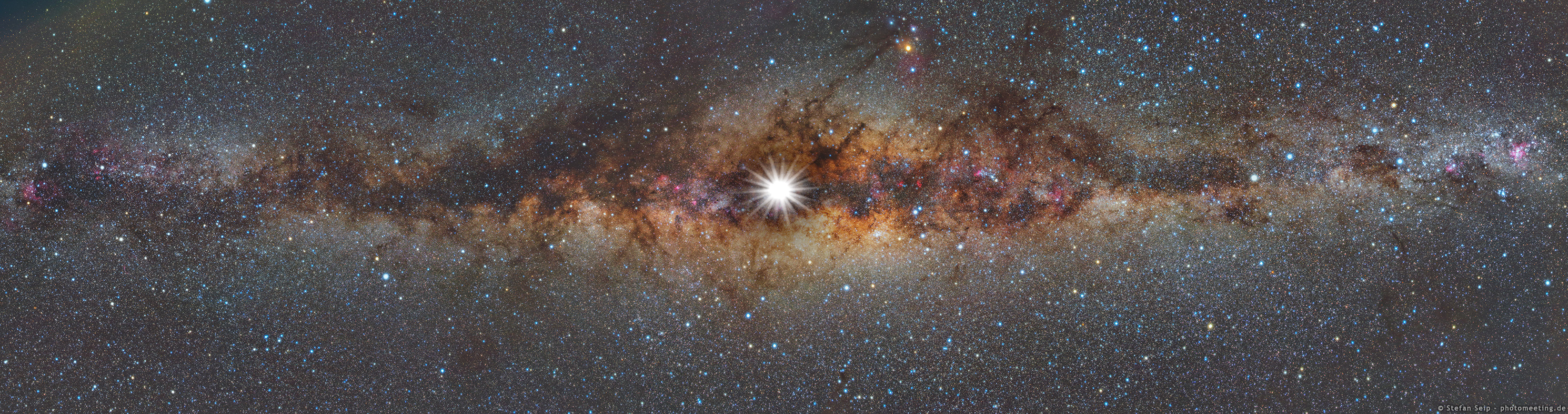
Explanation: Welcome to December's solstice, first day of winter in the north and summer for the southern hemisphere. Astronomical markers of the seasons, solstice and equinox dates are based on the Sun's place in its annual journey along the ecliptic, through planet Earth's sky. At this solstice, the Sun reaches its maximum southern declination of -23.5 degrees today at 16:28 UTC, while its right ascension coordinate on the celestial sphere is 18 hours. That puts the Sun in the constellation Sagittarius in a direction near the center of our Milky Way galaxy. In fact, if you could see today's Solstice Sun against faint background stars and nebulae (that's really hard to do, especially in the daytime ...) your view might look something like this composited panorama. To make it, images of our fair galaxy were taken under dark Namibian night skies, then stitched together in a panoramic view. From a snapshot made on December 21, 2015, the Sun was digitally overlayed as a brilliant star at today's northern winter solstice position, close to the center of the Milky Way.
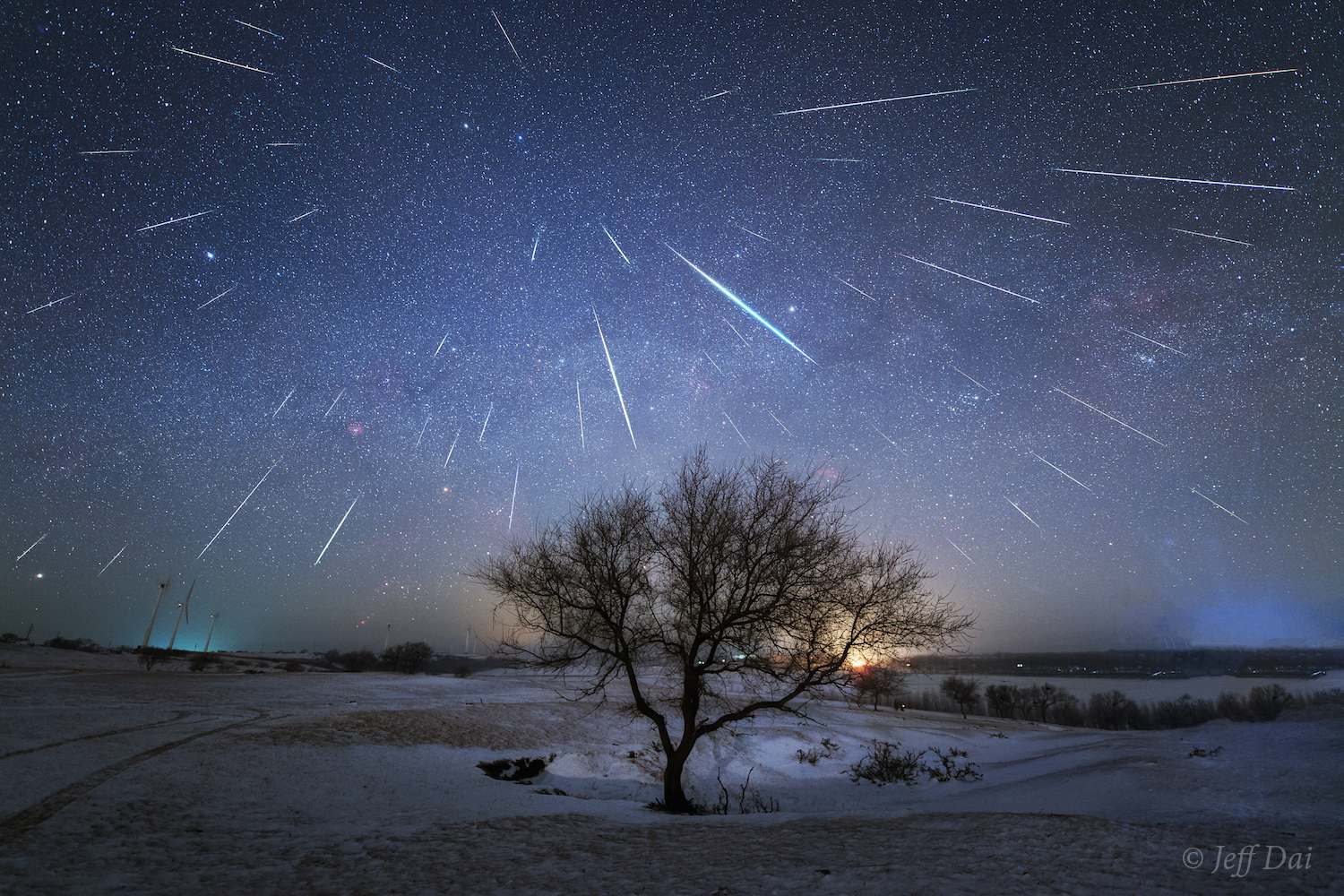
Explanation: From dark skies above Heilongjiang province in northeastern China, meteors rain down on a wintry landscape in this beautiful composited night scene. The 48 meteors are part of last week's annual Geminid meteor shower. Despite temperatures of -28 degrees C, all were recorded in camera exposures made during the peak hour of the celestial spectacle. They stream away from the shower's radiant high above the horizon near the two bright stars of the zodiacal constellation of the Twins. A very active shower, this year the December 13-14 peak of the Geminids arrived just before the December 16 closest approach of asteroid 3200 Phaethon to planet Earth. Mysterious 3200 Phaethon is the Geminid shower's likely parent body.
Explanation: How can you wash your hair in space -- without gravity? Long a bother for space-faring astronauts, Karen Nyberg, a flight engineer on the International Space Station (ISS) in 2013, gave a tutorial. Key components are a squirt package of water, no-rinse shampoo, and vigorous use of a towel and comb. Even so, the featured video shows that the whole process should take only a few minutes. Residual water will eventually evaporate from your hair, be captured by the space station's air conditioning system, and be purified into drinking water. After returning from a total of 180 days in space, Nyberg has worked for NASA in several capacities including as the Chief of Roboticsbranch.
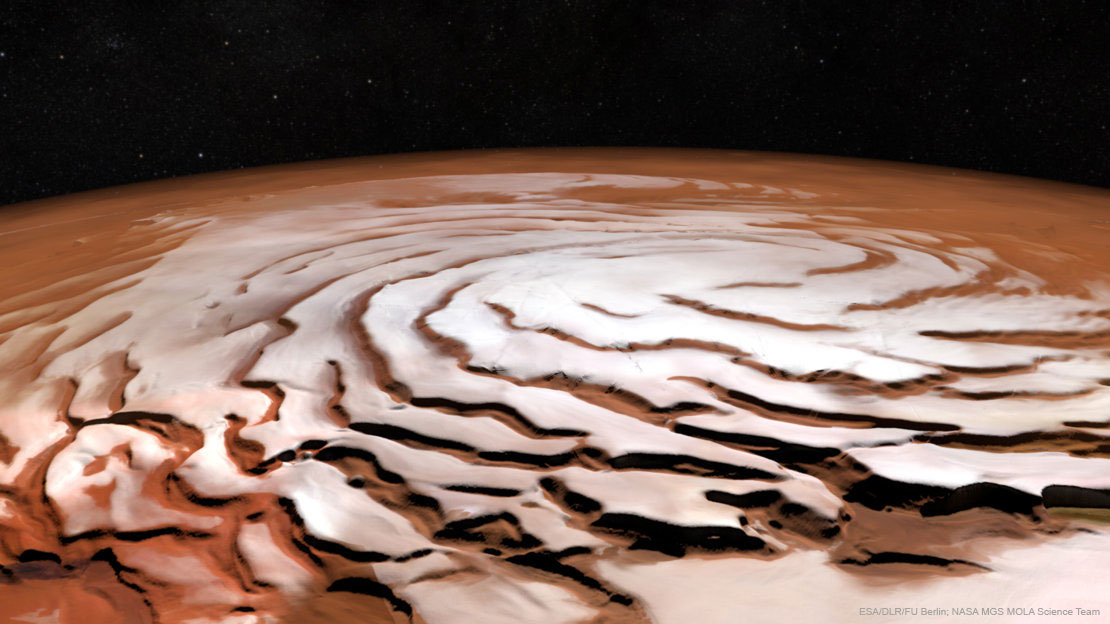
Explanation: Why is there a spiral around the North Pole of Mars? Each winter this pole develops a new outer layer about one meter thick composed of carbon dioxide frozen out of the thin Martian atmosphere. This fresh layer is deposited on a water-ice layer that exists year round. Strong winds blow down from above the cap's center and swirl due to the spin of the red planet -- contributing to Planum Boreum's spiral structure. The featured image is a perspective mosaic generated earlier this year from numerous images taken by ESA's Mars Express and elevations extracted from the laser altimeter aboard NASA's Mars Global Surveyor mission. New missions to Mars planned in the next few years include Insight with plans to drill into Mars, and ExoMars and the Mars 2020 Rover with plans to search for signs of microscopic Martian life -- past and present.
Explanation: Most galaxies have a single nucleus -- does this galaxy have four? The strange answer leads astronomers to conclude that the nucleus of the surrounding galaxy is not even visible in this image. The central cloverleaf is rather light emitted from a background quasar. The gravitational field of the visible foreground galaxy breaks light from this distant quasar into four distinct images. The quasar must be properly aligned behind the center of a massive galaxy for a mirage like this to be evident. The general effect is known as gravitational lensing, and this specific case is known as the Einstein Cross. Stranger still, the images of the Einstein Cross vary in relative brightness, enhanced occasionally by the additional gravitational microlensing effect of specific stars in the foreground galaxy.
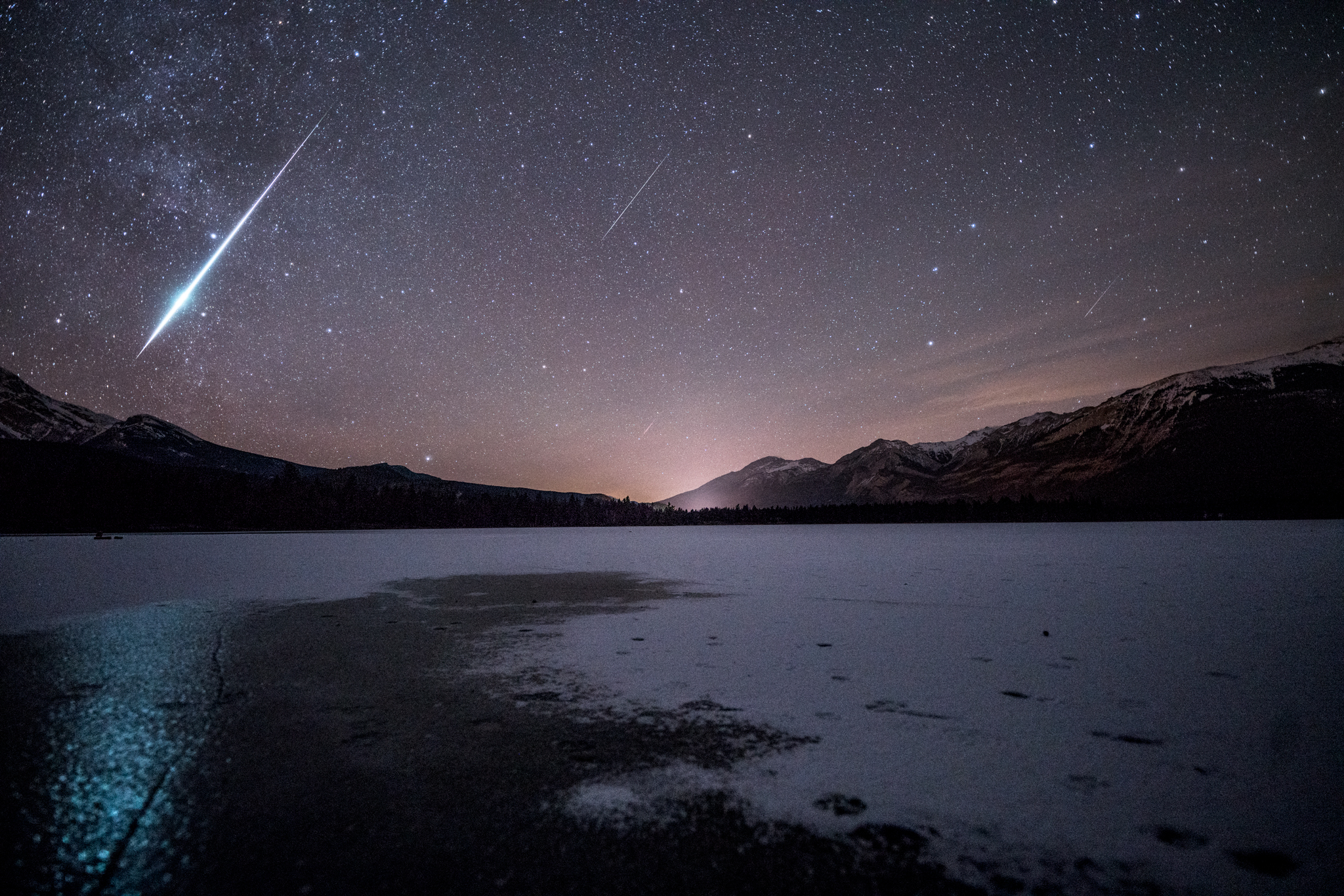
Explanation: Four Geminids flash through northern skies in this wintry night skyscape. The bright fireball and 3 fainter meteors were captured in a single 10 second exposure, near the peak of December's Geminid meteor shower. Reflecting the fireball's greenish light, a partially frozen Lake Edith in Alberta Canada's Jasper National Park lies in the foreground, with the Canadian Rocky Mountains ranging along the northern horizon. Of course, the glacial lake is cold even in summer. But photographer Jack Fusco reports that he experienced -9 degree C temperatures that night while enjoying one of the most active meteor showers he's ever seen.
Meteors over Inner Mongolia Image Credit & Copyright: Haitong Yu
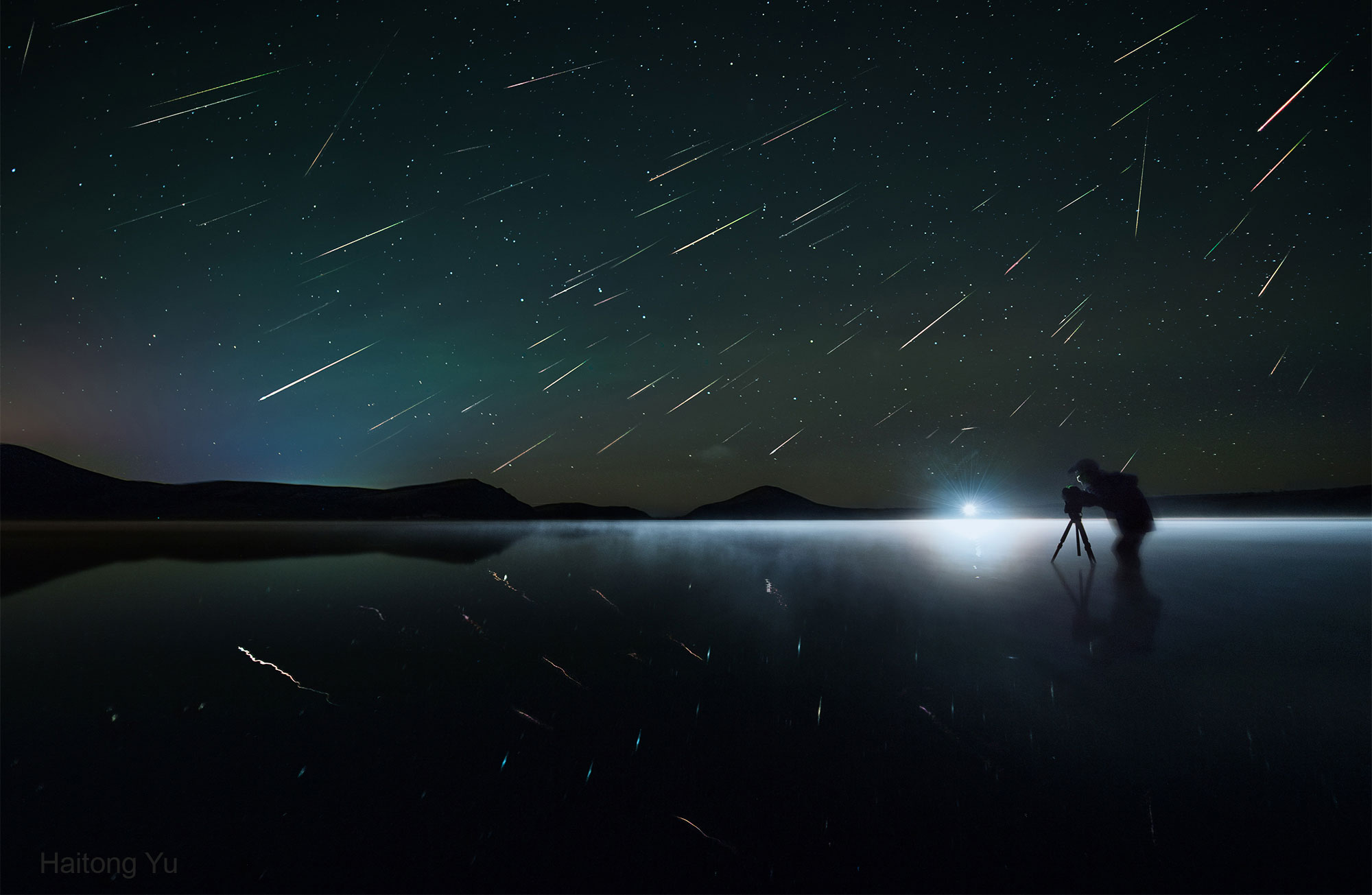
Explanation: Did you ever get caught in a meteor shower? If yes, then every minute or so the sky sparked with fleeting flashes of light. This was the fate of the pictured astrophotographer during last year's Perseids meteor shower. During the featured three-hour image composite, about 90 Perseids rained down above Lake Duolun of Inner Mongolia, China. If you trace back the meteor streaks, you will find that most of them appear to radiate from a single constellation -- in this case Perseus. In fact, you can even tell which meteors are notPerseids because they track differently. Tonight promises to be another good night to get caught in a meteor shower because it is the peak for the Geminids. Gemini, the shower radiant, should rise shortly after sunset and be visible most of the night.