2018-01-05

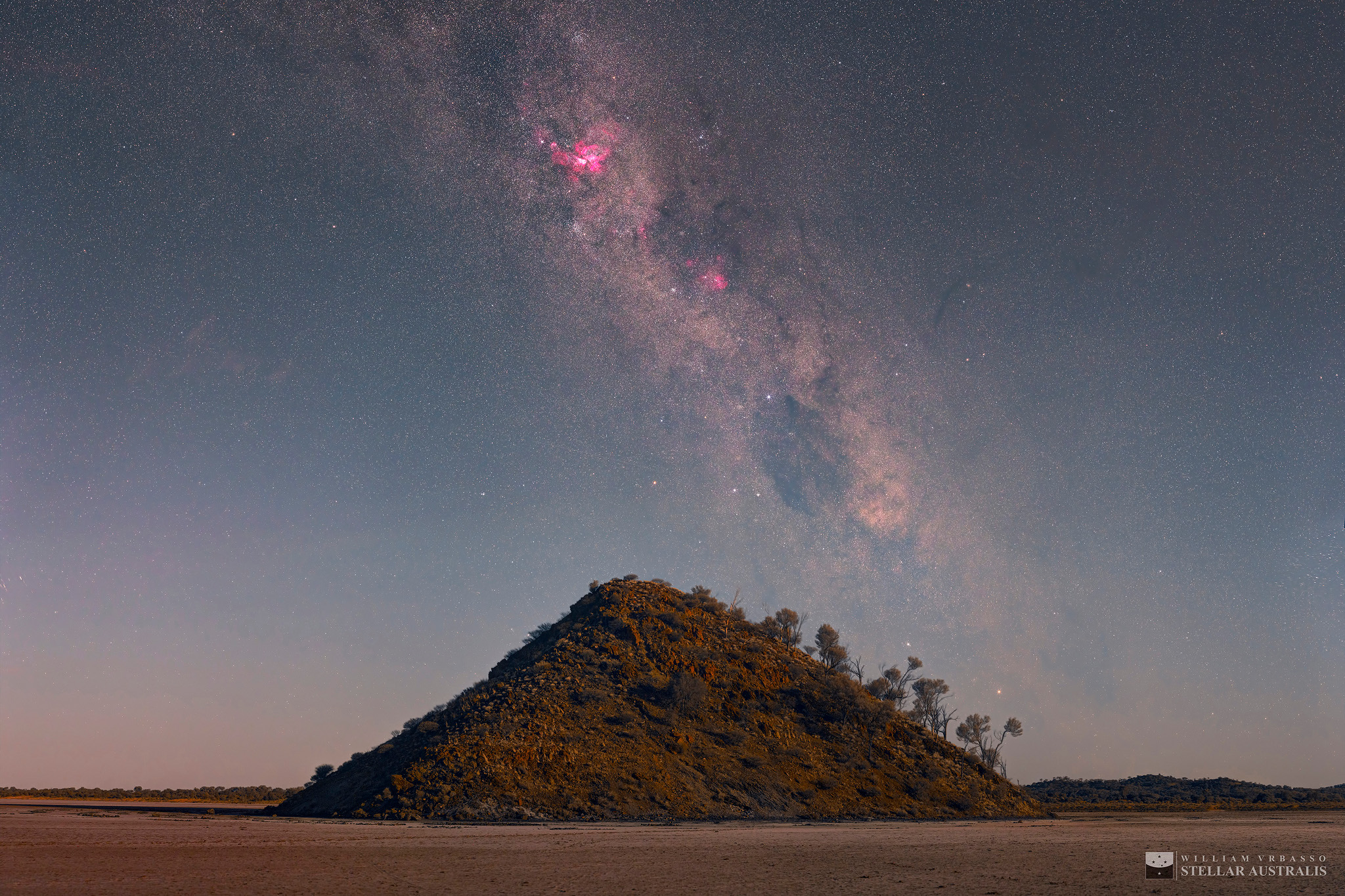
Astronomy picture of the day - 2018 January 5 - Carina over Lake Ballard

See Explanation.  Clicking on the picture will download
 the highest resolution version available.
Carina over Lake Ballard 
Image Credit & CopyrightWilliam Vrbasso
Explanation: A jewel of the southern sky, the Great Carina Nebula, also known as NGC 3372, is one of our galaxy's largest star forming regions. Easily visible to the unaided eye it stands high above the signature hill of Lake Ballard, ephemeral salt lake of Western Australia, in this serene night skyscape from December 25, 2017. The Milky Way itself stretches beyond the southern horizon. Along the Milky Way, bright stars Alpha and Beta Centauri lie just above the hill's right flank, with the Southern Cross and dark Coalsack Nebula above the hill top. Based on a 22 panel mosaic, the scene was cropped to reveal more closely the beauty of this region of the southern Milky Way. On that short summer night, a star tracking camera mount was used to record the mosaic images of the sky, but turned off to image the foreground in moonlight.

2018-01-04

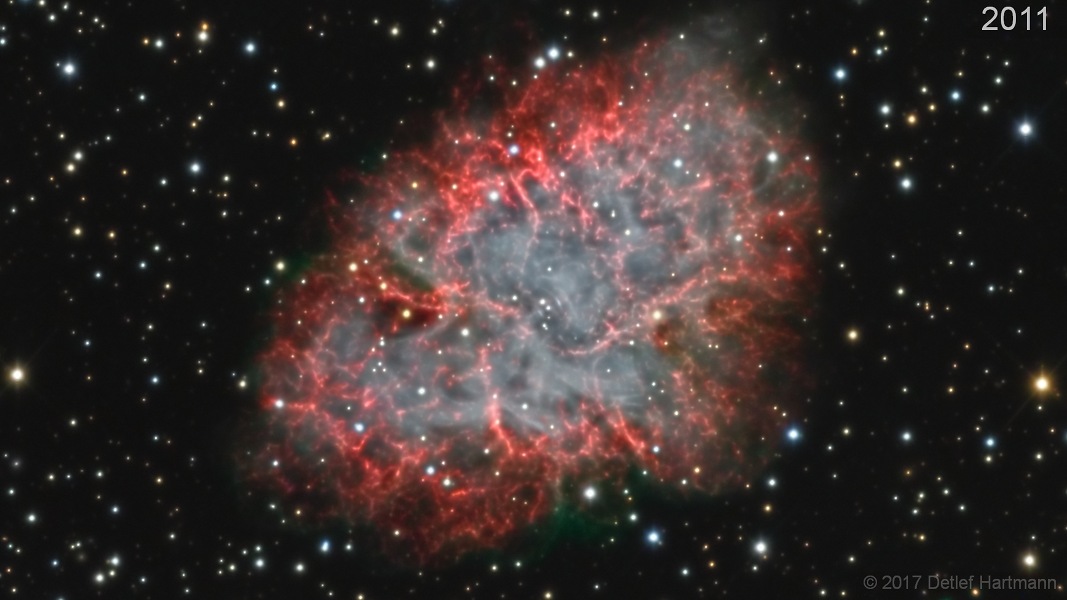
Astronomy picture of the day - 2018 January 4 - M1: The Incredible Expanding Crab

See Explanation.  Clicking on the picture will download
 the highest resolution version available.
M1: The Incredible Expanding Crab 
Image Credit & CopyrightDetlef Hartmann
Explanation: The Crab Nebula is cataloged as M1, the first on Charles Messier's famous list of things which are not comets. In fact, the Crab is now known to be a supernova remnant, an expanding cloud of debris from the explosion of a massive star. The violent birth of the Crab was witnessed by astronomers in the year 1054. Roughly 10 light-years across today, the nebula is still expanding at a rate of over 1,000 kilometers per second. Over the past decade, its expansion has been documented in this stunning time-lapse movie. In each year from 2008 to 2017, an image was produced with the same telescope and camera from a remote observatory in Austria. Combined in the time-lapse movie, the 10 images represent 32 hours of total integration time. The sharp, processed frames even reveal the dynamic energetic emission within the incredible expanding Crab. The Crab Nebula lies about 6,500 light-years away in theconstellation Taurus.

2018-01-03

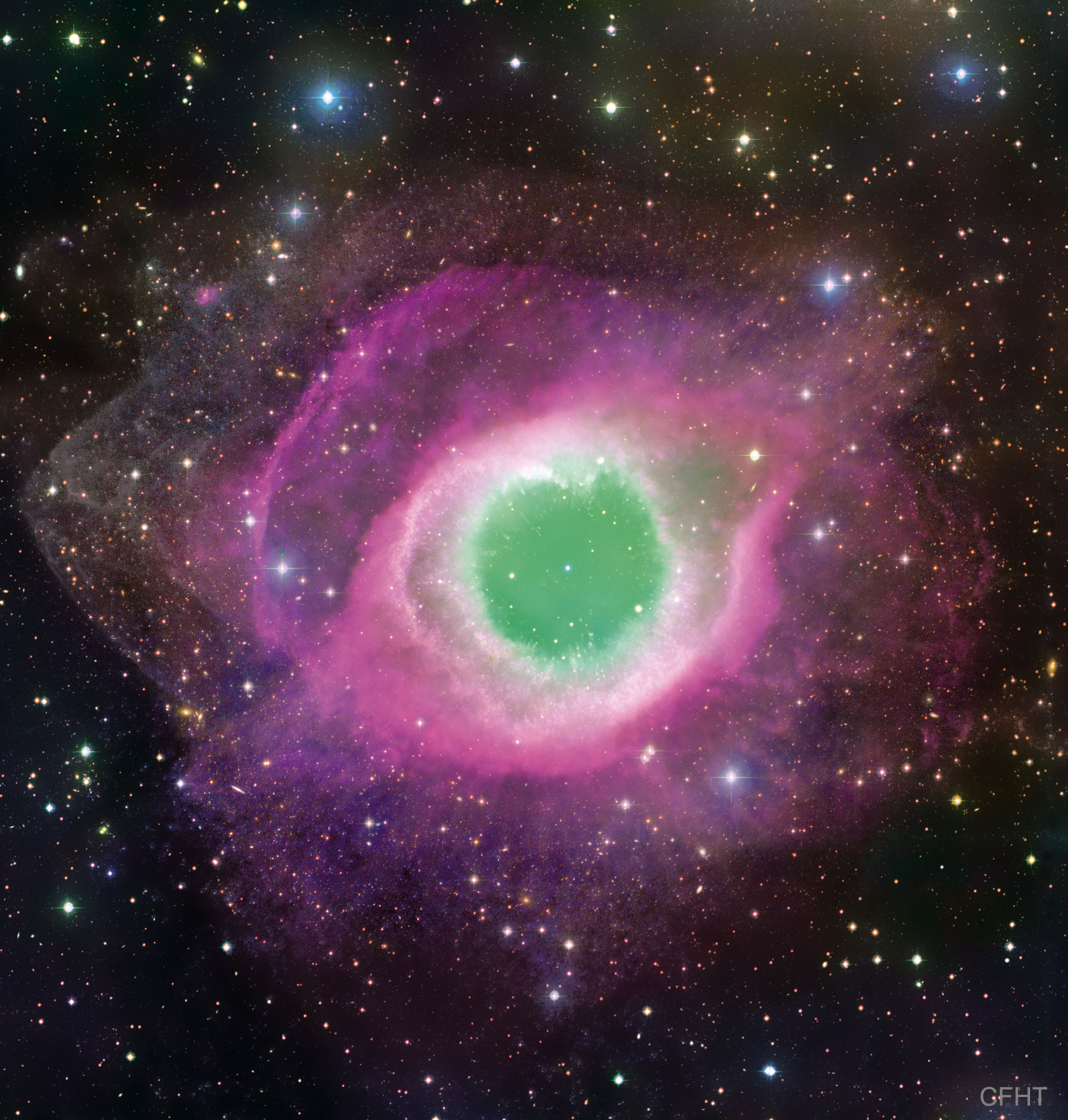
Astronomy picture of the day - 2018 January 3 - The Helix Nebula from CFHT

See Explanation.  Clicking on the picture will download
 the highest resolution version available.
The Helix Nebula from CFHT 
Image Credit: CFHTCoelumMegaCamJ.-C. Cuillandre (CFHT) & G. A. Anselmi (Coelum)
Explanation: Will our Sun look like this one day? The Helix Nebula is one of brightest and closest examples of a planetary nebula, a gas cloud created at the end of the life of a Sun-like star. The outer gasses of the star expelled into space appear from our vantage point as if we are looking down a helix. The remnant central stellar core, destined to become a white dwarf star, glows in light so energetic it causes the previously expelled gas to fluoresce. The Helix Nebula, given a technical designation of NGC 7293, lies about 700 light-years away towards the constellation of the Water Bearer (Aquarius) and spans about 2.5 light-years. The featured picture was taken with the Canada-France-Hawaii Telescope (CFHT) located atop a dormant volcano in HawaiiUSA. A close-up of the inner edge of the Helix Nebula shows complex gas knots of unknown origin.

2018-01-01

Astronomy picture of the day - 2018 January 1 - Sun Halo over Sweden

Sun Halo over Sweden 
Video Credit & Copyright: Håkan Hammar (Vemdalen Ski ResortSkiStar)
Explanation: What's happened to the Sun? Sometimes it looks like the Sun is being viewed through a giant lens. In the featured video, however, there are actually millions of tiny lenses: ice crystals. Water may freeze in the atmosphereinto small, flat, six-sided, ice crystals. As these crystals flutter to the ground, much time is spent with their faces flat and parallel to the ground. An observer may find themselves in the same plane as many of the falling ice crystals near sunrise or sunset. During this alignment, each crystal can act like a miniature lens, refracting sunlight into our view and creating phenomena like parhelia, the technical term for sundogs. The featured video was taken a month ago on the side of a ski hill at the Vemdalen Ski Resort near StockholmSweden. Visible in the center is the most direct image of the Sun, while two bright sundogs glow prominently from both the left and the right. Also visible is the bright 22 degree halo -- as well as the rarer and much fainter 46 degree halo -- also created by sunlight reflecting off of atmospheric ice crystals.

2017-12-30

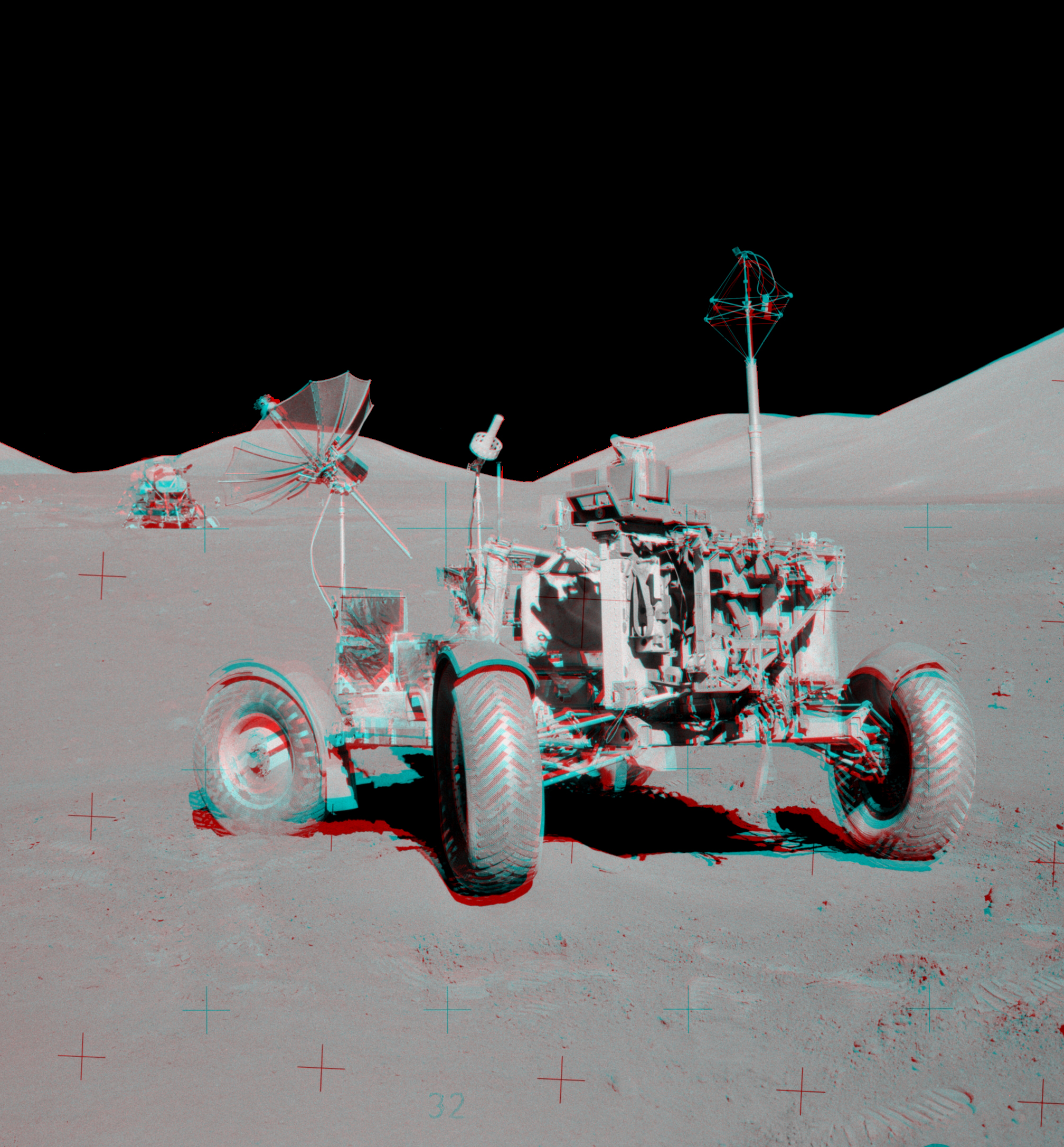
Astronomy picture of the day - 2017 December 30 - Apollo 17 VIP Site Anaglyph

See Explanation.  Clicking on the picture will download
 the highest resolution version available.
Apollo 17 VIP Site Anaglyph 
Image Credit: Gene CernanApollo 17NASA; Anaglyph by Erik van Meijgaarden
Explanation: Get out your red/blue glasses and check out this stereo scene from Taurus-Littrow valley on the Moon! The color anaglyph features a detailed 3D view of Apollo 17's Lunar Rover in the foreground -- behind it lies the Lunar Module and distant lunar hills. Because the world was going to be able to watch the Lunar Module's ascent stage liftoff via the rover's TV camera, this parking place was also known as the VIP Site. In December of 1972, Apollo 17 astronauts Eugene Cernan and Harrison Schmitt spent about 75 hours on the Moon, while colleague Ronald Evans orbited overhead. The crew returned with 110 kilograms of rock and soil samples, more than from any of the other lunar landing sites. Cernan and Schmitt are still the last to walk (or drive) on the Moon.

Salvador Sobral - "Boas festas venho desejar-te" - Video - Musica - Ao vivo

"Boas festas venho desejar-te"