2015-03-18

Foto - "Pilar para a saida" - Aufrery - France - 18-03-2015

"Pilar para a saida"

Aufrery, 18-03-2015
JoanMira

Astronomy picture of the day - 18-03-2015 - Earth During a Total Eclipse of the Sun

See Explanation.  Clicking on the picture will download
 the highest resolution version available.
Earth During a Total Eclipse of the Sun 
Image Credit: Expedition 12 CrewNASA
Explanation: What does the Earth look like during a total solar eclipse? It appears dark in the region where people see the eclipse, because that's where the shadow of the Moon falls. The shadow spot actually shoots across the Earth at nearly 2,000 kilometers per hour, darkening locations in its path for only a few minutes before moving on. The featured image shows the Earth during the total solar eclipse of 2006 March, as seen from the International Space Station. On Friday the Moon will move in front of the Sun once again, casting another distorted circular shadow that, this time, will zip over part of the north Atlantic Ocean.

2015-03-17

Aconteceu a 17 de março de...1939 - O Pacto Ibérico


A 17 de Março de 1939, é assinado, em Lisboa, o Pacto Ibérico, um tratado de amizade e não-agressão entre Portugal e Espanha. Foram subscritores deste tratado, por parte de Portugal, António de Oliveira Salazar, que acumulava as funções de chefe do Governo e de Ministro dos Negócios estrangeiros e, por parte de Espanha, o embaixador Don Nicolás Franco, irmão de Francisco Franco.
Don Nicolás Franco foi um dos principais instigadores do golpe de estado de 17 e 18 de Julho de 1936, que haveria de dar início à chamada Guerra Civil Espanhola. Como embaixador em Lisboa, Nicolás obteve, da parte de Salazar, ajuda material para o Movimento Nacional liderado por Francisco Franco assim como a sua colaboração para a detenção de republicanos que atravessassem a fronteira entre os dois países ibéricos. Na altura da assinatura deste tratado, o conflito estava prestes a terminar: a 1 de Abril de 1939, com a vitória dos auto-denominados nacionalistas ou Movimiento Nacional, Franco passou a desempenhar as funções de Regente do Reino, proclamando-se Caudilho de Espanha pela graça de Deus.

José Malhoa - "Jovens Músicos", 1891. - (Grandes Pintores Portugueses)

José Malhoa Nascido em 1855, foi um grande pintor, desenhista e professor da Língua Portuguesa. Estudou na escola de Belas Artes de Lisboa. Seu primeiro trabalho como pintor foi pintar o teto da sala de concerto no Conservatório Real de Lisboa. Mais tarde, também pintouo teto da sala do Supremo Tribunal de Justiça de Lisboa, o teto da sala de jantar do palácio do Sr. Conde de Burnay e o dos aposentos do senhor infante D. Afonso. É o artista português que mais se aproximou do Impressionismo, embora tenha sido o grande pioneiro do naturalismo. Realizou exposições em diversos pontos da Europa como Madrid, Paris, e também no Brasil. Malhoa alcança um novo recorde a 26 de Julho de 2007, na Christie’s de Londres, com o quadro naturalista Jóvens Músicos adjudicada por 445,560 euros.
Jovens Musicos, 1891, Jose MalhoaJovens Músicos, 1891, José Malhoa

Foto - "Arvoredo magico" - Aufrery - France - 17-03-2015

"Arvoredo magico"

Aufrery, 17-03-2015
JoanMira

Foto - "A luz da manhã" - Aufrery - France - 17-03-2015

"A luz da manhã"

Aufrery, 17-03-2015
JoanMira 

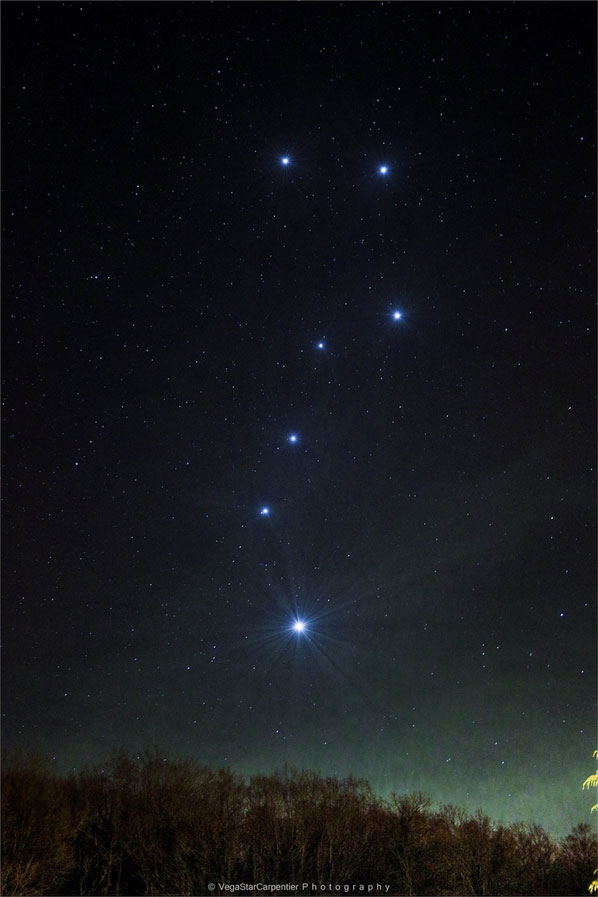
Astronomy picture of the day - 17-03-2015 - The Big Dipper Enhanced

See Explanation.
Moving the cursor over the image will bring up an annotated version.
Clicking on the image will bring up the highest resolution version
available.
The Big Dipper Enhanced 
Image Credit & Copyright: VegaStar Carpentier
Explanation: Do you see it? This common question frequently precedes the rediscovery of one of the most commonly recognized configurations of stars on the northern sky: the Big Dipper. This grouping of stars is one of the few things that has likely been seen, and will be seen, by every human generation. In this featured image, however, the stars of the Big Dipper have been digitally enhanced -- they do not really appear this much brighter than nearby stars. The image was taken earlier this month from France. The Big Dipper is not by itself a constellation. Although part of the constellation of the Great Bear (Ursa Major), the Big Dipper is an asterism that has been known by different names to different societies. Five of the Big Dipper stars are actually near each other in space and were likely formed at nearly the same time. Relative stellar motions will cause the Big Dipper to slowly change its apparent configurationover the next 100,000 years.

2015-03-16

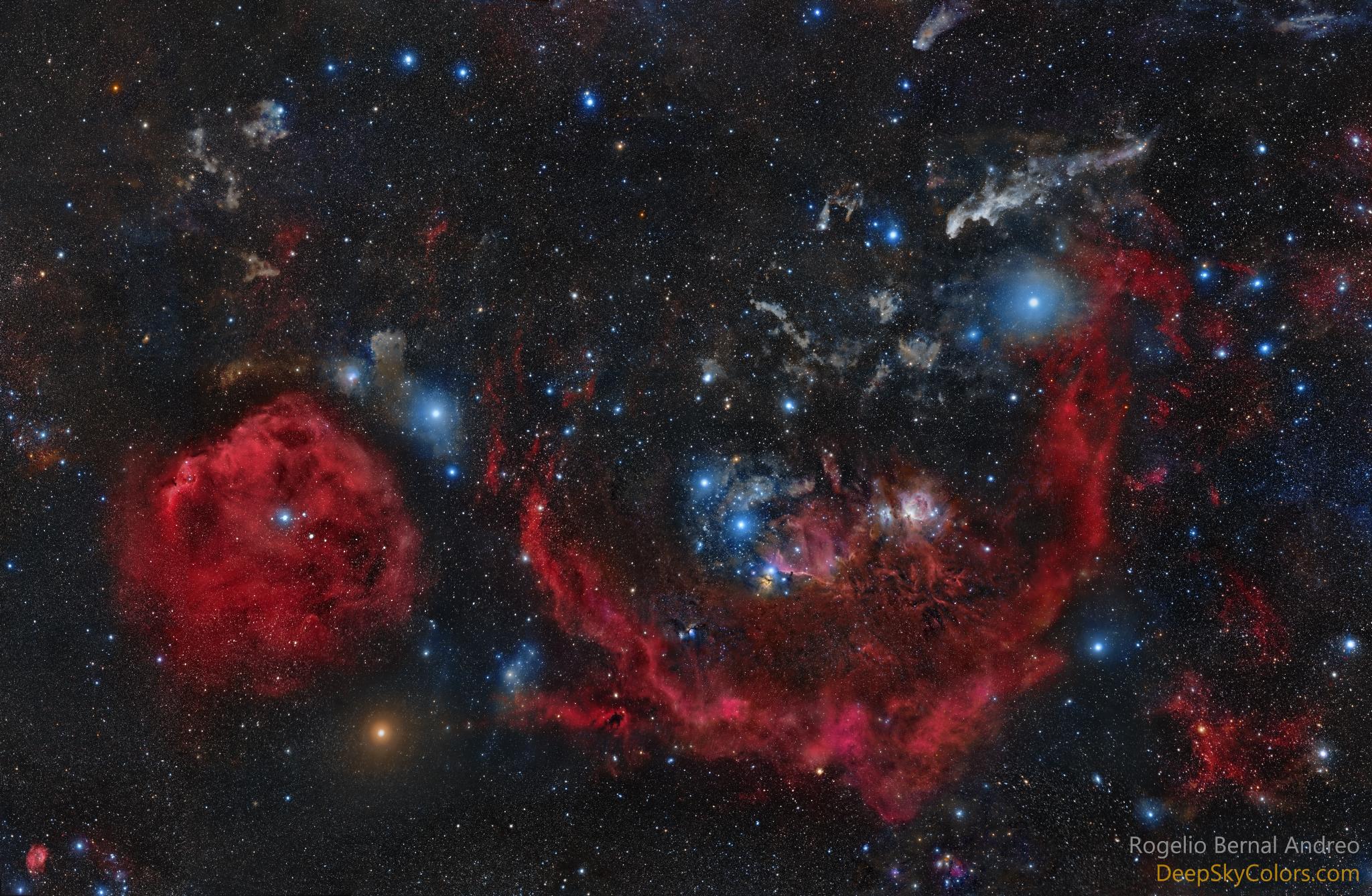
Astronomy picture of the day - 16-03-2015 - The Clouds of Orion the Hunter

See Explanation.
Moving the cursor over the image will bring up an annotated version.
Clicking on the image will bring up the highest resolution version
available.
The Clouds of Orion the Hunter 
Image Credit & Copyright: Rogelio Bernal Andreo
Explanation: Cradled in cosmic dust and glowing hydrogen, stellar nurseries in Orion the Hunter lie at the edge of giant molecular clouds some 1,500 light-years away. Spanning about 30 degrees, this breath-taking vista stretches across the well-known constellation from head to toe (left to right) and beyond. At 1,500 light years away, the Great Orion Nebula is the closest large star forming region, here visible just right and below center. To its left are theHorsehead NebulaM78, and Orion's belt stars. Sliding your cursor over the picture will also find red giant Betelgeuse at the hunter's shoulder, bright blue Rigel at his foot, the Witch Head Nebula above -- and illuminated by -- Rigel, and the glowing Lambda Orionis (Meissa) nebula on the left, near Orion's head. Of course, the Orion Nebula and bright stars are easy to see with the unaided eye, but dust clouds and emission from the extensive interstellar gas in thisnebula-rich complex, are too faint and much harder to record. In this mosaic of broadband telescopic images, additional image data acquired with a narrow hydrogen alpha filter was used to bring out the pervasive tendrils of energized atomic hydrogen gas like in the arc of the giant Barnard's Loop.

2015-03-15

Pintura - Paulo Santos - "Aldeia encantada" - 15-03-2015

"Aldeia encantada"

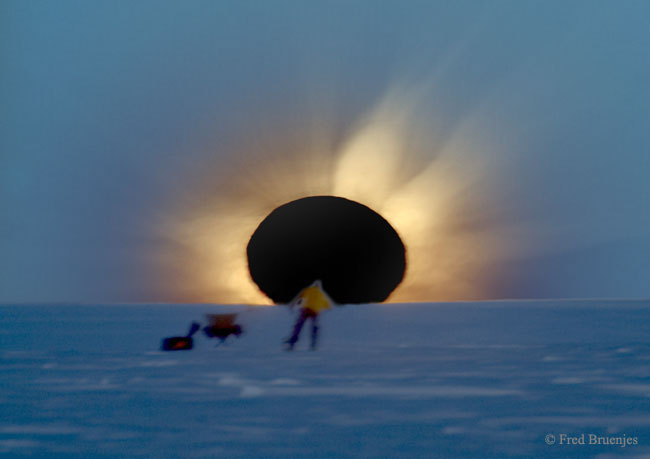
Astronomy picture of the day - 15-03-2015 - A Total Eclipse at the End of the World

See Explanation.  Clicking on the picture will download
 the highest resolution version available.
A Total Eclipse at the End of the World 
Image Credit & Copyright: Fred Bruenjes (moonglow.net)
Explanation: Would you go to the end of the world to see a total eclipse of the Sun? If you did, would you be surprised to find someone else there already? In 2003, the Sun, the Moon, Antarctica, and two photographers all lined up in Antarctica during an unusual total solar eclipse. Even given the extreme location, a group of enthusiastic eclipse chasers ventured near the bottom of the world to experience the surreal momentary disappearance of the Sun behind the Moon. One of the treasures collected was the above picture -- a composite of four separate images digitally combined to realistically simulate how the adaptive human eye saw the eclipse. As the image was taken, both the Moon and the Sun peaked together over an Antarctic ridge. In the sudden darkness, the magnificent corona of the Sun became visible around the Moon. Quite by accident, another photographer was caught in one of the images checking his video camera. Visible to his left are an equipment bag and a collapsible chair. A total solar eclipse will occur on Friday and be visible from the north Atlantic Ocean.