2017-09-26

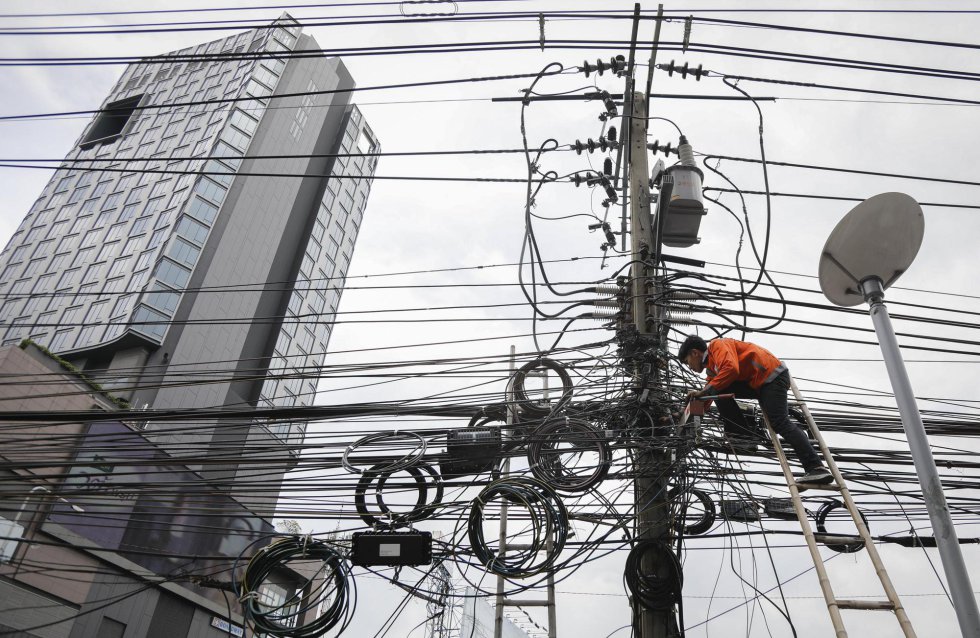
Imagens do Mundo - Trabalhador retira cabos elétricos numa rua de Banguecoque, Tailândia.

Un trabajador retira algunos cables de electricidad de una calle de Bangkok (Tailandia). El gobierno tailandés aprobó en 2016 un presupuesto para hacer subterráneos los cables de electricidad de la ciudad de Bangkok, con la intención de prevenir accidentes y mejorar la aparicencia de la ciudad.

Trabalhador retira cabos elétricos numa rua de Banguecoque, Tailândia.
DIEGO AZUBEL EFE

Imagens do Mundo - Policia militar na favela da Rocinha - Rio de Janeiro, Brasil

La policía militar del ejército brasileño patrulla a lo largo de un callejón en la favela de Rocinha, en Río de Janeiro (Brasil). Funcionarios de seguridad aseguran que la favela Rocinha vuelve a estar bajo control después de que cientos de soldados y policías fueran enviados a combatir traficantes de drogas armados.
"Favela da Rocinha, Rio de Janeiro"

Imagens do Mundo - Funâmbulo em Praga

Un funambulista hace equilibrios sobre una cuerda floja en la Plaza de la Ciudad Vieja de Praga (República Checa).
Funâmbulo em equilíbrio na corda bamba na praça da cidade velha de Praga (República Checa).
MARTIN DIVISEK EFE

Imagens do Mundo - Vulcão Agung, Indonésia

Un hombre observa el volcán Agung, cubierto de nubes, desde un templo de Karangasem (Indonesia).
Homem observa o vulcão Agung, coberto de nuvens, desde um templo de Karangasem (Indonesia).

FIRDIA LISNAWATI AP

Astronomy picture of the day - 2017 September 26 - Cassini's Last Ring Portrait at Saturn

See Explanation.  Clicking on the picture will download
 the highest resolution version available.
Cassini's Last Ring Portrait at Saturn 
Image Credit: NASAJPL-CaltechSpace Science InstituteMindaugas Macijauskas
Explanation: How should Cassini say farewell to Saturn? Three days before plunging into Saturn's sunny side, the robotic Cassini spacecraft swooped far behind Saturn's night side with cameras blazing. Thirty-six of these images have been merged -- by an alert and adept citizen scientist -- into a last full-ring portrait of Cassini's home planet for the past 13 years. The Sun is just above the frame, causing Saturn to cast a dark shadow onto its enormous rings. This shadow position cannot be imaged from Earth and will not be visible again until another Earth-launched spaceship visits the ringed giant. Data and images from Cassini's mission-ending dive into Saturn's atmosphere on September 15 continue to be analyzed.

2017-09-25

Sitios lindos de Portugal - Junto ao Museu de Evora

Fotos Evora
"Junto ao Museu de Evora"

Imagens do Mundo - Festival Durga Puja - Calcuta, India

Un artesano pinta una escultura, antes del comienzo del festival Durga Puja, en Calcuta (India).
Um artesão pinta uuma escultura, antes do começo do festival Durga Puja, em Calcuta (India).
RUPAK DE CHOWDHURI REUTERS

Astronomy picture of the day - 2017 September 25 - Massive Shell-Expelling Star G79.29+0.46

See Explanation.  Clicking on the picture will download
 the highest resolution version available.
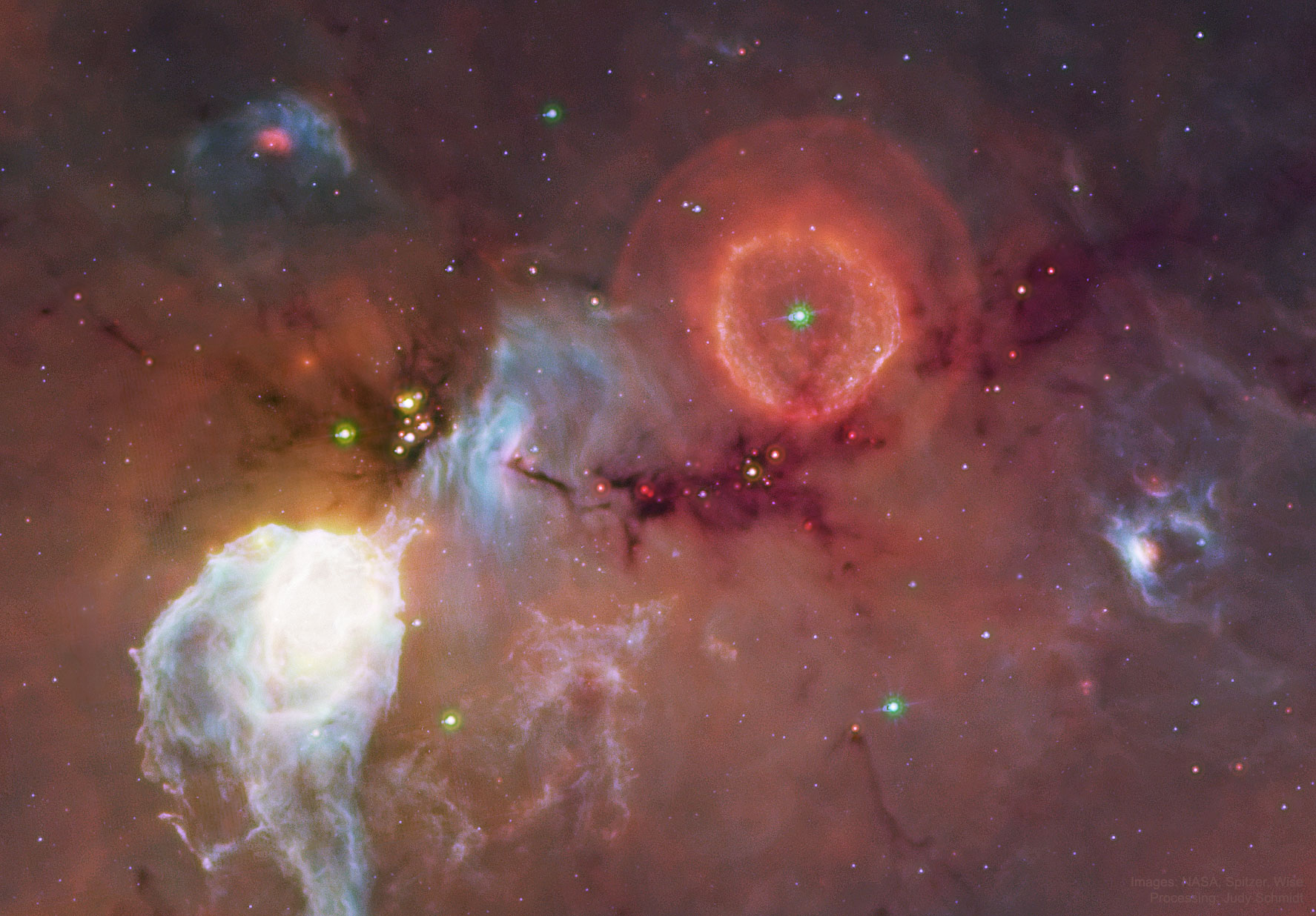
Massive Shell-Expelling Star G79.29+0.46 
Image Credit: NASASpitzer Space TelescopeWISEProcessing & License Judy Schmidt
Explanation: Stars this volatile are quite rare. Captured in the midst of dust clouds and visible to the right and above center is massive G79.29+0.46, one of less than 100 luminous blue variable stars (LBVs) currently known in our Galaxy. LBVs expel shells of gas and may lose even the mass of Jupiter over 100 years. The star, itself bright and blue, is shrouded in dust and so not seen in visible light. The dying star appears green and surrounded by red shells, though, in this mapped-color infrared picture combining images from NASA's Spitzer Space Observatory and NASA's Wide-Field Infrared Survey Explorer. G79.29+0.46 is located in the star-forming Cygnus X region of our Galaxy. Why G79.29+0.46 is so volatile, how long it will remain in the LBV phase, and when it will explode in a supernova is not known.

2017-09-24

Astronomy picture of the day - 2017 September 24 - How to Identify that Light in the Sky

See Explanation.  Clicking on the picture will download
 the highest resolution version available.
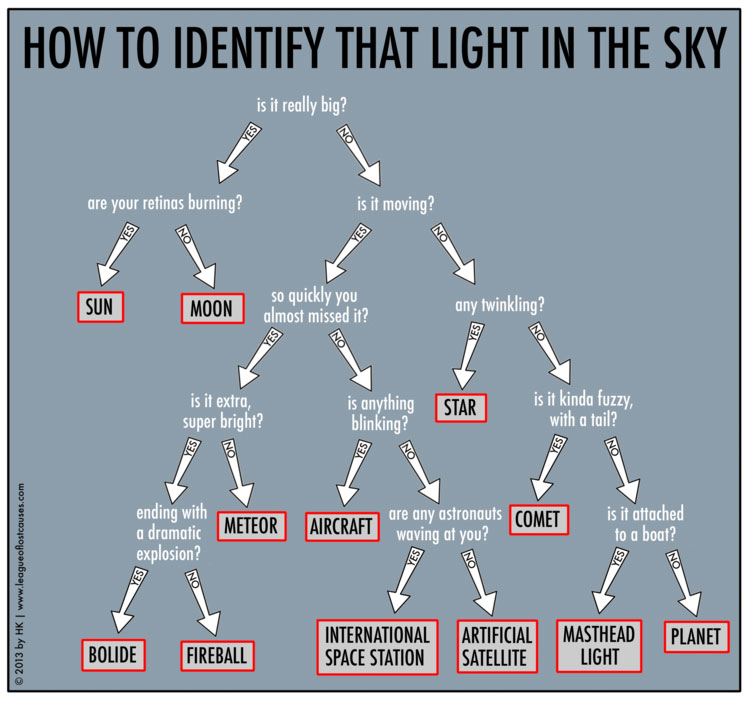
How to Identify that Light in the Sky 
Image Credit & Copyright: HK (The League of Lost Causes)
Explanation: What is that light in the sky? Perhaps one of humanity's more common questions, an answer may result from a few quick observations. For example -- is it moving or blinking? If so, and if you live near a city, the answer is typically an airplane, since planes are so numerous and so few stars and satellites are bright enough to be seen over the din of artificial city lights. If not, and if you live far from a city, that bright light is likely a planet such as Venus orMars -- the former of which is constrained to appear near the horizon just before dawn or after dusk. Sometimes the low apparent motion of a distant airplane near the horizon makes it hard to tell from a bright planet, but even this can usually be discerned by the plane's motion over a few minutes. Still unsure? The featured chart gives a sometimes-humorous but mostly-accurate assessment. Dedicated sky enthusiasts will likely note -- and are encouraged to provide -- polite corrections.