Explanation: Seen as a seagull and a duck, these nebulae are not the only cosmic clouds to evoke images of flight. But both are winging their way across this broad celestial landscape, spanning almost 7 degrees across planet Earth's night sky toward the constellation Canis Major. The expansive Seagull (top center) is itself composed of two major cataloged emission nebulae. Brighter NGC 2327 forms the head with the more diffuse IC 2177 as the wings and body. Impressively, the Seagull's wingspan would correspond to about 250 light-years at the nebula's estimated distance of 3,800 light-years. At the lower right, the Duck appears much more compact and would span only about 50 light-years given its 15,000 light-year distance estimate. Blown by energetic winds from an extremely massive, hot star near its center, the Duck nebula is cataloged as NGC 2359. Of course, the Duck's thick body and winged appendages also lend it the slightly more dramatic popular moniker, Thor's Helmet.
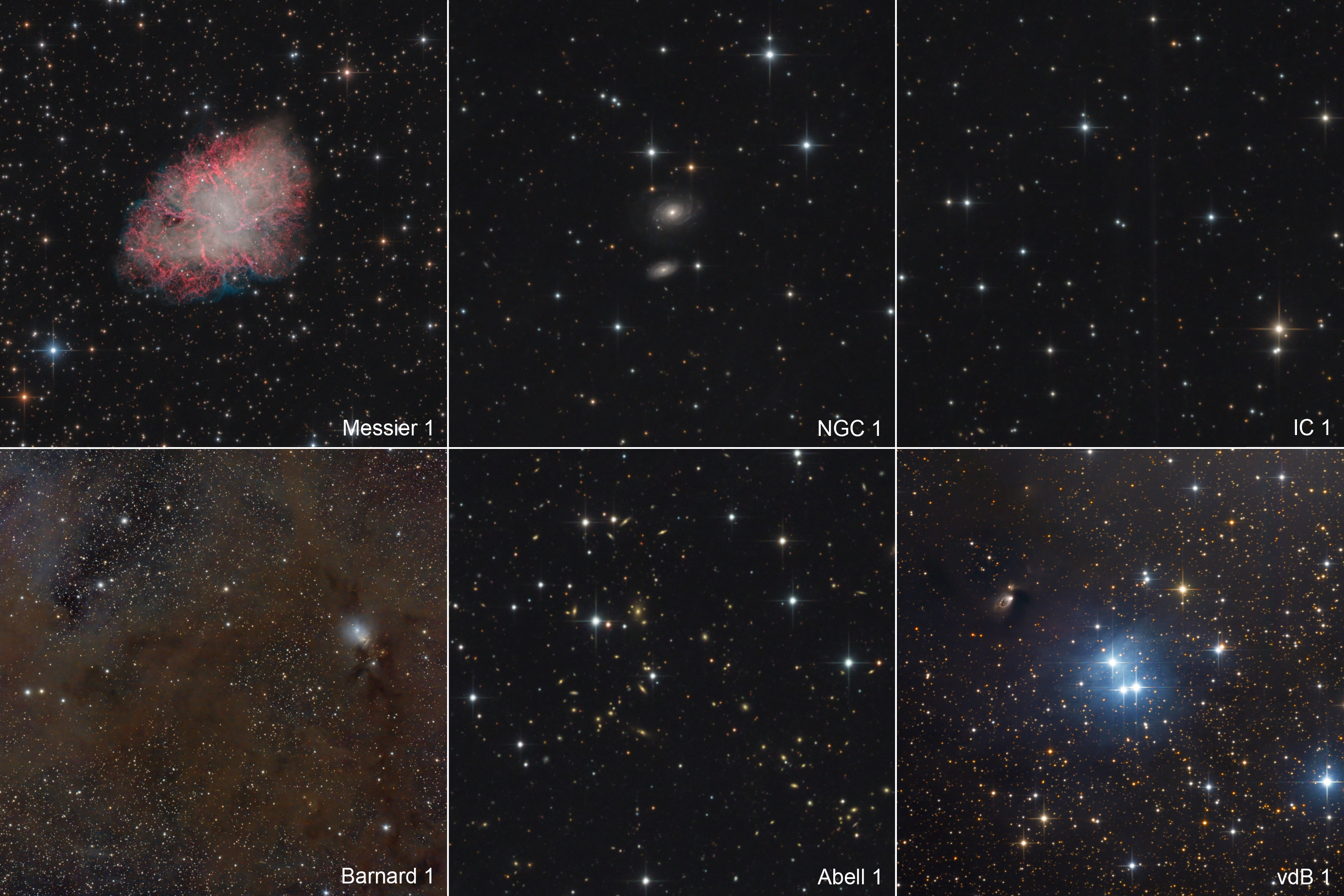
Explanation: Every journey has first step and every catalog a first entry. First entries in six well-known deep sky catalogs appear in these panels, from upper left to lower right in chronological order of original catalog publication. From 1774, Charles Messier's catalog entry number 1 is M1, famous cosmic crustacean and supernova remnant the Crab Nebula. J.L.E. Dreyer's (not so new) New General Catalog was published in 1888. A spiral galaxy in Pegasus, his NGC 1 is centered in the next panel. Just below it in the frame is another spiral galaxy cataloged as NGC 2. In Dreyer's follow-on Index Catalog (next panel), IC 1 is actually a faint double star, though. Now recognized as part of the Perseus molecular cloud complex, dark nebula Barnard 1 begins the bottom row from Dark Markings of the Sky, a 1919 catalog by E.E. Barnard. Abell 1 is a distant galaxy cluster in Pegasus, from George Abell's 1958 catalog of Rich Clusters of Galaxies. The final panel is centered on vdB 1, from Sidney van den Bergh's 1966 study. The pretty, blue galactic reflection nebula is found in the constellation Cassiopeia.
L’astrophysicien britannique, spécialiste des trous noirs, est mort aujourd'hui à 76 ans. Scientifiques mais aussi responsables scientifiques lui rendent hommage.
« Un être unique, dont on se souviendra avec affection non seulement à Cambridge, mais dans le monde entier », a écrit Stephen Toope, le vice-président de l’université de Cambridge, où Stephen Hawking avait étudié et travaillait, quelques minutes après l’annonce de la mort du physicien, mercredi 14 mars. "Son exceptionnelle contribution au savoir scientifique, aux mathématiques et à la vulgarisation laisse une contribution indélébile", a-t-il ajouté.
Sur Twitter, la NASA a salué "un physicien de renom et un ambassadeur de la science". "Ses découvertes ont ouvert un univers de possibilités que nous et le monde continuons à explorer", a déclaré l’agence spatiale américaine.
"D'où vient l'Univers? Comment et pourquoi a-t-il commencé? Connaîtra-t-il une fin, et si oui, comment?"
Voici ce qu'écrivait Stephen Hawking dans la préface de son livre "Une brève histoire du temps" paru en 1988.
Night Sky Highlights: March to May Illustration Credit & Copyright: Universe2go.com
Explanation: What might you see in the night sky over the next few months? The featured graphic gives a few highlights. Viewed as a clock face centered at the bottom, sky events in March fan out toward the left, April toward the top, and May toward the right. Objects relatively close to Earth are illustrated, in general, as nearer to the cartoon figure with the telescope at the bottom center -- although almost everything pictured can be seen without a telescope.Sky highlights this season include a bright Venus in the evening sky during March, the Lyrids meteor shower during April, and Jupiter entering the evening sky during May. As true in every season, the International Space Station (ISS) can be sometimes be found drifting across your sky if you know just when and where to look.
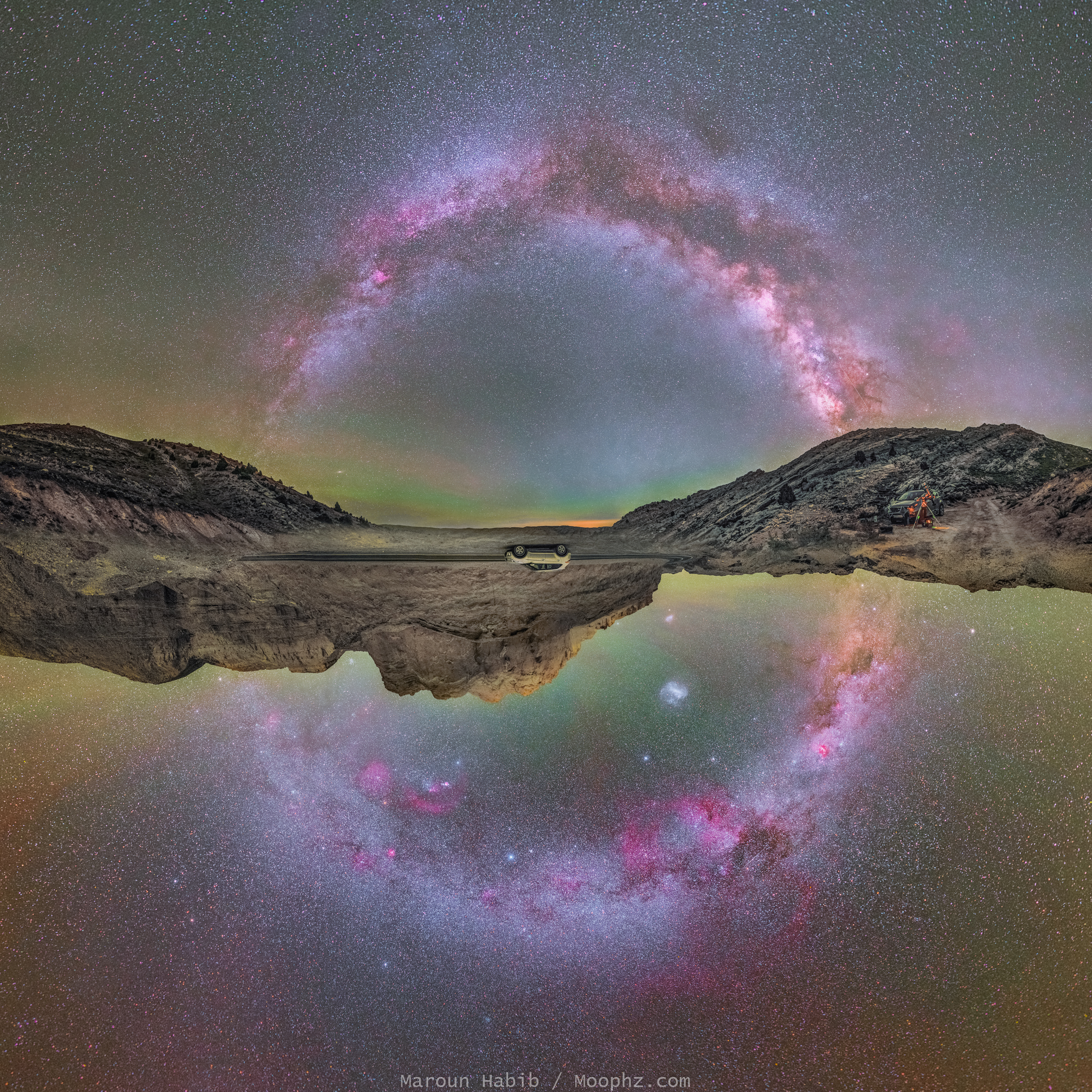
Explanation: Is it possible to capture the entire plane of our galaxy in a single image? Yes, but not in one exposure -- and it took some planning to do it in two. The top part of the featured image is the night sky above Lebanon, north of the equator, taken in 2017 June. The image was taken at a time when the central band of the Milky Way Galaxy passed directly overhead. The bottom half was similarly captured six months later in latitude-opposite Chile, south ofEarth's equator. Each image therefore captured the night sky in exactly the opposite direction of the other, when fully half the Galactic plane was visible. The southern half was then inverted -- car and all -- and digitally appended to the top half to show the entire central band of our Galaxy, as a circle, in a single image. Many stars and nebulas are visible, with the Large Magellanic Cloud being particularly notable inside the lower half of the complete galactic circle.