1910 - Una jornada laboral rutinaria en la vieja Jerusalén inmortalizada por American Colony Photographers. Esa calle se llama Bab el Haris (la puerta de la prisión), porque hubo un tiempo en el que condujo a la cárcel del Imperio otomano. ‘National Geographic’ describía así esos laberintos medievales en su número de diciembre de 1927: “Todas las tiendas están enmarcadas por arcos de mampostería, la luz entra por unos agujeros en el techo”.
2014-08-16
Imagens do Mundo passado - Beirute - Libano
Thomas Abercrombie captó esta imagen tan curiosa: un pastor con sus ovejas en la concurrida calle de Georges Picot. La foto resume los contrastes del Beirut de mediados del siglo pasado. Él lleva vestimenta árabe, pero también una chaqueta occidental. Mitad musulmana y mitad cristiana, Este y Oeste, Beirut era el París de Oriente Próximo, famosa por sus lujosas cafeterías, sus bancos y bazares.
Thomas Abercrombie
Astronomy picture of the day 16-08-2014
Image Credit: NASA /CXC / SAO /R. Margutti et al.
Explanation: Last January, telescopes in observatories around planet Earth were eagerly used to watch the rise of SN 2014J, a bright supernova in nearby galaxy M82. Still, the most important observations may have been from orbit where theChandra X-ray Observatorysaw nothing. Identified as aType Ia supernova, the explosion of SN2014J was thought to be triggered by the buildup of mass on a white dwarf star steadilyaccreting material from a companion star. That model predicts X-rays would be generated when the supernova blastwave struck the material left surrounding the white dwarf. But no X-rays were seen from the supernova. The mostly blank close-ups centered on the supernova's position are shown in the before and after inset panels of Chandra's false colorX-ray image of the M82 galaxy. The stunninglack of X-raysfrom SN 2014J will require astronomers to explore other models to explain what triggers thesecosmic explosions.
2014-08-15
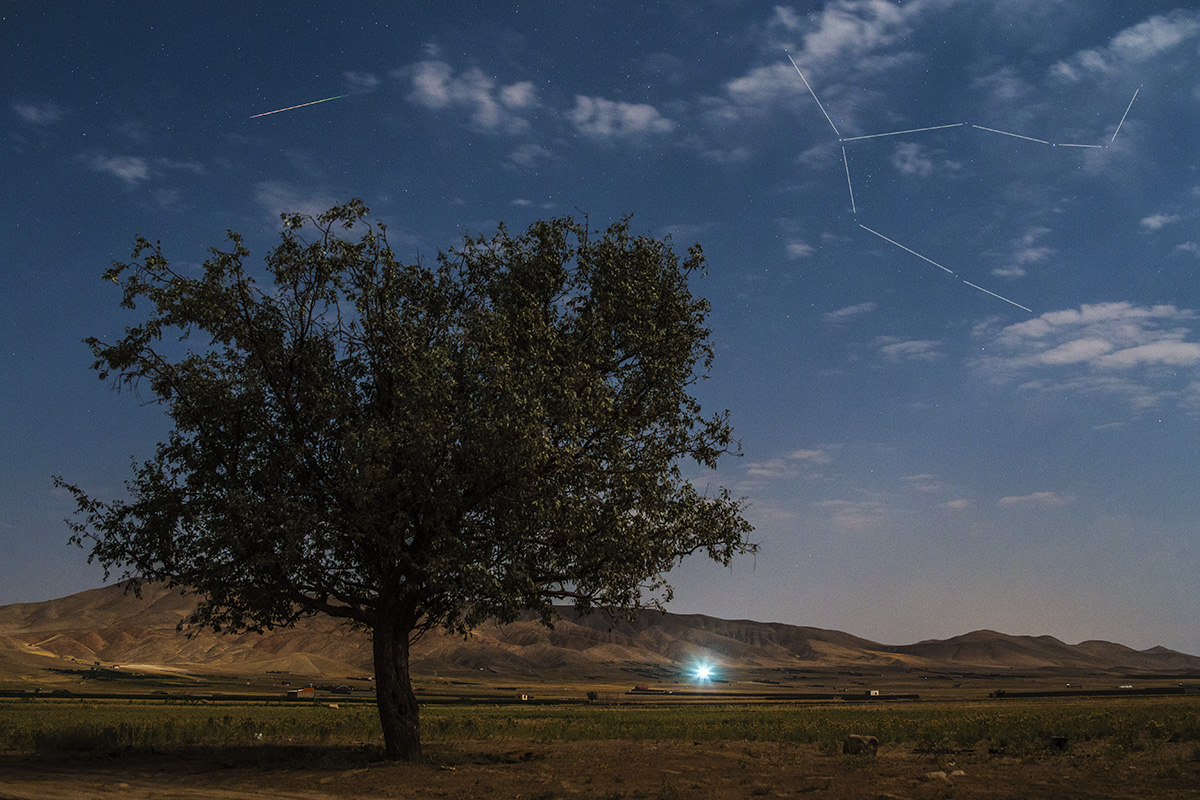
The picture of the day 15-08-2014 - Perseid in Moonlight
Image Credit &Copyright: Amir Hossein Abolfath(TWAN)
Explanation: Bright moonlight from aFull Moon near perigeeilluminates the night and casts shadows in thisskyscape from central Iran. Taken on August 12, near the peak of the annual Perseid meteor shower the exposure also captures a bright and colorful perseid streak above the shady tree in the foreground. This year the super moonlight interfered withmeteor watchinginto the early morning hours, overwhelming the trails from many fainter perseids in the shower. Brighter perseids like this one were still visible though, their trails pointing backto the heroic constellation Perseus outlined at the right.Swept up as planet Earth orbitsthrough dust left behind from periodic comet Swift-Tuttle, the cosmic grainsthat produce perseid meteors enter the atmosphere at nearly 60 kilometers per second, heated to incandesenceand vaporized at altitudes of about 100 kilometers. Next year,Perseid meteorswill flash through dark skies under a New Moon.
Inscription à :
Commentaires (Atom)